
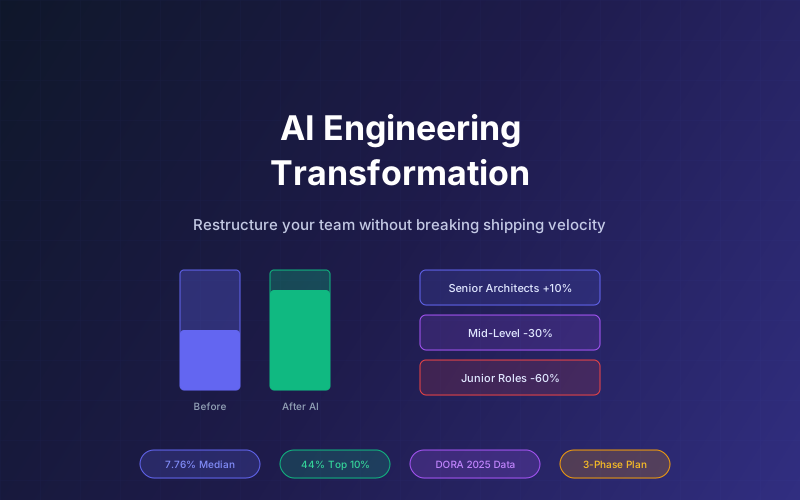

Your engineering team just lost key people. Leadership wants a vision for the function before approving backfills. The question on everyone's mind: should you replace those roles with humans, with AI tooling, or with some hybrid that ships more with less? This is the decision framework you need.
The data is finally in. The 2025 DORA report (published September 2025) studied AI's impact across thousands of teams. DX Research analyzed PR throughput across tools. Jellyfish studied 20 million pull requests across 1,000 companies. The picture is nuanced: AI raises individual output significantly for top performers, but median gains are modest, and poorly managed adoption actually increases incidents and review burden.
This guide gives engineering leaders a concrete framework for restructuring teams around AI without destroying shipping velocity. We cover the real productivity data, which roles change, which disappear, how to measure ROI, and how to phase the transformation so you don't end up worse off than before.
What This Guide Covers
- The Real Productivity Data (Not the Hype)
- Why Median Gains Are Modest and Top Performers Pull Away
- The Role Transformation Map
- Cost Math: AI Tooling vs. Headcount
- The 3-Phase Transformation Framework
- Measurement: Proving ROI to Leadership
- Anti-Patterns That Kill Transformations
- When to Hire, When to Automate, When to Wait
- Building the AI-Native Engineering Culture
- Why Lushbinary for Your AI Transformation
1The Real Productivity Data (Not the Hype)
Let's start with what the data actually says, because the marketing claims from tool vendors don't match the research.
| Source | Finding | Caveat |
|---|---|---|
| DX Research (Q1 2026) | Median PR throughput up 7.76%, mean up 13.1% | Despite 65% increase in AI tool usage |
| DX Research (90th percentile) | ~44% throughput gain | Small number of outlier teams |
| 2025 DORA Report | 21% more tasks completed, 98% more PRs merged | 441% more time in PR review, 242.7% more incidents per PR |
| Jellyfish (20M PRs, 1K companies) | Top adopters nearly 2x weekly PRs | Code quality stable, minimal revert rate increase |
| Cursor Enterprise | 25% more PRs, 100% larger average PR size | Self-reported by vendor (64% of Fortune 500) |
| Forasoft (2026 analysis) | 21-55% throughput lift per developer | Across 7 SDLC stages, not just coding |
Key Insight
The DORA data reveals a critical trap: AI makes individual developers produce more code, but without workflow redesign, that extra code creates a review and incident burden that can negate the gains. The teams that win are the ones that restructure their review process and quality gates alongside adoption.
2Why Median Gains Are Modest and Top Performers Pull Away
The gap between median (7.76%) and 90th percentile (44%) gains is the most important finding in the 2026 data. It tells us that AI coding tools are not a magic multiplier you can drop into any team. They are an amplifier of existing team quality.
The 2025 DORA report states this directly: "AI doesn't fix a team; it amplifies what's already there. Strong teams use AI to become even better. Struggling teams find that AI only highlights and intensifies their existing problems."
What separates top performers from the median:
- Existing CI/CD maturity - Teams with fast, reliable pipelines can absorb higher PR volume without bottlenecking at deploy
- Strong code review culture - They adapted review processes for AI-generated code (shorter reviews, automated checks, trust-but-verify patterns)
- Clear architecture boundaries - Well-defined module boundaries let AI work on isolated units without cascading side effects
- Senior-heavy composition - Seniors know what to ask AI for and can validate output. Juniors often accept incorrect suggestions
- Prompt engineering investment - Custom prompt libraries, project-specific context files, and shared AI workflows
This means your transformation plan must address team maturity first. Buying Cursor seats for a team with flaky CI and no code review standards will produce the median result: marginal gains drowned by increased review burden and incidents.
3The Role Transformation Map
Foundation Capital reports a company planning to go from 120 engineers to 25. Another went from 0.75 engineers per microservice to a projected 0.1. These are real data points, but they represent the aggressive end. Here is a more nuanced view of how roles actually shift:
| Role | Before AI | After AI Transformation | Headcount Impact |
|---|---|---|---|
| Junior Engineer | CRUD, boilerplate, test writing | AI handles 70-80% of this work | -50% to -70% |
| Mid-Level Engineer | Feature implementation, bug fixes | AI-augmented, 2-3x output per person | -20% to -40% |
| Senior Engineer | Architecture, complex features, mentoring | Architecture + AI governance + review | Stable or +10% |
| Staff/Principal | System design, cross-team coordination | Same + AI strategy, tool evaluation | Stable |
| QA Engineer | Manual testing, test case writing | AI test generation oversight, edge case focus | -30% to -50% |
| DevOps/Platform | CI/CD, infrastructure, monitoring | Critical enabler for AI adoption | Stable or +20% |
| Engineering Manager | People management, sprint planning | Fewer reports, more AI workflow design | -20% to -30% |
New Roles That Emerge
AI Workflow Architect
Designs prompt libraries, context files, agent configurations, and golden-path workflows for the team
AI Code Reviewer
Specializes in reviewing AI-generated code for security, performance, and architectural compliance
Developer Experience Engineer
Maintains AI tooling infrastructure, manages context windows, optimizes agent performance for the codebase
AI Quality Gate Owner
Defines and maintains automated quality checks that catch AI-generated code issues before they reach production
4Cost Math: AI Tooling vs. Headcount
The economics are compelling when you run the actual numbers. A fully-loaded senior engineer in a major market costs $250K-$350K/year (salary + benefits + equipment + office + management overhead). AI tooling costs a fraction of that.
AI Tooling Cost Per Developer (Monthly)
| Tool | Individual | Team/Business | Enterprise |
|---|---|---|---|
| Claude Code (Anthropic) | $20/mo (Pro) | $100/seat/mo (Team) | Custom |
| Claude Max | $100-$200/mo | - | - |
| Cursor | $20/mo (Pro) | $40/seat/mo (Business) | Custom |
| GitHub Copilot | $10/mo | $19/user/mo (Business) | $39/user/mo |
| Kiro (AWS) | Free (preview) | TBD | TBD |
The ROI Calculation
For a 20-person engineering team at $300K fully-loaded per engineer:
- Annual team cost: $6M
- AI tooling (mid-tier, all 20 devs): $40/seat x 20 x 12 = $9,600/year for Cursor Business, or $100/seat x 20 x 12 = $24,000/year for Claude Team
- If AI enables 20% headcount reduction (4 roles): $1.2M annual savings minus $24K tooling = $1.176M net savings
- If AI enables 30% output increase (no cuts): You ship 30% more features with the same team, equivalent to adding 6 engineers ($1.8M value) for $24K in tooling
The Real Decision
Most companies should pursue the "ship more" path rather than the "cut headcount" path. The DORA data shows that cutting too aggressively creates a review and quality bottleneck that erases the productivity gains. The sweet spot is modest headcount reduction (10-20%) combined with significantly higher output per remaining engineer.
5The 3-Phase Transformation Framework
Phase 1: Foundation (Weeks 1-4)
Do not buy tools yet. This phase is about establishing baselines and fixing prerequisites.
- Measure current state: PR throughput per developer, cycle time, deploy frequency, change failure rate (the four DORA metrics)
- Audit CI/CD reliability: If your pipeline fails more than 10% of the time, fix that first. AI generates more code, which means more pipeline runs
- Document architecture boundaries: AI works best on well-bounded modules. Map your system and identify where boundaries are clear vs. tangled
- Identify pilot team: Pick your strongest team (not weakest). Remember, AI amplifies existing quality
- Select 1-2 tools for pilot: Based on your stack. Claude Code for agentic work, Cursor for autocomplete-heavy workflows, Copilot if you are deep in the Microsoft ecosystem
Phase 2: Workflow Redesign (Weeks 5-12)
This is where most companies fail. They buy tools and expect magic. The real work is redesigning workflows around AI capabilities.
- Build prompt libraries: Shared, version-controlled prompts for common tasks (feature scaffolding, test generation, code review, documentation)
- Create context files: Project-specific context that AI tools can reference (architecture decisions, coding standards, domain knowledge)
- Redesign code review: AI-generated code needs different review patterns. Focus on architecture, security, and edge cases rather than style and syntax
- Update quality gates: Add automated checks for common AI failure modes (hallucinated imports, incorrect API usage, security anti-patterns)
- Measure and iterate: Track the same DORA metrics weekly. If review time is spiking, your review process needs adjustment
Phase 3: Team Restructuring (Months 4-6)
Only after you have data from Phase 2 should you make headcount decisions. By now you know your actual productivity multiplier, not a vendor's marketing claim.
- Redefine roles: Update job descriptions to reflect AI-augmented expectations. A mid-level engineer now owns 2-3x the feature surface
- Adjust hiring plan: Shift budget from junior implementation roles toward senior architecture and AI workflow roles
- Natural attrition first: Don't backfill roles that AI has absorbed. This is less disruptive than layoffs and gives you time to validate
- Invest savings in tooling and training: The $1M+ saved from not backfilling 3-4 roles funds premium AI tooling for the entire remaining team
- Communicate the vision: Remaining team members need to understand their roles are expanding, not shrinking. Frame it as career growth
6Measurement: Proving ROI to Leadership
Engineering leaders who cannot show data will lose budget. Here is the measurement framework that works:
Leading Indicators (Track Weekly)
- PR throughput per developer: DX Research baseline is 2.8 PRs/day for daily AI users (Q4 2025), rising to 4.1 in Q1 2026
- Cycle time (commit to deploy): Should decrease or stay flat. If it increases, your pipeline or review process is the bottleneck
- AI tool adoption rate: Percentage of team actively using tools daily (target: 80%+ within 8 weeks)
- AI suggestion acceptance rate: GitHub reports ~40% for Copilot. Lower rates suggest poor context or wrong tool fit
Lagging Indicators (Track Monthly)
- Features shipped per sprint: The metric leadership actually cares about
- Change failure rate: Must stay flat or decrease. If it spikes, AI is generating low-quality code that passes review
- Time to market for new features: End-to-end from spec to production
- Cost per feature: Total engineering cost divided by features shipped. This is the number that justifies the transformation to the CFO
Quality Guardrails (Track Continuously)
- Revert rate: Jellyfish found minimal increase in revert rates among top adopters. If yours is climbing, slow down
- Incident rate per PR: DORA found 242.7% increase in incidents per PR. Your quality gates must catch this
- Security vulnerability density: AI can introduce subtle security issues. Track findings from SAST/DAST tools
- Technical debt accumulation: AI tends to solve immediate problems without considering long-term architecture. Monitor coupling metrics
7Anti-Patterns That Kill Transformations
Anti-Pattern: Cut First, Measure Later
Laying off 30% of engineering and then buying AI tools. Without the institutional knowledge of the people you let go, the AI tools produce worse output because nobody can provide good context or review the results effectively.
Anti-Pattern: Tool-First Thinking
Buying enterprise Cursor seats for everyone without fixing the underlying workflow issues. The DX Research data shows 65% more AI usage produced only 7.76% median throughput gain. Tools without workflow redesign produce marginal results.
Anti-Pattern: Ignoring the Review Bottleneck
DORA found 441% more time in PR review with AI adoption. If you don't redesign your review process (automated checks, tiered review, trust levels), your seniors become the bottleneck and burn out.
Anti-Pattern: One-Size-Fits-All Adoption
Mandating the same tool and workflow for frontend, backend, infrastructure, and data teams. Each domain has different AI strengths. Frontend component generation is mature. Infrastructure as code generation is risky. Let teams choose tools that fit their domain.
Anti-Pattern: Treating AI Output as Trusted
Skipping review for AI-generated code because "the AI is smart." AI coding agents hallucinate imports, use deprecated APIs, introduce subtle security vulnerabilities, and make architectural decisions that create tech debt. Every line still needs human validation.
8When to Hire, When to Automate, When to Wait
Not every open role should be filled with AI. Here is the decision framework:
Hire a Human When:
- The role requires deep domain expertise that AI cannot replicate (regulatory compliance, industry-specific architecture)
- The role is primarily about cross-team coordination, stakeholder management, or organizational design
- You need someone to own AI governance and quality for the team (the new AI Workflow Architect role)
- The work involves novel system design where there is no existing pattern for AI to follow
Automate with AI When:
- The work is repetitive implementation against well-defined specs (CRUD endpoints, form components, data transformations)
- The task has clear acceptance criteria that can be validated automatically (tests pass, types check, linter clean)
- The codebase has strong typing, good documentation, and clear module boundaries that give AI sufficient context
- A senior engineer can review the output in 10-15 minutes rather than spending 2-4 hours writing it themselves
Wait When:
- Your CI/CD pipeline is unreliable (fix infrastructure before adding AI-generated code volume)
- Your codebase has poor boundaries and high coupling (AI will make spaghetti worse, not better)
- Your team lacks senior engineers who can effectively review AI-generated code
- You are in a regulated industry and haven't established AI governance policies yet
9Building the AI-Native Engineering Culture
The cultural shift is harder than the technical one. Engineers who have built careers on implementation skill now need to shift toward architecture, review, and AI orchestration. Here is how to manage that transition:
- Reframe the narrative: AI is not replacing engineers. It is eliminating the tedious parts of the job so engineers can focus on the hard, interesting problems. Most engineers actually prefer this framing because they dislike writing boilerplate
- Invest in training: Prompt engineering, AI tool mastery, and code review for AI output are learnable skills. Budget 2-4 hours per week for the first month
- Celebrate AI-augmented wins: When a developer ships a feature in 2 days that would have taken a week, highlight it. Create internal case studies
- Create safe experimentation space: Let developers try different tools and workflows without pressure. The DX Research data shows most developers run a 3-tool stack rather than committing to one
- Update performance reviews: Evaluate engineers on outcomes (features shipped, quality maintained) rather than lines of code or hours worked. AI changes the input-output ratio dramatically
The Adoption Curve
Stack Overflow's 2026 Developer Survey shows 90% of developers now use at least one AI tool. Claude Code leads developer satisfaction at 46%. Claude Code (28%) and Cursor (24%) account for over half of primary-tool selections. Your engineers likely already use these tools individually. The transformation is about making that usage systematic, measured, and team-wide rather than ad-hoc.
10Why Lushbinary for Your AI Transformation
Lushbinary helps engineering organizations navigate this transition with a structured, data-driven approach. We have implemented AI transformation programs for teams ranging from 5 to 50+ engineers, across SaaS, fintech, healthcare, and e-commerce.
What We Deliver
- AI Readiness Assessment: We audit your codebase, CI/CD pipeline, team composition, and workflow to identify where AI will have the highest impact and where prerequisites are missing
- Tool Selection and Configuration: We evaluate Claude Code, Cursor, Copilot, and Kiro against your specific stack and recommend the right combination
- Workflow Design: Custom prompt libraries, context files, agent configurations, and review processes tailored to your codebase and domain
- Measurement Framework: Dashboards and reporting that track the metrics leadership needs to see, connected to your existing tools (GitHub, Jira, Linear)
- Team Restructuring Advisory: Data-backed recommendations on role changes, hiring plans, and organizational design for the AI-augmented team
For related reading, see our AI Coding Agents Comparison and Claude Code Agent Teams Guide.
Free Consultation
Facing a personnel shakeup and need an aligned AI vision before committing to backfills? Lushbinary will assess your team, recommend a transformation roadmap, and give you the data framework to justify it to leadership. 30-minute call, no obligation.
Frequently Asked Questions
Can AI coding tools actually replace engineering headcount?
Not directly. DORA data shows AI raised individual output by 21% on tasks and 98% on PRs merged, but also increased review time by 441% and incidents by 242.7%. The realistic outcome is fewer junior roles and more senior architects who govern AI-driven workflows. Foundation Capital reports companies planning 80% reductions, but these are aggressive outliers.
What is the real productivity gain from AI coding agents in 2026?
DX Research found median PR throughput rose only 7.76% despite 65% more AI usage. Top performers at the 90th percentile saw ~44% gains. Jellyfish found top adopters nearly doubled weekly PRs across 20M PRs studied. The gap depends on team maturity and workflow design, not just tool adoption.
How much do AI coding tools cost per developer in 2026?
Claude Code Pro is $20/month, Max is $100-$200/month, Team is $100/seat/month. Cursor Pro is $20/month, Business is $40/seat/month. GitHub Copilot Business is $19/user/month. For a 20-person team on mid-tier plans, expect $800-$4,000/month, roughly 1-3% of a single senior engineer's annual cost.
What roles are most affected by AI in engineering teams?
Junior implementation roles (boilerplate, CRUD, test scaffolding) see 50-70% headcount reduction. Mid-level roles see 20-40% reduction with 2-3x output per remaining person. Senior and staff roles remain stable or grow, shifting toward architecture, AI governance, and code review.
How long does an AI engineering transformation take?
A phased approach takes 3-6 months. Phase 1 (weeks 1-4): baselines and prerequisites. Phase 2 (weeks 5-12): workflow redesign and pilot. Phase 3 (months 4-6): team restructuring based on measured data. Companies that skip measurement often revert within 90 days.
Sources
- 2025 DORA Report - Google Cloud
- DX Research - AI's Impact on Engineering Velocity
- DX Research - PR Throughput by Tool (Q1 2026)
- Foundation Capital - The Great Reorg
- Jellyfish - 20 Million PRs Analysis
- Cursor Enterprise - Productivity Claims
Content was rephrased for compliance with licensing restrictions. Productivity data sourced from official research reports as of May 2026. Pricing sourced from vendor websites as of May 2026. Pricing and features may change - always verify on the vendor's website.
Transform Your Engineering Team with AI
Get a data-driven transformation roadmap tailored to your team size, stack, and business goals. We help you ship more without breaking what works.
Ready to Build Something Great?
Get a free 30-minute strategy call. We'll map out your project, timeline, and tech stack - no strings attached.
Prefer email? Reach us directly: