

Multi-agent AI is the defining enterprise trend of 2026. Instead of building one monolithic agent that tries to do everything, teams are deploying fleets of specialized agents that collaborate, delegate, and scale independently. Gartner estimates 40% of enterprise applications will embed AI agents by year-end. MIT Technology Review named agent orchestration a top-10 AI trend for the year. The shift from single-agent to multi-agent is no longer experimental - it is production infrastructure.
The market reflects this momentum. Valued at $5.4 billion in 2024, the multi-agent AI market is projected to reach $236 billion by 2034, a compound annual growth rate of roughly 46%. Every major framework - LangGraph, CrewAI, AutoGen, OpenAI Swarm - now ships multi-agent primitives as first-class features. The question is no longer whether to adopt multi-agent architectures, but which orchestration pattern fits your workload.
This guide covers the four production-proven orchestration patterns: Supervisor, Router, Pipeline, and Swarm. For each, you will learn the architecture, trade-offs, best use cases, and implementation paths using Hermes Agent, Kimi K2.6, and LangGraph.
Table of Contents
- 1.Why Multi-Agent Over Single-Agent
- 2.The Supervisor Pattern
- 3.The Router Pattern
- 4.The Pipeline Pattern
- 5.The Swarm Pattern
- 6.Choosing the Right Pattern
- 7.Implementation with Hermes Agent
- 8.Implementation with LangGraph & Kimi K2.6
- 9.Production Concerns
- 10.Why Lushbinary for Multi-Agent Systems
1Why Multi-Agent Over Single-Agent
Single-agent systems hit a ceiling fast. A single LLM call has a finite context window, a fixed skill set, and a single point of failure. Multi-agent architectures solve three fundamental problems:
- Context limits - Even 200K-token windows fill up when an agent handles research, coding, testing, and deployment in one session. Splitting responsibilities across agents keeps each context focused and accurate.
- Specialization - A coding agent with deep repository knowledge outperforms a generalist on code reviews. A research agent with web access outperforms a coding agent on market analysis. Specialization compounds over time as each agent builds domain-specific memory.
- Fault tolerance - If one agent in a fleet fails or hallucinates, the system can retry, route to a backup, or isolate the failure. A single-agent system has no fallback.
The trade-off is complexity. Multi-agent systems require orchestration logic, state management, and observability that single agents do not. The four patterns below represent battle-tested approaches to managing that complexity, each optimized for different workload shapes.
2The Supervisor Pattern
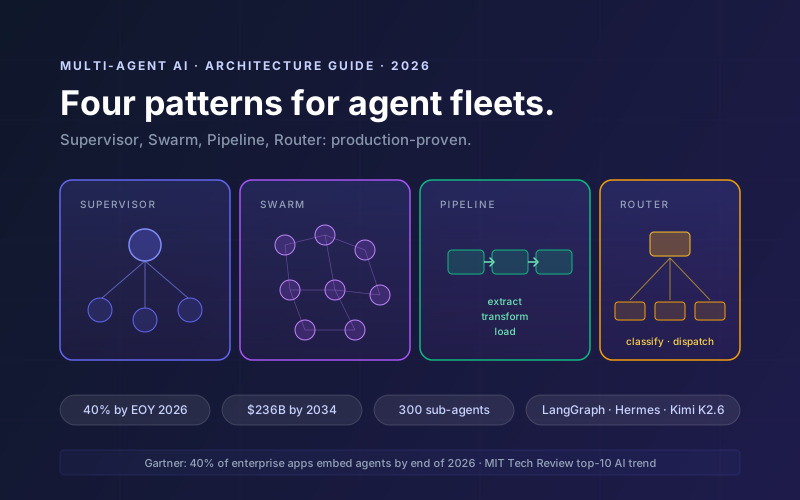
The Supervisor pattern is the most intuitive multi-agent architecture. A single orchestrator agent receives tasks, decomposes them into subtasks, delegates each subtask to a specialized worker agent, collects results, and synthesizes a final output. Think of it as a project manager coordinating a team.
Architecture
User request enters the Supervisor. The Supervisor plans the execution, assigns subtasks to Worker A, Worker B, Worker C. Each worker returns results to the Supervisor, which aggregates and responds.
Best for: Structured workflows, compliance-heavy environments, tasks requiring a coherent final output from multiple data sources. Enterprise document generation, multi-step research reports, and regulated financial analysis all fit this pattern.
Trade-offs: The supervisor is a single point of failure and a potential bottleneck. If the orchestrator hallucinates the plan, all downstream work is wasted. Latency scales with the number of sequential delegations.
In practice, the Hermes Agent profile system implements a lightweight Supervisor pattern where a coordinator profile delegates to specialized profiles (dev, ops, content) through shared filesystem or MCP bridge communication.
3The Router Pattern
The Router pattern classifies incoming requests and routes each to the appropriate specialist agent. Unlike the Supervisor, the router does not plan or aggregate. It simply decides who should handle the task and forwards it. The specialist handles the full request end-to-end.
Best for: Customer support systems, mixed-workload APIs, help desks, and any scenario where requests vary widely in type but each type has a clear handler. The router adds minimal latency (one classification call) and eliminates the central bottleneck of the Supervisor pattern.
Trade-offs: The router cannot handle tasks that require multiple specialists to collaborate. If a request needs both coding and research, the router must pick one or escalate to a Supervisor. Misclassification sends tasks to the wrong agent.
Implementation is straightforward: a lightweight classifier (often a small fine-tuned model or even a regex-based rules engine) examines the request, assigns a category, and forwards to the matching agent. Hermes Agent's gateway acts as a natural router when configured with channel-based routing rules across its 19 supported messaging platforms.
4The Pipeline Pattern
The Pipeline pattern chains agents sequentially. Each agent receives input, transforms it, and passes the result to the next agent in the chain. There is no central orchestrator - the flow is predetermined and linear.
Best for: Content pipelines (research, draft, edit, publish), CI/CD automation (lint, test, build, deploy), data processing (extract, transform, validate, load), and any workflow where the output of step N is the input of step N+1.
Trade-offs: Pipelines are predictable and easy to debug because each stage has clear inputs and outputs. However, they cannot parallelize independent work. If stage 3 fails, stages 4-N stall. Latency is the sum of all stages.
Pipelines shine when combined with quality gates between stages. A validation agent between the "draft" and "publish" stages can reject low-quality output and loop back, creating a self-correcting pipeline without the complexity of a full Supervisor.
5The Swarm Pattern
The Swarm pattern is fully decentralized. Multiple agents operate in parallel with no single controller. Agents communicate peer-to-peer, claim tasks from a shared queue, and exhibit emergent behavior through local interactions. This is the most powerful pattern for raw throughput and the hardest to debug.
Best for: Large-scale coding tasks, research exploration, vulnerability scanning, and any workload that benefits from massive parallelism. Kimi K2.6 demonstrates this at scale with 300 sub-agents executing 4,000 coordinated steps, achieving 58.6% on SWE-Bench Pro.
Trade-offs: Swarms offer the highest throughput but the lowest predictability. Debugging requires distributed tracing. Cost can spike unpredictably as agents spawn sub-agents. Without proper guardrails, swarms can enter infinite loops or duplicate work.
The key insight from Kimi K2.6's architecture is that effective swarms need a shared state layer (task queue + completion registry) even without a central controller. Each agent checks what has been done, claims unclaimed work, and reports completion. The coordination is emergent but the state is explicit.
Four Multi-Agent Orchestration Patterns
6Choosing the Right Pattern
No single pattern is universally best. The right choice depends on your workload characteristics, team size, and operational maturity. Use this decision matrix to guide your selection:
| Dimension | Supervisor | Router | Pipeline | Swarm |
|---|---|---|---|---|
| Control | High | Medium | High | Low |
| Latency | Medium-High | Low | Sum of stages | Low (parallel) |
| Fault Tolerance | Medium | High | Low | High |
| Debuggability | Good | Good | Excellent | Poor |
| Cost | Predictable | Predictable | Predictable | Variable |
| Best Use Case | Compliance, reports | Support, APIs | ETL, CI/CD | Coding, research |
Many production systems combine patterns. A Router at the edge classifies requests, sending structured tasks to a Supervisor and simple lookups directly to a specialist. A Supervisor might delegate a large coding task to a Swarm for parallel execution. The patterns are composable, not mutually exclusive. For a deeper comparison of the frameworks that implement these patterns, see our LangGraph vs CrewAI vs AutoGen comparison.
7Implementation with Hermes Agent
Hermes Agent's architecture maps naturally to multi-agent patterns. With support for 19 messaging platforms, profile-based multi-instance deployment, cron scheduling, and MCP server integration, it provides the building blocks for all four patterns without requiring a separate orchestration framework.
Profiles as agents: Each Hermes profile is an independent agent with its own config, memory, skills, and messaging channels. Create a "coordinator" profile (Supervisor), a "router" profile that classifies incoming messages, and specialist profiles for dev, ops, and content work.
# Create specialized profiles
hermes profile create coordinator
hermes profile create dev-worker
hermes profile create ops-worker
hermes profile create research-worker

# Configure coordinator with MCP bridge to workers
# coordinator/config.yaml
mcp_servers:
  dev-worker:
    command: "hermes"
    args: ["mcp", "serve", "--profile", "dev-worker"]
  ops-worker:
    command: "hermes"
    args: ["mcp", "serve", "--profile", "ops-worker"]
Cron as scheduler: Each profile runs independent cron jobs. The coordinator can schedule periodic task distribution, health checks on worker profiles, and result aggregation.
MCP for inter-agent communication: Run worker profiles in MCP server mode. The coordinator connects to each worker as an MCP client, enabling structured tool calls between agents with typed inputs and outputs.
Gateway as router: Hermes's gateway supports channel-based routing. Messages from #engineering go to the dev profile, messages from #ops-alerts go to the ops profile, and DMs go to the coordinator. This is the Router pattern implemented at the messaging layer. For a complete setup guide, see our Hermes Agent developer guide.
8Implementation with LangGraph & Kimi K2.6
LangGraph for graph-based orchestration: LangGraph models agent workflows as directed graphs where nodes are agents or tools and edges define control flow. This makes it ideal for Supervisor and Pipeline patterns where the execution path is deterministic or conditionally branching.
from langgraph.graph import StateGraph, END

# Supervisor pattern in LangGraph
workflow = StateGraph(AgentState)

# Add supervisor and worker nodes
workflow.add_node("supervisor", supervisor_agent)
workflow.add_node("researcher", research_agent)
workflow.add_node("coder", coding_agent)
workflow.add_node("reviewer", review_agent)

# Supervisor decides which worker to invoke
workflow.add_conditional_edges(
    "supervisor",
    route_to_worker,
    {
        "research": "researcher",
        "code": "coder",
        "review": "reviewer",
        "FINISH": END,
    },
)

# Workers report back to supervisor
for worker in ["researcher", "coder", "reviewer"]:
    workflow.add_edge(worker, "supervisor")

workflow.set_entry_point("supervisor")
app = workflow.compile()
LangGraph's state management handles the shared context between agents, and its checkpointing system enables fault recovery by replaying from the last successful node.
Kimi K2.6 for native swarm execution: Kimi K2.6 implements the Swarm pattern natively at the model level. Rather than orchestrating multiple LLM calls externally, K2.6 spawns up to 300 sub-agents internally, coordinating 4,000 steps across parallel execution threads. This achieves 58.6% on SWE-Bench Pro, the highest score for an open-weight model on complex multi-file coding tasks.
The key architectural difference: LangGraph orchestrates agents externally (you define the graph, LangGraph executes it), while Kimi K2.6 orchestrates internally (you give it a task, it spawns and coordinates sub-agents autonomously). Choose LangGraph when you need explicit control over the workflow. Choose Kimi K2.6 when you want maximum autonomy on complex, parallelizable tasks.
# Kimi K2.6 swarm - single API call, internal orchestration
response = kimi.chat.completions.create(
    model="kimi-k2.6-swarm",
    messages=[{
        "role": "user",
        "content": "Refactor the authentication module across "
                   "all 47 service files. Update tests. "
                   "Ensure backward compatibility."
    }],
    # K2.6 internally spawns ~300 sub-agents
    # coordinating across ~4,000 steps
    max_agents=300,
    coordination_budget=4000,
)
# Returns unified diff across all modified files9Production Concerns
Moving multi-agent systems from prototype to production introduces challenges that single-agent deployments never face. These are the five areas that break most teams:
State Management
Every agent in the system needs access to shared state (task queue, completion status, intermediate results) without creating race conditions. Solutions range from simple filesystem-based state (Hermes profiles sharing a directory) to Redis-backed task queues for high-throughput swarms. The key principle: make state explicit and centralized even when agents are decentralized.
Infinite Loop Prevention
When agents can delegate to other agents, circular delegation is a real risk. Agent A asks Agent B for help, Agent B asks Agent A for clarification, and the system burns tokens indefinitely. Prevention strategies include maximum iteration caps per task, task lineage tracking (reject tasks that have already visited this agent), and hard budget limits that halt execution when exceeded.
Cost Control
Multi-agent systems can generate 10-100x more LLM calls than single-agent equivalents. A Supervisor making 5 delegation calls, each generating 3-4 tool calls, produces 15-20 LLM invocations for one user request. Swarms are worse - Kimi K2.6's 4,000 steps represent significant compute. Implement per-request budgets, model tiering (cheap models for routing, expensive models for generation), and caching of repeated sub-task results.
Observability
You cannot debug what you cannot see. Tools like Langfuse provide distributed tracing for LLM applications, showing the full call chain across agents with latency, token usage, and cost per step. For production multi-agent systems, observability is not optional. Every agent call should emit a trace span with parent-child relationships so you can reconstruct the full execution graph when something fails.
Failure Recovery
When one agent in a multi-step workflow fails, the system needs a recovery strategy. Options include retry with exponential backoff, fallback to an alternative agent, checkpoint-based replay (LangGraph supports this natively), and graceful degradation where partial results are returned with a note about what failed. The worst outcome is silent failure where the system returns incomplete results without indicating the gap.
10Why Lushbinary for Multi-Agent Systems
Building a multi-agent system that works in production requires more than picking a pattern. It requires understanding your workload shape, choosing the right combination of patterns, implementing proper state management, and building observability from day one. Most teams underestimate the operational complexity and end up with fragile systems that break under real traffic.
Lushbinary architects production multi-agent systems for teams that need to move fast without building from scratch. We handle:
- Pattern selection - Analyzing your workload to recommend the right orchestration pattern (or combination)
- Agent design - Defining agent roles, boundaries, communication protocols, and failure modes
- Implementation - Building with Hermes, LangGraph, or custom orchestration depending on your stack
- Production hardening - State management, loop prevention, cost controls, observability, and failure recovery
- Scaling strategy - From 3 agents to 300, with proper infrastructure and cost modeling
Free Architecture Review
Not sure which orchestration pattern fits your use case? Lushbinary offers a free architecture review where we analyze your workload, recommend patterns, and outline an implementation roadmap. No obligation, no sales pitch - just engineering guidance from a team that has shipped multi-agent systems in production.
Frequently Asked Questions
What is the Supervisor pattern in multi-agent AI systems?
The Supervisor pattern uses a single orchestrator agent that delegates tasks to specialized worker agents, collects their results, and synthesizes a final output. It provides centralized control and is best for structured workflows and compliance-heavy environments.
How does the Swarm pattern differ from the Supervisor pattern?
The Swarm pattern is decentralized with no single controller. Agents operate in parallel, communicate peer-to-peer, and exhibit emergent behavior. Kimi K2.6 demonstrates this with 300 sub-agents across 4,000 coordinated steps. It offers highest throughput but is hardest to debug.
When should I use the Router pattern for AI agents?
Use the Router pattern when incoming tasks vary widely and need to reach the right specialist quickly. It classifies requests and routes them to domain-specific agents. Best for customer support systems, mixed-workload APIs, and scenarios where low latency matters.
What is the Pipeline pattern in multi-agent orchestration?
The Pipeline pattern chains agents sequentially where each agent transforms data and passes it to the next. It is predictable, debuggable, and best for content pipelines, CI/CD automation, and data processing workflows where order matters.
How large is the multi-agent AI market in 2026?
The multi-agent AI market was valued at $5.4 billion in 2024 and is projected to reach $236 billion by 2034, representing a CAGR of approximately 46%. Gartner estimates 40% of enterprise applications will embed AI agents by end of 2026.
How do I prevent infinite loops in multi-agent systems?
Implement maximum iteration caps per agent, use timeout-based circuit breakers, track task lineage to detect cycles, set budget limits that halt execution when exceeded, and use observability tools like Langfuse to monitor agent call chains in real time.
Sources
- Gartner - Intelligent Agents in AI (2026 Predictions)
- MIT Technology Review - AI Trends 2025-2026
- Precedence Research - AI Agents Market Size ($5.4B to $236B)
- LangGraph Documentation - Multi-Agent Orchestration
- Moonshot AI - Kimi K2.6 Technical Report
- Hermes Agent Documentation - Profiles & MCP
- Langfuse - LLM Observability & Tracing
Content was rephrased for compliance with licensing restrictions. Market figures sourced from Precedence Research and Gartner as of mid-2026. Technical capabilities sourced from official documentation and model cards. Features and pricing may change - always verify with primary sources.
Build Your Multi-Agent System
Need a production multi-agent architecture with the right orchestration patterns? Let's design your system together.
Ready to Build Something Great?
Get a free 30-minute strategy call. We'll map out your project, timeline, and tech stack - no strings attached.
Prefer email? Reach us directly: