
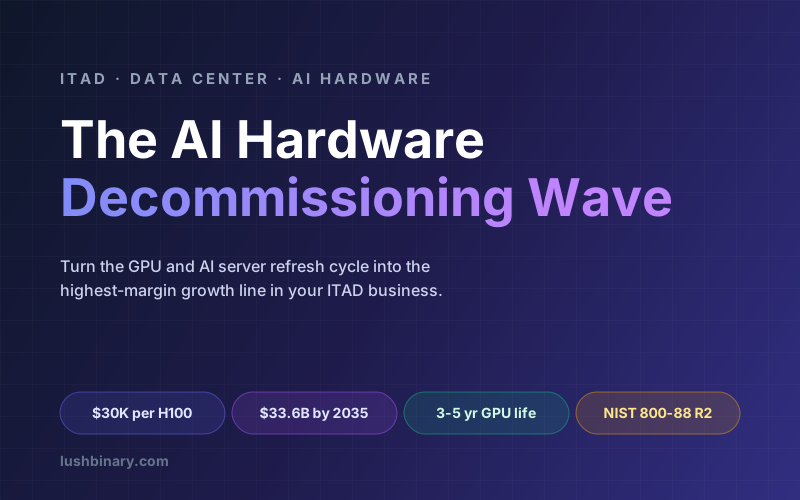
The AI buildout that filled data centers with GPU clusters is about to run in reverse. AI infrastructure refreshes far faster than traditional IT, with GPU useful life commonly cited at 3 to 5 years and each high-end accelerator like an NVIDIA H100 representing roughly a $30,000 capital investment (per Introl). The first big wave of those clusters is now reaching end of life.
That creates a once-in-a-cycle opportunity for IT asset disposition (ITAD) providers and the MSPs who serve hardware-heavy clients. The data center ITAD market alone is forecast to grow from about $13.1 billion in 2025 to $33.6 billion by 2035, according to Global Market Insights. Industry leaders describe the rapid refresh of AI infrastructure as a new class of secondary-market opportunity, paired with new challenges around data security, asset integrity, and compliance (remarks attributed to Re-Teck's Chief Strategy Officer via JSOnline).
The catch: AI and GPU servers are not normal ITAD. They are denser, far more valuable per unit, and harder to grade, sanitize, and remarket. Whoever has the software to do that quickly and provably wins the volume. This playbook covers where the margin is, why the compliance bar just rose, the AI software that captures the value, and what it costs to build.
What this playbook covers
- The AI hardware decommissioning gold rush
- Why AI and GPU servers are not normal ITAD
- Where the margin is: component-level remarketing
- The compliance bar just rose: NIST 800-88 Rev 2
- AI software plays that capture the value
- The MSP angle: decommissioning as a service line
- Architecture for an asset intake and remarketing platform
- What it costs to build
- Why Lushbinary
- Frequently asked questions
1The AI Hardware Decommissioning Gold Rush
The economics are simple. Operators bought enormous quantities of accelerators during the AI buildout, they depreciate those assets over a few years, and performance-per-watt gains push them to refresh aggressively. When a cluster is retired, the hardware does not become worthless. A decommissioned GPU server is a dense bundle of high-value, in-demand components with a real secondary market.
The volume is also becoming an environmental story. AI hardware is being pushed harder than traditional IT and is emerging as a fast growing e-waste category (per SAMR). That means enterprise buyers will increasingly demand certified, sustainable disposition, not just the highest bid. Providers who can prove both value recovery and responsible recycling will win the contracts.
The opportunity in one line
A wave of high-value AI hardware is hitting end of life faster than any prior IT category. The bottleneck is no longer demand, it is the speed and provability of your intake, grading, and remarketing. That is a software problem.
2Why AI and GPU Servers Are Not Normal ITAD
Processing a pallet of retired laptops and processing a retired GPU node are not the same job. The differences directly affect your margin and your risk:
- Value concentration. A single AI node can hold hundreds of thousands of dollars in GPUs, high-bandwidth memory, and cooling hardware. Mis-grading one component is an expensive mistake.
- Component-level resale. The value is often in the parts, not the chassis. Capturing it requires identifying and pricing each GPU, module, and drive individually.
- Specialized handling. Dense racks, liquid cooling, and complex power architectures need careful teardown and tracking, not a bulk shred.
- Data lives in more places. Sanitization must cover NVMe storage and any persistent memory, with documented proof per device.
3Where the Margin Is: Component-Level Remarketing
The single biggest lever in this market is accurate, fast, component-level value recovery. Two assets that look identical at the loading dock can differ by thousands of dollars in resale value based on exact model, condition, and current market demand. Manual grading cannot keep up with the volume or the precision the hardware demands.
This is exactly where custom software pays for itself. AI grading from photos and diagnostics, paired with a pricing engine that values each part against live market data, turns a slow manual judgment call into a fast, consistent, defensible number. We have already built systems in this space, including a smart glasses warehouse scanning app that tripled listing speed and a real-time live auction platform that lifts recovery value.
4The Compliance Bar Just Rose: NIST 800-88 Rev 2
Data security is the dominant concern in ITAD, and the standards keep tightening. NIST SP 800-88 is the federal guidance for media sanitization, and NIST published Revision 2 in 2025 to supersede Revision 1. Adoption is climbing fast: one benchmarking report found NIST 800-88 compliance rose to 52% in 2025 from 34% the prior year (per Cascade).
For high-value data center hardware, enterprise buyers now expect verifiable sanitization documented to NIST 800-88 Rev 2, alongside R2v3 certification and a serialized chain of custody. The providers who can generate that audit trail automatically, rather than assembling it by hand, will clear deals faster and command trust.
5AI Software Plays That Capture the Value
Four custom builds turn the AI hardware wave from an operational headache into a margin engine. Each one attacks a specific bottleneck.
AI component grading
Identify make, model, and condition of GPUs, memory, and drives from photos and diagnostics at intake, then auto-create accurate listings.
Automated remarketing engine
Price each component against live market data and route it to the channel that recovers the most value, including a buyer marketplace.
Serialized chain of custody
Track every asset from the client site to final disposition, with a tamper-evident log buyers and auditors can trust.
Auto certificate generation
Generate certificates of data destruction aligned to NIST 800-88 Rev 2 the moment a wipe completes, no manual paperwork.
6The MSP Angle: Decommissioning as a Service Line
This wave is not only for pure-play ITAD firms. MSPs own the client relationships, and many of their clients are now planning hardware refreshes. Offering secure decommissioning and refresh as a managed service, either directly or in partnership with an ITAD provider, turns a one-time hardware event into recurring revenue and deepens client trust.
The credibility comes from software. A branded portal that tracks a client's retired assets from their site through certified disposition, complete with value recovered and compliance documents, is the kind of visible, auditable offering that wins and retains accounts. It is also a clean upsell into the broader AI automation work an MSP can deliver.
7Architecture for an Asset Intake and Remarketing Platform
You do not need to replace your existing inventory or accounting systems. The right approach is a platform that handles intake, AI grading, remarketing, and compliance, and integrates with the tools you already run. Here is the shape of a typical build.
The recommended stack favors speed and ownership: a Next.js front end, a Node API, a relational database for assets and audit logs, and best-in-class AI models behind an abstraction layer so you are never locked to one vendor. It plugs into the inventory and accounting tools you already use.
8What It Costs to Build
Cost scales with scope, but most ITAD platforms fall into a predictable range. Unlock the detailed breakdown below to see typical investment by build and timeline.
Get Detailed Cost Breakdown
Fill in your details to unlock pricing and cost information.
9Why Lushbinary
We build custom AI and cloud software for service businesses, and we have shipped real systems in the ITAD space. For an ITAD client we built a Meta Ray-Ban smart glasses app with AI product detection that tripled warehouse listing speed, and a real-time live auction platform to lift resale value. If you want to learn the broader operational picture, see our AI for MSPs and ITAD playbook. We handle AI integration, web and mobile apps, cloud, and the security and compliance plumbing underneath.
🚀 Free Consultation
Want to capture the AI hardware decommissioning wave before your competitors do? Lushbinary builds AI-powered ITAD and asset platforms. We'll scope your idea, recommend the right tech stack, and give you a realistic timeline with no obligation.
❓ Frequently Asked Questions
Why is AI and GPU server decommissioning a growth opportunity for ITAD providers?
AI infrastructure refreshes far faster than traditional IT, with GPU useful life commonly cited at 3 to 5 years, and each high-end accelerator like an H100 representing roughly a $30,000 capital investment. As the first big wave of AI clusters reaches end of life, the secondary market for high-value components is expanding quickly, and the providers with software to grade, sanitize, and remarket fast will capture the most value.
How are AI and GPU servers different from normal IT asset disposition?
They are denser, far more valuable per unit, and harder to handle. A single rack can hold hundreds of thousands of dollars in GPUs, high-bandwidth memory, and liquid-cooling hardware. Grading is more nuanced, data destruction must cover GPU and NVMe storage, and resale value depends on accurate component-level assessment. Treating them like generic laptops leaves real money on the table.
What data security standard applies to decommissioned AI servers?
NIST SP 800-88 is the federal guidance for media sanitization, and NIST published Revision 2 in 2025 to supersede Revision 1. For ITAD providers handling enterprise and data center hardware, verifiable sanitization documented to NIST 800-88 Rev 2, alongside R2v3 and a serialized chain of custody, is increasingly a requirement to win contracts.
What software does an ITAD business need to capture this market?
The high-leverage builds are AI-assisted component grading from photos and diagnostics, an automated remarketing and pricing engine tied to live market data, a serialized chain-of-custody system, and automated certificate-of-data-destruction generation. Together they remove the manual bottlenecks that cap throughput and value recovery.
How can MSPs benefit from the AI hardware decommissioning wave?
MSPs sit on the client relationships. Offering secure decommissioning and refresh as a managed service line, either directly or in partnership with an ITAD provider, turns a one-time hardware event into recurring revenue and deepens client trust. Custom software that tracks assets from the client site through final disposition is what makes that offering credible and auditable.
How much does it cost to build an ITAD asset intake and remarketing platform?
A focused MVP, such as AI-assisted grading plus a listings workflow, typically runs $35,000 to $70,000 over 3 to 5 months. A full platform with a pricing engine, chain of custody, compliance automation, and a buyer marketplace typically runs $90,000 to $180,000 over 6 to 9 months. Final cost depends on scope and integrations, so we scope before quoting.
Sources
- Introl, Asset Lifecycle Management for GPUs (lifecycle and cost)
- Global Market Insights, Data Center ITAD Market
- NIST SP 800-88 Revision 2 (media sanitization)
- Cascade, IT Asset Management Benchmarking Report
- SAMR, AI Hardware and E-Waste
Content was rephrased for compliance with licensing restrictions. Market figures, hardware costs, and statistics sourced from the official reports and industry publications linked above as of June 2026. Figures and pricing may change - always verify on the source's website.
Capture the AI Hardware Wave First
Tell us about your ITAD or MSP business and we'll map out a custom AI platform that grades, remarkets, and documents at the speed this market demands.
Ready to Build Something Great?
Get a free 30-minute strategy call. We'll map out your project, timeline, and tech stack - no strings attached.
Prefer email? Reach us directly: