
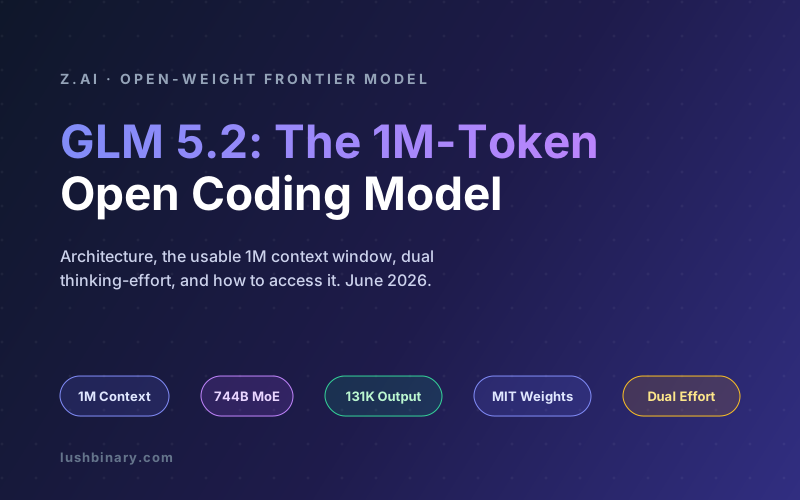
Updated June 16, 2026. Z.ai (formerly Zhipu AI) released GLM 5.2 on June 13, 2026 with a usable 1M-token context window, a dual thinking-effort system, and 131,072 max output tokens. The company published no launch benchmarks. API access, a chatbot, and MIT-licensed open weights were promised within about a week. All figures below are sourced from Z.ai's announcement and reporting as of June 16, 2026 and may change as the full release lands.
On June 13, 2026, Z.ai shipped GLM 5.2 and did something unusual for a flagship model launch: it published zero benchmark numbers. No SWE-bench Verified, no LiveCodeBench, no HumanEval. Instead the company led with three real-world claims - strong coding, a genuinely usable 1-million-token context window, and continued strength on long-horizon agent tasks. For a model line that has gone from open-weight curiosity to frontier contender in under five months, that confidence is the story.
GLM 5.2 is the third major step in 2026 after GLM 5 (February 11) and GLM 5.1 (March 27). GLM 5.1 already reached roughly 94.6% of Claude Opus 4.6 on coding evaluations, trained entirely on Huawei Ascend hardware and shipped under the MIT license. GLM 5.2 keeps the open-weight, coding-first DNA and adds the one capability serious agentic workflows keep asking for: a long context window that holds up on real repositories instead of falling apart past a few hundred thousand tokens.
This guide breaks down what GLM 5.2 actually is, how the architecture and context window work, what the dual thinking-effort system changes for developers, how to access it across the GLM Coding Plan tiers, and where it fits against the closed frontier models. Where Z.ai has not published a number, this guide says so rather than inventing one.
📋 Table of Contents
- 1.What Is GLM 5.2?
- 2.Architecture: 744B-Parameter Mixture-of-Experts
- 3.The 1M-Token Context Window
- 4.The Dual Thinking-Effort System
- 5.The No-Benchmarks Launch and What It Signals
- 6.How to Access GLM 5.2
- 7.GLM 5.2 vs the Closed Frontier
- 8.Open Weights and the MIT License
- 9.Frequently Asked Questions
- 10.How Lushbinary Helps You Ship With GLM 5.2
1What Is GLM 5.2?
GLM 5.2 is the flagship model from Z.ai, the company formerly known as Zhipu AI and now listed in Hong Kong as Knowledge Atlas Technology. The GLM (General Language Model) series is deliberately built for software development rather than pure chat: coding, tool use, multi-step reasoning, repository analysis, and long-running agent workflows are the design center, with conversation as a side effect.
The headline features at launch are concrete and developer-facing:
- A usable 1-million-token context window, roughly 5x larger than the previous GLM 5.x window.
- A dual thinking-effort system with two selectable reasoning levels.
- 131,072 maximum output tokens per response, enough to generate or refactor very large files in a single pass.
- MIT-licensed open weights promised shortly after launch, continuing the open-weight strategy of GLM 5 and 5.1.
- Immediate availability across the GLM Coding Plan tiers in supported coding tools.
Context: Z.ai released GLM 5.2 as Washington moved to suspend access to top U.S. models in some overseas markets. The open-weight launch landed at a moment when an unrestricted, self-hostable frontier model is strategically valuable, and Zhipu's stock reacted sharply on the news.
2Architecture: 744B-Parameter Mixture-of-Experts
GLM 5.2 continues the Mixture-of-Experts (MoE) design that the series has used to scale parameters without scaling the per-token compute cost. Reporting around the launch places GLM 5.2 at roughly 744 billion total parameters in an MoE configuration, where only a subset of expert parameters activate for any given token. Z.ai has not published the exact active-parameter count or expert layout in a formal model card yet, so treat the 744B figure as reported rather than officially confirmed until the open weights and card land.
The practical upshot of MoE for developers is straightforward: you get the knowledge capacity of a very large dense model, but inference cost and latency track the much smaller active-parameter slice. That is a big part of why the GLM line has been able to undercut closed frontier models on price while staying competitive on coding quality.
GLM 5.2 was trained on Huawei Ascend accelerators, the same domestic hardware path used for GLM 5.1. For teams tracking the supply-chain and sovereignty angle, that matters: the model does not depend on export-restricted Western GPUs to train or, ultimately, to run.
3The 1M-Token Context Window
The defining upgrade in GLM 5.2 is the context window. It grows to 1 million tokens, about five times the previous generation. Z.ai is explicit that this is not a marketing ceiling: the company claims the model holds its performance on long-range tasks, which is exactly where most long-context implementations quietly degrade. A 1M window is roughly the same league as the longest-context frontier models.
What does 1M tokens buy you in practice? Roughly:
- A mid-sized repository (tens of thousands of lines across many files) loaded into a single prompt without aggressive chunking.
- Long agent transcripts where the model needs to remember decisions made hundreds of steps earlier in a multi-hour task.
- Large specification documents, design docs, and the code that implements them, all in context at once for grounded refactors.
Combined with 131,072 output tokens, the window makes GLM 5.2 a strong fit for repository-scale refactors and long-horizon coding agents, which we cover in depth in our 1M-context agentic workflows guide.
4The Dual Thinking-Effort System
GLM 5.2 introduces two thinking-effort levels. This is a deliberate control surface: instead of one fixed reasoning behavior, you choose how much the model deliberates before answering. The trade-off is the familiar one - more reasoning tokens buy more reliability on hard problems, at the cost of higher latency and token spend.
| Effort level | Best for | Trade-off |
|---|---|---|
| Lower effort | Routine edits, autocomplete-style tasks, quick Q&A, high-volume tool calls | Fastest responses, lowest token cost, less deliberation |
| Higher effort | Complex refactors, multi-file changes, long-horizon agent planning, debugging | Deeper reasoning and reliability, higher latency and token spend |
For agent builders, the practical pattern is to route by task: keep the cheap, fast level as the default for the high-volume tool-calling loop, and escalate to the higher effort level only for the planning and verification steps where a wrong decision is expensive.
5The No-Benchmarks Launch and What It Signals
Shipping a flagship model with no published benchmarks is unusual at this scale. There are two ways to read it. The optimistic read is confidence: Z.ai is steering the early conversation toward real-world testing rather than leaderboard positioning, betting that hands-on results will speak louder than a SWE-bench number. The skeptical read is caution: without numbers, buyers cannot independently rank GLM 5.2 against Claude Opus 4.8 or GPT-5.5 on a like-for-like basis yet.
Either way, the responsible move for teams is to run your own evaluation harness on your own tasks before committing. We walk through how GLM 5.2 stacks up against the closed frontier, with the caveats that the missing benchmarks demand, in our GLM 5.2 vs Claude Opus 4.8 vs GPT-5.5 comparison.
6How to Access GLM 5.2
At launch, GLM 5.2 went live immediately across all GLM Coding Plan tiers - Lite, Pro, Max, and Team - inside officially supported coding tools. The GLM Coding Plan is the most affordable on-ramp; standalone API access and a chatbot were promised within roughly a week of launch, alongside the open weights.
There are three realistic ways to reach GLM 5.2:
- GLM Coding Plan - subscription access inside supported coding agents and IDEs. Cheapest path for individual developers. See our GLM 5.2 API and pricing guide for the tier breakdown.
- Standalone API - pay-per-token access for building your own applications, expected shortly after launch.
- Self-hosting the open weights - run the MIT-licensed model on your own infrastructure for data control and no per-token cost. See our self-hosting guide.
7GLM 5.2 vs the Closed Frontier
GLM 5.2's pitch against Claude Opus 4.8, GPT-5.5, and Gemini 3.5 rests on three levers: open weights under MIT, dramatically lower cost per token, and a 1M context window that matches the longest closed models. The historical pattern holds here - GLM 5 delivered competitive SWE-bench results at a small fraction of frontier per-token pricing, and GLM 5.1 closed the coding gap to within a few points of Claude Opus 4.6.
The honest caveat is that the deepest reasoning across very large, high-stakes codebases has remained a strength of the top closed models. Without GLM 5.2 benchmarks, the smart approach is to use GLM 5.2 as the cost-efficient default for the bulk of agentic coding work and reserve a premium closed model for the small share of changes where a mistake is genuinely expensive.
8Open Weights and the MIT License
The MIT license is about as permissive as open licensing gets. It allows commercial use, modification, redistribution, and self-hosting with essentially no copyleft obligations. For enterprises, that removes the two biggest objections to building on a frontier model: data leaving your boundary, and vendor lock-in.
Open weights also unlock fine-tuning, quantization for cheaper serving, and air-gapped deployment in regulated environments. We cover the enterprise and data-sovereignty implications in our GLM 5.2 for enterprise guide.
9Frequently Asked Questions
What is GLM 5.2 and when was it released?
GLM 5.2 is Z.ai's (formerly Zhipu AI) flagship large language model, released June 13, 2026. It is a coding-focused Mixture-of-Experts model with a usable 1-million-token context window, a dual thinking-effort system, and up to 131,072 output tokens per response. Open weights ship under the MIT license shortly after launch.
Did Z.ai publish benchmarks for GLM 5.2?
No. Z.ai shipped GLM 5.2 on June 13, 2026 with no published benchmark numbers - no SWE-bench Verified, LiveCodeBench, or HumanEval scores at launch. The company positioned the release around real-world coding, the 1M-token context, and long-horizon agent tasks rather than leaderboard figures. For reference, the prior GLM 5.1 scored roughly 94.6% of Claude Opus 4.6 on coding evaluations.
How big is the GLM 5.2 context window?
GLM 5.2 ships with a 1-million-token context window, roughly 5x larger than the ~200K of earlier GLM 5.x releases. Z.ai describes it as a usable window that holds performance on long-range tasks, not a theoretical ceiling. Maximum output is 131,072 tokens per response.
Is GLM 5.2 open source?
Yes. Z.ai committed to releasing GLM 5.2 weights under the permissive MIT license shortly after the June 13, 2026 launch, following the same open-weight strategy as GLM 5 and GLM 5.1. The MIT license permits commercial use, modification, and self-hosting with minimal restrictions.
What is the GLM 5.2 dual thinking-effort system?
GLM 5.2 introduces two selectable thinking-effort levels, letting you trade reasoning depth against latency and token cost. A lower effort level answers fast for routine edits, while a higher effort level spends more reasoning tokens on complex, multi-step or long-horizon agent tasks.
How can I access GLM 5.2 today?
At launch GLM 5.2 is available immediately across every GLM Coding Plan tier (Lite, Pro, Max, and Team) inside supported coding tools. Z.ai stated that standalone API access, a chatbot, and MIT-licensed open weights would follow within about a week of the June 13, 2026 launch.
10How Lushbinary Helps You Ship With GLM 5.2
Lushbinary builds production AI systems on open-weight and closed frontier models alike. Whether you want to wire GLM 5.2 into a coding agent, stand up a self-hosted deployment for data control, or design a cost-routing layer that uses GLM 5.2 for the bulk of work and escalates to a premium model when needed, we have shipped the patterns before.
We help teams evaluate models on their own tasks (especially important when a vendor ships no benchmarks), build the surrounding agent tooling, and deploy it reliably on AWS or your own infrastructure.
🚀 Free Consultation
Want to put GLM 5.2 to work without guessing? Lushbinary builds agentic coding systems and open-weight deployments. We'll scope your use case, design the right architecture, and give you a realistic plan with no obligation.
11Sources
- Z.ai Developer Documentation - GLM Coding Plan
- SCMP - Zhipu AI stock and GLM 5.2 open-source release
- Hugging Face - GLM 5 frontier model background
Content was rephrased for compliance with licensing restrictions. Specifications and availability sourced from Z.ai announcements and technology reporting as of June 16, 2026. GLM 5.2 launched without official benchmarks; parameter counts are reported, not vendor-card confirmed. Details may change as the full release lands - always verify on Z.ai's official channels.
Build on GLM 5.2 With a Team That Has Shipped It
From coding agents to self-hosted open-weight deployments, Lushbinary turns frontier models into production systems. Tell us what you want to build.
Ready to Build Something Great?
Get a free 30-minute strategy call. We'll map out your project, timeline, and tech stack - no strings attached.
Prefer email? Reach us directly: