
Medical imaging is the most storage-hungry, latency-sensitive, and compliance-heavy workload in healthcare IT. A single CT exam can contain 2,500 to 5,000 slices, modern mammography studies routinely exceed several gigabytes, and a mid-sized hospital generates tens of terabytes of DICOM data every year. Most providers still run this on aging on-prem PACS archives duplicated across departments, vendors, and research silos.
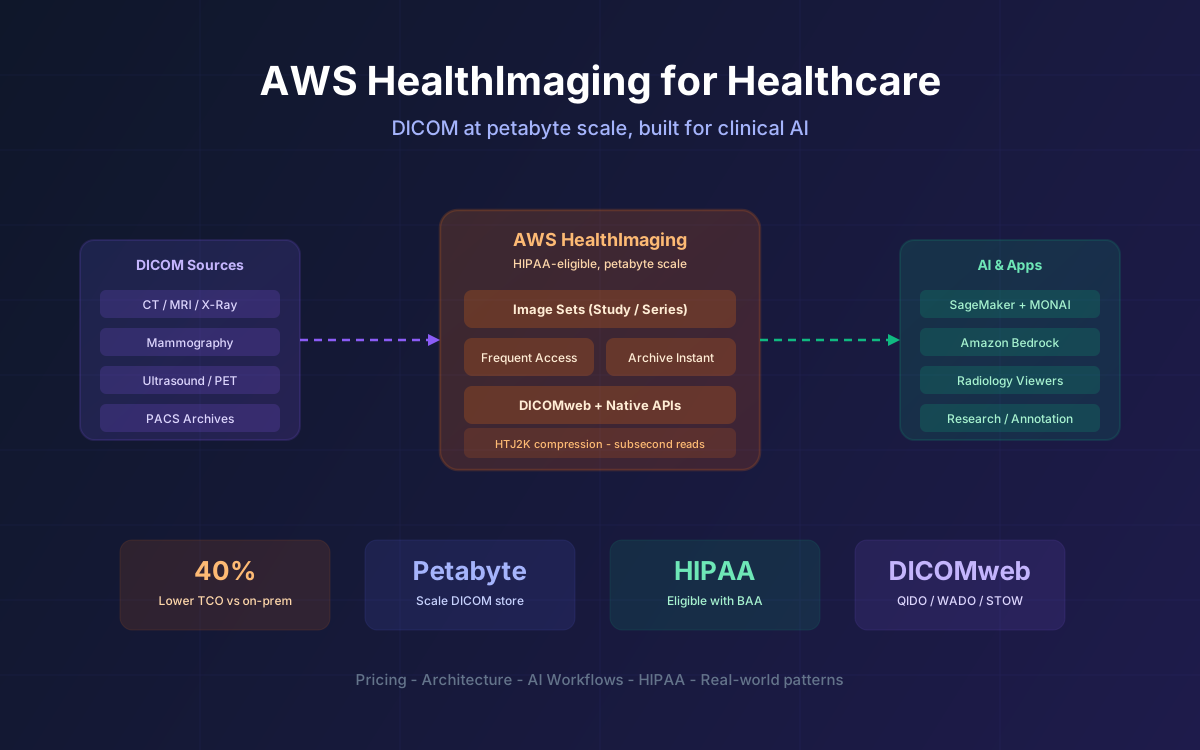
AWS HealthImaging is the cloud-native answer: a HIPAA-eligible, petabyte-scale DICOM store with subsecond image-frame access, automatic tiering, and first class hooks into SageMaker, Bedrock, and MONAI. AWS states this architecture can cut medical imaging total cost of ownership by up to 40% by collapsing the duplicated storage that every hospital quietly pays for.
This guide is the practical playbook. We cover how HealthImaging works, the pricing model you will actually be billed under, an end-to -end reference architecture, the AI and clinical workflow patterns that matter in 2026, how the new DICOMweb and fine-grained access control launches change deployments, and how Lushbinary helps healthcare teams go from pilot to production without blowing up their compliance posture.
What you'll learn
- What AWS HealthImaging is and who it's for
- Data stores, image sets, and the DICOM hierarchy
- Pricing, storage tiers, and real cost examples
- Reference architecture for a modern imaging platform
- Use cases in hospitals, imaging centers, and research
- AI workflows with SageMaker, Bedrock, and MONAI
- HIPAA, security, and compliance guardrails
- Migrating from legacy PACS and VNAs
- Recent launches and AWS re:Invent 2025 context
- How Lushbinary helps you ship a compliant imaging platform
1What AWS HealthImaging is and who it's for
AWS HealthImaging is a purpose-built, HIPAA-eligible managed service for ingesting, storing, querying, and serving DICOM medical imaging data at petabyte scale. It ships as a managed backend, not a viewer. You bring the DICOM files, AWS gives you durable object storage for pixel data, structured storage for indexable metadata, a cloud-native API, and a standards-conformant DICOMweb surface on top.
It's designed for teams who are one of these:
- Hospitals and health systems that want to consolidate radiology, cardiology, pathology, and specialty imaging into a single durable archive without buying more PACS storage appliances.
- Imaging centers and teleradiology providers that need multi-tenant, low-latency image delivery to distributed radiologists over the public internet.
- Radiology and clinical software vendors building cloud-native viewers, reporting tools, or AI products that need a backend they don't have to operate.
- Life sciences and clinical research organizations running multi-site studies that need de-identified, queryable imaging data for model training and annotation.
- Medical AI startups that need a DICOM-native store behind their inference pipelines without standing up an enterprise-grade PACS.
If you only need to dump a handful of DICOM files into S3 for a one-off project, S3 alone is cheaper. HealthImaging earns its keep the moment you care about DICOM-aware querying, multi-tenant isolation, clinical-grade access patterns, or AI workflows against real imaging data.
2Data stores, image sets, and the DICOM hierarchy
The core concepts are small, but getting them right early will save pain later.
Data store
The top-level container. Most customers create one per environment or tenant. A data store is region-scoped and comes pre-provisioned with 10 GB of structured metadata storage.
Image set
The AWS primitive, roughly aligned with a DICOM Series. When you import DICOM P10 files, HealthImaging organizes them into image sets made of normalized metadata plus image frames.
Image frame
The individual pixel payload. Frames are transcoded (often to HTJ2K lossless) and served with millisecond latency even from the Archive Instant Access tier.
DICOM hierarchy
HealthImaging preserves Study / Series / Instance semantics and since May 2025 automatically groups image sets into Study and Series resources for DICOMweb QIDO-RS search.
Design tip
Clinical use of DICOM data before it is cleaned can cause patient harm. HealthImaging keeps conflicting imports as non-primary image sets until you explicitly reconcile them. Make reconciliation a first-class workflow, not an afterthought.
3Pricing, storage tiers, and real cost examples
HealthImaging has three cost levers: storage (in two tiers), request pricing on the API, and outbound data transfer. The numbers below reference the US East (N. Virginia) region as published on the AWS HealthImaging pricing page. Data imports are always free, and retrieval between tiers has no extra charge.
| Component | Rate (US East) | Notes |
|---|---|---|
| Frequent Access storage | $0.105 / GB-month | Default tier on import. Moves to Archive after 30 days idle. |
| Archive Instant Access | $0.006 / GB-month | Same millisecond latency as Frequent. No retrieval fees. |
| API requests | ~$0.005 per 1,000 calls | Same rate via console and SDK. Frame retrievals count. |
| Image set minimum | 5 MB billable minimum | Small image sets still charged as 5 MB each. |
| Structured metadata | Per GB-month beyond 10 GB free | Contact AWS for workloads above 100 GB of indexed metadata. |
| Data transfer out | Tiered egress pricing | Free between AWS services in the same region. |
Pricing as of the official AWS HealthImaging pricing page. Always verify on the vendor's site before locking in budgets, rates vary by region and change over time.
🧮 Real-world cost example: 20 TB archive migration
Take a provider moving a 20 TB DICOM archive into HealthImaging and storing it for two years. AWS's own pricing example (US East) works out to $2,150.40 in month one while data sits in Frequent Access, then $122.88 per month once it transitions to Archive Instant Access. Total year one: $3,502.08. Total year two: $1,474.56. That compares favorably to a typical on-prem mid-tier storage appliance with support contracts, replication, and refresh cycles.
🧮 Active research workload example
A research team stores 1,000 de-identified 3D volumes (roughly 244 GB) in HealthImaging and hits them with 20,000 API calls per month for three months for labeling and annotation. Total: around $77.20, end to end. That is why HealthImaging is popular for model training shops, the storage follows the usage curve.
🎤 AWS re:Invent 2025 update
At re:Invent 2025, AWS emphasized that Trainium3 UltraServers and the P6e lineup, plus Amazon S3 Vectors (first cloud object store with native vector support), directly benefit medical imaging teams. You can train larger imaging models cheaper and run similarity search across huge DICOM archives without operating your own vector database.
4Reference architecture for a modern imaging platform
A production imaging platform on AWS typically has four layers: ingestion, storage, access, and workflow. HealthImaging sits in the middle.
Ingestion choices
- StartDICOMImportJob from S3, the bulk path. You upload DICOM P10 files to a staging bucket and kick off an import job. Great for migrations and batch workflows.
- DICOMweb STOW-RS, the synchronous path. Good for modern imaging apps that already speak DICOMweb and want immediate confirmation of stored objects.
- DICOM C-STORE (DIMSE) via an SCP adapter. AWS publishes a DICOM Store SCP for AWS HealthImaging in Marketplace that runs on Fargate and bridges legacy modalities and PACS.
Access choices
- Cloud-native actions like
GetImageFrame,GetImageSetMetadata,SearchImageSets. Lowest overhead, best for your own apps. - DICOMweb QIDO-RS, WADO-RS, STOW-RS, and since mid -2025, BulkData support. Drop-in compatibility with viewers, worklists, and AI frameworks expecting a standards-based DICOM endpoint.
- EventBridge notifications on image-set create, update, and delete. The hook that makes every AI pattern below possible.
In March 2026, AWS also launched study-level fine-grained access control, which is a big deal for multi-tenant platforms. You can now scope permissions down to a specific study without building your own policy layer on top.
5Use cases in hospitals, imaging centers, and research
🏥 Enterprise imaging consolidation
Most hospitals run a separate archive for radiology, cardiology, oncology, and specialty imaging. Every silo has its own backup, disaster recovery, and refresh cycle. HealthImaging lets you consolidate into a single HIPAA-eligible archive with one access model, one metering model, and intelligent tiering that moves cold priors to Archive Instant Access automatically.
🧑⚕️ Teleradiology and distributed reading
Radiologists reading across time zones don't want to wait for a 5 GB study to trickle through a VPN. HealthImaging's subsecond image-frame retrieval and region presence in the US, Sydney, Ireland, and London make it a strong fit for multi-site reading, especially when paired with a zero-footprint viewer leveraging progressive rendering over DICOMweb.
🧪 AI labeling and model training
Research teams import de-identified studies, grant scoped access to annotators, train models on SageMaker, and validate against held-out studies without ever moving a file. The AI/ML training path using Amazon Nova 2 Omni or custom vision transformers fed directly from HealthImaging frames is one of the fastest-growing patterns we are seeing.
🧬 Clinical trials and multi-site research
HealthImaging pairs well with AWS Clean Rooms for cross-organization collaboration. Multiple hospitals can contribute imaging data into a shared environment while preserving privacy and data residency. At re:Invent 2025, AWS expanded Clean Rooms with privacy-enhancing synthetic dataset generation, which is a clean fit for rare disease imaging studies.
🧭 Radiology software vendors building clouds
If you sell radiology software, HealthImaging eliminates the PACS storage tier you used to quote. You can offer customers a cloud-native backend out of the box, scope permissions per tenant using the new study-level access control, and run your differentiated IP on top. Your cost structure is usage-based, which maps better to SaaS margins than capex storage.
6AI workflows with SageMaker, Bedrock, and MONAI
Clinical AI against DICOM data is the most common reason teams choose HealthImaging over rolling their own S3 plus metadata database.
Pattern 1: Event-driven inference on new imports
HealthImaging emits events to Amazon EventBridge when image sets are created, updated, or deleted. You route the create event to a SageMaker async endpoint or a Lambda, pull frames with WADO-RS, run inference, and write results back to DICOMweb STOW-RS as a DICOM Structured Report. No polling, no cron jobs, no infrastructure state.
# EventBridge rule matching every new HealthImaging import
{
  "source": ["aws.medical-imaging"],
  "detail-type": ["Image Set Created"],
  "detail": { "datastoreId": ["${DATASTORE_ID}"] }
}

# Lambda handler (simplified)
import boto3, os
ahi = boto3.client("medical-imaging")
runtime = boto3.client("sagemaker-runtime")

def handler(event, _ctx):
    image_set_id = event["detail"]["imageSetId"]
    ds = event["detail"]["datastoreId"]
    meta = ahi.get_image_set_metadata(datastoreId=ds, imageSetId=image_set_id)
    # Pull frames via WADO-RS or GetImageFrame, run inference
    runtime.invoke_endpoint_async(
        EndpointName=os.environ["SM_ENDPOINT"],
        InputLocation=f"s3://${STAGING_BUCKET}/{image_set_id}.json",
    )
Pattern 2: MONAI Deploy pipeline
AWS publishes a MONAI Deploy connector for HealthImaging that streams image frames directly into MONAI Deploy Application Packages. If you are standing up a segmentation, classification, or detection pipeline, this is the shortest path to production. See the AWS ML blog on MONAI Deploy with HealthImaging.
Pattern 3: Report generation with Amazon Bedrock
Once inference produces findings, Bedrock-hosted models (Claude, Amazon Nova 2 Omni, open models) can draft structured radiology reports, highlight critical findings, and translate patient-friendly summaries in multiple languages. The ground truth always stays in HealthImaging, Bedrock just wraps it in natural language.
Pattern 4: Similarity search at scale
With Amazon S3 Vectors (announced at re:Invent 2025 as the first cloud object store with native vector support), teams can index embeddings generated from HealthImaging frames and build prior-study retrieval, rare finding search, or quality control workflows that would have required a dedicated vector database a year ago.
📺 Related re:Invent and AWS sessions
- AWS HealthImaging: Cloud-Native Medical Imaging Solution- Service deep dive hosted on AWS TV.
- Healthcare Transformed: Reimagining the Future with Generative AI- re:Invent 2025 session on GenAI across clinical workflows.
- Beyond EHR: Leveraging AWS for Maximum Clinical and Operational Impact- re:Invent 2025 session on clinical AWS architectures.
- Matt Garman re:Invent 2025 Keynote- Healthcare customer spotlights (Lila Sciences, Bristol Myers Squibb, Cohere Health, Pfizer).
7HIPAA, security, and compliance guardrails
HealthImaging being HIPAA-eligible is necessary but not sufficient. You still own the governance around it. Here's the non- negotiable shortlist every production deployment should have:
- Executed BAA with AWS, covering every AWS account that will touch PHI. Verify before any modality sends data.
- Customer-managed KMS keys for HealthImaging. Use per-tenant keys when you are a SaaS vendor so you can revoke access on contract termination without re-encrypting shared data.
- Least-privilege IAM policies. Use the new study-level fine-grained access control to scope tokens down to specific studies for teleradiology partners and research collaborators.
- VPC endpoints and private connectivity. Route modality traffic over AWS Direct Connect or VPN, never the public internet, and restrict the DICOMweb surface via AWS WAF.
- CloudTrail data events on HealthImaging API calls. For HIPAA audits, you need to prove who accessed which image set and when.
- De-identification before research use. Use AWS Comprehend Medical, purpose-built DICOM de-identification tooling, or the OHIF/CTP pipeline before sharing data with annotators or external AI vendors.
- AWS Security Hub and GuardDuty Extended Threat Detection. Both had significant re:Invent 2025 updates that make HIPAA evidence collection much easier.
- Break-glass workflows. Clinical emergencies sometimes require override access. Design the break-glass path explicitly, log it heavily, and review it monthly.
HealthImaging does not remove your HIPAA responsibilities, it makes them tractable. If your compliance team has never seen the shared responsibility model applied to a DICOM archive, plan for a few weeks of joint review before the first production import.
8Migrating from legacy PACS and VNAs
Most real-world projects start as migrations. A typical sequence looks like this:
- Inventory and profiling. Catalog every modality, study volume, annual growth, retention policy, and downstream consumer. Pay special attention to duplicate studies and orphaned series, those are 80% of the reconciliation work.
- Landing zone setup. Pick your AWS region based on data residency, run an account hardening pass, enable CloudTrail and Config, and create the HealthImaging data store and KMS keys.
- Backfill pipeline. For existing archives, run a parallel export from the legacy PACS or VNA into S3, trigger
StartDICOMImportJob, and reconcile non-primary image sets against your master patient index. - Dual-run cutover. Route new modality traffic to both the legacy archive and HealthImaging for a calibration window, often 30 to 60 days. Use EventBridge and CloudWatch to prove parity before decommissioning the old system.
- Consumer migration. Point viewers, AI pipelines, and research environments at HealthImaging using the DICOMweb endpoints. Keep the legacy archive read-only during the migration window as a rollback option.
- Cost tuning. After 30 days, verify studies are transitioning to Archive Instant Access as expected. Audit your API call patterns, most surprises come from viewers that re-fetch the same frame repeatedly.
CitiusTech, CDW, and several SI partners publish reference ingestion pipelines in the AWS Partner blog. These are worth reading before you roll your own.
9Recent launches and AWS re:Invent 2025 context
HealthImaging has been shipping steadily. A few launches that directly affect deployment choices in 2026:
- May 2025: DICOMweb QIDO-RS search and automatic organization of image sets into DICOM Study and Series resources.
- July 2025: DICOMweb BulkData support, which is critical for high-throughput pixel data retrieval by modern viewers.
- Late 2025: UpdateImageSetMetadata gained the
--include-study-image-setsflag, so Patient and Study level attribute changes can fan out across related primary image sets atomically. - January 2026: JPEG XL support across all GA regions, useful when your source modalities already produce JPEG XL-encoded DICOM.
- February 2026: Additional CloudWatch metrics for monitoring data stores, closing a long-standing observability gap.
- March 2026: Study-level fine-grained access control and GA expansion to Europe (London), which unlocks new UK healthcare deployments.
🎤 re:Invent 2025 context for imaging teams
Healthcare and life sciences were center stage at re:Invent 2025. Key adjacencies for imaging workloads: AWS Clean Rooms privacy-enhancing synthetic datasets, Amazon Nova 2 Omni for multimodal analysis (medical images, text, reports), Amazon S3 Vectors for semantic search, Amazon Bedrock AgentCore for automating clinical workflows, and AWS AI Factories for on-premises sensitive-data processing. All of them plug cleanly into a HealthImaging-backed architecture.
10How Lushbinary helps you ship a compliant imaging platform
Most healthcare teams don't need more white papers, they need an AWS partner that has actually moved DICOM data through production, understands HIPAA at both a technical and program level, and can ship software on top. That's where we come in.
What Lushbinary delivers for AWS HealthImaging projects:
Landing zone and compliance setup
Multi-account AWS Organization structure, HIPAA-aligned guardrails, KMS key design, CloudTrail data events, and Security Hub/GuardDuty baselines before your first PHI byte lands.
Ingestion and migration pipelines
DICOM C-STORE SCP on Fargate, S3-based import jobs, DICOMweb STOW-RS endpoints, reconciliation tooling for non-primary image sets, and dual-run cutover plans that don't disrupt clinical reading.
AI and inference workflows
SageMaker async endpoints, MONAI Deploy pipelines, Bedrock-powered report drafting, and S3 Vectors-backed similarity search. Event-driven with EventBridge so inference runs on every new study.
Viewers and clinical apps
Custom radiology viewers, teleradiology portals, and clinician-facing Next.js apps wired directly to HealthImaging's DICOMweb endpoints with study-level access control.
HIPAA program support
Technical implementation plus security risk assessments, BAA coordination, audit logging review, break-glass workflow design, and quarterly compliance drift checks.
Cost optimization and ops
CloudWatch dashboards, tier transition audits, API call hot-spot analysis, Reserved capacity planning when relevant, and monthly FinOps reviews against your imaging growth curve.
If you already have an AWS account and are evaluating HealthImaging, we'll do a free architecture review and give you a realistic cost model based on your study volume. If you are still deciding between HealthImaging, a VNA product, or rolling your own on S3, we can run that comparison honestly, sometimes HealthImaging is the wrong answer, and we'll tell you when.
🚀 Free consultation
Building on AWS HealthImaging or planning a PACS modernization? Lushbinary specializes in HIPAA-aligned cloud architectures and AI workflows for healthcare. We'll scope your project, map the compliance checkpoints, and deliver a realistic timeline, no obligation.
Related reading: Muse Spark AI for Healthcare Apps · Amazon S3 Files Guide · AWS Cost Optimization Techniques
❓ Frequently Asked Questions
What is AWS HealthImaging and who should use it?
AWS HealthImaging is a HIPAA-eligible managed service that stores, analyzes, and shares DICOM medical imaging data at petabyte scale. It fits hospitals, imaging centers, teleradiology providers, radiology software vendors, and medical AI teams that need subsecond access to CT, MRI, X-ray, and other imaging data without running their own PACS.
How much does AWS HealthImaging cost?
In US East (N. Virginia), Frequent Access is $0.105 per GB-month and Archive Instant Access is $0.006 per GB-month. API calls are roughly $0.005 per 1,000 requests, and image sets are billed at a 5 MB minimum. Imports are free. AWS says TCO can drop up to 40% versus duplicated on-prem archives.
Is AWS HealthImaging HIPAA compliant?
It is HIPAA-eligible under an executed BAA with AWS. You still own encryption, IAM, logging, de-identification for research, and your HIPAA Security Rule risk assessment.
What regions is AWS HealthImaging available in?
As of early 2026, GA regions are US East (N. Virginia), US West (Oregon), Asia Pacific (Sydney), Europe (Ireland), and Europe (London). Data residency requirements should drive region choice.
How does AWS HealthImaging integrate with AI and machine learning?
It exposes cloud-native APIs and DICOMweb (QIDO-RS, WADO-RS, STOW-RS). Common patterns: Amazon SageMaker and MONAI Deploy for training/inference, Amazon Bedrock for report drafting, Amazon S3 Vectors for similarity search, and EventBridge for on-import inference triggers.
Can AWS HealthImaging replace a traditional PACS?
Not on its own. It is the storage and API layer. You still need a viewer, worklist, modality worklist broker, and workflow glue. Most deployments pair it with a cloud-native PACS/VNA partner plus a zero-footprint viewer.
📚 Sources
- AWS HealthImaging product page
- AWS HealthImaging pricing
- AWS HealthImaging release history
- DICOMweb QIDO-RS search launch (May 2025)
- DICOMweb BulkData support (July 2025)
- JPEG XL support (January 2026)
- Additional CloudWatch metrics (February 2026)
- Study-level fine-grained access control (March 2026)
- AWS re:Invent 2025 healthcare and life sciences recap
- MONAI Deploy inference pipeline with AWS HealthImaging
- Konica Minolta case study on AWS HealthImaging
Content was rephrased for compliance with licensing restrictions. Pricing, regions, and feature data sourced from official AWS documentation and What's New posts as of May 2026. Pricing and regions change, always verify on the AWS site before committing.
Build Your Cloud-Native Medical Imaging Platform with Lushbinary
From PACS modernization to AI inference pipelines on HealthImaging, we design, build, and operate HIPAA-aligned imaging platforms on AWS. Tell us about your project and we'll map a pragmatic path forward.
Ready to Build Something Great?
Get a free 30-minute strategy call. We'll map out your project, timeline, and tech stack - no strings attached.
Prefer email? Reach us directly: