
The charity fundraising platform market is projected to grow from $7.7 billion in 2025 to $8.75 billion in 2026 at a 13.6% CAGR, according to The Business Research Company. Non-profits raise roughly $22 billion annually through auctions, and yet most nonprofits still run their galas on paper paddles, clipboards, and a prayer.
Off-the-shelf tools like OneCause, Greater Giving, and Qtego handle the basics, but they take a cut of every transaction, lock data in proprietary silos, and force nonprofits into templated event flows that do not match their brand or donor relationships. For mid-size and large nonprofits running multiple auctions per year, a custom platform pays for itself within 18 months by cutting per-event fees and unlocking year-round online auctions.
This guide walks through exactly how to build a charity auction platform that raises more money, respects donor privacy, handles tax receipts automatically, and scales from a 50-person dinner to a 10,000-bidder virtual gala. We cover the features that move revenue, the tech stack that scales, realistic cost ranges, and how Lushbinary ships these platforms in under 4 months.
Table of Contents
- 1.Why Generic Auction Tools Fall Short for Charities
- 2.Market Size, Donor Behavior & Why Mobile Bidding Wins
- 3.Core Features for a Charity Auction MVP
- 4.System Architecture & Recommended Tech Stack
- 5.Tax Receipts, Compliance & Donor Data
- 6.Gala Mode: Live Streaming, Paddle Raises & Fund-a-Need
- 7.Payments, Stripe for Nonprofits & Anti-Fraud
- 8.Cost, Timeline & Revenue Model
- 9.Why Lushbinary for Your Nonprofit Auction Platform
- 10.FAQ & Sources
1Why Generic Auction Tools Fall Short for Charities
Generic charity auction SaaS platforms solve the 80% use case but leave 20% of revenue and 100% of brand equity on the table. Here are the recurring complaints we hear from nonprofit development directors:
- Per-transaction fees of 2 to 4% on top of Stripe fees, which add up to tens of thousands of dollars for large galas
- Templated event pages that do not match the nonprofit's brand, donor communication style, or existing website
- Poor CRM integration with tools like Salesforce Nonprofit Cloud, Bloomerang, or DonorPerfect
- Limited reporting that hides donor behavior, bidding patterns, and year-over-year lifetime value
- No ownership of donor data, which lives in the vendor's database and gets monetized across their customer base
- Weak tax receipt handling that forces development staff to manually calculate fair market value versus charitable contribution splits
💡 The Math on Custom vs SaaS
A mid-size nonprofit running $1.5M in annual auction revenue pays $45K-$60K per year in SaaS fees and transaction cuts. A custom platform built by Lushbinary typically costs $55K-$90K one-time plus $300-$600/month in AWS hosting, which breaks even in 12-18 months.
2Market Size, Donor Behavior & Why Mobile Bidding Wins
The business case for investing in a charity auction platform is backed by data:
- The global charity fundraising platform market is projected to reach $8.75 billion in 2026 (The Business Research Company)
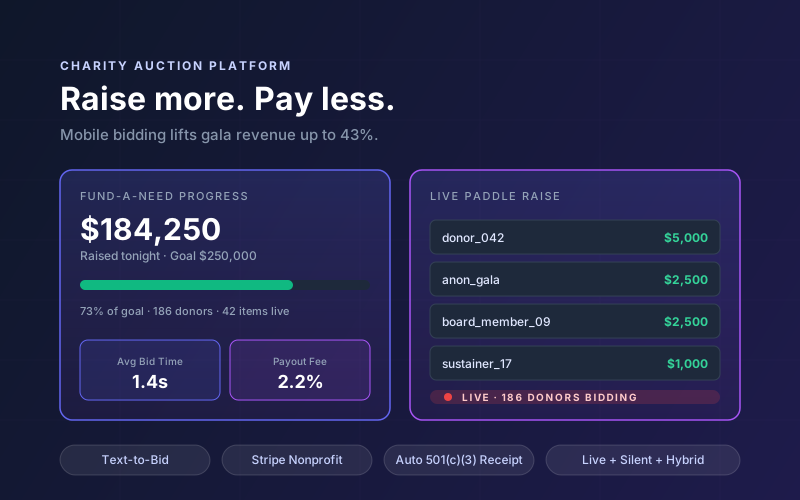
- Mobile bidding increases auction revenue by up to 43% and participation by 52% (Charity Auctions Today 2026 data)
- Online donations grew at double-digit rates in 2024-2025 across every nonprofit segment tracked by industry reports
- Hybrid events (in-person plus remote bidders) consistently out-raise pure in-person galas by 25-40%
The underlying driver is obvious: when a guest does not have to raise a paddle, flag down a volunteer, and write on a bid sheet, they bid more often. When they get an outbid push notification 30 seconds before the silent auction closes, they bid again.
3Core Features for a Charity Auction MVP
Build these in Phase 1. They cover 90% of what a nonprofit needs to run a real event:
Phase 1: Lean MVP (3 to 4 months)
Branded Event Page
Custom domain, logo, colors, mission statement, sponsor banners
Silent Auction Catalog
Item photos, descriptions, starting bid, min increment, end time
Mobile Bidding
One-tap bid placement with outbid SMS and push notifications
Max Bid / Proxy Bidding
Set a ceiling and let the system bid on your behalf up to that amount
Anti-Sniping Extensions
Last-minute bids extend the auction by 2 to 5 minutes to keep it fair
Stripe Checkout
Automatic card charge on auction close with failed-payment retry
Tax Receipts
PDF receipts with fair market value and charitable contribution split
Admin Dashboard
Add items, monitor live bids, run post-event reports, export to CSV
Phase 2: Gala & Live Auction (1 to 2 months)
- Live auction mode with auctioneer interface, projected bid display, and hammer price confirmation
- Fund-a-Need / paddle raise with tiered giving levels ($100, $500, $1,000, $5,000) and live thermometer
- YouTube or Mux Live embed for hybrid events so remote bidders can watch the gala stream
- Guest check-in and seating with QR code bidder numbers and table assignments
- Sponsor recognition pages with tiered logo placement and custom thank-you content
Phase 3: AI & Scale (2 to 3 months)
- AI item description writer that takes photos and donor notes and drafts compelling catalog copy
- Donor lifetime value predictions to prioritize follow-up calls after the event
- Salesforce Nonprofit Cloud / Bloomerang sync for automatic donor record updates and engagement scoring
- Multi-chapter support for national nonprofits running simultaneous regional auctions
4System Architecture & Recommended Tech Stack
The architecture is similar to what we built for MSP Disposal's live auction platform, tuned for charitable event traffic patterns (quiet most of the month, then 10x spikes on gala night).
| Layer | Recommended Stack |
|---|---|
| Frontend | Next.js 15 + React 19 + Tailwind CSS 4 |
| Real-time bidding | Socket.IO 4.8 + @socket.io/redis-adapter |
| Backend API | Node.js 22 + Fastify or Express |
| Database | PostgreSQL 17 on AWS RDS |
| Cache / Pub-Sub | Redis 7 on AWS ElastiCache |
| Payments | Stripe (nonprofit rate) + Stripe Connect for multi-org |
| Messaging | Twilio Verify + SMS + WebPush (VAPID) |
| Email receipts | AWS SES or Postmark |
| Hosting | AWS ECS Fargate + CloudFront + ALB |
| CRM sync | Salesforce NPSP / Bloomerang / DonorPerfect APIs |
5Tax Receipts, Compliance & Donor Data
In the US, auction items sold above their fair market value (FMV) create a deductible charitable contribution for the portion above FMV. The platform must automate this to avoid manual post-event cleanup.
A compliant receipt includes:
- Donor name and address, with email on file for year-end summary
- Nonprofit legal name, EIN, and 501(c)(3) status statement
- Item description, fair market value (set by the donor or nonprofit), and winning bid amount
- Deductible portion calculation (winning bid minus FMV, floored at zero)
- Statement of no goods or services received beyond FMV
⚠️ IRS Publication 1771
Any single donation over $250 requires a written acknowledgment. Build this as an automated email triggered by Stripe webhook on successful payment so development staff never have to chase it down at year-end.
6Gala Mode: Live Streaming, Paddle Raises & Fund-a-Need
The live gala is where the biggest revenue lift happens. A typical gala generates 40-60% of annual auction revenue in a single evening. The platform needs to handle this mode cleanly:
- Auctioneer interface: shows current item, current high bid, bidder paddle number, and one-tap "confirm hammer" button
- Ballroom projector view: large text, animated bid updates, fund-a-need thermometer, sponsor rotation
- Fund-a-need paddle raise: tiered giving levels with live count at each tier, a shared progress bar, and celebration animations when milestones hit
- Remote bidder stream: embedded YouTube Live or Mux Video with synchronized bid controls below the video
- Text-to-bid: donors text a keyword plus amount to a Twilio shortcode for bidders who prefer not to use the web app
Synchronization is critical: when the auctioneer moves to the next lot, all screens must update within 200ms. This is where Socket.IO rooms and Redis pub/sub earn their keep.
7Payments, Stripe for Nonprofits & Anti-Fraud
Stripe offers a discounted charity pricing rate (commonly 2.2% + $0.30 in the US) for verified 501(c)(3) organizations. Note that Stripe's charity rate is primarily intended for donation acceptance, not product or ticket sales, so auction item bids may fall under standard processing. Verify your eligibility with Stripe support during setup and keep standard rates in your baseline revenue model.
Anti-fraud essentials:
- Stripe Radar for ML-based card fraud scoring on every charge
- Pre-authorization holds of $1 on registration to verify the card before allowing bids
- Phone verification via Twilio Verify on signup and before any bid above a configurable threshold
- Bid limits tied to verified payment methods, with manual review for anything above the threshold
- 3D Secure automatic step-up on large charges
8Cost, Timeline & Revenue Model
| Scope | Timeline | Cost Range |
|---|---|---|
| Lean MVP (silent auction + mobile bidding) | 3 to 4 months | $28K to $55K |
| Full event platform (silent + live + fund-a-need) | 5 to 6 months | $60K to $95K |
| Full + multi-chapter + CRM sync + AI catalog | 7 to 9 months | $110K to $180K |
| Ongoing maintenance & hosting | Per month | $800 to $2,500 |
For nonprofits that cannot fund the full build upfront, a common model is to charge a modest per-event fee to other nonprofits while your flagship uses it free, creating a revenue-positive platform within 18 months.
9Why Lushbinary for Your Nonprofit Auction Platform
We have built a production live auction platform end-to-end with real-time bidding, live streaming, AWS auto-scaling, and analytics. Our MSP Disposal case study covers the technical playbook we reuse for every auction build.
What we bring to nonprofit auction projects:
- Production Socket.IO bidding engine with sub-50ms propagation and horizontal scaling via Redis adapter
- Stripe integration with nonprofit rate setup, tax receipt automation, and failed-charge retry logic
- AWS ECS Fargate hosting that scales from idle to 10,000+ concurrent bidders on gala night
- Salesforce NPSP, Bloomerang, and DonorPerfect sync so donor records update automatically
- Branded, accessible (WCAG 2.1 AA) event pages that match your existing nonprofit website
🚀 Free Nonprofit Consultation
Running a gala in the next 12 months? Lushbinary offers free scoping calls for nonprofit auction builds. We will review your current tools, estimate the revenue lift, and give you a realistic timeline and budget with no obligation.
❓ Frequently Asked Questions
How much does it cost to build a charity auction platform?
A lean MVP costs $28,000 to $55,000 for 3 to 4 months of development. A full-featured platform with mobile bidding, live-streamed gala mode, and nonprofit CRM integrations typically runs $75,000 to $140,000 over 5 to 7 months.
Can mobile bidding actually increase charity auction revenue?
Yes. Industry data from 2026 shows that in-browser mobile bidding can increase auction revenue by up to 43% and participation by 52% compared to paddle-only in-person auctions.
Do charity auction platforms need to handle tax receipts?
Yes. Every winning bid must generate a receipt that separates the fair market value of the item from the charitable contribution portion per IRS Publication 1771.
What payment processor is best for nonprofit auctions?
Stripe offers a verified nonprofit charity pricing rate (commonly 2.2% + $0.30) for qualifying 501(c)(3) orgs, primarily for donations. Auction item sales may fall under standard pricing, so confirm with Stripe during account setup. Stripe Connect handles multi-charity marketplaces cleanly.
How do you prevent fraudulent bidders on a charity auction?
Standard protections include Stripe Radar, pre-authorization holds, phone verification via Twilio Verify, bid limits tied to verified payment methods, and manual review above configurable thresholds.
Sources
- Charity Fundraising Platform Market Report 2026
- Charity Auctions Today: Auction Software Guide 2026
- Stripe nonprofit fee discount support article
- IRS Publication 1771: Charitable Contributions
Content was rephrased for compliance with licensing restrictions. Market and pricing data sourced from official reports and vendor pages as of May 2026. Pricing and tax rules may change, always verify with the vendor and IRS directly.
Ready to Raise More With a Custom Charity Auction Platform?
Tell us about your next gala. We will scope the build, estimate the revenue lift, and get you a fixed-price quote within a week.
Ready to Build Something Great?
Get a free 30-minute strategy call. We'll map out your project, timeline, and tech stack - no strings attached.
Prefer email? Reach us directly: