
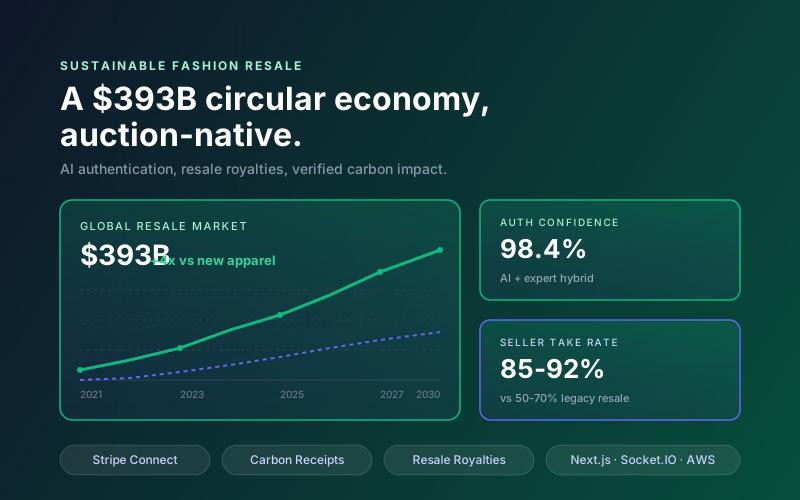
The secondhand fashion market is no longer a niche. ThredUp's 2026 Resale Report values the global resale market at $393 billion and growing, and Future Market Insights projects secondhand apparel to climb from $53.7 billion in 2026 to $154.3 billion by 2036 at an 11.1% CAGR. Resale is growing four times faster than new apparel, with 60% of Americans now buying pre-owned clothing.
Yet most resale platforms treat every item like a fixed-price listing, which leaves money on the table for one-of-one vintage, limited-edition streetwear, and pre-owned luxury. Auction-based models capture true price discovery and drive the urgency that converts browsers into bidders. Done right, a sustainable fashion auction platform earns better margins, creates a stronger brand story, and keeps more textiles out of landfill.
This guide covers exactly how to build a sustainable fashion auction platform: the multi-seller architecture, AI-powered authentication, carbon impact accounting, payment flows with Stripe Connect, and the realistic cost and timeline to ship it.
Table of Contents
- 1.Market Size & Why Resale is a Flywheel
- 2.Why Auctions Beat Fixed-Price for Curated Resale
- 3.Gaps in Existing Platforms (The RealReal, Vestiaire, Depop)
- 4.Core Features for a Sustainable Fashion Auction MVP
- 5.AI-Powered Authentication & Condition Grading
- 6.Carbon Impact Accounting That Donors Trust
- 7.System Architecture & Tech Stack
- 8.Multi-Seller Payments with Stripe Connect
- 9.Cost, Timeline & Revenue Model
- 10.Why Lushbinary for Your Resale Auction Build
- 11.FAQ & Sources
1Market Size & Why Resale is a Flywheel
The resale flywheel is real, and it is accelerating:
- The US secondhand market is estimated at $61 billion in 2026, up 8.2% from 2025, per Capital One Shopping research
- Global secondhand apparel will more than triple by 2036, reaching $154.3 billion at an 11.1% CAGR (Future Market Insights)
- Resale is growing four times faster than new apparel, with Gen Z buying secondhand at the highest rate of any generation
- Consumers now factor resale value into new-purchase decisions, which Forbes calls the "new value flywheel" of fashion
🌱 The Environmental Case
WRAP UK estimates that extending the active life of clothing by nine months reduces its carbon, water, and waste footprints by around 20-30% each. Circular-economy research suggests a shift to reuse could generate $4.5 trillion in additional economic output by 2030.
2Why Auctions Beat Fixed-Price for Curated Resale
Fixed-price listings work for commodity resale (mass-market tees, common jeans). They leave value on the table for:
- One-of-one vintage: a 1970s Saint Laurent blazer has no comparable market price
- Limited drops: hyped streetwear (Travis Scott Jordans, Supreme box logos) has volatile, real-time pricing
- Pre-owned luxury: condition, provenance, and scarcity drive 20-50% price swings on the same model
- Curator drops: platforms that want to create an event moment and drive urgency
Auction mechanics that move the needle:
- Timed auctions with 72-hour to 7-day windows, ending at a specific time to drive last-minute bidding
- Anti-sniping extensions: bids in the final 2 minutes extend the end time by 2-5 minutes
- Buy Now / Reserve options so casual buyers can skip the auction for a premium
- Bidder ranking system with trust badges to prevent shill bidding
3Gaps in Existing Platforms
| Platform | Model | Common Complaints |
|---|---|---|
| The RealReal | Consigned luxury, fixed-price | Consignor payouts 40-65%, slow approval, no auction dynamic on hyped items |
| Vestiaire Collective | P2P luxury with optional authentication | Authentication adds weeks, shipping friction, platform fees up to 15%+ |
| Depop | P2P streetwear / Y2K | 10% fees, no dispute resolution for high-value items, no auction format |
| eBay Fashion | Generic P2P with auctions | No specialization, poor luxury authentication, buyer trust issues |
| Grailed | Menswear marketplace | Limited to menswear, 9% fees, no womenswear or vintage curation |
The opportunity: a curated auction platform for sustainable fashion that combines authentication, carbon accounting, fair seller payouts, and auction-native mechanics in a single branded experience.
4Core Features for a Sustainable Fashion Auction MVP
Phase 1: Lean MVP (4 to 5 months)
Seller onboarding
KYC, Stripe Connect Express, payout bank details, sustainability pledge
Item listing
Up to 12 images, condition grade, brand, size, category, provenance notes
Timed auctions
72h default, start price, min increment, anti-sniping 5-min extension
Real-time bidding
Socket.IO WebSocket updates, outbid push notifications, bid history
Condition grading
1-5 scale (Excellent, Very Good, Good, Fair, For Repair) with visible photos
Shipping integration
ShipStation or EasyPost labels, buyer pays or flat-rate included
Return policy engine
Per-seller rules (final sale, 7-day return, authentication guarantee)
Dispute resolution
In-platform messaging, escrow hold, admin adjudication workflow
Phase 2: Differentiation (2 to 3 months)
- AI-assisted authentication: CLIP embeddings and fine-tuned vision transformers for logo, stitching, hardware checks
- Carbon impact tracking: CO2-saved badge on each item and a lifetime tally per user
- Curator drops: time-boxed collections from trusted stylists, vintage dealers, or celebrities
- Watchlists & alerts: price drops, bid notifications, new items in saved brands/sizes
- AR try-on: using Snap AR or custom iOS VisionKit for size and fit confidence
Phase 3: Scale (2 to 3 months)
- Native iOS & Android apps via React Native or Flutter for push-notification-driven bidding
- AI stylist: "find me a vintage trench in my size under $400" semantic search using embeddings
- Circular loyalty program: buyer credits for re-listing worn items, creating a closed loop
- Tokenized provenance (optional): on-chain certificate of authenticity that follows the item across owners
5AI-Powered Authentication & Condition Grading
Authentication is the single biggest trust barrier in pre-owned luxury. A hybrid AI-plus-human workflow is the industry standard:
- Seller upload with structured prompts: logo close-up, inside tag, hardware, stitching, serial number
- AI first-pass: fine-tuned vision transformer (e.g., ViT or OpenCLIP) trained on authentic-vs-counterfeit pairs for top brands
- Confidence scoring: items above threshold go to listing, below threshold route to human expert review
- Human expert review: trained authenticators using a rubric, with photos, video, and notes archived for future ML training
- Condition grading: separate model or rubric that scores wear, damage, and restoration signals
Training a vision model for authentication requires 5,000 to 50,000 labeled images per brand. Early-stage platforms partner with vintage dealers and authentication services to collect this data and bootstrap the model over 6-12 months.
6Carbon Impact Accounting That Buyers Trust
Shoppers buying secondhand want to see the impact of their choice. Build carbon accounting into the product, not a press release:
- Use WRAP UK and Ellen MacArthur Foundation lifecycle data as the source of truth
- Display CO2 saved, water saved, and textile kept out of landfill per item
- Aggregate lifetime impact in the user profile with shareable graphics
- Offer optional offsets at checkout through a vetted partner like Patch or CNaught
⚠️ Avoid Greenwashing
Cite your data source on every impact display, use category averages rather than one-size-fits-all numbers, and have an LCA (lifecycle assessment) expert review the methodology before launch. Regulators in the EU and UK are tightening rules on unsubstantiated green claims.
7System Architecture & Tech Stack
A resale auction platform is a multi-vendor marketplace with real-time bidding. The key subsystems are listing management, auction engine, payments, and authentication pipeline.
| Layer | Stack Choice |
|---|---|
| Frontend web | Next.js 15 + React 19 + Tailwind 4 |
| Mobile apps | React Native 0.77 (Expo SDK 52) |
| Auction engine | Node.js 22 + Socket.IO 4.8 + Redis adapter |
| Image handling | S3 + CloudFront + ImageKit or Sharp transforms |
| Auth ML | Python 3.12 + FastAPI + PyTorch + OpenCLIP |
| Database | PostgreSQL 17 + pgvector for embeddings |
| Search | Typesense or Algolia for faceted listing search |
| Payments | Stripe Connect Express with split payouts |
| Shipping | EasyPost or ShipStation API |
| Hosting | AWS ECS Fargate + RDS + ElastiCache + S3 |
8Multi-Seller Payments with Stripe Connect
A resale auction is a marketplace. Use Stripe Connect Express to onboard sellers, hold funds in escrow during shipping, and release to sellers after the buyer confirms receipt or the return window closes.
Typical payment flow:
- Seller onboards via Stripe Connect Express, completes KYC
- Auction closes, highest bidder is charged via Stripe Checkout or Payment Intent
- Funds held in platform-controlled escrow balance for 7-14 days
- Seller ships with EasyPost label; buyer confirms receipt or return window expires
- Platform transfers 85-92% to seller minus fees, retains 8-15% commission
9Cost, Timeline & Revenue Model
| Scope | Timeline | Cost Range |
|---|---|---|
| Lean MVP (web auctions, Stripe Connect, basic listings) | 4 to 5 months | $45K to $80K |
| Mid (AI auth assist, carbon tracking, mobile apps) | 6 to 8 months | $110K to $170K |
| Full marketplace (ML training, AR, tokenized provenance) | 9 to 12 months | $200K to $320K |
| Ongoing hosting & ML ops | Per month | $1,500 to $4,000 |
Revenue model: 8-15% platform commission on winning bid, optional $3-12 authentication fee for luxury items, and premium seller subscription for higher visibility.
10Why Lushbinary for Your Resale Auction Build
We ship marketplaces and auction platforms end to end. Relevant recent work includes our MSP Disposal live auction case study and our MedusaJS full-stack e-commerce guide.
What we bring to sustainable fashion builds:
- Production real-time bidding engine with Socket.IO and Redis adapter, ready to drop in
- Stripe Connect marketplace payments with escrow, refunds, and multi-currency support
- Vision ML pipeline for authentication using OpenCLIP and custom fine-tuned models
- Carbon impact calculator built from WRAP and Ellen MacArthur data, externally auditable
- AWS infrastructure that scales from 100 to 100,000 users without rework
🚀 Free Sustainable Fashion Consultation
Building a resale auction platform with a real sustainability story? Lushbinary offers a free scoping call. We will review your vision, estimate the build, and share how we have shipped auction platforms to production at scale.
❓ Frequently Asked Questions
How big is the secondhand fashion market in 2026?
Secondhand apparel is projected to reach roughly $54 billion in 2026 and $350 to $393 billion globally by 2030 to 2031. The US alone is estimated at $61 billion in 2026.
Why use auctions instead of fixed-price for resale fashion?
Auctions capture 15-30% more value on one-of-one vintage, limited streetwear, and pre-owned luxury, where true price discovery matters.
What does it cost to build a sustainable fashion auction platform?
$45K to $80K for a lean MVP over 4 to 5 months. $120K to $220K for a full-featured marketplace with AI authentication and mobile apps over 6 to 9 months.
How do you handle authentication for pre-owned luxury?
Hybrid AI-plus-human workflow. AI vision models first-pass, human experts review flagged items. Cost $3 to $12 per item for luxury brands.
How do you calculate carbon impact for a resale purchase?
Use WRAP UK and Ellen MacArthur lifecycle data for category averages. A dress saves about 3.6kg CO2, jeans save about 8kg CO2 versus new.
Sources
- ThredUp 2026 Resale Report
- Future Market Insights: Secondhand Apparel 2026-2036
- WRAP UK lifecycle assessment data
- Ellen MacArthur Foundation circular economy research
- Stripe Connect documentation
Content was rephrased for compliance with licensing restrictions. Market data sourced from official industry reports as of May 2026. Pricing, market size, and LCA estimates may change, always verify with vendor and research sources directly.
Build the Sustainable Fashion Auction Platform You Want to Own
Tell us about your resale vision. We will scope the build, recommend the right tech stack, and share a realistic timeline with no obligation.
Ready to Build Something Great?
Get a free 30-minute strategy call. We'll map out your project, timeline, and tech stack - no strings attached.
Prefer email? Reach us directly: