
Property management has the best data-to-decision ratio of any real estate vertical. Every unit generates a continuous stream of maintenance tickets, payment events, inspection notes, renewal signals, and tenant conversations. That data has been sitting in Yardi, AppFolio, and Buildium for years, largely unused by the operators paying for it. AI changes that economics.
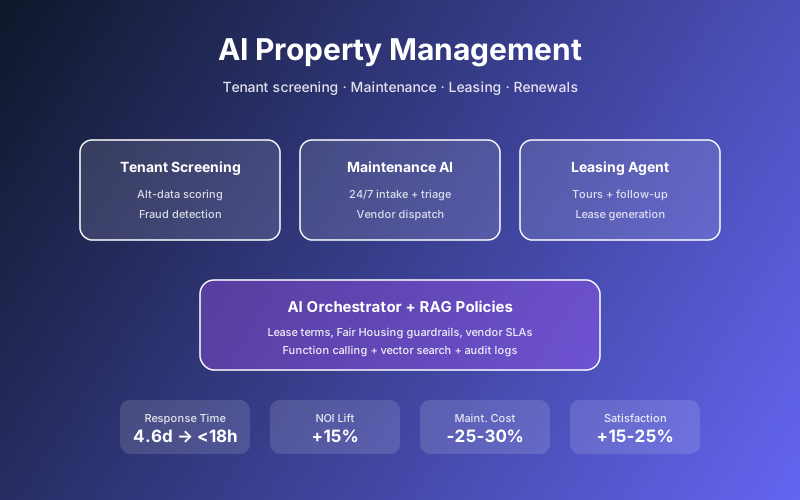
In 2026, best-in-class AI property management platforms cut maintenance response time from an industry average of 4.6 days to under 18 hours, reduce operating costs 20-35%, and lift NOI roughly 15% according to McKinsey-cited research. The catch: cramming AI everywhere backfires. The operators winning are scoping AI narrowly on the highest-ROI workflows and keeping humans in the loop on the rest.
This guide covers the architecture of a production AI property management platform: tenant screening, maintenance AI, AI leasing agents, renewal prediction, and the data and compliance layers that make it safe to ship. Plus how Lushbinary builds these for operators and PropTech startups.
📋 Table of Contents
- 1.The 2026 AI Property Management Landscape
- 2.Five Workflows Where AI Actually Wins
- 3.Maintenance AI: Intake → Triage → Dispatch
- 4.AI Leasing Agent: From Lead to Lease
- 5.Tenant Screening: Alt-Data + Fair Housing
- 6.Renewal Prediction & Resident Experience
- 7.Reference Architecture & Data Model
- 8.Compliance: FCRA, Fair Housing, Privacy
- 9.Cost, Timeline & Team Shape
- 10.How Lushbinary Builds PM Platforms
- 11.FAQ
1The 2026 AI Property Management Landscape
The market has split into two camps: AI bolted onto legacy platforms (Yardi, AppFolio, Buildium) and AI-native platforms built around intelligent automation from day one. Neither is universally better. The right choice depends on portfolio size, existing stack, and willingness to change workflow.
Where AI in PM demonstrably moves the needle as of 2026:
- Maintenance triage: 24/7 intake, instant triage, automated vendor dispatch. 4.6-day industry average response time collapses to under 18 hours.
- Leasing: AI leasing agents handle inquiries, schedule tours, answer unit questions, and qualify applicants without waiting for office hours.
- Tenant screening: Alt-data scoring and fraud detection on applications, all with FCRA-required human review on adverse actions.
- Renewal prediction: Early signal on at-risk residents so operators can intervene 60-90 days before lease end.
- Financial operations: Invoice capture, lease abstraction, and reconciliation that used to eat hours of accounting time.
Where the hype outpaces reality: predictive maintenance without real sensor data, churn prediction on thin data sets, and AI-driven rent pricing running without human oversight (recent DOJ and state AG activity on algorithmic rent collusion is a live risk, not theoretical).
2Five Workflows Where AI Actually Wins
| Workflow | What AI Does | Impact |
|---|---|---|
| Maintenance Intake | 24/7 chat + voice, photo triage, priority score | 4.6d → <18h response, -25-30% cost |
| AI Leasing Agent | After-hours inquiry handling, tour booking, app qualification | +25-40% lead-to-tour rate |
| Tenant Screening | Alt-data income/rent history, fraud detection, audit logs | -40% bad-debt on multifamily portfolios |
| Renewal Prediction | Churn scoring 60-90 days out, personalized outreach | +3-6 pts retention rate |
| Ops Document AI | Lease abstraction, invoice capture, inspection reports | 10-20 hrs/week back to accounting |
For most portfolios, maintenance AI plus AI leasing is the highest-leverage combo to ship first. Tenant screening and renewal prediction have more compliance surface and deserve deeper design work before launching.
3Maintenance AI: Intake → Triage → Dispatch
Maintenance is the highest-ROI entry point for AI in property management because the workflow is repetitive, data-rich, and immediately visible to residents. The pipeline:
- Intake: 24/7 chat (web + SMS + WhatsApp), voice line with Twilio plus OpenAI Realtime, or in-app form. Multi-language by default (Claude and GPT both handle Spanish, Mandarin, Portuguese natively).
- Triage: LLM plus vision (tenant uploads a photo of the leaky faucet) classifies category, severity, and compliance flags (mold, gas smell, bed bugs go straight to human).
- Scheduling: AI checks vendor availability, resident preferences, and lease access rules, proposes times, books once confirmed.
- Dispatch: Vendor gets a structured work order with tenant contact info, access instructions, and a priority flag. AI follows up on no-shows and delays.
- Completion + feedback: Post-visit survey, completion photo, AI-authored summary pushed back to the PM system of record.
💡 First-Trip Completion is the Real KPI
Empty or mis-scoped vendor trips are the hidden cost of maintenance. Best-in-class AI intake plus compliance gates can lower after-hours surcharges 30-40% by getting the right parts and access info on the first trip. Measure First-Trip Completion Rate from day one.
4AI Leasing Agent: From Lead to Lease
Leasing inquiries peak after hours and on weekends, exactly when most leasing offices are closed. An AI leasing agent closes that gap:
- Inquiry handling: answers questions about unit availability, floor plans, pet policy, parking, amenities, and pricing.
- Tour booking: live-syncs to the leasing team's calendar (or a self-tour platform like Tour24 or PointCentral), books and confirms via SMS.
- Pre-qualification: walks through basic eligibility (income, move-in date, pet count, proof of income upload). Does not make the approval decision, passes scored results to a leasing specialist.
- Application follow-up: chases missing documents, reminds about deposit deadlines, escalates to human when stalled.
- Nurture: long-horizon drip for prospects whose timeline is 60-180 days out.
Self-tour integrations are the biggest lever for AI leasing in multifamily. They shift the unit tour from "schedule in 3 days with a leasing agent" to "drive by this evening with a code from your phone." Conversion rates on self-tours consistently run 2-3x traditional.
5Tenant Screening: Alt-Data + Fair Housing
Tenant screening is where AI has the highest potential upside and the highest compliance risk. The playbook for shipping it safely:
- Alt-data scoring: verified income (Plaid, Argyle), rent payment history (Experian RentBureau), utility payment records. More predictive than credit score alone for rent performance.
- Fraud detection: document forgery checks on pay stubs and IDs, synthetic identity flags. A high-ROI feature independent of credit screening.
- Policy-driven decisions: the model outputs a score, not a yes/no. A documented policy (e.g., 2x rent income, no unpaid rental judgments in 5 years) decides. This makes the decision auditable and compliant.
- Adverse action compliance: FCRA requires adverse action notices when a decision is based on consumer report data. Build the notice generation into the workflow so it cannot be skipped.
- Disparate impact audits: quarterly analysis of approval rates by protected class (where proxies can be inferred at aggregate level). Any significant gap is a signal to re-examine the model and policy.
🚨 CFPB and State AGs Are Watching
The CFPB has taken enforcement action against tenant screening companies for inaccurate reports and inadequate dispute processes. Multiple state AGs are active on algorithmic screening. Any AI screening you ship needs: documented methodology, dispute resolution workflow, adverse action notices, and ongoing bias audits.
6Renewal Prediction & Resident Experience
A lost resident costs roughly 2-3 months of rent when you stack vacancy, turn costs, and leasing commission. Getting to renewals 60-90 days out with a personalized pitch is the single highest ROI retention move.
How AI supports this:
- Signal aggregation: late payments, maintenance ticket sentiment, tour activity elsewhere (where detectable), survey scores, communication tone all aggregate into a renewal risk score.
- Personalized outreach: residents who rarely complain get a warm renewal letter. High-risk residents get a call or concession offer.
- Concession optimization: small, personalized concessions (in-unit upgrade, waived pet fee, flexible term) often beat big rent cuts on retention math. Guardrails: human approval on anything above a $X threshold.
- Feedback loop: post-move-out surveys feed back into the renewal risk model.
Pair this with active resident experience AI (maintenance updates, community announcements, lease renewal self-serve) to compound the retention lift.
7Reference Architecture & Data Model
Core data model additions on top of a standard CRM-style schema:
unitsandbuildings: physical inventory with amenities, rent bands, and availability.residentsandleases: lease terms, move-in date, deposit, renewal status.maintenance_tickets: category, priority, status, vendor assignment, completion photos.applications: application data, screening results, adverse action history, decision audit trail.ai_runs: every AI invocation with prompt, model, tools used, output, and cost. Non-negotiable.
8Compliance: FCRA, Fair Housing, Privacy
Property management AI touches more regulation than most real estate use cases. The non-negotiables:
- FCRA: screening decisions based on consumer reports require accurate data, dispute processes, and adverse action notices. Model outputs are not exempt.
- Fair Housing: every AI-generated resident communication must pass a protected-class filter. Pricing and concession offers must be explainable and consistent.
- TCPA: outbound SMS and automated calls require opt-in and time-of-day compliance. Resident maintenance communication is usually fine under the existing- relationship exemption but leasing prospects need clear opt-in.
- State-specific rent rules: source-of-income protections, eviction notice requirements, and rent pricing restrictions vary by state and locality. Encode these at the tool/policy layer, not in LLM prompts.
- Privacy: lease docs, SSNs, bank statements, and pay stubs are PII. Encrypt at rest, access-control at the row level, and redact from AI run logs.
Our AI agent production guardrails guide covers the broader pattern. Property management adds the regulatory surface on top.
9Cost, Timeline & Team Shape
| Scope | Build Cost | Timeline | Hosting/mo |
|---|---|---|---|
| Maintenance AI Pilot | $55K-$120K | 10-14 weeks | $1,500-$3,000 |
| Leasing + Maintenance | $140K-$280K | 4-6 months | $2,500-$4,500 |
| Full PM Platform | $220K-$500K | 6-10 months | $3K-$6K |
| PropTech SaaS Launch | $450K-$1.1M+ | 9-16 months | $5K-$15K+ |
Typical team for the Full PM Platform tier:
- 1 tech lead / architect
- 2 senior full-stack engineers
- 1 AI/ML engineer (orchestration + evals)
- 1 data engineer (PM system integration + analytics)
- 1 designer / PM
- 0.5 compliance reviewer (FCRA, Fair Housing, state rules)
10How Lushbinary Builds PM Platforms
Lushbinary ships AI property management platforms end-to-end. What we bring:
- Integration experience with Yardi Voyager, AppFolio, Buildium, RentManager, Entrata, and the rest of the PM system landscape.
- Voice AI built on Twilio plus OpenAI Realtime or LiveKit covered in our multimodal AI agents guide.
- Compliance-first builds with FCRA adverse action workflows, Fair Housing filters, TCPA opt-in flows, and audit logs shipped by default.
- AWS infrastructure with FinOps discipline from our AWS cost optimization guide.
- Resident-facing mobile apps via Flutter or React Native, sharing the same backend as your portal.
- Owner reporting dashboards with AI-generated executive summaries and per-property financials.
🚀 Free PM Pilot Scoping
Tell us your unit count, current PM stack, and where maintenance or leasing is bleeding hours. Lushbinary will come back with a scoped pilot plan, realistic ROI projection, and target KPIs within a few days, no obligation.
❓ Frequently Asked Questions
What is the ROI of AI in property management in 2026?
McKinsey-cited research shows 25-30% maintenance cost reduction and 15% NOI lift. Maintenance response time drops from 4.6 days to under 18 hours. Best-in-class platforms cut operating costs 20-35%.
Does AI property management work for small portfolios?
Yes. Cloud AI PM now serves 50-unit owners up. For 50-500 units, layering AI leasing + maintenance on AppFolio or Buildium is fastest. Above 1,000 units, custom platforms pay back in 12-18 months.
Can AI do tenant screening fairly?
With the right controls, yes. FCRA, Fair Housing Act, and state laws apply. Need: human-review adverse action notices, model audits, protected-class proxy exclusion, and documented scoring methodology.
How much does an AI property management platform cost to build?
Pilot runs $55K-$120K over 10-14 weeks. Full platform runs $220K-$500K over 6-10 months. Hosting $1,500-$6,000/month.
What are the biggest AI property management pitfalls?
Chatbots for everything (edge cases erode trust), predictive maintenance without sensors (marketing), and AI-driven rent or screening decisions without human review (Fair Housing exposure).
📚 Sources
- Haven AI Maintenance KPI Benchmarks
- Haven AI Tenant Satisfaction & Renewals
- AI Property Management Tools Compared (2026)
- FTC Fair Credit Reporting Act
- HUD Fair Housing & Equal Opportunity
- Content was rephrased for compliance with licensing restrictions. Benchmark and market data sourced from official research and vendor pages as of April 2026. Figures may change, always verify on the vendor's website.
Reclaim 15%+ NOI with AI Your Team Will Trust
Tell us about your portfolio, current PM stack, and where the biggest operational pain sits. We will come back with a pilot plan and target KPIs within a few days.
Ready to Build Something Great?
Get a free 30-minute strategy call. We'll map out your project, timeline, and tech stack - no strings attached.
Prefer email? Reach us directly: