
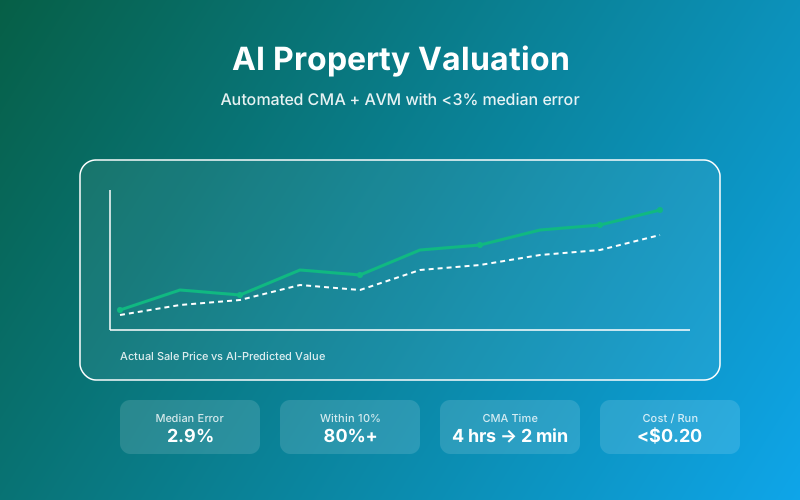
A good CMA used to take an agent three to four hours: pull MLS comps, apply adjustments, build a branded PDF, walk the seller through it. In April 2026, production AI systems are doing that in under two minutes, for under twenty cents of compute, with ATTOM reporting a 2.9% median absolute percentage error and more than 80% of valuations landing within 10% of actual sale price on their new AI-powered AVM.
The off-the-shelf CMA tools real estate agents can buy today are still basically fancy calculators. They do not read your listing photos, they do not use LLMs for narrative, and they do not adjust for hyperlocal factors. Custom AI valuation systems close that gap. They are how brokerages and proptech platforms differentiate on pricing accuracy and seller trust.
This guide covers the full architecture of a modern AI valuation system: AVM modeling, CMA generation, data sources, accuracy targets, confidence scoring, and how Lushbinary ships these in production for brokerages and proptech teams.
📋 Table of Contents
- 1.AVM vs CMA: What You Are Actually Building
- 2.Accuracy Benchmarks to Target
- 3.Data Sources & Ingestion Pipeline
- 4.The AVM: Model Architecture
- 5.Computer Vision for Condition Adjustments
- 6.The CMA: LLM-Powered Narrative & PDF
- 7.Confidence Scoring & Guardrails
- 8.When Human Appraisers Still Win
- 9.Cost, Timeline & Delivery Model
- 10.How Lushbinary Builds AI Valuation Systems
- 11.FAQ
1AVM vs CMA: What You Are Actually Building
These are often confused but they are different artifacts:
- AVM (Automated Valuation Model): a machine learning model that outputs a point estimate (e.g., $742,500) plus confidence score (FSD or similar) and a range. Used inside lenders, portfolio managers, proptech platforms, and iBuyers.
- CMA (Comparative Market Analysis): an agent- facing artifact, usually a PDF, showing 3-6 comparable properties, adjustments, ranges, and a recommended list price. Used in listing presentations and seller conversations.
Modern AI platforms combine both. The AVM is the core engine; the CMA is a presentation layer driven by an LLM that takes AVM outputs, selects narratives, and generates PDFs. MISMO (Mortgage Industry Standards Maintenance Organization) formalized AVM confidence scoring standards in 2025, which the big platforms are now starting to adopt.
💡 Build Both, Ship the CMA First
The CMA has higher immediate user value for agents. The AVM has higher strategic value (B2B proptech API, internal pricing). Lushbinary typically ships the CMA generator first, then layers the AVM engine underneath in phase 2.
2Accuracy Benchmarks to Target
Accuracy is measured with a few standard metrics. Know the numbers before you pitch a client or sign an SLA.
| Metric | What It Means | Industry Benchmark |
|---|---|---|
| MdAPE | Median Absolute Percentage Error vs actual sale price | 2.9% (ATTOM), 1-4% top-tier AVMs |
| PPE10 | % of valuations within 10% of actual sale price | 80%+ (ATTOM, HouseCanary) |
| FSD | Forecast Standard Deviation, the AVM's own confidence | Vendor-specific; MISMO 2025 standard emerging |
| Hit Rate | % of address queries returning a valuation | 80-95% in well-covered markets |
Target numbers for a production system, as ranges we have seen hold up in deployments:
- MdAPE < 5% on a representative holdout across your target markets.
- PPE10 > 75% on the same holdout.
- Clean calibration: the FSD should correlate with actual error. If high-confidence predictions miss as often as low-confidence ones, the confidence model is broken.
- Stable across segments: no more than a 2x gap in MdAPE between price tiers or neighborhoods. Otherwise you have fairness and Fair Housing exposure.
3Data Sources & Ingestion Pipeline
Valuation is a data problem first, a model problem second. The sources that matter:
- MLS sold records (RESO Web API): ground truth for recent sales. Pull incrementally using
ModificationTimestamp. - MLS active and pending listings: forward looking signals for momentum, days on market, and price changes.
- Public records: tax assessor data, ownership history, lot geometry, permits. ATTOM, CoreLogic, Regrid, and direct county feeds are the main providers.
- Property characteristics: bedrooms, bathrooms, GLA, lot size, year built. Often noisy between MLS and tax records; a normalization step is required.
- Listing media: photos for computer vision, floor plans, virtual tours.
- Neighborhood signals: school ratings (GreatSchools), walkability (Walk Score), crime indices, Census demographics. Treat these as features, not as marketing claims.
⚠️ Bias Audit Is Non-Negotiable
Urban Institute research has shown that AVMs can reproduce historical pricing disparities, often correlating with race/ethnicity of the neighborhood. Any production AVM must run disparate-impact testing on holdout data and have a human escalation path when confidence is low in underrepresented markets.
4The AVM: Model Architecture
There is no single "AVM model." Production systems ensemble several approaches:
- Hedonic regression (base): linear or generalized models on structural characteristics. Interpretable, stable, and a good sanity check.
- Gradient boosted trees (core): XGBoost, LightGBM, or CatBoost on tabular features. This is the workhorse for most modern AVMs, including HouseCanary's reported 97.2% accuracy model.
- Spatial models: geographically weighted regression or learned spatial embeddings to capture hyperlocal effects.
- Computer vision overlay: separate CNN or vision-LLM (GPT-5.5, Claude Opus 4.7 vision) on listing photos for condition and quality adjustments.
- Ensembler + calibration: a meta-learner combines the above and outputs a calibrated point estimate plus FSD.
// Typical AVM feature set (simplified)
interface AvmFeatures {
  // Structural
  gla: number;                // sq ft
  bedrooms: number;
  bathrooms: number;
  lotSize: number;            // sq ft
  yearBuilt: number;
  garage: boolean;
  stories: number;

  // Location
  lat: number;
  lng: number;
  zip: string;
  schoolRating: number;
  walkScore: number;

  // Market
  daysOnMarketMedian30d: number;
  saleToListMedian30d: number;
  inventoryMonthsOfSupply: number;

  // Condition (from CV overlay)
  conditionScore: number;     // 0-1
  renovationSignal: number;   // 0-1, flags unreported reno
}
For most brokerage scope projects, gradient boosted trees with a CV overlay get you 90% of the way to the top-tier numbers. The last 10% of accuracy is where ATTOM, HouseCanary, and CoreLogic invest years of data engineering.
5Computer Vision for Condition Adjustments
The biggest accuracy gap in legacy AVMs is condition. Two houses with identical beds/baths/GLA can sell for a 30% delta because one is renovated and one is not. Listing photos carry that signal, and modern vision models extract it.
Typical CV pipeline:
- Fetch up to N listing photos (most MLSes allow 20-50) from the Media resource.
- Classify each image by room type (kitchen, bath, exterior, living, bedroom).
- Score each image on a condition scale (fine-tuned classifier or prompted multimodal LLM with a rubric).
- Detect renovation signals (new cabinetry, quartz counters, stainless appliances, hardwood flooring, modern fixtures).
- Aggregate to a single condition score and renovation flag, passed as features to the AVM.
For vision, Claude Opus 4.7 is currently strong on detailed condition rubrics. GPT-5.5 is faster and cheaper for high volume. For cost-sensitive builds, an open-weight model like Qwen 3.6 VL fine-tuned on real estate photo data runs locally. See our Claude Opus 4.7 vision guide for the exact vision API details.
6The CMA: LLM-Powered Narrative & PDF
Once the AVM produces a valuation and comps, an LLM layer turns that into an agent-ready CMA document:
- Comp selection: the model picks 3-6 comps from the AVM-ranked candidate list based on recency, proximity, size similarity, and condition match.
- Adjustments: numeric adjustments come from the hedonic regression (rule-based, auditable). The LLM writes the narrative explanation.
- Market context: trends on days on market, sale-to-list, inventory, and competing listings pulled from your local MLS data.
- Recommended list price range: low/mid/high anchored to the AVM FSD and seller goals (speed vs top dollar).
- Branded PDF: rendered with Puppeteer or a React-PDF template that pulls in the agent's branding.
Important guardrail: numeric adjustments must never come from the LLM. They come from the hedonic layer. The LLM only writes narrative over numbers it is handed. This keeps the system auditable and prevents arithmetic hallucinations.
💡 Agent Override Is a Feature
Agents know things the model does not: the seller's renovation receipts, the deal falling through next door, the neighborhood's upcoming commercial development. Ship a clean override UI with mandatory notes and audit logging; the AVM learns from these over time.
7Confidence Scoring & Guardrails
Every AVM output needs a confidence score. Without it, agents and clients treat point estimates as truth. With it, you can trigger human review when needed.
Guardrails we ship on every valuation system:
- FSD tiers: Green (high confidence), Yellow (moderate, show range), Red (low, do not auto-publish).
- Thin market guard: if fewer than 6 closed comps within 90 days and 1 mile, mark confidence Red.
- Outlier guard: if the AVM value is >20% from the hedonic baseline, flag for human review.
- Fairness audit: weekly job checks MdAPE by zip, price tier, and Census tract. Drift triggers an alert.
- Freshness SLA: valuations older than 30 days auto-expire and re-compute on view.
8When Human Appraisers Still Win
AI valuation is not a replacement for licensed appraisers in every case. Know the boundary:
- Most federally regulated mortgage transactions still require a USPAP-compliant appraisal with on-site inspection. Some low-risk GSE programs allow appraisal waivers backed by AVM data, but the bar is high.
- Unique properties (historic homes, working farms, custom builds with no comps) underperform in AVMs. Flag these as Red and route to a human.
- Thin markets (rural, ultra-luxury) have structural data sparsity. The model's confidence score should recognize this and punt to humans.
- Legal and tax disputes where a certified appraiser's opinion is the required artifact, not the model's.
AI is best positioned as a pricing and listing tool (CMA, pre- inspection pricing, portfolio marks) rather than a replacement for regulatory appraisals. Build to that contract.
9Cost, Timeline & Delivery Model
Cost ranges we see on valuation builds, as of April 2026:
| Scope | Build Cost | Timeline |
|---|---|---|
| CMA Generator (LLM on existing MLS) | $25K-$60K | 6-10 weeks |
| AVM (single market, no CV) | $80K-$180K | 3-5 months |
| Full AVM + CV overlay + CMA (multi-market) | $220K-$550K | 5-9 months |
| National AVM API product | $700K-$2M+ | 12-24 months |
Ongoing costs:
- Data licenses: $500-$5,000/month per MLS, $2K-$10K/month for ATTOM/CoreLogic national feeds.
- Model hosting: $500-$2,500/month on AWS for most brokerage-scope deployments.
- LLM spend: $0.02-$0.15 per CMA generation with tiered routing and prompt caching.
- Retraining cadence: quarterly at minimum, monthly for active markets. Budget 1-2 weeks of data eng + MLOps time per retrain.
10How Lushbinary Builds AI Valuation Systems
Lushbinary ships valuation platforms end-to-end: data engineering, modeling, vision overlays, LLM narrative, PDF rendering, and agent-facing UX. What we bring:
- Senior data engineers with RESO Web API and public records experience across multiple MLSes.
- ML engineers with deployed AVM production experience, including fairness audits and MISMO-aligned confidence scoring.
- Multi-model LLM orchestration with Langfuse tracing and cost telemetry baked in. See our AI-native SaaS architecture guide for the patterns we use.
- AWS infrastructure playbooks with per-environment cost ceilings from our AWS cost optimization playbook.
- Agent-facing CMA UX shipped as a Next.js module that can embed inside your existing CRM or listing platform.
🚀 Free Valuation Accuracy Audit
Already running a CMA or AVM workflow? Lushbinary can audit a holdout of 500+ recent sales in your market and benchmark your MdAPE, PPE10, and fairness metrics against industry targets - no obligation.
❓ Frequently Asked Questions
How accurate are AI property valuation models in 2026?
Leading AVMs report MdAPE around 2.9% and 80%+ of valuations within 10% of actual sale price. HouseCanary reports 97.2% accuracy combining gradient boosted trees with computer vision. Accuracy varies by market liquidity and data freshness.
What is the difference between an AVM and a CMA?
AVM is a point estimate plus confidence from an ML model. CMA is the agent-facing document with 3-6 comps, adjustments, and narrative. Modern systems produce both from the same underlying data.
Can AI replace a licensed appraiser?
Not for federally regulated mortgage appraisals in most cases. AVMs are used for pricing, pre-listing, portfolio valuation, and some low-risk loan programs, but USPAP-compliant appraisals still require a licensed human.
How long does it take to build a custom AI valuation system?
A CMA generator on top of an existing MLS license takes 6-10 weeks. A full AVM with statistical modeling, CV adjustments, and confidence scoring takes 4-7 months.
What data powers a high-accuracy AVM?
MLS sold/active records via RESO, public records from ATTOM or CoreLogic or Regrid, listing media for CV condition assessment, and neighborhood signals. Agent-verified condition inputs catch unreported renovations.
📚 Sources
- ATTOM AI-Powered AVM Launch
- HouseCanary AVM Case Study
- Urban Institute: AVM Disparity Research
- MISMO (Mortgage Industry Standards)
- RESO (Real Estate Standards Organization)
- Content was rephrased for compliance with licensing restrictions. Benchmark and vendor data sourced from official press releases and case studies as of April 2026. Figures may change, always verify on the vendor's website.
Ship Accurate Valuations in Weeks, Not Years
Tell us about your target markets, data access, and use case. We will map out the shortest path to a production AI valuation system and share an accuracy projection within a few days.
Ready to Build Something Great?
Get a free 30-minute strategy call. We'll map out your project, timeline, and tech stack - no strings attached.
Prefer email? Reach us directly: