
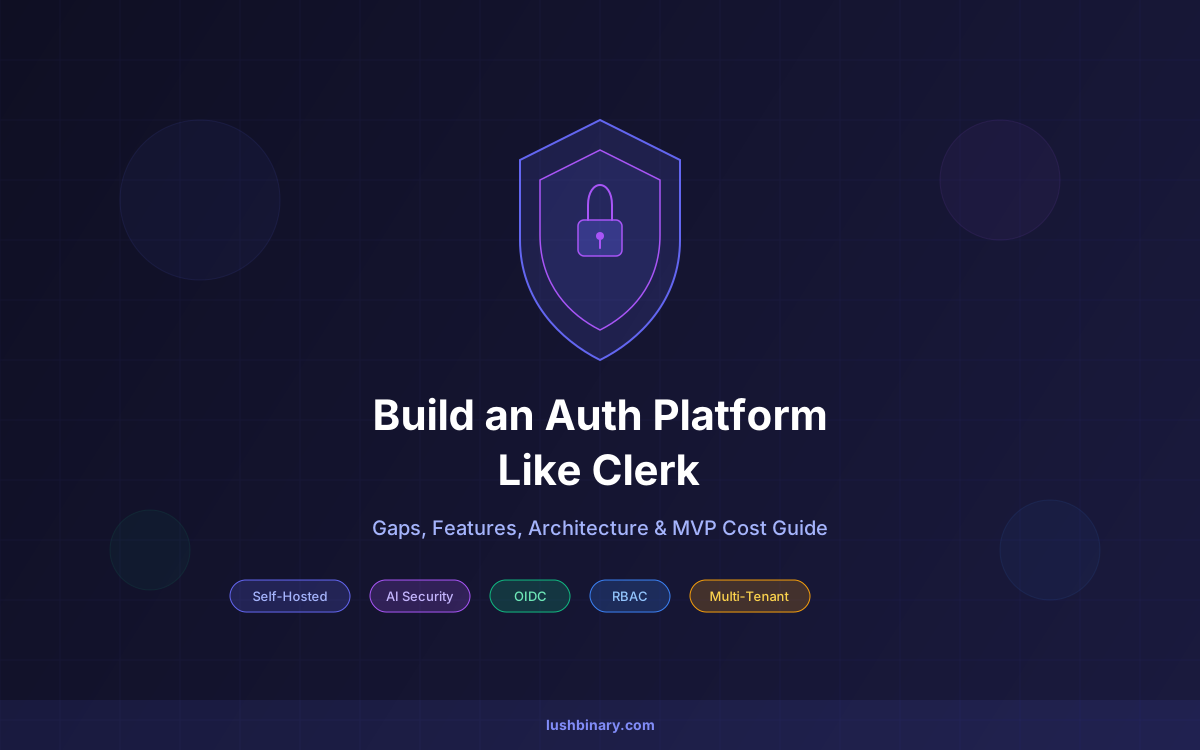
Clerk turned the authentication problem into a $130 million venture-backed business. Founded in 2019 by brothers Colin and Braden Sidoti, the platform now powers authentication for over 15,000 applications serving more than 200 million users. Clerk raised a $50M Series C in July 2025 led by Menlo Ventures with participation from Anthropic's Anthology Fund, pushing total funding past $130M. The identity verification and authentication market is projected to reach $18.14 billion in 2026, growing at 15.9% CAGR (source). Every app needs auth, and Clerk proved that developer experience is the winning differentiator.
But Clerk's reliability has taken a hit. In early 2026, the platform suffered multiple service outages - including a major incident on March 10 where database lock contention caused cascading failures across all APIs. Their own postmortem acknowledged that "frustration is rightfully mounting." Costs scale quickly past the free tier at $0.02 per monthly active user. There's no self-hosting option, which is a dealbreaker for healthcare, finance, and government customers. And the SDK ecosystem, while excellent for React and Next.js, leaves teams on other frameworks with limited support.
This guide breaks down what makes Clerk successful, the specific pricing and reliability gaps you can exploit, the core features you need for an MVP, the architecture and tech stack, AI-powered features that can leapfrog the competition, realistic development costs, and how Lushbinary can help you ship it.
📋 Table of Contents
- 1.What Makes Clerk Successful
- 2.Clerk's Revenue Model & Pricing Breakdown
- 3.User Complaints & Market Gaps You Can Exploit
- 4.Core Features for an Authentication Platform MVP
- 5.System Architecture & Tech Stack
- 6.AI-Powered Features That Differentiate
- 7.Development Cost & Timeline Breakdown
- 8.Why Lushbinary for Your Auth Platform MVP
1What Makes Clerk Successful
Clerk didn't invent authentication. It reinvented the developer experience of adding it to an app. Instead of wiring up OAuth flows, session management, and user profile pages from scratch, developers drop in pre-built React components that handle the entire auth flow in under 10 minutes. That single design decision - treating auth as a UI component library rather than a backend service - is the foundation of a platform trusted by over 15,000 applications.
Embeddable Components as a Moat
Clerk's <SignIn />, <SignUp />, <UserButton />, and <OrganizationSwitcher /> components render directly inside your app - no redirect flows, no hosted login pages, no jarring context switches. This embedded approach consistently delivers higher conversion rates than redirect-based auth providers like Auth0. The components are fully customizable with CSS, support dark mode out of the box, and handle edge cases like email verification, MFA enrollment, and password reset without any custom code.
B2B Multi-Tenancy Built In
Clerk's Organizations feature provides full multi-tenant support: team creation, member invitations, role-based access control with custom permissions, domain-verified enrollment, and SCIM directory sync (which went GA in April 2026). This is the feature that turns a B2C auth tool into a B2B SaaS platform. Building equivalent multi-tenancy from scratch typically costs $250,000-$600,000 and takes 6-12 months according to Clerk's own analysis.
Framework-First SDK Strategy
Clerk invested heavily in first-class Next.js integration, including App Router support, React Server Components, and middleware-based route protection. They also ship SDKs for React, Remix, Expo (React Native), Express, Fastify, and a Python backend SDK. This framework-first approach creates deep lock-in: once your middleware, route guards, and user management are wired through Clerk's SDK, switching costs are significant.
| Metric | Clerk (2026) |
|---|---|
| Total Funding | $130M+ (Series C, July 2025) |
| Active Applications | 15,000+ |
| Users Served | 200M+ collective |
| Founded | 2019, San Francisco |
| Founders | Colin Sidoti (CEO), Braden Sidoti (CTO) |
| Key Investors | Menlo Ventures, CRV, Stripe, a16z, Madrona |
| Identity Provider Market Share | 24% adoption among organizations (Ramp data) |
| Strongest Segment | Micro-SMB (34% adoption) |
2Clerk's Revenue Model & Pricing Breakdown
Clerk follows a usage-based pricing model that scales with monthly retained users (MRUs). In February 2026, they launched a major pricing overhaul that eliminated the Enhanced Authentication add-on and expanded the free tier from 10,000 to 50,000 MRUs (source). This was a direct response to competitive pressure from SuperTokens, Better Auth, and other open-source alternatives.
| Plan | Price | Included MRUs | Best For |
|---|---|---|---|
| Hobby | Free | 50,000 | Startups & prototypes |
| Pro | $20/mo | 50,000 (then $0.02/MAU) | Production apps |
| Business | $250/mo | 50,000 (then $0.02/MAU) | Larger teams |
| Enterprise | Custom | Custom | Enterprise deployments |
Where the Real Costs Hide
The base pricing looks generous, but add-ons stack up fast:
- Organizations: $0.21-$1 per active organization per month depending on plan. A B2B SaaS with 500 active orgs on Pro pays an extra $105-$500/month.
- Enterprise SSO (SAML/OIDC): $50 per connection per month on Pro. Ten enterprise customers with SSO adds $500/month.
- API Keys (Machine Auth): 1,000 free key creations per month, then $0.001 each. 100,000 free verifications, then $0.00001 each.
- Custom Domains: Included on Pro and above, but requires DNS configuration and SSL provisioning.
- Dashboard Seats: Only 3 seats on Hobby. Additional seats require upgrading.
💰 Cost Reality Check
A B2B SaaS with 100,000 MAUs, 200 organizations, and 5 enterprise SSO connections on Clerk Pro would pay roughly $20 (base) + $1,000 (extra MAUs) + $42-$200 (orgs) + $250 (SSO) = $1,312-$1,470/month. That's $15,744-$17,640/year for authentication alone. A self-hosted alternative eliminates the per-user and per-org fees entirely.
3User Complaints & Market Gaps You Can Exploit
Clerk has earned a loyal developer following, but real pain points are driving teams to evaluate alternatives. Here are the gaps a competitor can exploit:
1. Reliability Concerns
Clerk suffered multiple outages in early 2026. On February 19, an inefficient query plan caused a service-wide outage. On March 10, a more severe incident caused by database lock contention took down all APIs. Clerk's own postmortem stated: "We have failed at our commitment to customers and we are deeply sorry." They shifted the majority of their engineering team to reliability projects. For authentication - the front door to every app - downtime is unacceptable. A self-hosted or multi-region alternative eliminates single-vendor dependency.
2. No Self-Hosting Option
Clerk is cloud-only. There is no way to run it on your own infrastructure. This is a dealbreaker for healthcare companies (HIPAA), financial institutions (SOC 2 with data residency), government agencies (FedRAMP), and any organization with strict data sovereignty requirements. Open-source alternatives like Keycloak, SuperTokens, and Better Auth have gained traction specifically because they offer self-hosting.
3. Vendor Lock-In
Clerk's SDK deeply integrates into your middleware, route guards, and component tree. Migrating away means rewriting authentication logic across your entire application. The proprietary session token format, custom JWT claims, and Clerk-specific hooks like useUser() and useOrganization() create tight coupling. A standards-based alternative using OIDC and standard JWTs makes switching providers straightforward.
4. Framework Coverage Gaps
Clerk's React and Next.js support is excellent. Everything else is second-class. Teams building with Vue, Svelte, Angular, or server-rendered frameworks like Laravel or Django get limited SDK support. The Python backend SDK is relatively new. Mobile support through Expo works, but native iOS (Swift) and Android (Kotlin) SDKs are missing. A platform with broader framework coverage captures the non-React market.
5. Pricing at Scale
At $0.02 per MAU past the free tier, costs grow linearly with your user base. Clerk sits in the middle of the pricing spectrum - more expensive than Supabase Auth but cheaper than Auth0's $0.07 per user. For a consumer app with 1 million MAUs, that's $19,000/month just for authentication. A self-hosted solution with a flat infrastructure cost becomes dramatically cheaper at scale.
| Pain Point | Clerk's Gap | Your Opportunity |
|---|---|---|
| Reliability | Multiple 2026 outages | Multi-region, self-hosted deployment |
| Self-hosting | Cloud-only | Docker/Kubernetes self-hosted option |
| Vendor lock-in | Proprietary SDKs | OIDC-standard, portable tokens |
| Framework support | React/Next.js focused | Vue, Svelte, Angular, native mobile SDKs |
| Cost at scale | $0.02/MAU | Flat infrastructure cost, open-source core |
| Machine auth | New, limited | First-class API keys, service tokens, M2M |
4Core Features for an Authentication Platform MVP
Building a Clerk alternative doesn't mean replicating every feature on day one. Here's a phased approach that gets you to market fast while building toward feature parity.
Phase 1: Lean MVP (3-4 months)
Ship the core authentication loop that developers actually need:
- Email/password authentication with secure hashing (Argon2id), email verification, and password reset flows
- Social OAuth - Google, GitHub, Apple, and Microsoft as launch providers (covers 90%+ of developer use cases)
- Session management with JWT access tokens and rotating refresh tokens, configurable expiration, and device tracking
- Embeddable UI components - pre-built sign-in, sign-up, and user profile components for React (your primary differentiator over backend-only solutions)
- Developer dashboard - application management, user browser, API key generation, and webhook configuration
- REST API & SDK - a clean API with a TypeScript SDK and Next.js middleware for route protection
- Webhooks - user.created, user.updated, session.created events for syncing with external systems
Phase 2: B2B & Differentiation (2-3 months)
- Organizations & multi-tenancy - team creation, member invitations, org-scoped data isolation
- Role-based access control (RBAC) - custom roles and fine-grained permissions per organization
- Multi-factor authentication - TOTP (authenticator apps), SMS, and email-based second factors
- Passwordless login - magic links and email OTP for frictionless sign-in
- Self-hosting support - Docker Compose and Helm chart for on-premise deployment (your biggest differentiator)
- Additional framework SDKs - Vue, Svelte, and Express/Fastify backend packages
Phase 3: Enterprise & Scale (3-4 months)
- Enterprise SSO - SAML 2.0 and OIDC connections for Okta, Azure AD, Google Workspace
- SCIM directory sync - automatic user provisioning and deprovisioning from identity providers
- Passkey/WebAuthn support - passwordless biometric authentication using FIDO2 standards
- Machine authentication - API keys, service tokens, and machine-to-machine OAuth flows
- Audit logging - comprehensive event logs for compliance (SOC 2, HIPAA, GDPR)
- AI-powered features - anomaly detection, adaptive MFA, intelligent rate limiting (covered in Section 6)
🎯 MVP Strategy
Phase 1 alone is enough to compete with Clerk for early-stage startups. The self-hosting option in Phase 2 is your wedge into the compliance-sensitive market that Clerk cannot serve. Enterprise SSO in Phase 3 unlocks the high-ACV contracts that fund long-term growth.
5System Architecture & Tech Stack
An authentication platform has unique architectural requirements: every request to your customers' apps flows through your system, so latency and availability are non-negotiable. Here's the recommended architecture:
Recommended Tech Stack
| Layer | Technology | Why |
|---|---|---|
| Dashboard & Admin UI | Next.js 15 (App Router) | SSR, React Server Components, fast iteration |
| Auth API | Node.js + Fastify | Low latency, TypeScript-native, plugin ecosystem |
| OIDC Provider | node-oidc-provider | OIDC-certified, battle-tested, standards-compliant |
| Database | PostgreSQL 16 | JSONB for flexible user metadata, row-level security |
| Session Store | Redis 7 (Cluster) | Sub-ms reads, TTL-based expiration, pub/sub for real-time |
| Object Storage | S3 or Cloudflare R2 | User avatars, data exports, audit log archives |
| Event Queue | SQS or BullMQ (Redis) | Webhook delivery, async email, audit event processing |
| AWS SES or Resend | Transactional email for verification, MFA codes, invites | |
| Embeddable UI | React component library | Shadow DOM isolation, CSS custom properties for theming |
| Infrastructure | AWS ECS Fargate or Kubernetes | Auto-scaling, multi-AZ, self-hostable via Helm |
🔐 Security-First Architecture
Authentication is a security product first. Use Argon2id for password hashing (not bcrypt), enforce HTTPS everywhere, implement CSRF protection with double-submit cookies, use HttpOnly/Secure/ SameSite flags on all auth cookies, and store secrets in AWS Secrets Manager or HashiCorp Vault. Every endpoint must be rate limited. Every mutation must be audit logged.
6AI-Powered Features That Differentiate
AI is the biggest opportunity to leapfrog Clerk. Authentication generates massive amounts of behavioral data - login patterns, device fingerprints, geographic signals, timing anomalies - that are perfect for machine learning. Here's how to use AI to build a smarter auth platform:
🛡️ Anomaly Detection
ML models trained on login patterns detect impossible travel (login from NYC then Tokyo 30 minutes later), credential stuffing attacks (high-velocity failed logins from distributed IPs), and account takeover attempts. Flag suspicious sessions in real-time and trigger step-up authentication.
🔑 Adaptive MFA
Instead of forcing MFA on every login, use risk scoring to trigger it only when needed. Low-risk logins (known device, usual location, normal time) skip MFA for frictionless UX. High-risk signals (new device, VPN, unusual hour) automatically require a second factor.
🤖 Bot & Fraud Detection
Behavioral biometrics (typing cadence, mouse movement patterns, touch pressure) combined with device fingerprinting to distinguish real users from bots and automated attacks. No CAPTCHAs needed for legitimate users.
📊 Smart Rate Limiting
AI-driven rate limiting that adapts to traffic patterns. Normal traffic spikes (product launch, marketing campaign) pass through while attack patterns (credential stuffing, brute force) are blocked. Reduces false positives compared to static rate limits.
🔍 Threat Intelligence
Aggregate anonymized threat data across all tenants to build a shared intelligence layer. If a credential stuffing attack hits one customer, all customers get protection automatically. Similar to how Cloudflare's network effect works for DDoS.
💬 AI-Powered Support
An AI agent that helps developers integrate your auth SDK, debug authentication issues, and configure SSO connections. Trained on your documentation and common integration patterns. Reduces support burden and accelerates developer onboarding.
These AI features are technically feasible with current tools. Anomaly detection can be built with Amazon SageMaker or open-source libraries like PyOD. Behavioral biometrics use client-side JavaScript to collect signals and server-side models to score them. Adaptive MFA is a rules engine with ML-based risk scoring. The key insight: Clerk doesn't offer any of these AI capabilities today, making them a clear differentiator for a new entrant.
7Development Cost & Timeline Breakdown
Authentication is one of the most complex software categories to build correctly. Security mistakes are catastrophic, and the surface area is large. Here's a realistic cost breakdown:
Get Detailed Cost Breakdown
Fill in your details to unlock pricing and cost information.
⚠️ Security Is Non-Negotiable
Authentication is a security product. Budget for a professional penetration test before launch ($5,000-$15,000), and plan for ongoing security audits. The average cost of a data breach reached $4.88 million in 2024 according to IBM. Cutting corners on security in an auth platform is not an option.
8Why Lushbinary for Your Auth Platform MVP
Building an authentication platform is one of the hardest categories in software. Security mistakes are catastrophic, the compliance surface is vast, and the developer experience bar set by Clerk is high. Lushbinary has the expertise to help you ship a production-ready auth platform that competes:
- Security-first engineering: Our team has deep experience with OAuth 2.0, OIDC, SAML, JWT security, and cryptographic best practices. We build auth systems that pass penetration tests and compliance audits.
- AWS infrastructure expertise: We deploy on AWS with multi-AZ PostgreSQL (RDS), ElastiCache Redis clusters, ECS Fargate for auto-scaling, and CloudFront for global edge distribution. Check out our AWS cost optimization guide for how we keep infrastructure costs low.
- React component library development: We build embeddable UI components with Shadow DOM isolation, CSS custom properties for theming, and accessibility compliance. The same approach Clerk uses, but with your branding and your control.
- AI integration: We integrate anomaly detection, adaptive MFA, and intelligent rate limiting using AWS SageMaker and open-source ML libraries. See our AI-native SaaS architecture guide for our approach to building AI into products from day one.
- Self-hosting & compliance: We package applications for self-hosted deployment with Docker Compose and Helm charts, including documentation for HIPAA, SOC 2, and GDPR compliance requirements.
🚀 Free Consultation
Want to build an authentication platform that actually competes with Clerk? Lushbinary specializes in security-first SaaS MVPs with AI-powered features. We'll scope your project, recommend the right tech stack, and give you a realistic timeline - no obligation.
❓ Frequently Asked Questions
How much does it cost to build an authentication platform like Clerk?
A lean MVP with email/password, social OAuth, session management, embeddable UI components, and basic RBAC costs $47,000-$85,000 over 3-4 months. A full-featured platform with enterprise SSO, SCIM, self-hosting, and AI-powered security features ranges from $175,000-$320,000 over 8-12 months.
What are the biggest complaints about Clerk?
Multiple service outages in early 2026 (February 19 and March 10), no self-hosting option for compliance-sensitive industries, vendor lock-in through proprietary SDKs, costs scaling at $0.02/MAU past the free tier, and limited framework support outside React/Next.js.
What tech stack should I use to build a Clerk alternative?
Next.js 15 for the dashboard, Fastify for the auth API, node-oidc-provider for standards compliance, PostgreSQL 16 for user data, Redis 7 for sessions and rate limiting, and a React component library for embeddable auth widgets. Deploy on AWS ECS Fargate with multi-AZ RDS.
How does Clerk make money?
Usage-based subscriptions: free Hobby plan (50K MRUs), Pro at $20/month, Business at $250/month, and custom Enterprise pricing. Add-on charges for organizations ($0.21-$1/active org/month), enterprise SSO ($50/connection/month), and machine authentication (API keys).
Can I build a self-hosted Clerk alternative?
Yes, and self-hosting is one of the biggest market gaps. Open-source projects like Keycloak, SuperTokens, and Better Auth prove the model works. A self-hostable auth platform lets customers keep user data on their own infrastructure, which is critical for healthcare (HIPAA), finance (SOC 2), and government (FedRAMP) compliance.
📚 Sources
- Clerk Pricing Page - Official pricing tiers and feature breakdown
- Clerk Pricing Update (Feb 2026) - New plans and 50K free MRU tier
- Clerk March 2026 Outage Postmortem - Service outage details and response
- Clerk Series C Announcement - $50M raise led by Menlo Ventures
- Georgian Partners - Why We Invested in Clerk - 15,000+ apps, 200M+ users data
- Ramp Vendor Data - Clerk - 24% identity provider market adoption
- Identity Verification Market Report - $18.14B market size, 15.9% CAGR
- SuperTokens - Clerk Pricing Complete Guide - Detailed pricing analysis and hidden costs
Content was rephrased for compliance with licensing restrictions. Pricing data sourced from official Clerk pricing page and changelog as of April 2026. Market data sourced from The Business Research Company. Funding data sourced from official Clerk blog and investor announcements. All pricing and features may change - always verify on the vendor's website.
Build Your Authentication Platform with Lushbinary
From security architecture to embeddable UI components to AI-powered threat detection, we build auth platforms that compete with Clerk. Tell us about your project.
Ready to Build Something Great?
Get a free 30-minute strategy call. We'll map out your project, timeline, and tech stack - no strings attached.
Prefer email? Reach us directly: