
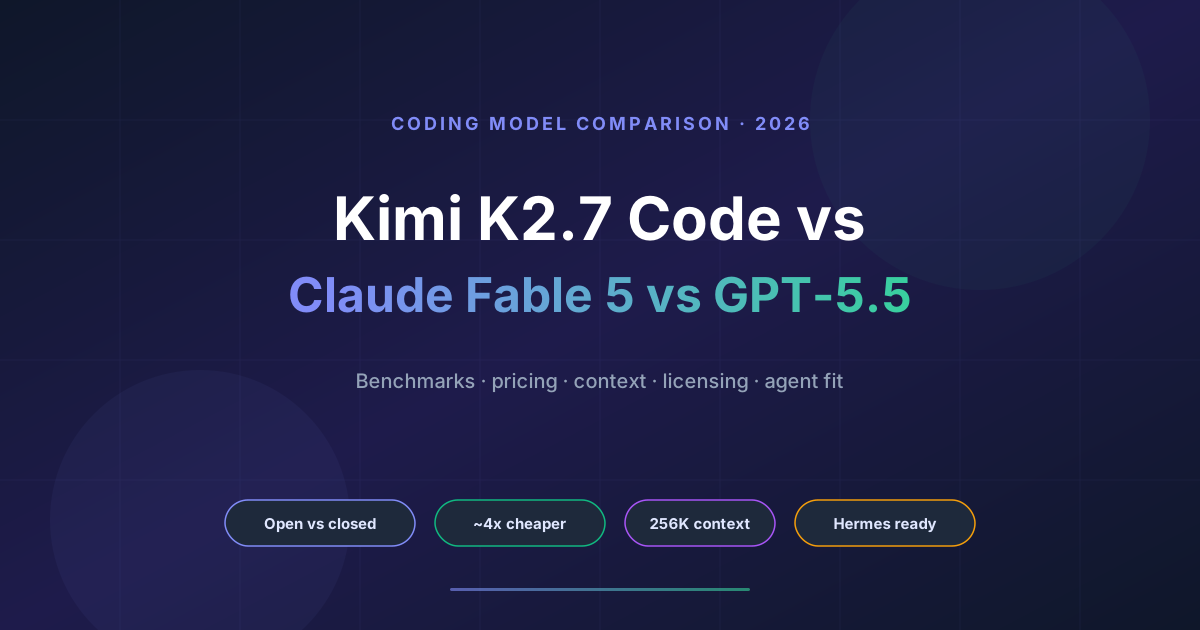
Choosing a coding model in 2026 is no longer a question of capability alone. The frontier closed models from Anthropic and OpenAI are excellent, but they are priced like premium infrastructure. Then there is Kimi K2.7 Code, an open-weight model from Moonshot AI that ships with published weights, a 256K context window, and token pricing that undercuts the closed frontier by a wide margin. This comparison puts the numbers first.
We will compare Kimi K2.7 Code against Claude Fable 5 (Anthropic) and GPT-5.5 (OpenAI) across pricing, architecture, coding benchmarks, licensing, and agentic capability. We have verified exact figures for Kimi K2.7 Code and cite them precisely. For the two closed frontier models we describe their positioning qualitatively rather than inventing token prices or benchmark scores, because those numbers change often and a wrong figure is worse than no figure.
If you want a deeper single-model walkthrough first, see our Kimi K2.7 Code developer guide or our Claude Fable 5 developer guide.
📋 What This Comparison Covers
1The Three Contenders at a Glance
Before the deep dive, here is the high-level picture. The single most important structural difference is openness: Kimi K2.7 Code is an open-weight model you can download and host, while Claude Fable 5 and GPT-5.5 are closed frontier models you can only reach through their vendors' paid APIs. That one fact shapes pricing, data control, and deployment flexibility for everything that follows.
| Attribute | Kimi K2.7 Code | Claude Fable 5 | GPT-5.5 |
|---|---|---|---|
| Vendor | Moonshot AI | Anthropic | OpenAI |
| License | Open weights, Modified MIT | Closed, proprietary API | Closed, proprietary API |
| Self-host | Yes, weights on Hugging Face | No | No |
| Output token price | $4.00 / M (Moonshot) | Premium frontier rate | Premium frontier rate |
| Context window | 256K tokens | Large frontier context | Large frontier context |
| Released | June 12, 2026 | Current frontier release | Current frontier release |
💡 The Headline
All three are strong coding models. The real decision is structural: Kimi K2.7 Code trades a managed frontier experience for open weights, lower token cost, and full data control. Claude Fable 5 and GPT-5.5 trade that openness for a polished, fully managed frontier API.
2Pricing: Open Source vs Frontier
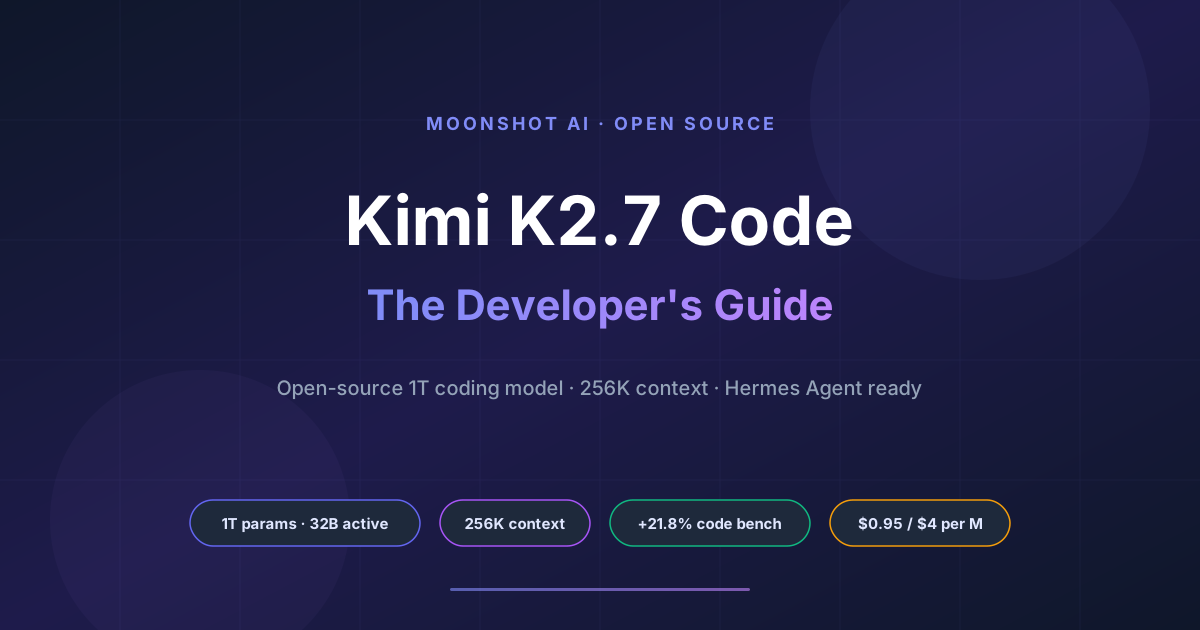
Pricing is where the gap is most concrete. On the Moonshot API, Kimi K2.7 Code costs $0.95 per million input tokens, $4.00 per million output tokens, and $0.19 per million cache-hit tokens. Those are the exact published rates. The cache-hit price in particular is striking, because long agentic coding sessions reuse a lot of context, and at $0.19 per million tokens that reused context is nearly free.
| Token type | Kimi K2.7 Code (Moonshot) | Closed frontier models |
|---|---|---|
| Input | $0.95 / M | Premium frontier rate |
| Output | $4.00 / M | Premium frontier rate |
| Cache hit | $0.19 / M | Varies by vendor |
Claude Fable 5 and GPT-5.5 are premium frontier models priced well above this. We are deliberately not quoting exact competitor dollar figures here, because frontier API pricing shifts frequently and publishing a stale number would mislead you. As a general statement, Kimi K2.7 Code is roughly four times cheaper on output tokens than typical frontier closed models. For high-volume coding workloads, where output tokens dominate the bill, that multiplier compounds fast.
There is a second cost lever that the closed models cannot match. Because Kimi K2.7 Code is open-weight, you can self-host it and pay for GPU time instead of per-token API fees. At sufficient volume, a self-hosted deployment removes the per-token cost entirely and replaces it with a fixed infrastructure bill. That is a structural option Claude Fable 5 and GPT-5.5 simply do not offer, since neither can be downloaded.
If you want the full cost model, including when self-hosting actually beats the API, see our Kimi K2.7 Code cost optimization and token efficiency guide.
3Architecture & Context Windows
Kimi K2.7 Code uses a Mixture-of-Experts (MoE) architecture with 1 trillion total parameters but only 32 billion active per token. That design is what makes a model this large economical to serve: each token routes through a small slice of the network, so you get the knowledge capacity of a trillion-parameter model at the inference cost of a much smaller dense model. It is multimodal across text and vision, and it runs in an always-on thinking mode.
The context window is 256K tokens, which comfortably holds large codebases, long agent trajectories, and extended multi-file edits in a single session. Claude Fable 5 and GPT-5.5 are also built for large context and long reasoning chains, and both are strong here. The practical point is that 256K tokens is firmly in frontier territory, so context length is unlikely to be the deciding factor between these three.
💡 Why Active Parameters Matter
With 32 billion active parameters out of 1 trillion total, Kimi K2.7 Code activates roughly 3 percent of its weights per token. This sparse activation is the reason an open model of this scale can be served at $4.00 per million output tokens rather than at frontier-API prices.
4Coding Benchmarks & What They Mean
Moonshot published Kimi K2.7 Code's gains relative to its previous K2.6 release, and the jumps are large. These are the verified, generation-over-generation improvements, not cross-vendor comparisons.
| Benchmark | Gain vs K2.6 |
|---|---|
| Kimi Code Bench v2 | +21.8% |
| Program Bench | +11.0% |
| MLS Bench Lite | +31.5% |
Alongside those accuracy gains, Kimi K2.7 Code uses about 30 percent fewer thinking tokens than K2.6. That is a rare combination: it scores higher while spending less on its own reasoning. For an always-thinking model, fewer thinking tokens directly lowers the cost and latency of every request, which matters a great deal in agentic loops that call the model hundreds of times.
Claude Fable 5 and GPT-5.5 are widely regarded as top-tier coding models, with strong reputations for code quality, instruction following, and reliable tool use. We are describing that strength qualitatively on purpose. Cross-vendor benchmark leaderboards move week to week, methodology differs between labs, and a specific score we quoted today could be wrong tomorrow. The honest summary is that all three are genuinely strong, and the right move is to benchmark them on your own tasks rather than trusting any single published number.
💡 Benchmark Reality Check
A model that wins a public leaderboard can still lose on your codebase. Build a small evaluation set from your real tickets and pull requests, run all three models against it, and weight the results by cost. That number is the only one that should drive your decision.
5Licensing & Data Control
Kimi K2.7 Code ships under a Modified MIT license with open weights published on Hugging Face as moonshotai/Kimi-K2.7-Code. You can download the weights, inspect them, fine-tune them, and run them inside your own network. For teams in regulated industries, this is decisive: code and prompts never have to leave your infrastructure, which sidesteps a whole category of data-residency and confidentiality concerns.
Claude Fable 5 and GPT-5.5 are closed models served only through Anthropic and OpenAI. Both vendors offer enterprise data protections, and for many teams those protections are sufficient. But the model itself is a black box you cannot download, audit at the weight level, or run air-gapped. Your data flows to the vendor's servers, even when contractual guarantees restrict how it is used.
| Data control dimension | Kimi K2.7 Code | Closed frontier models |
|---|---|---|
| Run air-gapped | Yes | No |
| Fine-tune on your data | Yes, you hold the weights | Vendor-mediated only |
| Inspect model weights | Yes | No |
| Data leaves your network | Only if you choose the API | Always |
The Modified MIT license is permissive enough for commercial use, which means the open-weight advantage is not just theoretical. You can build a product on top of Kimi K2.7 Code without negotiating a model license, and you keep the option to migrate between self-hosting and the API as your volume changes.
6Agentic & Long-Horizon Capability
Coding in 2026 is increasingly agentic. The model does not just write a function, it plans a change, edits multiple files, runs tests, reads the failures, and iterates. That long-horizon loop rewards two things: a large context window to hold the working state, and cheap, token-efficient reasoning so that hundreds of iterations do not become prohibitively expensive.
Kimi K2.7 Code is well suited to this pattern. Its 256K context holds a long trajectory, its always-on thinking mode is built for multi-step reasoning, and the roughly 30 percent reduction in thinking tokens versus K2.6 keeps the per-iteration cost down. Combined with the $0.19 per million cache-hit price, a long agent session that re-reads the same files repeatedly stays cheap.
Claude Fable 5 and GPT-5.5 are also designed for agentic workflows and have mature tool-use behavior. The trade-off returns to economics: on a long-horizon task that burns large volumes of output and reasoning tokens, the frontier models deliver excellent results at premium cost, while Kimi delivers strong results at a fraction of the token price. For a hands-on autonomous setup, see our Kimi K2.7 Code and Hermes Agent autonomous coding setup guide.
7Running Each Model in Hermes Agent
One of the cleanest ways to compare these models in practice is to run them through the same agent. Hermes Agent from Nous Research is a provider-agnostic, self-improving terminal AI agent. Because it speaks the OpenAI-compatible API format, it can point at Moonshot, Anthropic, OpenAI, or OpenRouter without any change to your workflow. You switch providers with the hermes model command.
For Kimi K2.7 Code, point Hermes at the Moonshot endpoint using the model id kimi-k2.7-code, or reach it through OpenRouter with the id moonshotai/kimi-k2.7-code:
# Kimi K2.7 Code via Moonshot (OpenAI-compatible)
export OPENAI_BASE_URL="https://api.moonshot.ai/v1"
export OPENAI_API_KEY="your-moonshot-key"
hermes model kimi-k2.7-code

# Or reach Kimi through OpenRouter
export OPENAI_BASE_URL="https://openrouter.ai/api/v1"
export OPENAI_API_KEY="your-openrouter-key"
hermes model moonshotai/kimi-k2.7-code
Switching to a closed frontier model is the same pattern with a different base URL, key, and model id. Point Hermes at the Anthropic or OpenAI endpoint and select the model you want:
# Switch the provider, keep the same agent
# Claude Fable 5 (Anthropic)
export OPENAI_BASE_URL="https://api.anthropic.com/v1"
export OPENAI_API_KEY="your-anthropic-key"
hermes model claude-fable-5

# GPT-5.5 (OpenAI)
export OPENAI_BASE_URL="https://api.openai.com/v1"
export OPENAI_API_KEY="your-openai-key"
hermes model gpt-5.5

# Or route all three behind one OpenRouter key
export OPENAI_BASE_URL="https://openrouter.ai/api/v1"
hermes model moonshotai/kimi-k2.7-code
💡 Why This Matters for Comparison
Running all three models through one agent means the harness, prompts, and tools are identical, so any difference you observe comes from the model itself. It also makes a hybrid strategy trivial: route high-volume work to Kimi K2.7 Code and switch to a frontier model for specific tasks, all from the same terminal.
8Decision Framework: Which One Should You Pick
There is no single winner here, because the three models optimize for different things. Use the following framework to map your priorities to a choice.
- Pick Kimi K2.7 Code when token cost, data control, or the ability to self-host is a top priority. It is open-weight, cheap per token, and the only one of the three you can run inside your own network.
- Pick Claude Fable 5 or GPT-5.5 when you want a fully managed frontier API, a polished vendor ecosystem, and are willing to pay premium rates for it. These are excellent models with mature tooling.
- Run a hybrid when you have both high-volume and high-stakes work. Route the bulk of your coding traffic to Kimi K2.7 Code for cost, and reserve a frontier model for the specific tasks where you want it.
| If your priority is... | Lean toward |
|---|---|
| Lowest token cost at scale | Kimi K2.7 Code |
| Data never leaving your network | Kimi K2.7 Code (self-hosted) |
| Fully managed frontier API | Claude Fable 5 or GPT-5.5 |
| Both cost and frontier quality | Hybrid via Hermes Agent |
Whatever your starting hypothesis, validate it with your own evaluation set. The cheapest model that clears your quality bar on your real tasks is the right answer, and that is usually a question only your codebase can settle.
9Why Lushbinary
Choosing a coding model is the easy part. Wiring it into a production workflow, controlling cost, and keeping data inside the right boundary is where teams get stuck. Lushbinary builds production AI integrations end to end, from model selection and agent setup to self-hosting and cost optimization on AWS.
Here is what we bring to a model evaluation and rollout:
- Workload benchmarking: we build an evaluation set from your real tickets and run Kimi K2.7 Code, Claude Fable 5, and GPT-5.5 against it, weighted by cost.
- Self-hosting and infrastructure: we deploy open weights on AWS with the right GPU sizing, autoscaling, and monitoring so the economics actually work.
- Hybrid routing: we design provider-agnostic agent setups that route each task to the most cost-effective model.
- Data control and compliance: we keep sensitive code inside your network where your policies require it.
🚀 Free Consultation
Not sure whether to go open-weight, frontier API, or hybrid? Book a free consultation and we will benchmark the options against your real workload and recommend the most cost-effective coding model for your stack. No obligation.
Ready to Build Something Great?
Get a free 30-minute strategy call. We'll map out your project, timeline, and tech stack - no strings attached.
Prefer email? Reach us directly:
Contact Us
❓ Frequently Asked Questions
How much cheaper is Kimi K2.7 Code than Claude Fable 5 and GPT-5.5?
Kimi K2.7 Code is priced on the Moonshot API at $0.95 per million input tokens, $4.00 per million output tokens, and $0.19 per million cache-hit tokens. Claude Fable 5 and GPT-5.5 are premium closed frontier models accessed through paid APIs at meaningfully higher token rates. On output tokens Kimi is roughly four times cheaper than typical frontier closed models, and because it is open-weight under a Modified MIT license you can also self-host to remove per-token API cost entirely. Always confirm current competitor pricing on the vendor's website.
What is the context window and architecture of Kimi K2.7 Code?
Kimi K2.7 Code is a Mixture-of-Experts model with 1 trillion total parameters and 32 billion active parameters per token. It has a 256K token context window, is multimodal across text and vision, and runs in an always-on thinking mode. It uses roughly 30 percent fewer thinking tokens than the previous K2.6 release, which lowers the cost of its reasoning.
Is Kimi K2.7 Code really open source?
Yes. Kimi K2.7 Code was released by Moonshot AI on June 12, 2026 with open weights under a Modified MIT license, published on Hugging Face as moonshotai/Kimi-K2.7-Code. You can download the weights and run them on your own infrastructure. Claude Fable 5 and GPT-5.5 are closed models available only through their vendors' APIs, so you cannot download or self-host them.
Can I use all three models in Hermes Agent?
Yes. Hermes Agent from Nous Research is provider-agnostic and works with any OpenAI-compatible endpoint. You can point it at Moonshot for Kimi K2.7 Code, at Anthropic for Claude Fable 5, at OpenAI for GPT-5.5, or at OpenRouter to reach all three behind one key. Use the hermes model command to switch providers without changing your workflow.
Which model should I pick for coding in 2026?
Pick Kimi K2.7 Code when cost, data control, and the ability to self-host matter most, since it is open-weight and far cheaper per token. Choose Claude Fable 5 or GPT-5.5 when you want a fully managed frontier API and are willing to pay premium rates for it. Many teams run a hybrid setup, routing high-volume coding work to Kimi and reserving the closed frontier models for specific tasks. Benchmark all three against your own workload before committing.
📚 Sources
- Hugging Face: moonshotai/Kimi-K2.7-Code
- Moonshot AI Platform and API Pricing
- OpenRouter: moonshotai/kimi-k2.7-code
- Nous Research: Hermes Agent on GitHub
Content was rephrased for compliance with licensing restrictions. Kimi K2.7 Code data sourced from Moonshot AI and Hugging Face as of June 2026. Competitor pricing and capabilities change frequently - always verify on the vendor's website.
Not Sure Which Model Fits Your Stack?
We will benchmark the options against your real workload and recommend the most cost-effective coding model.
Ready to Build Something Great?
Get a free 30-minute strategy call. We'll map out your project, timeline, and tech stack - no strings attached.
Prefer email? Reach us directly: