
Local food sales in the US are climbing steadily as consumers prioritize freshness, food miles, and knowing who grew their dinner. Existing platforms like Local Line, Farmigo, and Locally Grown serve this market well with fixed-price and pre-order models. None of them capture the real-time pricing dynamics that make produce sourcing actually efficient for both farmers and buyers.
Produce is uniquely suited to auction models. Harvest sizes vary. Shelf life is measured in days. Early-season strawberries and late-season squash have wildly different price elasticities. Restaurants pay premiums for first pick. A well-designed auction platform clears perishable inventory, captures premium pricing on scarce items, and reduces food waste, all while paying farmers better than a distributor ever will.
This guide covers how to build a farm-to-table produce auction platform: the multi-farm listing flow, Dutch and English auction mechanics, cold-chain logistics integration, certification verification, and the realistic cost and timeline to ship a production-ready MVP.
Table of Contents
- 1.The Farm-to-Table Market in 2026
- 2.Why Auctions Fit Produce Better Than Fixed Price
- 3.Gaps in Existing Platforms
- 4.Core Features for a Produce Auction MVP
- 5.Dutch vs English Auctions for Perishables
- 6.Cold-Chain Logistics & Pickup Flow
- 7.Organic & Regenerative Certification Verification
- 8.System Architecture & Tech Stack
- 9.Cost, Timeline & Revenue Model
- 10.Why Lushbinary for Your Farm Auction Platform
- 11.FAQ & Sources
1The Farm-to-Table Market in 2026
The local food ecosystem has matured into a structured market:
- Farmers market and local food e-commerce platforms (Local Line, Locally Grown, Farmigo, Homegrown) collectively serve thousands of small farms
- Typical platform fees range from 3% (Locally Grown) to $10-$300 per month flat fees (Homegrown, Local Line) plus payment processing
- Restaurant demand for traceable, local sourcing is growing alongside the farm-to-table dining movement
- Community Supported Agriculture (CSA) memberships are increasingly integrated with marketplace platforms for ad-hoc add-on purchases
2Why Auctions Fit Produce Better Than Fixed Price
Produce has four characteristics that make auctions the right mechanism:
- Variable supply: a farmer may have 15 quarts or 150 quarts of blueberries depending on weather and labor
- Perishability: unsold inventory at end of day loses 100% of value within 3-7 days
- Premium tiers: heirloom varieties, first-pick, and single-origin honey command 2-3x the commodity price when priced by competition
- Restaurant willingness to pay: chefs will pay premiums for first access and will fight for scarce lots
💡 The Dutch Auction for Perishables
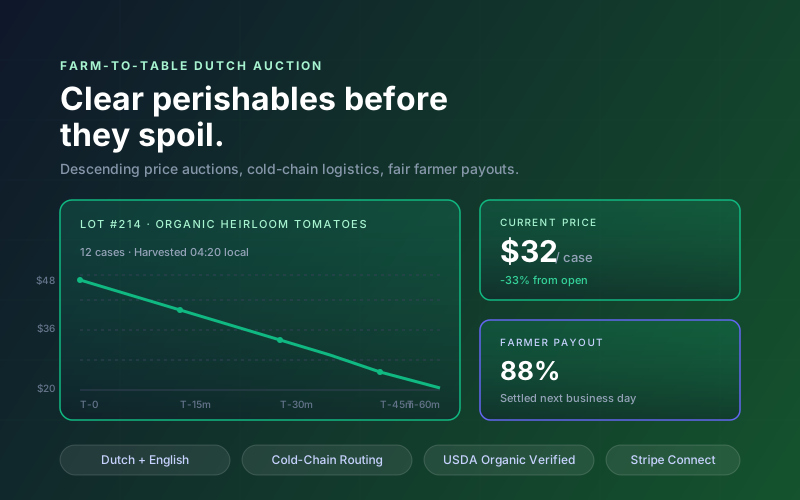
The Dutch flower auction (Royal FloraHolland) clears billions of euros of perishable product annually using descending-price auctions that settle in seconds. The same model applied to end-of-day produce can clear inventory that would otherwise be composted.
3Gaps in Existing Platforms
| Platform | Model | Gaps for Auctions |
|---|---|---|
| Local Line | DSD farm commerce, fixed-price | No auction format, no real-time price discovery |
| Locally Grown | Farmer network, 3% fees | Weekly fixed-price; no live bidding |
| Homegrown | $10/month starter | Built for micro-vendors, not multi-farm auctions |
| Market Wagon | Marketplace, 10-30% fees | High platform cut, no auction mechanics |
| FreshDirect / Misfits | National consumer delivery | No real local sourcing, no auction model |
Opportunity: the first platform to combine multi-farm auctions, cold-chain pickup logistics, and restaurant B2B integration wins a defensible niche in a growing market.
4Core Features for a Produce Auction MVP
Phase 1: Lean MVP (3 to 5 months)
Farm profile
Farm name, practices disclosure, certifications, photos, pickup address
Morning-of listing
Batch listing of available lots with quantity, unit, condition notes
Dutch auctions
Descending price for end-of-day perishables, auto-accept at floor
English auctions
Ascending price for premium heirloom and single-origin lots
Buyer accounts
Consumer, restaurant, grocer tiers with verified business info
Pickup scheduling
Time-slot booking at farm hub or aggregation point
Payment capture
Card authorized at bid, captured at auction close via Stripe
Waste tracking
Per-farm dashboard of cleared vs unsold inventory for planning
Phase 2: Differentiation (2 to 3 months)
- Cold-chain delivery via Onfleet or Bringg with temperature logging
- Restaurant B2B portal: standing orders, credit terms, chef-friendly search filters
- CSA box integration: auction-won items roll into weekly CSA customization
- Harvest calendar: buyer-visible planting schedule so chefs can plan menus 4-8 weeks ahead
- Yield prediction: ML-based forecast from historical plot data and weather APIs
Phase 3: AI & Scale (2 to 3 months)
- AI recipe suggestions: buyer sees recipe ideas for the produce in their cart
- Dynamic pricing floor: ML-recommended reserve price from historical clearing data
- Multi-hub federation: network of farm clusters in different regions with unified buyer accounts
- Native mobile apps: push notifications for harvest drops and auction closes
5Dutch vs English Auctions for Perishables
The two mechanics serve different scenarios. Your platform should support both and let the farmer choose per lot.
| Type | Best For | Mechanic |
|---|---|---|
| Dutch (descending) | End-of-day surplus, commodity lots, quick clearance | Start high, price drops every 30s until buyer accepts |
| English (ascending) | Premium heirloom, first-pick, limited-run specialty | Start low, bidders compete up, anti-sniping extension |
| Sealed-bid | Wholesale contracts for restaurants on standing needs | Buyers submit hidden bids, highest wins, tied prices resolved by commitment size |
6Cold-Chain Logistics & Pickup Flow
Fresh produce has three logistics models to support. Most platforms ship all three:
- Farm pickup: buyer picks up at farm during scheduled window, simplest and cheapest
- Aggregation hub: farms deliver to central cold room, buyers pick up same or next day
- Cold-chain delivery: third-party courier with refrigerated bags or truck, for restaurants or premium consumers
⚠️ HACCP Compliance
If your platform handles the cold chain (not just farm pickup), you need Hazard Analysis and Critical Control Points logging. Temperature sensors at hubs and in delivery vehicles, with records retained per local food safety rules, typically FSMA for US platforms.
7Organic & Regenerative Certification Verification
Certification trust is what separates a serious farm platform from a generic marketplace. Integrate with or verify:
- USDA Organic: farm-level certification with public certifier lookup
- Certified Naturally Grown: peer-review certification for smaller farms
- Regenerative Organic Certified (ROC): higher-tier certification with soil health and animal welfare
- Animal Welfare Approved / Certified Humane: for meat, dairy, and eggs
- Transparent Practices: for uncertified small farms, show farming methods with photos and farm-visit documentation
8System Architecture & Tech Stack
| Layer | Stack |
|---|---|
| Frontend | Next.js 15 + React 19 + Tailwind 4 |
| Auction engine | Node.js 22 + Socket.IO 4.8 with Redis adapter |
| Dutch timer | Redis sorted sets + Bull queue for price-drop ticks |
| Database | PostgreSQL 17 on AWS RDS |
| Cache / Pub-Sub | Redis 7 on AWS ElastiCache |
| Payments | Stripe Connect Express with pre-auth holds |
| Logistics | Onfleet or Bringg for delivery, Twilio for driver comms |
| Weather & yield | OpenWeatherMap API + USDA Agricultural Data |
| Certifications | USDA Organic Integrity Database (OID) API |
| Hosting | AWS ECS Fargate + CloudFront + S3 |
9Cost, Timeline & Revenue Model
| Scope | Timeline | Cost Range |
|---|---|---|
| Lean MVP (multi-farm listings, English auctions, pickup) | 3 to 5 months | $40K to $75K |
| Mid (Dutch auctions, cold-chain delivery, B2B portal) | 5 to 7 months | $85K to $140K |
| Full (multi-hub, ML pricing, mobile apps) | 8 to 11 months | $160K to $250K |
| Hosting & support | Per month | $900 to $2,800 |
Revenue model: 5-10% platform commission on cleared lots, $50-$200 per month flat fee for farm accounts with unlimited listings, and optional premium features like restaurant directory placement.
10Why Lushbinary for Your Farm Auction Platform
Produce auctions combine real-time bidding, marketplace payments, and logistics, which maps directly to our existing engineering playbook. See our live auction case study for our approach to real-time bidding at scale.
What we bring:
- Dutch and English auction engines tuned for low-latency and fair clearing
- Stripe Connect marketplace payments with pre-authorization holds for bid commitment
- Cold-chain logistics integrations with Onfleet, Bringg, or custom driver apps
- USDA Organic Integrity Database and certifier API integrations for verified trust badges
- AWS infrastructure sized for spiky daily auction close traffic
🚀 Free Farm Platform Consultation
Thinking about a farm-to-table auction platform for your cooperative, food hub, or restaurant group? Lushbinary offers a free scoping call to discuss your market, pilot farms, and logistics model with no obligation.
❓ Frequently Asked Questions
Why use auctions for farm-to-table produce instead of fixed-price?
Produce has variable supply, perishability, and premium tiers. Dutch auctions clear end-of-day perishables; English auctions capture premium pricing on scarce items like heirloom tomatoes.
What does it cost to build a produce auction platform?
$40K to $75K for a lean MVP over 3 to 5 months. $110K to $200K for a full B2B/B2C platform with cold-chain and subscriptions.
How do you handle cold-chain logistics?
Hub-and-spoke with morning farm drop-off and same-day buyer pickup, or third-party cold-chain couriers like Onfleet/Bringg for delivery.
Can small farms benefit from an auction platform?
Yes. Dutch clearing prevents waste and competitive English bidding on premium lots can capture 20-40% above wholesale.
How do you verify organic or regenerative farming claims?
Integrate with USDA Organic Integrity Database, Certified Naturally Grown, and ROC; display certificate ID and expiration on each listing.
Sources
- Local Line commerce platform
- Locally Grown farmers market platform
- Homegrown 2026 platform comparison
- USDA Organic Integrity Database
- FDA HACCP Guidance
Content was rephrased for compliance with licensing restrictions. Platform pricing and regulatory data sourced from official vendor and agency pages as of May 2026. Fees and compliance rules may change, always verify directly.
Build a Farm-to-Table Auction Platform That Pays Farmers Fairly
Tell us about your region, farms, and buyer base. We will scope the MVP, recommend the right auction mechanics, and share a realistic timeline with no obligation.
Ready to Build Something Great?
Get a free 30-minute strategy call. We'll map out your project, timeline, and tech stack - no strings attached.
Prefer email? Reach us directly: