
The AI design tools market is projected to hit $4.5 billion by 2026, growing at 28% year-over-year. Anthropic's Claude Design launched on April 17, 2026 and immediately positioned itself against Figma (80–90% UI/UX market share) and Canva (265M+ monthly active users). Teams at Brilliant reported reducing complex page prototyping from 20+ prompts to just 2.
But Claude Design has clear gaps: no free tier, no Figma export, no plugin ecosystem, and Enterprise requires admin opt-in. Users on Reddit and Product Hunt are asking for offline support, more granular design controls, and open-source alternatives. There's a real opportunity to build a competing product that addresses these pain points.
This guide covers the business model, architecture, tech stack, AI integration, and development costs for building an AI-powered design tool that competes with Claude Design. Whether you're a startup founder or an enterprise team, here's your blueprint.
📑 Table of Contents
- What Makes Claude Design Successful
- Revenue Model & Pricing Analysis
- User Complaints & Market Gaps
- Core Features for an MVP
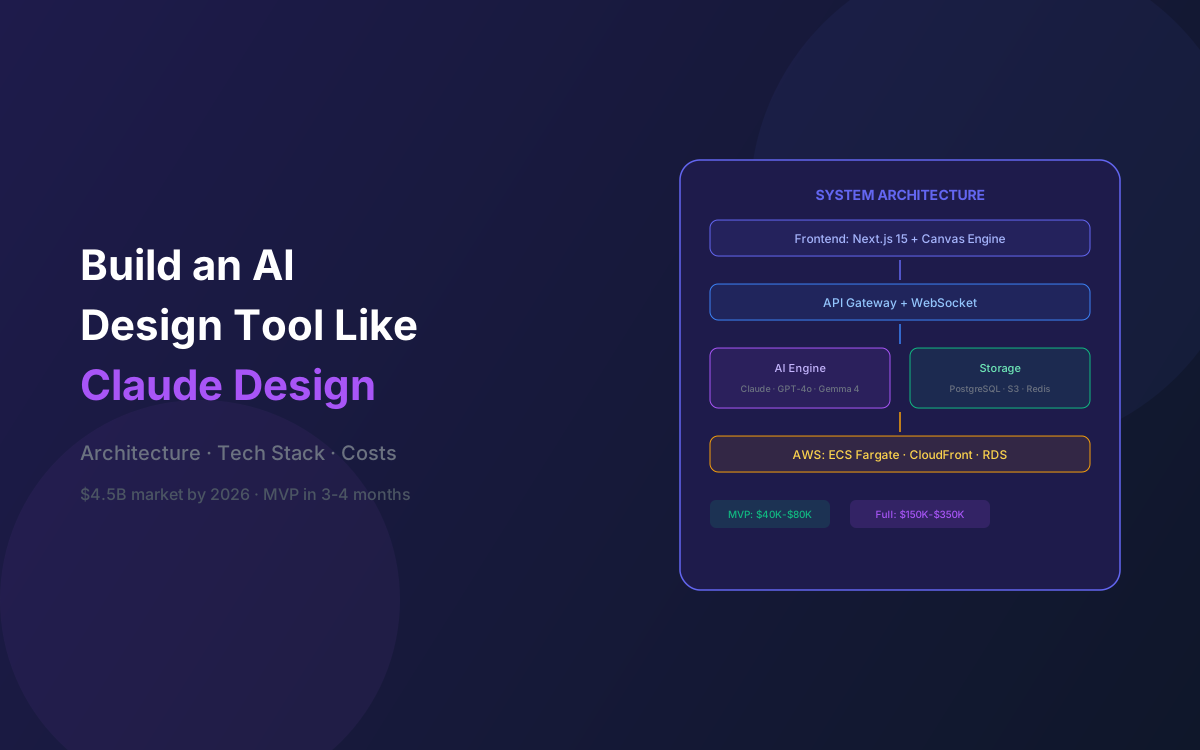
- System Architecture & Tech Stack
- AI-Powered Features That Differentiate
- Development Cost & Timeline
- Why Lushbinary for Your AI Design Tool MVP
1What Makes Claude Design Successful
Claude Design's success comes from several strategic decisions:
- Bundled pricing — Included with existing Claude subscriptions (Pro $20/mo, Max $100-$200/mo, Team $25-$30/seat/mo). No separate purchase needed. This instantly gives it access to Claude's entire paid user base.
- Opus 4.7 vision model — Powered by Anthropic's most capable model with 3.75 megapixel image understanding. This gives it a design comprehension advantage that competitors can't easily replicate.
- Multi-format output — Unlike tools that focus on one output type (Figma → UI, Canva → marketing), Claude Design produces prototypes, decks, wireframes, marketing assets, and frontier designs from a single interface.
- Design-to-code pipeline — The Claude Code handoff creates a unique end-to-end AI workflow that no competitor offers. Design intent is preserved from prototype to production.
- Automatic design systems — Reads your codebase and design files during onboarding to build a brand-consistent design system. Every project uses your colors, typography, and components automatically.
- Canva partnership — Launch-day integration with Canva (265M+ users) for export and final editing. Smart positioning as complementary rather than competitive.
2Revenue Model & Pricing Analysis
Claude Design uses a bundled subscription model rather than standalone pricing. Here's how the economics work:
| Plan | Price | Design Access | Metering |
|---|---|---|---|
| Pro | $20/mo | Included | Own weekly limits |
| Max 5x | $100/mo | Included | Higher weekly limits |
| Max 20x | $200/mo | Included | Highest limits |
| Team | $25-$30/seat | Included | Per-seat allowance |
| Enterprise | Custom | Admin opt-in | Custom + extra usage |
For a competing product, consider these pricing strategies:
- Freemium — Free tier with limited generations (5-10/week) to build user base. Pro at $15-$25/mo for unlimited generations. This addresses Claude Design's biggest gap: no free tier.
- Usage-based — Pay per design generation ($0.10-$0.50 per generation depending on complexity). Appeals to occasional users who don't want a subscription.
- Team + Enterprise — $10-$20/seat/mo for teams with shared design systems, collaboration, and admin controls. Undercut Claude's $25-$30/seat Team pricing.
3User Complaints & Market Gaps
Based on early user feedback from Reddit, Product Hunt, and review sites, here are the key pain points with Claude Design and the broader AI design tool market:
⚠️ No free tier
Requires $20/mo minimum. Google Stitch is free. Canva has a generous free tier. Many users want to try before committing.
⚠️ No Figma export
Teams using Figma as their source of truth can't import Claude Design output. Google Stitch exports to Figma; Claude Design doesn't.
⚠️ Weekly usage limits
Heavy users hit limits quickly, especially on Pro plans. No way to buy one-off generations without upgrading to Max.
⚠️ No plugin ecosystem
Figma has 2,000+ plugins. Claude Design has zero third-party extensions. No way to extend functionality.
⚠️ Enterprise friction
Off by default for Enterprise orgs. Admins must enable it. Slow rollout frustrates teams eager to adopt.
⚠️ Limited offline support
Fully cloud-dependent. No offline mode for working on planes, in areas with poor connectivity, or for data-sensitive work.
⚠️ No version control
Conversation-based history, not true version control. Can't branch, diff, or merge design iterations like in Figma.
⚠️ Vendor lock-in
Designs live in Claude's ecosystem. If you cancel your subscription, access to designs is unclear. No open format export.
4Core Features for an MVP
Phase 1: Lean MVP (3-4 months)
- Text-to-design generation using LLM API (Claude or GPT-4o)
- Canvas editor with basic element manipulation (move, resize, edit text)
- Conversational refinement (chat-based iteration on designs)
- Single-format export (HTML or PNG)
- User authentication and project management
- Free tier with 10 generations/week
Phase 2: Differentiation (3-4 months)
- Multi-format export (Figma, Canva, PPTX, PDF, HTML, React/Tailwind)
- Design system import and auto-application
- Real-time collaboration (multiplayer editing, not just group chat)
- Version history with branching and diffing
- Plugin/extension API for third-party integrations
- Image upload and reference-based generation
Phase 3: AI & Scale (4-6 months)
- Multi-model support (Claude, GPT-4o, Gemini, open-source models)
- AI code handoff (generate React/Vue/Swift code from designs)
- Voice input for design commands
- Offline mode with local model inference
- Enterprise features (SSO/SCIM, audit logs, data residency)
- Marketplace for community design templates and plugins
5System Architecture & Tech Stack
Recommended Tech Stack
| Layer | Technology | Why |
|---|---|---|
| Frontend | Next.js 15 + React 19 | SSR, App Router, server components for fast initial load |
| Canvas | Fabric.js or Konva.js | Mature canvas libraries with object manipulation, export, and event handling |
| Real-time | Socket.IO v4.8 + Redis adapter | WebSocket collaboration with horizontal scaling via Redis pub/sub |
| Backend | Node.js 22 + Express/Fastify | TypeScript end-to-end, streaming AI responses, WebSocket support |
| AI Models | Claude API + GPT-4o + Gemma 4 | Multi-model routing: Claude for complex, GPT-4o for fast, Gemma 4 for cost |
| Database | PostgreSQL 17 | JSONB for flexible design metadata, strong consistency, proven at scale |
| Cache | Redis 7 | Session state, real-time collaboration state, rate limiting |
| Storage | S3 + CloudFront | Design assets, exported files, CDN for global delivery |
| Vector DB | pgvector or Pinecone | Design system similarity search, template matching |
| Infra | AWS ECS Fargate | Serverless containers, auto-scaling, no server management |
| CI/CD | GitHub Actions | Automated testing, deployment, and preview environments |
6AI-Powered Features That Differentiate
To compete with Claude Design, your AI features need to go beyond basic text-to-design generation:
🧠 Multi-Model Design Generation
Route design requests to the optimal model: Claude Opus 4.7 for complex layouts, GPT-4o for fast iterations, Gemma 4 for cost-sensitive batch generation. This hybrid approach can reduce AI costs by 60-80% compared to using a single premium model.
🎨 Design System Intelligence
Go beyond Claude Design's auto-import. Use vector embeddings to understand design system relationships, suggest component reuse, and flag inconsistencies. Train on the team's design history to predict preferred patterns.
📐 Figma + Canva Bidirectional Sync
Claude Design exports to Canva but not Figma. Build bidirectional sync with both platforms. Import from Figma, export to Figma. This alone addresses the #1 user complaint.
🔌 Plugin API & Marketplace
Launch with an extension API from day one. Let developers build custom export formats, AI model integrations, and design system connectors. Figma's 2,000+ plugins are a moat - start building yours early.
📱 Offline Mode with Local AI
Use Gemma 4 or Qwen 3.6 running locally via Ollama for basic design generation offline. Sync when back online. This addresses data-sensitive enterprise use cases and travel scenarios.
🔄 True Version Control
Git-like branching and merging for designs. Diff visual changes between versions. This is a gap in both Claude Design (conversation-based history) and Canva (basic version history).
7Development Cost & Timeline
| Component | MVP Cost | Full Platform |
|---|---|---|
| Frontend + Canvas Editor | $12K–$25K | $40K–$80K |
| AI Design Engine | $10K–$20K | $35K–$70K |
| Backend + API | $8K–$15K | $25K–$50K |
| Export System | $3K–$5K | $15K–$30K |
| Collaboration | $5K–$10K | $20K–$40K |
| Design System Mgmt | - | $15K–$30K |
| Plugin API | - | $10K–$25K |
| Infrastructure + DevOps | $2K–$5K | $10K–$25K |
| Total | $40K–$80K | $150K–$350K |
| Phase | Timeline | Team Size | Deliverables |
|---|---|---|---|
| MVP | 3–4 months | 3–4 devs | Text-to-design, canvas editor, basic export, free tier |
| Differentiation | 3–4 months | 4–5 devs | Multi-format export, collaboration, design systems, plugins |
| AI & Scale | 4–6 months | 5–7 devs | Multi-model, code handoff, voice, offline, enterprise |
8Why Lushbinary for Your AI Design Tool MVP
Lushbinary has deep experience building AI-powered SaaS products with the exact tech stack needed for an AI design tool:
- Multi-model AI integration (Claude, GPT-4o, Gemma 4, open-source models via Ollama)
- Real-time collaboration systems with WebSocket and Redis
- Next.js and React frontend development with canvas-based editors
- AWS infrastructure (ECS Fargate, S3, CloudFront, RDS) for production-grade deployment
- Export pipeline development (PDF, PPTX, HTML, Figma/Canva integration)
🚀 Free Consultation
Want to build an AI design tool that competes with Claude Design? Lushbinary specializes in AI-powered SaaS MVPs. We'll scope your project, recommend the right tech stack, and give you a realistic timeline — no obligation.
❓ Frequently Asked Questions
How much does it cost to build an AI design tool like Claude Design?
A lean MVP costs $40K-$80K over 3-4 months. A full-featured platform with collaboration, multi-format export, and AI code handoff costs $150K-$350K over 8-14 months.
What tech stack is needed to build an AI design tool?
Next.js 15 + canvas engine (Fabric.js/Konva) for frontend, Node.js 22 backend, Claude API + GPT-4o for AI, PostgreSQL + S3 + Redis for storage, AWS ECS Fargate for infrastructure.
What makes Claude Design successful as a product?
Bundled pricing with Claude subscriptions, Opus 4.7 vision model, multi-format output, Claude Code handoff pipeline, automatic design systems, and Canva launch partnership.
Can I build a Claude Design alternative with open-source models?
Partially. Gemma 4 or Qwen 3.6 handle basic design understanding. A hybrid approach (open-source for simple tasks, API models for complex generation) reduces AI costs by 60-80%.
How long does it take to build an MVP design tool?
3-4 months for a focused MVP with text-to-design, canvas editing, and single-format export. 8-14 months for a full platform with collaboration and multi-model support.
📚 Sources
- Introducing Claude Design — Anthropic
- 12 Best AI Design Tools in 2026 — SimilarLabs ($4.5B market projection)
- Claude Design vs Figma & Canva Market Analysis — WinBuzzer
- Claude Design Pricing & Usage — Claude Support
Content was rephrased for compliance with licensing restrictions. Market data sourced from industry reports and official vendor pages as of April 2026. Pricing and features may change — always verify on the vendor's website.
Ready to Build Your AI Design Tool?
From MVP to full platform — Lushbinary builds AI-powered SaaS products that compete. Get a free project scope and timeline.
Ready to Build Something Great?
Get a free 30-minute strategy call. We'll map out your project, timeline, and tech stack - no strings attached.
Prefer email? Reach us directly: