
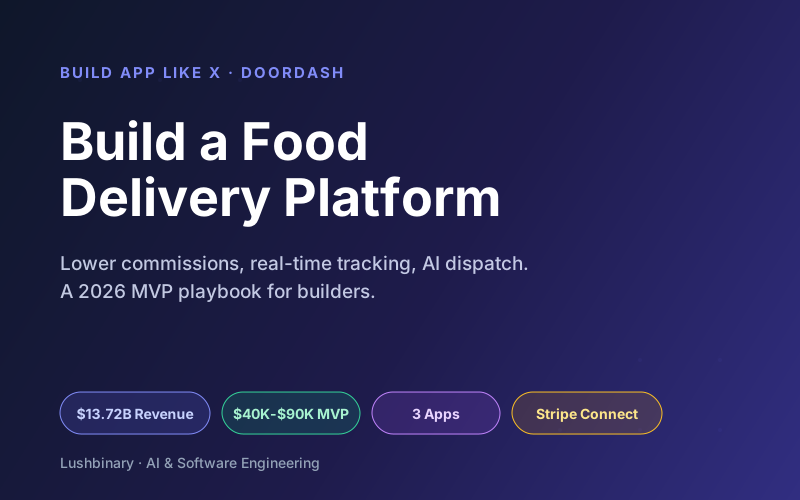
DoorDash closed 2025 with $13.72 billion in revenue, up roughly 28% year over year, and processed nearly $29.7 billion in marketplace orders in the fourth quarter alone. It is the dominant on-demand delivery platform in the United States and now spans food, grocery, retail, and convenience. The on-demand delivery market it helped create is enormous, and it keeps expanding into new categories.
But DoorDash is far from beloved. Restaurants complain about commission rates that can reach 30% and erase already thin margins. Customers are tired of stacked delivery, service, and small-order fees. Drivers question how much they actually keep after gas and wear. Every one of those frustrations is a wedge a focused competitor can drive into - a single city, a cuisine vertical, or a commission-free model built for restaurants that want to own their customers.
This guide breaks down what makes DoorDash work, how it makes money, the gaps you can exploit, the features your MVP needs, the system architecture and tech stack, the AI capabilities that can set you apart, realistic cost and timeline, and how Lushbinary can help you ship it.
📋 Table of Contents
- 1.What Makes DoorDash Successful
- 2.DoorDash’s Revenue Model & Economics
- 3.User Complaints & Market Gaps You Can Exploit
- 4.Core Features for a Delivery MVP
- 5.System Architecture & Tech Stack
- 6.AI-Powered Features That Differentiate
- 7.Development Cost & Timeline Breakdown
- 8.Why Lushbinary for Your Delivery MVP
1What Makes DoorDash Successful
DoorDash did not win by being first. It won by executing a tight, three-sided marketplace better than competitors and by going deep into suburban markets that rivals ignored. Three things drove that dominance.
Logistics, Not Just a Menu
The hard part of delivery is not showing restaurants. It is matching the right driver to the right order at the right moment, predicting food-ready times, and batching deliveries without making the food cold. DoorDash treats dispatch as a real-time optimization problem, and that operational edge is what keeps delivery times competitive at scale.
Suburban Density First
While competitors fought over dense urban cores, DoorDash built density in suburbs where car-based delivery economics work better and competition was thinner. That contrarian focus gave it a defensible base before it expanded everywhere.
Subscription Lock-In with DashPass
DashPass at $9.99/month removes per-order delivery fees and turns occasional users into habitual ones. A subscription that changes ordering behavior is one of the strongest retention levers in the entire delivery category.
| Metric | DoorDash |
|---|---|
| Full-Year 2025 Revenue | $13.72 billion (up ~28% Y/Y) |
| Q4 2025 Marketplace GOV | $29.7 billion (up 39% Y/Y) |
| Subscription | DashPass at $9.99/month |
| Restaurant Commission | ~15-30% per order |
| Founded | 2013, Palo Alto, California |
| Categories | Food, grocery, retail, convenience |
| Apps | Customer, Dasher (driver), Merchant |
2DoorDash's Revenue Model & Economics
DoorDash is a marketplace that monetizes every side of the transaction. Understanding these streams matters because your alternative needs at least two of them to be sustainable.
| Revenue Stream | How It Works |
|---|---|
| Restaurant Commissions | ~15-30% of each order, tiered by marketing and delivery options chosen |
| Customer Fees | Delivery fee, service fee, and small-order fee per checkout |
| DashPass Subscriptions | $9.99/month for reduced fees, drives repeat ordering |
| Advertising & Promotions | Sponsored listings and promotions paid by merchants |
| Commerce Platform | White-label online ordering and delivery-as-a-service tools |
💡 Revenue Opportunity
The fastest-growing wedge is white-label, commission-light delivery. Restaurant groups and grocers increasingly want to own their customer data and avoid 30% commissions. A platform that charges a flat monthly fee or low single-digit commission, plus a software subscription, can win merchants that resent the marketplace tax.
3User Complaints & Market Gaps You Can Exploit
We reviewed merchant, customer, and driver feedback across Reddit, app stores, and industry forums. The same pain points repeat, and each is a feature or positioning opportunity.
💸 Commissions Crush Margins
Restaurants routinely cite 15-30% commissions as the reason delivery is barely profitable. A low-commission or flat-fee model is the single most compelling pitch to merchants.
🧾 Fee Stacking for Customers
Delivery fee plus service fee plus small-order fee plus tip makes a $15 meal cost $28. Transparent, bundled pricing wins trust.
🍔 Quality & Missing Items
Cold food, wrong orders, and missing items are constant complaints. Better handoff verification and photo confirmation improve trust.
🎧 Weak Support
Customers and merchants report slow, scripted support. Fast, local, human-backed support is a real differentiator.
🚗 Thin Driver Earnings
Drivers question take-home pay after expenses. Transparent earnings and fairer payouts attract a more reliable fleet.
🏙️ Underserved Niches
Halal-only, regional cuisine, pharmacy, and rural delivery are underserved. Vertical focus beats trying to deliver everything.
💡 The Opportunity
You will not out-spend DoorDash on a national marketplace. You can win by going narrow: one city, one cuisine, or one merchant group, with lower commissions, transparent pricing, and tighter quality control. Density in a focused area beats thin coverage everywhere.
4Core Features for a Delivery MVP
A delivery platform is really three apps and a dispatch brain. Scope the MVP carefully or the project balloons.
Phase 1: Lean MVP (10-14 weeks)
- Customer App - Browse restaurants, menu, cart, checkout, live order tracking, and order history
- Driver App - Accept orders, turn-by-turn navigation, pickup and drop-off confirmation, earnings view
- Merchant Dashboard - Menu management, incoming order queue, accept and prep-time controls, payouts
- Real-Time Tracking - Live driver location via WebSockets and map updates for customers
- Payments - Card checkout and automatic split between platform, merchant, and driver via Stripe Connect
- Basic Dispatch - Assign the nearest available driver based on distance and current load
Phase 2: Differentiation (8-12 weeks)
- Order Batching - Combine nearby orders to improve driver efficiency without hurting delivery times
- Scheduled Orders - Let customers order ahead for a specific time slot
- Ratings & Photo Confirmation - Handoff photos and per-order ratings to enforce quality
- Promotions Engine - Merchant-funded discounts, first-order offers, and referral credits
- Subscription Tier - A DashPass-style plan that removes delivery fees for frequent customers
Phase 3: AI & Scale (10-14 weeks)
- Predictive Dispatch - Forecast food-ready times and pre-position drivers near high-demand merchants
- Demand Forecasting - Predict order volume by zone and hour to manage driver supply
- Dynamic ETAs - Machine-learned delivery estimates using traffic, prep time, and driver load
- Multi-City Operations - Zone management, surge handling, and per-market configuration
5System Architecture & Tech Stack
A delivery platform has three demanding requirements: real-time location at scale, low-latency dispatch decisions, and reliable split payments. Here is the architecture we recommend.
Recommended Tech Stack
| Layer | Technology | Why |
|---|---|---|
| Mobile | React Native or Flutter | Three apps from shared code, native performance for maps |
| Backend | Node.js or Go | Async I/O for live orders, Go for low-latency dispatch |
| Database | PostgreSQL + PostGIS | Geospatial queries for nearest-driver and zone logic |
| Realtime | Redis + WebSockets | Live order state and driver location streaming |
| Payments | Stripe Connect | Split payouts to merchants and drivers, subscriptions |
| Maps | Mapbox or Google Maps | Routing, ETAs, and turn-by-turn navigation |
| Cloud | AWS (ECS / Lambda) | Auto-scaling for surge, managed databases, queues |
| AI | Python services + open models | Demand forecasting, dynamic ETAs, predictive dispatch |
6AI-Powered Features That Differentiate
Dispatch and forecasting are where AI pays for itself in delivery. These are the capabilities that let a small platform run efficient operations.
🧠 Predictive Dispatch
Predict when food will be ready and assign drivers so they arrive just in time, cutting wait and keeping food hot.
📈 Demand Forecasting
Forecast order volume by zone and hour so you can incentivize enough drivers before the rush instead of reacting late.
⏱️ Dynamic ETAs
Machine-learned delivery estimates from traffic, prep time, and driver load that are more accurate than static estimates.
🍽️ Smart Recommendations
Personalized restaurant and dish suggestions based on order history, time of day, and local trends to lift basket size.
🛡️ Fraud & Anomaly Detection
Flag refund abuse, fake accounts, and suspicious order patterns in real time before they erode margins.
💬 AI Support Assistant
Resolve common issues like missing items or refunds instantly, escalating only edge cases to human agents.
7Development Cost & Timeline Breakdown
A delivery platform costs more than a typical app because it is three apps plus a real-time dispatch backend. Here is what to budget.
Get Detailed Cost Breakdown
Fill in your details to unlock pricing and cost information.
8Why Lushbinary for Your Delivery MVP
At Lushbinary, we build real-time, location-aware platforms and AI-powered mobile products for startups and enterprises. Here is what we bring to a delivery project:
- Real-time systems - We build WebSocket-based live tracking, dispatch engines, and geospatial backends that hold up under surge load
- Multi-app products - We ship coordinated customer, driver, and merchant apps from a shared React Native or Flutter codebase
- Split payments - We implement Stripe Connect payouts, subscriptions, and merchant ledgers with audit trails
- AI integration - We add demand forecasting, dynamic ETAs, and predictive dispatch using open and hosted models
- AI-accelerated delivery - We use AI coding tools to ship MVPs 30-40% faster without cutting quality
🚀 Free Consultation
Want to build a delivery platform that actually competes? Lushbinary specializes in real-time, AI-powered marketplaces. We'll scope your project, recommend the right tech stack, and give you a realistic timeline with no obligation.
❓ Frequently Asked Questions
How much does it cost to build a food delivery app like DoorDash?
An MVP with customer, driver, and merchant apps, real-time tracking, and payments costs $40,000-$90,000 over 10-14 weeks. A full platform with dispatch optimization and AI ranges from $120,000-$300,000.
How does DoorDash make money?
Restaurant commissions of ~15-30%, customer delivery and service fees, DashPass subscriptions at $9.99/month, merchant advertising, and a commerce platform. Full-year 2025 revenue was $13.72 billion.
What are the biggest complaints about DoorDash?
High restaurant commissions, stacked customer fees, missing or cold food, weak support, and thin driver earnings. Each is an opening for a leaner, more transparent competitor.
What tech stack should I use to build a delivery app like DoorDash?
React Native or Flutter for the three apps, Node.js or Go for the backend, PostgreSQL with PostGIS, Redis and WebSockets for real time, Stripe Connect for split payments, and AWS for hosting.
Can a new food delivery app compete with DoorDash?
Yes, by going narrow: one city, one cuisine vertical, grocery or pharmacy niches, lower commissions for restaurants, or white-label delivery for restaurant groups that want to own their customers.
📚 Sources
- DoorDash Q4 & Full-Year 2025 Financial Results - Revenue and GOV data
- Stripe Connect Documentation - Split payments and payouts
- DoorDash Newsroom - Product and economic impact reporting
Content was rephrased for compliance with licensing restrictions. Financial data sourced from official DoorDash investor releases as of early 2026. Commission and fee figures are industry estimates and may change - always verify on the vendor's website.
Build a Delivery Platform That Wins Your Market
Lower commissions, transparent pricing, real-time tracking, and AI-powered dispatch. Let Lushbinary build your DoorDash alternative for the niche you can own.
Ready to Build Something Great?
Get a free 30-minute strategy call. We'll map out your project, timeline, and tech stack - no strings attached.
Prefer email? Reach us directly: