
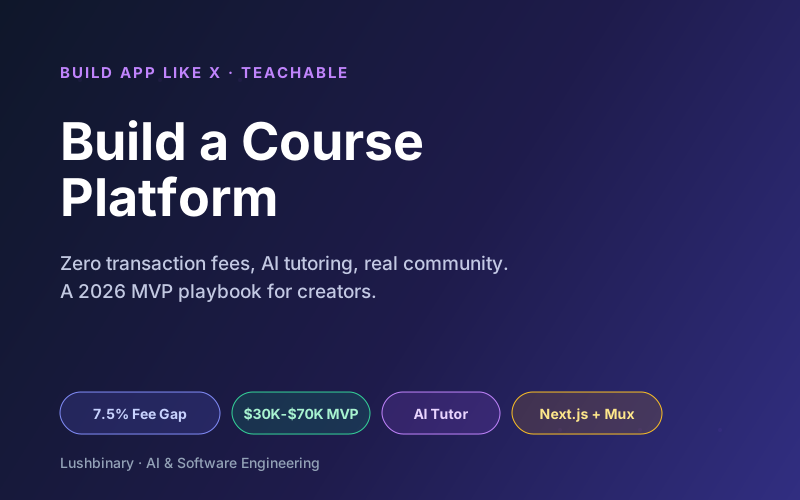
The creator economy turned teaching into a serious business, and Teachable is one of the platforms that made it possible. It lets experts package knowledge into courses, host video, take payments, and run a school without writing code. Pricing in 2026 spans roughly $39 to $309 per month, with the entry Starter tier still carrying a 7.5% transaction fee while higher tiers offer 0% base transaction fees.
That fee structure is exactly where creators feel the pinch. As soon as a course business scales, transaction fees on lower plans and the jump in subscription cost on higher plans start to eat into margins. Add limited design control, a basic community experience, and shallow marketing automation, and you have a clear set of gaps a purpose-built platform can fill, especially one with modern AI tutoring baked in.
This guide breaks down what makes Teachable work, how it monetizes, the complaints you can turn into features, the MVP feature set, the architecture and tech stack, the AI features that differentiate, real cost and timeline, and how Lushbinary can help you ship it.
📋 Table of Contents
- 1.What Makes Teachable Successful
- 2.Teachable’s Revenue Model & Pricing
- 3.Creator Complaints & Market Gaps You Can Exploit
- 4.Core Features for a Course Platform MVP
- 5.System Architecture & Tech Stack
- 6.AI-Powered Features That Differentiate
- 7.Development Cost & Timeline Breakdown
- 8.Why Lushbinary for Your Course Platform MVP
1What Makes Teachable Successful
Teachable removed the technical barrier to selling knowledge. Before it, a creator needed a website, a video host, a payment processor, and a way to gate content. Teachable bundled all of that into a tool a non-technical expert could use in an afternoon.
End-to-End Course Creation
From uploading video to structuring lessons, building a sales page, and collecting payment, the whole flow lives in one place. That all-in-one simplicity is the core value proposition.
Built-In Payments and Checkout
Integrated checkout, order bumps, coupons, and subscription billing mean creators can monetize immediately. Owning the checkout is also how Teachable justifies transaction fees on lower tiers.
Low Time-to-Launch
A creator can go from idea to live, paid course in days. That speed is what wins the casual and first-time creator segment, even if they later outgrow the platform.
| Metric | Teachable |
|---|---|
| Pricing Range (2026) | ~$39 to $309/month |
| Entry Tier Transaction Fee | 7.5% on Starter |
| Higher Tier Transaction Fee | 0% base on Builder/Growth/Advanced |
| Category | Courses-first creator platform |
| Core Use | Sell online courses and coaching |
| Main Rivals | Thinkific, Kajabi, LearnWorlds, Podia |
2Teachable's Revenue Model & Pricing
Teachable blends subscriptions with transaction fees. The lower the plan, the higher the cut Teachable takes per sale, which nudges successful creators up the pricing ladder.
| Tier | Approx. Price | Transaction Fee |
|---|---|---|
| Free | $0 | Higher fees, very limited |
| Starter | ~$39/month | 7.5% per transaction |
| Builder | ~$89/month (less annually) | 0% base |
| Growth | ~$189/month (less annually) | 0% base |
| Advanced / Higher | up to ~$309/month | 0% base |
💡 Revenue Opportunity
High-revenue creators hate paying a percentage of every sale. A platform with flat, predictable pricing and 0% transaction fees, plus AI tutoring and stronger community tools, is a compelling pitch to creators doing six or seven figures who feel taxed by hosted platforms.
3Creator Complaints & Market Gaps You Can Exploit
We reviewed creator feedback across review sites, Reddit, and comparison articles. These are the recurring pain points, and each maps to a feature opportunity.
💸 Transaction Fees on Lower Tiers
The 7.5% Starter fee plus payment processing eats meaningful revenue. A 0% transaction model is the strongest differentiator for serious creators.
🎨 Limited Customization
Theme and design control is shallow. Creators who want a branded, unique school experience hit walls quickly.
👥 Basic Community
Native community and discussion features are thin compared to Skool or Circle. Cohort and community-driven learning is underserved.
📝 Shallow Assessments
Quizzes and certificates are basic. Skills-based programs need richer assessment, grading, and proof of completion.
📣 Weak Marketing Automation
Email and funnel automation lag behind all-in-one rivals, forcing creators to bolt on extra tools.
🤖 No Real AI Tutoring
Hosted platforms add AI cautiously. An AI tutor that answers learner questions inside the course is a genuine leap forward.
💡 The Opportunity
The clearest wedge is an AI-native, community-rich course platform with 0% transaction fees, aimed at a specific vertical such as professional certification, language learning, or technical skills. Owning a niche with deep features beats competing on generic course hosting.
4Core Features for a Course Platform MVP
Phase 1: Lean MVP (8-10 weeks)
- Course Builder - Sections, lessons, drip scheduling, and reordering with drag and drop
- Video Hosting - Adaptive streaming via Mux or Cloudflare Stream with signed playback URLs
- Student Dashboard - Enrolled courses, progress tracking, and resume-where-you-left-off
- Checkout & Payments - One-time and subscription payments, coupons, and order receipts via Stripe
- Auth & Roles - Creator, student, and admin roles with secure access control
- Sales Pages - Customizable landing pages per course with checkout embedded
Phase 2: Differentiation (8-12 weeks)
- Quizzes & Assessments - Question banks, graded quizzes, and pass thresholds
- Certificates - Auto-issued, verifiable completion certificates
- Community & Discussions - Per-course or cohort-based discussion spaces
- Memberships - Recurring access bundles and tiered content libraries
- Affiliates & Coupons - Referral tracking and payout rules to drive creator-led growth
Phase 3: AI & Scale (8-12 weeks)
- AI Tutor - A course-aware assistant that answers learner questions grounded in the lesson content
- AI Course Authoring - Generate outlines, quizzes, and lesson drafts from a creator's source material
- Auto Transcripts & Captions - Searchable video transcripts and multilingual captions
- Learning Analytics - Drop-off detection, completion prediction, and engagement insights
5System Architecture & Tech Stack
A course platform has three core demands: secure video delivery, reliable payments, and fast content access for learners worldwide. Here is the architecture we recommend.
Recommended Tech Stack
| Layer | Technology | Why |
|---|---|---|
| Web | Next.js + React | SEO-friendly sales pages and fast learner experience |
| Backend | Node.js (Express/Fastify) | Large ecosystem, TypeScript, easy Stripe and webhook handling |
| Database | PostgreSQL | Relational data for courses, enrollments, and progress |
| Video | Mux or Cloudflare Stream | Adaptive streaming, signed playback, transcripts |
| Payments | Stripe | Subscriptions, one-time payments, coupons, tax handling |
| Storage / CDN | AWS S3 + CloudFront | Course assets, downloads, and global delivery |
| AI | OpenAI / Claude + vector DB | AI tutor grounded in course content, authoring assistance |
6AI-Powered Features That Differentiate
AI is the clearest way for a new course platform to leapfrog the incumbents. These features change the learning experience, not just the admin work.
🎓 Course-Aware AI Tutor
An assistant grounded in each course's transcripts and materials that answers learner questions instantly and cites the exact lesson.
✍️ AI Course Authoring
Generate course outlines, lesson drafts, and quiz questions from a creator's notes, slides, or recordings to cut production time.
🗣️ Transcripts & Captions
Automatic, searchable transcripts and multilingual captions that make video accessible and discoverable.
📊 Learning Analytics
Detect where learners drop off, predict completion likelihood, and recommend interventions to lift completion rates.
🧪 Adaptive Quizzes
Quizzes that adjust difficulty to the learner and target weak areas with targeted review content.
🌍 AI Translation
Translate course content into new languages to expand a creator's addressable market without re-recording.
7Development Cost & Timeline Breakdown
A course platform is moderate complexity. The main cost drivers are secure video delivery, payments and subscriptions, and the AI layer. Here is what to budget.
Get Detailed Cost Breakdown
Fill in your details to unlock pricing and cost information.
8Why Lushbinary for Your Course Platform MVP
At Lushbinary, we build content platforms, subscription products, and AI-powered web apps. Here is what we bring to a course platform project:
- Video and media - We implement secure, adaptive video delivery with signed URLs, transcripts, and global CDN
- Subscriptions and payments - We build Stripe-based billing with coupons, memberships, and affiliate payouts
- AI integration - We build retrieval-grounded AI tutors and authoring assistants using OpenAI, Claude, and vector databases
- Performance and SEO - We ship fast Next.js sales pages and learner experiences that rank and convert
- AI-accelerated delivery - We use AI coding tools to ship MVPs 30-40% faster without cutting quality
🚀 Free Consultation
Want to build a course platform that actually competes? Lushbinary specializes in AI-powered content and subscription products. We'll scope your project, recommend the right tech stack, and give you a realistic timeline with no obligation.
❓ Frequently Asked Questions
How much does it cost to build an online course platform like Teachable?
An MVP with a course builder, video hosting, checkout, and student dashboard costs $30,000-$70,000 over 8-10 weeks. A full platform with memberships, certificates, affiliates, and AI ranges from $90,000-$200,000.
How does Teachable make money?
Monthly subscriptions from roughly $39 to $309/month plus transaction fees on lower tiers (7.5% on Starter), with 0% base transaction fees on Builder, Growth, and Advanced. Payment processing fees are separate.
What are the biggest complaints about Teachable?
Transaction fees on lower tiers, limited design customization, basic community and quizzing, escalating fees and limits with revenue, and weaker marketing automation than all-in-one rivals.
What tech stack should I use to build a course platform?
Next.js for the web app, Node.js for the backend, PostgreSQL for data, Mux or Cloudflare Stream for video, Stripe for payments, and AWS S3 with CloudFront for assets and delivery.
Should I build my own platform or use Teachable?
Use Teachable to validate quickly. Build your own when transaction fees on high revenue hurt, when you need custom branding, deep community, or AI tutoring, or when you want to own the data and customer relationship.
📚 Sources
- Teachable Pricing - Plan tiers and transaction fees
- Teachable Plans and Fees (Help Center) - Fee details
- Mux Video Documentation - Adaptive streaming and signed playback
Content was rephrased for compliance with licensing restrictions. Pricing data sourced from official Teachable pages and reputable comparison sites as of early 2026. Plans and fees may change - always verify on the vendor's website.
Build a Course Platform Creators Won't Outgrow
Zero transaction fees, AI tutoring, rich community, and full branding. Let Lushbinary build your Teachable alternative for the vertical you want to own.
Ready to Build Something Great?
Get a free 30-minute strategy call. We'll map out your project, timeline, and tech stack - no strings attached.
Prefer email? Reach us directly: