
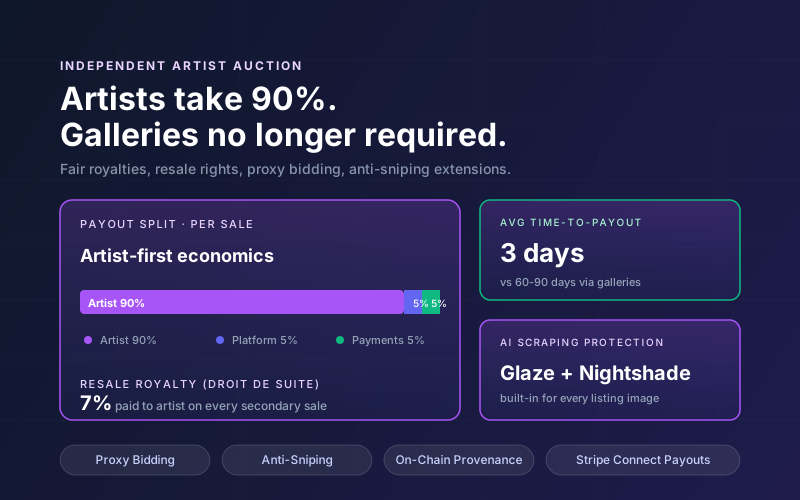
Independent artists have a pricing problem. Traditional galleries and auction houses take 30-50% commissions, online marketplaces layer buyer premiums on top of seller fees, and the artist ends up with a fraction of the final sale price. Meanwhile, resale royalties (droit de suite), which let artists earn from every future sale of their work, are enforced in the EU and UK but voluntary and rare elsewhere.
The music industry showed what is possible. Bandcamp has paid over $1.5 billion to artists by giving them 82-90% of every sale, per OnesToWatch 2026 data. Visual art is ready for the same shift: a fair-royalty auction platform that pays artists the majority of the sale, tracks resale royalties forever, and rejects the extractive gallery model.
This guide covers how to build that platform: artist-first payout splits, timed auctions with provenance tracking, resale royalty automation, AI scraping protection, and the realistic cost and timeline to ship a production-ready MVP.
Table of Contents
- 1.Why Current Art Platforms Fail Independent Artists
- 2.Lessons from Ethical Music Platforms
- 3.Core Features for an Artist Auction MVP
- 4.Resale Royalties & Provenance Tracking
- 5.AI Scraping Protection for Artist Images
- 6.System Architecture & Tech Stack
- 7.Payments: Stripe Connect & Artist-First Splits
- 8.Cost, Timeline & Revenue Model
- 9.Why Lushbinary for Your Artist Platform
- 10.FAQ & Sources
1Why Current Art Platforms Fail Independent Artists
The recurring pain points from artist forums and community feedback:
- Gallery splits of 30-50% on primary sales, with opaque curator commissions
- Double-fee structure on online platforms: buyer premium on top of seller commission eats 25-40% of final price
- No resale royalties for most platforms outside the EU, meaning artists see zero revenue when their work appreciates
- Poor discoverability for emerging artists buried under blue-chip curation
- AI training exposure: artist images scraped into training sets without consent or compensation
- Slow payouts: gallery payout windows of 30-120 days after sale
2Lessons from Ethical Music Platforms
Music has a 5-year head start on ethical-platform economics. Lessons that translate to visual art:
| Platform | Artist Cut | Why It Works |
|---|---|---|
| Bandcamp | 82-90%, 100% on Bandcamp Fridays | Direct-sale model, no ad-funded pro-rata pool |
| Qobuz | ~$0.0187 per stream | Premium hi-fi tier, user-centric payments |
| Tidal | ~$0.010-0.013 per stream | User-centric, 3-6x higher than Spotify |
| Spotify | ~$0.003-0.005 per stream | Pro-rata pool favors superstars; common benchmark of bad economics |
The takeaway: direct-sale economics work when the platform bets on volume and artist retention instead of commission extraction. A visual art auction platform taking 8-12% instead of 30-40% will attract artists faster than any marketing campaign.
3Core Features for an Artist Auction MVP
Phase 1: Lean MVP (4 to 6 months)
Artist onboarding
Portfolio submission, bio, statement, verified social profiles
Artwork listing
Hi-res images (watermarked), dimensions, medium, year, edition
Timed auctions
3, 5, or 7 day options with anti-sniping extensions
Reserve pricing
Artist-set floor with optional Buy Now price
Proxy bidding
Set max bid and let system auto-bid up to ceiling
Collector accounts
Bid history, saved artists, collection profile, ID verification
Certificate of Authenticity
PDF COA generated on sale, signed by artist (digital)
Fast payouts
Stripe Connect Express payout within 2-3 days of sale
Phase 2: Differentiation (2 to 3 months)
- Resale royalties: 3-5% auto-routed to original artist on every secondary sale within the platform
- Provenance timeline: public chain of custody from first buyer through every resale
- Curator drops: time-limited themed collections with 50/50 curator/artist split on curator fees
- AR preview: collectors see the artwork on their wall via iOS VisionKit or Snap AR before bidding
- Shipping & insurance: integrated with art-grade shippers like UOVO or FedEx Priority with declared value
Phase 3: Scale (2 to 3 months)
- Print-on-demand editions: artist-approved limited prints with auto-royalty per unit
- Collector tools: insurance valuations, viewing room, lending library for museum loans
- Optional on-chain provenance: Base or Arbitrum NFT linked to physical work for crypto-native collectors
- Secondary market: collectors list owned pieces back to the platform with automatic royalty routing
4Resale Royalties & Provenance Tracking
Resale royalty (droit de suite) is the single most artist-friendly feature a new platform can offer. It is law in EU member states under the Resale Right Directive. In the US it is voluntary and therefore differentiating.
How to implement it:
- On first sale, record the artist ID, buyer ID, sale price, and date as a provenance event
- When a piece is resold on the platform, detect the match by artwork ID and route a configured percentage (default 3-5%) to the original artist via Stripe Connect
- Display the provenance chain publicly (with buyer privacy controls) on each artwork page
- Provide artists with a royalty dashboard showing past, pending, and projected royalty income
💡 Off-Platform Resales
Resales outside your platform cannot be enforced without legal mechanism. Provide an optional off-platform reporting portal where sellers can voluntarily report and pay royalty, and include a public registry of participating collectors.
5AI Scraping Protection for Artist Images
Artists are understandably wary of any platform that could expose their work to AI training datasets. Build these protections in from day one:
- robots.txt + User-Agent blocking: explicitly disallow GPTBot, ClaudeBot, CCBot, Google-Extended, PerplexityBot, and Bytespider
- Watermarking: visible watermark on all preview images above a configurable resolution
- Adversarial perturbations: Glaze or Nightshade-style server-side image processing that degrades model training while remaining imperceptible to humans
- Terms of service: explicit no-AI-training license attached to every listing, with artist opt-in only for any AI research use
- Rate limiting & CAPTCHA: CloudFront WAF rules plus Turnstile or reCAPTCHA on scraper-prone endpoints
⚠️ Reality Check
No technical measure fully stops determined scrapers. The combination of legal terms, User-Agent blocking, and image perturbation is currently the state of the art, but the landscape is evolving quickly. Announce your policy loudly and publish an annual transparency report on takedown notices and training-set opt-outs.
6System Architecture & Tech Stack
| Layer | Stack |
|---|---|
| Frontend | Next.js 15 + React 19 + Tailwind 4 |
| Auction engine | Node.js 22 + Socket.IO 4.8 + Redis adapter |
| Image processing | Sharp + Glaze/Nightshade integration on Lambda |
| Database | PostgreSQL 17 with provenance event log table |
| Cache / Queue | Redis 7 + BullMQ for royalty disbursement jobs |
| Payments | Stripe Connect Express with platform-held royalty escrow |
| Shipping | UOVO, FedEx Priority, or ShipStation for art-grade |
| Bot protection | CloudFront WAF + Cloudflare Turnstile |
| Optional on-chain | Base or Arbitrum L2 for NFT provenance mirror |
| Hosting | AWS ECS Fargate + RDS + S3 + CloudFront |
7Payments: Stripe Connect & Artist-First Splits
The payout split is the most visible ethical signal. Recommended structure for a new platform:
| Party | Primary Sale Cut | Secondary Sale Cut |
|---|---|---|
| Artist (primary) | 85-92% | 3-5% resale royalty |
| Platform | 8-15% | 8-12% |
| Optional curator | 5% (split with platform) | 0% |
| Seller (secondary) | N/A | 83-89% |
| Stripe processing | 2.9% + $0.30 | 2.9% + $0.30 |
Implement splits using Stripe Connect's transfer_data and application fees. For secondary sales, use a platform-held escrow balance to collect the resale royalty and transfer it to the original artist on the next payout cycle.
8Cost, Timeline & Revenue Model
| Scope | Timeline | Cost Range |
|---|---|---|
| Lean MVP (auctions, Stripe Connect, COA, AI scraping protection) | 4 to 6 months | $50K to $90K |
| Mid (resale royalties, AR preview, curator drops) | 6 to 8 months | $110K to $170K |
| Full (print-on-demand, on-chain provenance, mobile apps) | 8 to 11 months | $180K to $280K |
| Hosting & moderation | Per month | $1,200 to $3,500 |
Revenue model: 8-15% platform commission (lower than gallery norm), optional featured placement for 2-5% additional, and print-on-demand revenue share once Phase 3 ships.
9Why Lushbinary for Your Artist Platform
A fair-royalty art platform is a real-time auction marketplace with strong image handling, provenance state, and royalty disbursement, which is exactly what we build. Relevant work includes our MSP Disposal live auction case study and our MedusaJS full-stack e-commerce guide.
- Production real-time auction engine with proxy bidding and anti-sniping
- Stripe Connect payout splits with royalty escrow and recurring disbursement workflows
- AI scraping protection via WAF rules, Glaze-style image processing, and bot detection
- Provenance state model in PostgreSQL with optional on-chain mirror on Base or Arbitrum
- AWS infrastructure that scales and supports artist-focused analytics
🚀 Free Artist Platform Consultation
Building a platform that actually pays artists fairly? Lushbinary offers a free scoping call. We will review your vision, share how we ship marketplaces, and give you a realistic timeline with no obligation.
❓ Frequently Asked Questions
What cut do existing art auction platforms take from independent artists?
Gallery and auction splits leave artists with 35-50% of primary sale price. Major online platforms charge buyer premiums of 20-30% plus seller commissions of 10-30%.
How do you implement resale royalties on an auction platform?
Add a 3-5% resale royalty to every secondary sale via Stripe Connect with provenance tracking in PostgreSQL. EU law mandates this; US is voluntary.
What does it cost to build a fair-royalty art auction platform?
$50K to $90K for a lean MVP over 4 to 6 months. $130K to $230K for a full platform with print-on-demand and provenance certificates.
Should an artist auction platform use blockchain or NFTs?
Optional and secondary. Skip NFTs at MVP and focus on Stripe payments, COA PDFs, and PostgreSQL royalty tracking. Base or Arbitrum L2 for crypto-native niches.
How do you protect artist images from AI training?
robots.txt + User-Agent blocking of GPTBot/ClaudeBot/CCBot, visible watermarking, Glaze-style image perturbations, clear no-AI-training terms.
Sources
- OnesToWatch: Ethical Spotify Alternatives 2026
- Stripe Connect documentation
- Glaze: AI protection for artists (University of Chicago)
- EU Resale Right Directive (droit de suite)
Content was rephrased for compliance with licensing restrictions. Pricing and royalty data sourced from official vendor pages and public research as of May 2026. Regulatory rules vary by jurisdiction, always verify with legal counsel before launch.
Launch a Fair-Royalty Art Auction Platform Artists Will Trust
Tell us about your vision. We will scope the build, estimate timeline, and share exactly how we ship artist-first marketplaces with no obligation.
Ready to Build Something Great?
Get a free 30-minute strategy call. We'll map out your project, timeline, and tech stack - no strings attached.
Prefer email? Reach us directly: