
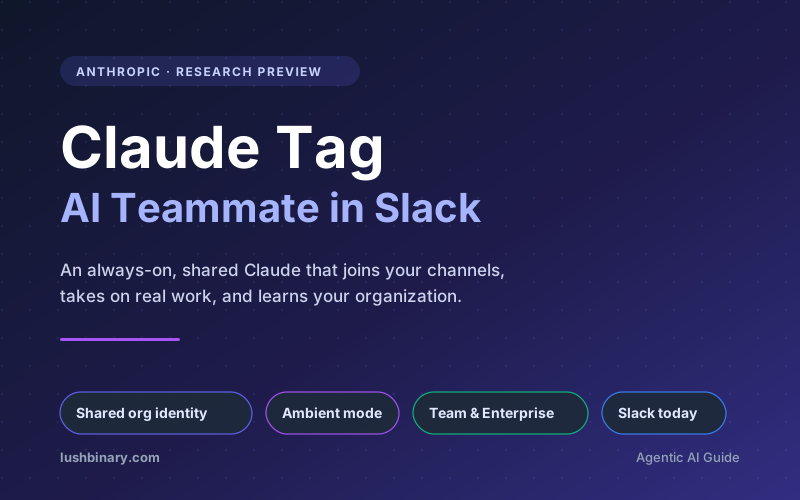
On June 23, 2026, Anthropic introduced Claude Tag, an always-on Claude that lives inside your Slack channels and behaves like an actual teammate rather than a chatbot you ping in a private DM. You tag @Claude in a thread, hand it a task, and it gets to work while everyone in the channel can see what it is doing. Slack's general manager Rob Seaman framed the shift as making AI "multiplayer": instead of a private back-and-forth, Claude shows up in the open where the team already works.
The headline change is not the chat surface, it is the identity model. Earlier integrations ran Claude under your personal permissions. Claude Tag gives the whole organization a single shared Claude that acts under an org-level identity, uses the tools and data an admin wired up for each channel, and bills usage to the organization. That turns Claude from a personal assistant into a shared resource with memory, governance, and the ability to pick up half-finished work from a colleague.
This guide covers what actually shipped, how the agent-identity model works, the August 3 migration from the older Claude in Slack integration, the security and admin controls you need to understand before rolling it out, the workflows worth delegating, and a practical rollout playbook. For the broader context on running agents safely, see our AI agent production guardrails guide.
📋 What This Guide Covers
- What Claude Tag Is (And What Actually Changed)
- From Claude in Slack to Claude Tag: The August 3 Migration
- How the Agent-Identity Model Works
- Ambient Mode: Proactive vs On-Demand
- Security, Admin Controls & Governance
- Real Workflows: What to Delegate
- How to Roll It Out: A Practical Playbook
- Limitations & Open Questions
- Why Lushbinary for Agentic AI Rollouts
- FAQ
1What Claude Tag Is (And What Actually Changed)
Claude Tag is a way to bring Claude into a Slack conversation as a participant. An admin grants Claude access to selected channels and connects it to whichever tools, data, and even codebases the team chooses. After that, anyone in the channel can tag @Claude in and delegate a task while they move on to other work. When you assign it something, Claude breaks the task into stages, works through them using whatever tools it has access to, and replies in the thread with what it produced.
The part that matters for teams is shared context. Because everyone in the channel talks to the same Claude, teammates can see what it is working on, continue a task someone else kicked off, and build on earlier conversations without re-explaining the situation every time. Anthropic describes Claude Tag as retaining context over time and learning the organization as it goes, which is why several outlets characterized it as an "always-on Claude" that gradually gets to know how your company works.
💡 The Core Shift
Older Slack integrations gave each person their own private Claude. Claude Tag gives the whole team one shared Claude with a single identity, persistent context, and admin-governed access. The assistant moves out of your DMs and into the channel where work actually happens.
It is worth being precise about status: Claude Tag launched in a research preview / beta on June 23, 2026, available on Claude Team and Enterprise plans, and it works in Slack today. Anthropic has said it plans to expand the capability to other platforms over time, so treat Slack as the first surface rather than the only one.
2From Claude in Slack to Claude Tag: The August 3 Migration
Claude Tag is an evolution of integrations that already existed, not a green-field product. Teams could already DM @Claude in Slack or mention it in a channel for on-demand help, and Claude Code in Slack already routed coding tasks from channel mentions into full coding sessions on the web, posting updates back into the thread. Claude Tag pulls these threads together under one identity model.
⚠️ Action Required: August 3, 2026
Anthropic is retiring the older Claude in Slack integration on August 3, 2026, and Claude Tag replaces it. If your team relies on the existing integration, plan the switch before that date so channel access, connected tools, and any automations carry over without a gap.
The practical difference during migration is the identity and billing change. With the old integration, when you tagged Claude it acted under your personal permissions and the usage counted against you. In a Claude Tag channel, Claude acts under your organization's identity, uses the tools and access an admin set up for that channel, and the work is billed to the organization. That is a meaningful governance upgrade, but it also means an admin has to configure channels deliberately rather than relying on each user's own connected accounts.
Note that DM-style, personal interactions with Claude can still behave under your own identity. The org-identity behavior is specific to channel tagging, where Claude is acting as a shared teammate rather than your personal assistant.
3How the Agent-Identity Model Works
The agent-identity model is the most important concept to understand before rolling Claude Tag out. Instead of inheriting an individual user's permissions every time it acts, Claude operates under a workspace-level identity. Admins decide, per channel, which tools, data sources, and codebases that identity can reach. This shifts control from scattered personal connections to a single, centrally governed surface.
The flow is straightforward: a teammate tags Claude in a channel, Claude assumes the org identity for that channel, reaches only the tools and codebases the admin authorized, executes the task in stages, and posts the result back into the thread for everyone to see. The benefit of this model is autonomy with a control boundary. Claude can act on its own without borrowing a specific person's credentials, and admins get granular control over what the agent can touch in each channel.
💡 Why Org Identity Beats Per-User Permissions
A shared identity means a task does not break when the person who started it logs off or leaves. Context, access, and ownership live with the channel and the organization, not with one employee's account. That continuity is what makes handing off half-finished work between people and Claude actually workable.
4Ambient Mode: Proactive vs On-Demand
By default Claude Tag is reactive: it responds when someone tags @Claude. But it also has an ambient mode that, when turned on, lets Claude jump into the conversation on its own. In ambient mode it can keep the team updated, flag relevant items from across the organization, and follow up on open threads or tasks without anyone asking it to.
On-Demand (default)
- Acts only when tagged
- Predictable, low-noise
- Good first step for a new channel
- Easier to audit who triggered what
Ambient (opt-in)
- Acts proactively without a tag
- Flags cross-org updates
- Follows up on threads and tasks
- Best once the team trusts its judgment
The sensible adoption path is to start on-demand, let the team build trust in the quality of Claude's output, and only enable ambient mode on channels where proactive nudges add value rather than noise. A busy incident channel might benefit from proactive follow-ups, while a quiet leadership channel probably should not have an agent volunteering opinions unprompted.
5Security, Admin Controls & Governance
Anthropic's pitch is that administrators can tightly control the data and tools Claude Tag can access in each channel. That control is the whole point of the agent-identity model, but it also means the security posture is only as good as how you configure it. An agent that can read a channel's history and call connected tools is a powerful capability and a real attack surface.
- Scope access per channel, not globally. Give each channel only the tools and data its work requires. A support channel does not need access to your production deploy tooling.
- Mind what lives in channel history. Claude reads the conversation context, so channels holding secrets, customer PII, or credentials need extra scrutiny before you add an agent identity.
- Treat connected codebases as sensitive. Connecting a repo lets Claude act on it. Confirm branch protections and review requirements still apply to anything it produces.
- Watch for prompt injection. Because Claude reads messages that any channel member (or an external integration) can post, untrusted content in a channel can attempt to steer the agent. See our prompt injection defense guide for mitigations.
- Keep a human in the loop for high-impact actions. Deploys, data deletion, customer-facing messages, and anything hard to reverse should require explicit human confirmation.
⚠️ Governance Reality Check
A shared, always-on agent that learns your organization is genuinely useful, and it concentrates access in one identity. Decide who can add Claude to channels, who can connect tools, and who reviews ambient-mode behavior before you scale beyond a pilot.
6Real Workflows: What to Delegate
Claude Tag is most valuable for work that lives in Slack threads and benefits from shared visibility. Strong early candidates:
Engineering
Triage bug reports, draft fixes via connected codebases, summarize PR discussions, and route deeper coding tasks to full sessions.
Support & Ops
Draft responses from a knowledge base, summarize long incident threads, and follow up on unresolved tickets in ambient mode.
Product & PM
Turn channel discussion into structured specs, track decisions, and surface related context from connected docs.
Cross-Team Handoffs
Pick up a task one teammate started, keep the shared context, and continue it so work does not stall when people switch off.
The pattern that makes Claude Tag different from a personal assistant is the handoff. Because the context is shared and the identity is the organization's, a task can move between three people and Claude across a week without anyone re-explaining what happened. That is the "multiplayer" idea in practice. For teams thinking about how agentic tooling reshapes delivery, our AI engineering transformation guide goes deeper on restructuring around these workflows.
7How to Roll It Out: A Practical Playbook
A measured rollout beats flipping it on everywhere. A sequence that works:
- Pick one pilot channel. Choose a team that lives in Slack and has clear, repetitive tasks worth delegating.
- Scope access narrowly. Connect only the tools and data that channel needs. Resist the urge to wire up everything on day one.
- Start on-demand. Keep ambient mode off until the team trusts the output and you understand the failure modes.
- Define guardrails for high-impact actions. Require human confirmation for anything irreversible before it happens, not after.
- Review and expand. After a couple of weeks, look at what Claude did well, where it needed correction, then enable ambient mode or add channels deliberately.
- Plan the August 3 cutover. If you use the older Claude in Slack integration, migrate channel access and connected tools to Claude Tag before the retirement date.
The goal is to learn how Claude behaves with your data and your team on a small surface before you give it broad reach.
8Limitations & Open Questions
- Beta status. Claude Tag launched in a research preview / beta. Expect behavior, limits, and controls to change as Anthropic iterates on feedback.
- Slack first. It works in Slack today. Expansion to other platforms is planned but not yet shipped, so do not architect assuming it is available everywhere.
- Plan-gated. Availability is limited to Claude Team and Enterprise plans. Smaller teams on other tiers do not have it yet.
- Concentrated access. A single org identity with broad channel access is convenient and a meaningful security consideration. Governance discipline matters more, not less.
- Ambient noise. Proactive behavior can become noise in the wrong channel. Tune where it is enabled rather than turning it on globally.
9Why Lushbinary for Agentic AI Rollouts
Tools like Claude Tag make it easy to drop an agent into a channel. Making that agent safe, useful, and wired into your real systems is the harder part, and it is where most rollouts stall. Lushbinary helps teams design the access model, connect the right tools and codebases, set guardrails for high-impact actions, and measure whether the agent is actually moving work forward.
- Agent integration: connect Slack-based agents to your tools, data sources, and repos with scoped, auditable access.
- Guardrails & governance: human-in-the-loop checkpoints, prompt-injection defenses, and access policies that scale beyond a pilot.
- Workflow design: identify what to delegate, where handoffs add value, and how to keep humans in control of the outcomes.
🚀 Free Consultation
Rolling out Claude Tag or another agentic AI tool? Lushbinary will help you scope the access model, wire it into your stack safely, and set the guardrails to keep it under control, with no obligation.
10Frequently Asked Questions
What is Claude Tag?
Claude Tag is Anthropic's always-on Claude that lives inside your Slack channels as a shared AI teammate. You tag @Claude in a thread to delegate real work, and it acts under a single organization identity using the tools and data an admin scoped for that channel. It launched on June 23, 2026 in beta for Claude Team and Enterprise plans.
How is Claude Tag different from Claude in Slack?
Claude in Slack acted under your personal user permissions and billing. Claude Tag introduces an agent-identity model: in a channel, Claude works under your organization's identity with admin-defined tools and access, and the usage is billed to the organization rather than to you. Anthropic is retiring the older Claude in Slack integration on August 3, 2026.
What plans is Claude Tag available on?
Claude Tag is available in beta on Claude Team and Enterprise plans and works in Slack today. Anthropic has said it plans to expand the capability to other platforms over time.
What is ambient mode in Claude Tag?
Ambient mode lets Claude act proactively without being tagged. When enabled for a channel, it can flag relevant updates from across the organization, follow up on open threads or tasks, and keep the team informed. With ambient mode off, Claude only responds when someone tags @Claude.
Is Claude Tag secure for enterprise use?
Admins control which channels Claude Tag can join and which tools, data sources, and codebases it can access per channel. Because it runs under an org-level agent identity rather than individual user permissions, access is centrally governed. As with any agent that reads channel content and calls tools, you should still scope access narrowly and review what data each channel exposes.
Does Claude Tag remember context over time?
Yes. Claude Tag retains context over time so the whole team works with the same Claude. Teammates can see what it is working on, continue tasks others started, and build on prior conversations without repeating context each time.
Sources
- Anthropic: Introducing Claude Tag
- Anthropic Support: What is Claude Tag?
- Reuters: Anthropic launches Claude Tag in Slack
- TechCrunch: Claude Tag is learning your company
- 9to5Mac: Claude Tag enterprise collaborative tool
Content was rephrased for compliance with licensing restrictions. Feature details, availability, and dates sourced from Anthropic and press coverage as of June 24, 2026. Product details may change during the research preview - always verify on Anthropic's official channels.
Put AI Teammates to Work, Safely
Tell us how your team works and what you want to delegate. We'll help you roll out Claude Tag or another agentic AI tool with the right access model and guardrails.
Ready to Build Something Great?
Get a free 30-minute strategy call. We'll map out your project, timeline, and tech stack - no strings attached.
Prefer email? Reach us directly: