
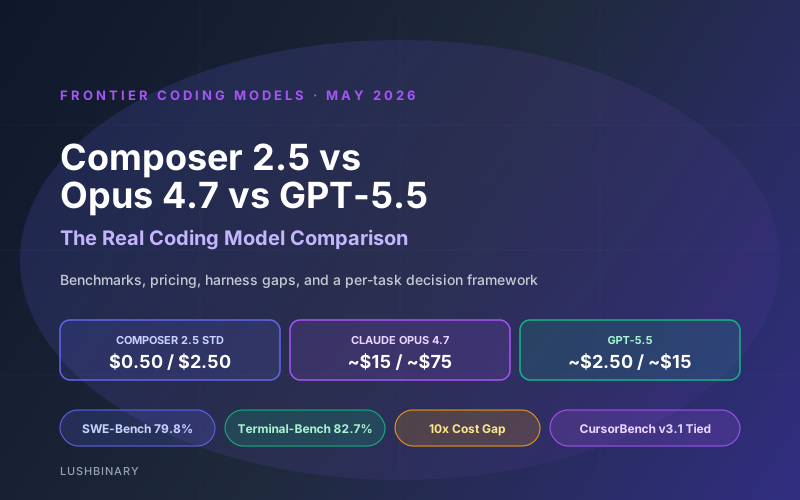
Cursor's Composer 2.5, Anthropic's Claude Opus 4.7, and OpenAI's GPT-5.5 are the three frontier coding models most engineering teams are choosing between in May 2026. Composer 2.5 shipped on May 18 and immediately matched Opus 4.7 and GPT-5.5 on two of three public benchmarks, at roughly one tenth the per-token cost (source).
That changes the buy decision. For the last 12 months the question was "which frontier model can my team afford". Now the question is "when is paying for Opus or GPT-5.5 worth it given Composer 2.5 sits at the same accuracy band on agentic workloads at a fraction of the cost".
This comparison breaks down benchmarks, pricing, harness differences, real-world workload fit, and a decision framework so you can pick the right model per task rather than per team.
Table of Contents
- The Three Models at a Glance
- Benchmark Comparison: SWE-Bench, Terminal-Bench, CursorBench
- Pricing Side by Side
- Harness and Tooling Differences
- Workload Fit by Task Type
- Cost Modeling for Real Agent Sessions
- Decision Framework
- Multi-Model Routing in Practice
- Why Lushbinary for Multi-Model Engagements
1The Three Models at a Glance
Composer 2.5
- Released May 18, 2026
- Built on Moonshot Kimi K2.5
- Agentic coding specialist
- Cursor-only access
- Cheapest of the three
Claude Opus 4.7
- Anthropic flagship
- Strong on long-context reasoning
- Available via API and Cursor
- Closed weights
- Best for complex single-shot work
GPT-5.5
- OpenAI frontier model
- Leads Terminal-Bench 2.0
- Native computer use
- Multimodal (text, image, audio)
- Best for terminal-heavy work
2Benchmark Comparison: SWE-Bench, Terminal-Bench, CursorBench
Cursor published the three-way benchmark comparison alongside the Composer 2.5 launch. The numbers below are from the official Cursor announcement and corroborating coverage.
| Benchmark | Composer 2.5 | Opus 4.7 | GPT-5.5 | Winner |
|---|---|---|---|---|
| SWE-Bench Multilingual | 79.8% | ~80% | ~80% | Three-way tie |
| Terminal-Bench 2.0 | 69.3% | 69.4% | 82.7% | GPT-5.5 by 13 points |
| CursorBench v3.1 | 63.2% | ~63% | ~63% | Three-way tie |
The story: Composer 2.5 matches Opus 4.7 and GPT-5.5 on two of three benchmarks. GPT-5.5 holds a clear lead on Terminal-Bench 2.0, which measures shell-driven autonomous task completion.
Benchmarks do not tell the whole story. Cursor explicitly trained Composer 2.5 on behavioral dimensions like effort calibration and communication style that the three public benchmarks do not capture. Anthropic and OpenAI similarly tune their flagship models for general-purpose use that benchmarks miss.
3Pricing Side by Side
The pricing gap is the headline story for May 2026. All numbers per million tokens.
| Model | Input | Output | Notes |
|---|---|---|---|
| Composer 2.5 Standard | $0.50 | $2.50 | Background and batch agents |
| Composer 2.5 Fast | $3.00 | $15.00 | Default for interactive IDE use |
| Claude Opus 4.7 | ~$15 | ~$75 | Anthropic API and partner platforms |
| GPT-5.5 | ~$2.50 to $30 | ~$15 to $180 | Tier depends on standard vs Pro variant |
On the standard tier, Composer 2.5 is roughly 10x cheaper than Opus 4.7 on input and 30x cheaper on output. Even GPT-5.5 standard is several times more expensive on output. For agent workloads where output token volume dominates (multi-file edits, terminal sessions, refactor patches), this gap compounds quickly.
4Harness and Tooling Differences
A model is only as good as the harness wrapping it. The same model can score wildly different on the same eval depending on which IDE or agent is driving it. Mindstudio published data showing Opus 4.7 scores 91.1% in Cursor versus 87.2% in Anthropic's native Claude Code harness, a 4 percentage point harness gap that exceeds most model-to-model gaps (source).
What that means in practice:
- Composer 2.5 is only available inside the Cursor harness (IDE, CLI, SDK, web app, cloud agents). It is purpose-built for that harness.
- Claude Opus 4.7 is available in Cursor, Claude Code, the Anthropic API directly, AWS Bedrock, and various third parties. The same model can underperform in a weaker harness.
- GPT-5.5 is available in OpenAI's API, Cursor, OpenAI Codex, the ChatGPT desktop app, and via Azure OpenAI. Native computer use shines in OpenAI's own harness.
5Workload Fit by Task Type
| Task type | Best pick | Why |
|---|---|---|
| Multi-file refactor (50+ files) | Composer 2.5 | Cost dominates, accuracy parity |
| Architectural review on large codebase | Claude Opus 4.7 | Long-context reasoning depth |
| CI fixer, terminal automation | GPT-5.5 | Terminal-Bench leader |
| Background agents, scheduled jobs | Composer 2.5 Standard | Cost matters more than latency |
| Interactive IDE pair programming | Composer 2.5 Fast | Throughput plus cost |
| Multimodal tasks (image, audio) | GPT-5.5 | Native multimodal |
| Sensitive single-shot reliability | Claude Opus 4.7 | Reasoning depth on a single pass |
6Cost Modeling for Real Agent Sessions
Token volumes for agentic coding sessions are larger than most teams expect. A single multi-file refactor agent can easily consume 1-2M tokens per run when you add up reads, edits, terminal output, and the model's own reasoning.
For a worked comparison, assume a 2M token agent run with a 70/30 input/output split (1.4M input, 600K output):
| Model | Input cost | Output cost | Total per run | 100 runs / month |
|---|---|---|---|---|
| Composer 2.5 Standard | $0.70 | $1.50 | $2.20 | $220 |
| Composer 2.5 Fast | $4.20 | $9.00 | $13.20 | $1,320 |
| Claude Opus 4.7 | $21.00 | $45.00 | $66.00 | $6,600 |
Math shown: input cost = 1.4 * price_input, output cost = 0.6 * price_output. Composer 2.5 Standard: 1.4 * 0.50 = 0.70; 0.6 * 2.50 = 1.50; total = 2.20. Composer 2.5 Fast: 1.4 * 3.00 = 4.20; 0.6 * 15.00 = 9.00; total = 13.20. Opus 4.7 at $15 input / $75 output: 1.4 * 15 = 21.00; 0.6 * 75 = 45.00; total = 66.00.
At 100 runs per month, Composer 2.5 Standard costs $220 versus $6,600 for Opus 4.7. That is a real-world 30x cost gap on equivalent work for many teams. Pure GPT-5.5 standard pricing falls between Composer 2.5 Fast and Opus 4.7 depending on which variant.
7Decision Framework
Match the model to the failure mode you care about most:
- Cost-sensitive, agentic, Cursor-native team: Composer 2.5 as the default. Standard tier for background agents, Fast tier for interactive IDE use.
- Sensitive to single-shot correctness on complex tasks: Claude Opus 4.7 for the gnarliest 5-10% of work, Composer 2.5 for the rest.
- Heavy terminal automation, CI fixers, infrastructure agents: GPT-5.5 inside its own harness or in Cursor for terminal-driven trajectories. Composer 2.5 for everything else.
- Multimodal needs (image input, voice): GPT-5.5 is the only one of the three with native multimodal. Composer 2.5 is text-and-tool-call only.
- Self-hosting hard requirement: none of the three ship open weights. Look at Kimi K2.5, GLM 5.1, or DeepSeek V4 for self-hosted options. See our open-source LLM comparison.
8Multi-Model Routing in Practice
The most cost-effective production setup right now is not picking one model. It is routing tasks across all three. A typical pattern:
- Composer 2.5 Fast for interactive Composer sessions in the IDE (90% of developer time)
- Composer 2.5 Standard for background agents and cloud agent runs
- Claude Opus 4.7 by hook on tasks tagged architectural-review or migration-design (5% of tasks)
- GPT-5.5 by hook on tasks tagged terminal-heavy or sandboxed-automation (5% of tasks)
Cursor's rules and hooks make this routing trivial: tag a task, a hook re-runs Agent.create with a different model, the rest of the harness stays identical. The cost optimization compounds quickly once Composer 2.5 owns the bulk of the volume at one tenth the per token cost.
9Why Lushbinary for Multi-Model Engagements
We design and operate multi-model coding stacks for engineering teams. That means picking the right default for your workload, wiring per-task routing rules, building eval harnesses, and keeping per-developer monthly spend predictable.
- Workload analysis to identify which 5-10% of tasks justify Opus 4.7 or GPT-5.5
- Cursor rules and hooks that route tasks to the right model automatically
- Eval harnesses to catch regressions when any of the three models ship a new version
- Cost dashboards for per-team and per-project Cursor usage and external API spend
Free Consultation
Want to cut your AI coding spend without sacrificing quality? Lushbinary builds multi-model routing setups using Composer 2.5, Opus 4.7, and GPT-5.5 in the same Cursor harness, no obligation.
Sources
- Cursor: Introducing Composer 2.5
- Cursor: Composer 2.5 changelog
- The Decoder: Composer 2.5 matches Opus 4.7 and GPT-5.5
- Mindstudio: Cursor SDK vs Claude Code Harness
- OfficeChai: Composer 2.5 benchmarks
Content was rephrased for compliance with licensing restrictions. Pricing and benchmarks sourced from official Cursor announcements and Anthropic / OpenAI pricing pages as of May 19, 2026. Opus 4.7 and GPT-5.5 list prices may vary by region and tier. Always verify on the vendor's pricing page before committing budget.
Frequently Asked Questions
Is Composer 2.5 actually as good as Claude Opus 4.7?
On the public benchmarks Cursor reported, yes for many workloads. SWE-Bench Multilingual is 79.8% vs roughly 80% for Opus 4.7, CursorBench v3.1 is 63.2% vs roughly 63%, Terminal-Bench 2.0 is 69.3% vs 69.4%. Opus 4.7 still tends to lead on long-context architectural reasoning and single-shot reliability.
How much cheaper is Composer 2.5 than Opus 4.7 and GPT-5.5?
Composer 2.5 standard tier is $0.50 input and $2.50 output per million tokens. Opus 4.7 lists at roughly $15 input and $75 output. That makes Composer 2.5 standard roughly 10x cheaper on input and 30x cheaper on output. Even Composer 2.5 fast ($3.00 / $15.00) is cheaper than the fast tiers of either closed frontier model.
Which model wins on Terminal-Bench 2.0?
GPT-5.5 with 82.7%, ahead of Composer 2.5 (69.3%) and Opus 4.7 (69.4%). If your workload is heavy in shell-driven trajectories, GPT-5.5 has a measurable edge.
Which model should I use for long-horizon agents?
Composer 2.5 was specifically retrained for long-horizon work with 25x more synthetic tasks than Composer 2 and effort-calibration training. For agents that run for hours on multi-step tool-heavy tasks, Composer 2.5 plus the Cursor harness is the most cost-effective option in May 2026.
Can I run all three models from Cursor?
Yes. Cursor exposes Composer 2.5, Composer 2, Claude Opus 4.7, GPT-5.5, Gemini 3.1 Pro, and others through the same model picker. A common pattern is to make Composer 2.5 the default and route specific tasks to Opus 4.7 or GPT-5.5 by hook or rule.
Cut Your AI Coding Spend with Smart Model Routing
We design multi-model setups that use Composer 2.5 as the default and reach for Opus 4.7 or GPT-5.5 only on tasks that earn it.
Ready to Build Something Great?
Get a free 30-minute strategy call. We'll map out your project, timeline, and tech stack - no strings attached.
Prefer email? Reach us directly: