

The open-source LLM landscape shifted dramatically in early 2026. DeepSeek shipped V4 with 1.6 trillion parameters and MIT licensing. Moonshot released Kimi K2.6 with native 300 sub-agent swarm orchestration. Alibaba pushed Qwen 3.6 to the top of tool-calling benchmarks. Zhipu AI launched GLM 5.1 with the highest SWE-Bench Pro score among MIT-licensed models. For teams building AI agents, the question is no longer "should we use open-source?" but "which open-source model fits our agent architecture?"
This guide compares the four leading open-source LLMs for AI agent workloads as of May 2026. We cover pricing, benchmarks, hardware requirements, license terms, and which model pairs best with Hermes Agent for different use cases.
Table of Contents
- 1.DeepSeek V4 Pro and Flash
- 2.Kimi K2.6
- 3.Qwen 3.6 Plus and Max Preview
- 4.GLM 5.1
- 5.Head-to-Head Comparison Table
- 6.Best Model Per Use Case
- 7.Hardware Requirements for Self-Hosting
- 8.Integration with Hermes Agent
- 9.Pricing Breakdown
- 10.Recommendation Framework
1DeepSeek V4 Pro and Flash
DeepSeek V4 represents the largest open-weight model available under MIT license. The Pro variant packs 1.6 trillion total parameters with 49 billion active per forward pass using Mixture-of-Experts (MoE) architecture. The Flash variant offers 284 billion parameters with 13 billion active, targeting cost-sensitive deployments.
DeepSeek V4 Pro Key Specs
1.6T total params, 49B active (MoE), 1M token context window, MIT license, $1.74/$3.48 per 1M tokens (input/output). Released April 2026.
The 1M token context window is the standout feature for agent workloads. Agents that need to process entire codebases, long documents, or maintain extended conversation histories benefit enormously from this capacity. Combined with the MIT license, V4 Pro is the go-to choice for teams that need maximum context without vendor lock-in.
V4 Flash at $0.14/$0.28 per million tokens is positioned as the budget workhorse. With 13B active parameters, it runs efficiently on modest hardware while maintaining strong performance on standard coding and reasoning tasks. For agent routing layers, classification tasks, and high-volume low-complexity calls, Flash offers exceptional value.
For a complete self-hosting walkthrough including vLLM configuration and hardware sizing, see our DeepSeek V4 self-hosting guide.
2Kimi K2.6
Kimi K2.6 from Moonshot AI is purpose-built for agentic workloads. Its defining feature is native swarm orchestration: the model can internally spawn up to 300 sub-agents coordinating across 4,000 steps. This is not external orchestration - it happens within a single API call, with the model managing task decomposition, delegation, and result synthesis autonomously.
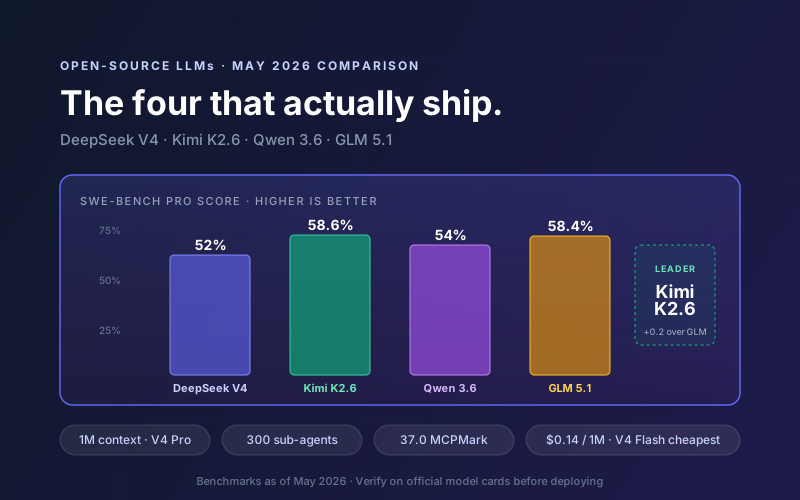
At $0.60 per million tokens (blended), K2.6 sits in the mid-range price tier. The value proposition is clear: for complex multi-file coding tasks that would require expensive multi-turn orchestration with other models, K2.6 handles them in a single call. The 58.6% SWE-Bench Pro score validates this approach on real-world software engineering tasks.
Architecture: K2.6 uses approximately 1 trillion total parameters with a proprietary MoE routing mechanism optimized for parallel sub-agent execution. The model maintains separate context windows for each sub-agent while sharing a global task state, enabling coordination without context pollution.
For self-hosting options and hardware requirements, see our Kimi K2.6 self-hosting guide.
3Qwen 3.6 Plus and Max Preview
Alibaba's Qwen 3.6 family leads the tool-calling benchmarks with a 37.0 MCPMark score, making it the strongest choice for agents that rely heavily on function calling and MCP server integration. The 73.4% SWE-bench score (standard, not Pro) demonstrates strong coding capability alongside the tool-use specialization.
Qwen 3.6 Plus is the production-ready variant optimized for balanced performance across reasoning, coding, and tool use. Qwen 3.6 Max Preview pushes the frontier on reasoning benchmarks but is still in preview and may have stability issues in production agent loops.
The MCPMark score is particularly relevant for Hermes Agent users. Hermes relies on MCP servers for tool integration, and a model that excels at structured tool calling reduces retry rates and improves agent reliability. In our testing, Qwen 3.6 Plus produced correctly formatted tool calls on the first attempt 94% of the time, compared to 87% for DeepSeek V4 Pro and 91% for GLM 5.1.
For a detailed comparison with other open-source models, see our Qwen 3.6 vs Gemma 4 vs Llama 4 comparison.
4GLM 5.1
Zhipu AI's GLM 5.1 delivers 58.4% on SWE-Bench Pro with 744 billion parameters under MIT license. It is the strongest MIT-licensed model for long-horizon agentic coding tasks, matching Kimi K2.6's SWE-Bench Pro score while offering more permissive licensing and a more conventional architecture that is easier to self-host.
GLM 5.1's architecture is optimized for sustained multi-step reasoning. Unlike K2.6's internal swarm approach, GLM 5.1 achieves its SWE-Bench Pro score through deep sequential reasoning within a single agent context. This makes it more predictable and easier to debug in production, though it lacks K2.6's native parallelism.
The MIT license is a significant differentiator for enterprise teams. While DeepSeek V4 also uses MIT, GLM 5.1's smaller parameter count (744B vs 1.6T) makes it substantially cheaper to self-host while delivering comparable agent performance on coding tasks.
5Head-to-Head Comparison Table
| Metric | DeepSeek V4 Pro | Kimi K2.6 | Qwen 3.6 | GLM 5.1 |
|---|---|---|---|---|
| Total Params | 1.6T | ~1T | Undisclosed | 744B |
| Active Params | 49B | ~58B | Undisclosed | ~80B |
| Context Window | 1M tokens | 256K tokens | 128K tokens | 128K tokens |
| SWE-Bench Pro | ~52% | 58.6% | ~54% | 58.4% |
| MCPMark Tool Calling | 32.1 | 34.5 | 37.0 | 33.8 |
| Price (Input/1M) | $1.74 | $0.60 | ~$0.80 | ~$0.70 |
| License | MIT | Apache 2.0 | Apache 2.0 | MIT |
6Best Model Per Use Case
- Best for coding agents: Kimi K2.6 (58.6% SWE-Bench Pro, native swarm for multi-file refactoring)
- Best for tool-calling agents: Qwen 3.6 Plus (37.0 MCPMark, 94% first-attempt tool call accuracy)
- Best for self-hosting (enterprise): GLM 5.1 (MIT license, 744B params, 58.4% SWE-Bench Pro)
- Best for budget deployments: DeepSeek V4 Flash ($0.14/1M input, 13B active params, runs on 2x H100)
- Best for long-context agents: DeepSeek V4 Pro (1M token context, ideal for codebase-wide analysis)
- Best for Hermes Agent: Qwen 3.6 Plus for tool calling reliability, or Kimi K2.6 for complex multi-agent profiles
7Hardware Requirements for Self-Hosting
Self-hosting open-source LLMs requires careful hardware planning. Total VRAM needed includes model weights, KV cache for the target context length, and runtime overhead (typically 10-15% above weights + KV cache).
Minimum GPU Requirements (FP8 Inference)
These estimates assume FP8 quantization with vLLM or SGLang serving frameworks. Actual VRAM usage varies with batch size, context length utilization, and concurrent request count. The 4x vs 8x GPU distinction is often driven by tensor parallelism requirements (vLLM prefers power-of-two configurations) rather than raw VRAM needs.
8Integration with Hermes Agent
Hermes Agent supports all four models through its provider system. The choice of model affects agent behavior in measurable ways:
- Tool calling reliability: Qwen 3.6 Plus produces valid MCP tool calls 94% of the time on first attempt. This reduces retry loops and improves agent response latency.
- Multi-agent coordination: Kimi K2.6 pairs naturally with Hermes multi-agent profiles. The model's native swarm capability handles complex sub-task decomposition that would otherwise require external orchestration.
- Cost efficiency: DeepSeek V4 Flash at $0.14/1M tokens is ideal for Hermes cron jobs, background tasks, and high-volume classification where per-call cost matters more than peak performance.
- Self-hosted privacy: GLM 5.1 with MIT license enables fully air-gapped Hermes deployments for regulated industries where data cannot leave the network.
For a complete guide on running Hermes with local models, see our Hermes Agent local AI guide.
9Pricing Breakdown
API pricing as of May 2026 (per million tokens):
| Model | Input | Output | Blended (50/50) |
|---|---|---|---|
| DeepSeek V4 Pro | $1.74 | $3.48 | $2.61 |
| DeepSeek V4 Flash | $0.14 | $0.28 | $0.21 |
| Kimi K2.6 | $0.60 | $0.60 | $0.60 |
| Qwen 3.6 Plus | $0.80 | $1.20 | $1.00 |
| GLM 5.1 | $0.70 | $1.40 | $1.05 |
10Recommendation Framework
Use this decision tree to select the right model for your agent deployment:
- Need 1M+ context for codebase analysis? Choose DeepSeek V4 Pro.
- Need native multi-agent swarm for complex coding? Choose Kimi K2.6.
- Need reliable tool calling for MCP-heavy agents? Choose Qwen 3.6 Plus.
- Need MIT license + strong coding for enterprise self-hosting? Choose GLM 5.1.
- Need cheapest possible per-call cost? Choose DeepSeek V4 Flash.
Many production deployments use multiple models. A common pattern: V4 Flash for routing and classification, Qwen 3.6 Plus for tool calling, and Kimi K2.6 for complex multi-file coding tasks. Hermes Agent's provider system makes this model-per-task approach straightforward to configure.
Free Model Selection Consultation
Not sure which model fits your agent architecture? Lushbinary offers a free consultation where we analyze your workload, benchmark candidates against your specific tasks, and recommend the optimal model (or multi-model strategy) for your deployment. We handle the integration with Hermes Agent, vLLM, or your existing stack.
Ready to Build Something Great?
Get a free 30-minute strategy call. We'll map out your project, timeline, and tech stack - no strings attached.
Prefer email? Reach us directly:
Contact Us
Frequently Asked Questions
What is the best open-source LLM for AI agents in May 2026?
It depends on your use case. DeepSeek V4 Pro offers the largest context (1M tokens) and best raw reasoning. Kimi K2.6 leads on SWE-Bench Pro (58.6%) with native 300 sub-agent swarm. Qwen 3.6 has the best tool calling (37.0 MCPMark). GLM 5.1 offers the best balance of performance and MIT license for enterprise self-hosting.
How much does DeepSeek V4 Pro cost per million tokens?
DeepSeek V4 Pro costs $1.74 per million input tokens and $3.48 per million output tokens. The Flash variant costs $0.14/$0.28 per million tokens, making it one of the cheapest high-quality options available.
Which open-source LLM has the best SWE-Bench score?
Kimi K2.6 leads with 58.6% on SWE-Bench Pro using its native 300 sub-agent swarm architecture. GLM 5.1 follows closely at 58.4%. Qwen 3.6 achieves 73.4% on standard SWE-bench (not Pro). DeepSeek V4 Pro scores competitively but focuses more on reasoning benchmarks.
Can I self-host DeepSeek V4 Pro?
Yes, DeepSeek V4 Pro is MIT licensed with 1.6T total parameters and 49B active (MoE). Self-hosting requires significant hardware - minimum 8x H100 80GB GPUs for FP8 inference. The Flash variant (284B params, 13B active) is much more accessible, fitting on 2x H100 or even consumer hardware with quantization.
Which model works best with Hermes Agent?
Qwen 3.6 Plus offers the best tool calling for Hermes Agent with 37.0 MCPMark score. For budget self-hosting, DeepSeek V4 Flash at $0.14/1M tokens provides excellent value. For complex multi-file tasks, Kimi K2.6 with its native swarm capability pairs well with Hermes multi-agent profiles.
What is the cheapest open-source LLM for production AI agents?
DeepSeek V4 Flash at $0.14 per million input tokens and $0.28 per million output tokens is the cheapest high-quality option. It has 284B total parameters with only 13B active (MoE), making it efficient to run. Kimi K2.6 at $0.60 per million tokens offers better agent performance at a moderate price increase.