
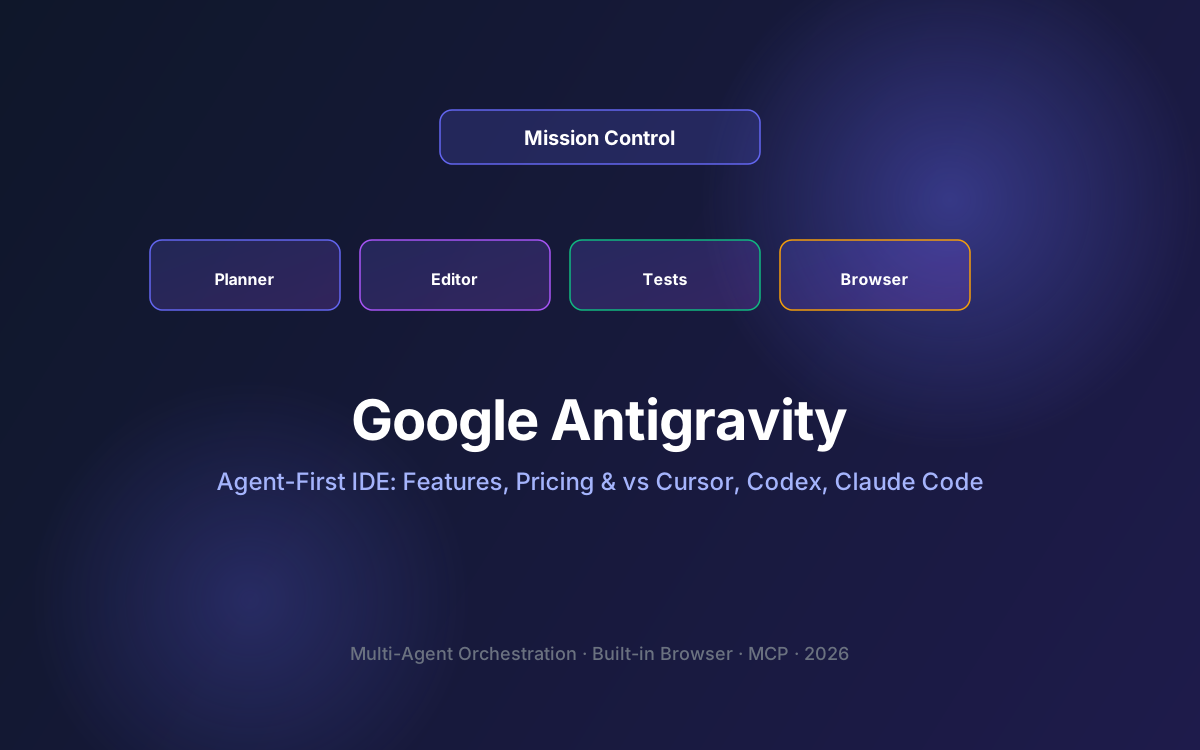
Google Antigravity arrived in November 2025 with a bold pitch: stop treating AI as an autocomplete sidekick and start treating it as a team of autonomous agents. Instead of a single chat pane glued to a code editor, Antigravity gives you a Mission Control surface where multiple agents plan, execute, and verify work in parallel across an editor, a terminal, and a full Chromium browser.
It runs on Gemini 3 Pro by default, with optional Claude Sonnet 4.5 and GPT-OSS models. The public preview is free for personal Google accounts, and Google AI Pro subscribers get enhanced access. But the story since launch has been bumpy: rate limit protests, a hasty shift to a credit-pack model in March 2026, and an evolving feature set that has added MCP support, custom rules, and workflows after launch.
This guide covers what Antigravity actually is, how the agent architecture works, how it compares to Cursor, Claude Code, Codex, and Kiro, what it costs today, and when it makes sense (and when it does not) for your team.
📑 What This Guide Covers
- What Antigravity Is and Why It Matters
- The Agent-First Architecture
- Mission Control and Parallel Agents
- Supported Models: Gemini 3 Pro, Claude, GPT-OSS
- Built-In Browser and Verification Loop
- Custom Rules, Workflows, and MCP
- Pricing in 2026
- Antigravity vs Cursor vs Codex vs Claude Code vs Kiro
- When to Pick Antigravity (and When Not To)
- How Lushbinary Integrates Antigravity
1What Antigravity Is and Why It Matters
Antigravity is Google's agent-first development platform. The core idea: software work is rarely a single edit. A real task spans planning, code changes, running tests, browsing docs, verifying UI behavior, and iterating. Most AI coding tools bolt an agent onto a single-threaded chat. Antigravity inverts that by making the agent orchestration surface the primary view.
📊 Antigravity at a Glance (May 2026)
Launched November 2025 · Public preview · macOS, Windows, Linux · Gemini 3 Pro default · Multi-agent Mission Control · Built-in Chromium · Free tier with rate limits · Google AI Pro $20/mo · Google AI Ultra $249.99/mo
The Antigravity value proposition rests on three things:
- Agent-first UI: Mission Control shows every active agent, its mission, current step, and output artifacts side by side.
- Parallel execution: Agents work concurrently on separate missions without blocking each other.
- Native browser verification: A full Chromium instance is embedded so agents can click through the app they just built, capture screenshots, and verify behavior.
2The Agent-First Architecture
Most IDE-first AI tools share one conversation with one agent. If you want parallel work, you open a new window. Antigravity collapses that into one canvas. A Mission is a user-defined goal. Each mission spawns an agent with its own plan, context, and artifact stream.
The critical design move: missions, agents, and surfaces are decoupled. The same planner agent can fan out work to several editor agents, each on a different file. A browser agent can run end-to-end checks while the test agent handles unit tests. Mission Control surfaces every artifact in one timeline so you can inspect what each agent produced.
3Mission Control and Parallel Agents
Mission Control is the part that justifies the "agent-first" label. A typical workflow:
- You describe a mission in natural language (for example, "refactor the checkout module to use the new payment API and update the tests").
- The Planner agent breaks it into steps, assigns steps to editor and test agents, and surfaces the plan for your review.
- Editor agents make code changes in parallel across multiple files.
- The Test agent runs the suite, reports failures back as artifacts, and agents iterate.
- The Browser agent exercises the updated flow end-to-end and captures screenshots.
- Every step is logged as an artifact you can diff, rerun, or discard.
⚠️ Rate Limits in Preview
Public preview rate limits have been aggressive, especially during peak US working hours. Google introduced credit packs at $25 for 2,500 credits in March 2026 to bridge the gap, though the credit-to-token conversion is not fully documented. Expect to hit limits on long multi-agent missions.
4Supported Models: Gemini 3 Pro, Claude, GPT-OSS
Antigravity is designed around Gemini 3 Pro, which handles planning, coding, and multimodal verification (screenshots, PDFs, UI mockups) in one model. You can also route specific missions to:
- Claude Sonnet 4.5: Stronger on long refactors, instruction-following, and code review style work.
- GPT-OSS: Open-weight OpenAI models for tasks where you prefer an open architecture.
- Gemini 3.1 Pro: For missions that benefit from deeper reasoning (ARC-AGI-2 77.1%, SWE-Bench Verified 80.6%). See our Gemini 3.1 Pro guide for benchmarks.
Model selection happens per-mission, not per-session. You can pin Gemini 3 Pro for most work and spin up a Claude Sonnet mission for a sensitive refactor, all in the same Antigravity window.
5Built-In Browser and Verification Loop
The embedded Chromium instance is Antigravity's strongest differentiator. Cursor, Claude Code, and Codex cannot drive a browser out of the box; they rely on MCP servers like Playwright to bridge that gap. Antigravity ships with it.
The browser agent can:
- Open a local dev server or staging URL and interact with forms, buttons, and modals.
- Capture screenshots at each step and diff them against expected output.
- Read DOM state, network requests, and console logs, and feed them back to the Planner for fix cycles.
- Verify accessibility basics (focus order, contrast) during the verification pass.
This verification loop is what makes multi-agent work feel reliable on frontend-heavy tasks. The Planner can demand a "browser check" step before marking a mission complete, which prevents the classic AI-coding failure mode of code compiling but the UI being broken.
6Custom Rules, Workflows, and MCP
At launch, Antigravity did not support MCP, which limited extensibility compared to Cursor, Kiro, and Claude Code. That changed. Antigravity now supports:
- Custom rules: Project-level guidelines the agents must follow (coding standards, preferred libraries, forbidden patterns).
- Workflows: Reusable mission templates that package a planner prompt, agent assignments, and verification steps.
- MCP servers: External tool integrations through the Model Context Protocol. GitHub, PostgreSQL, Linear, Slack, and custom servers all work.
7Pricing in 2026
| Tier | Price | What You Get |
|---|---|---|
| Public Preview | Free | Personal Google account, rate-limited, Gemini 3 Pro access |
| Google AI Pro | $20 / mo | Enhanced Antigravity access, higher limits |
| Google AI Ultra | $249.99 / mo | Highest limits, priority on frontier models, enterprise pilot |
| Credit Packs | $25 / 2,500 credits | Top-up for heavy use, credit-to-token ratio undocumented |
The credit-pack model was introduced in March 2026 after users protested aggressive rate limits. The unclear credit conversion has remained a point of friction. Compare this to Cursor Pro ($20/mo) and Claude Code Pro ($20/mo), both of which have more transparent usage limits.
8Antigravity vs Cursor vs Codex vs Claude Code vs Kiro
| Feature | Antigravity | Cursor | Codex | Claude Code | Kiro |
|---|---|---|---|---|---|
| Paradigm | Agent-first IDE | AI IDE | Cloud agent | Terminal agent | Spec-first IDE |
| Parallel agents | Native | Background Agents | Multi-agent desktop | Sub-agents | Hooks |
| Built-in browser | Yes | No | No | No | No |
| MCP support | Yes (added post-launch) | Yes | No | Yes | Yes |
| Default model | Gemini 3 Pro | Anthropic + others | o3 family | Claude Opus 4.7 | Bedrock models |
| Free tier | Preview (rate limits) | Limited | ChatGPT Plus | No | 50 credits/mo |
| Paid entry | $20/mo AI Pro | $20/mo Pro | $20/mo ChatGPT Plus | $20/mo Pro | $19/mo Pro |
For a deeper comparison of the full AI coding tool landscape, see our 2026 AI coding agents comparison.
9When to Pick Antigravity (and When Not To)
Good fit
- Frontend-heavy projects where browser verification matters.
- Greenfield prototyping where you want to explore a stack quickly.
- Solo developers and small teams already paying for Google AI Pro or Ultra.
- Tasks that genuinely benefit from parallel agents (large refactors, migrations, end-to-end feature builds).
Weak fit
- Regulated environments that need predictable cost, audit trails, and SLA-backed availability.
- Teams that rely on deep MCP ecosystems built up in Cursor or Claude Code.
- Cost-sensitive projects where rate limits or credit packs would bite.
- Backend-only work where the built-in browser delivers little value.
10How Lushbinary Integrates Antigravity
At Lushbinary, we treat AI coding tools as interchangeable parts of a broader workflow. For frontend-heavy client work, we often use Antigravity in Mission Control mode to parallelize UI builds with automated browser verification. For backend refactors, we route work to Claude Code or Cursor. For spec-driven production systems, we lean on Kiro.
If you want help selecting the right AI coding stack for your team, integrating Antigravity with your CI/CD and MCP servers, or training your developers on multi-agent workflows, we can help.
🚀 Free Consultation
Want to ship faster with an AI-augmented workflow? Lushbinary helps teams evaluate, deploy, and operationalize Antigravity, Cursor, Claude Code, and Kiro. We'll assess your stack and recommend the right mix, no obligation.
❓ Frequently Asked Questions
What is Google Antigravity and how does it work?
An agent-first AI development platform launched November 2025. It coordinates autonomous agents that plan, execute, and verify coding tasks across editor, terminal, and a built-in Chromium browser. Runs on Gemini 3 Pro, Claude Sonnet 4.5, or GPT-OSS.
How much does Antigravity cost in 2026?
Free during public preview with rate limits. Google AI Pro is $20/month, AI Ultra is $249.99/month. Credit packs available at $25 for 2,500 credits for heavy users.
How does it compare to Cursor, Codex, and Claude Code?
Antigravity's differentiators are native multi-agent orchestration and a built-in browser. Cursor is IDE-first, Codex is cloud-native, Claude Code is terminal-native. All except Codex support MCP. For a full breakdown see our 2026 AI coding agents comparison.
Does Antigravity support MCP servers?
Yes. MCP support, custom rules, and reusable workflows were added after launch. You can connect GitHub, PostgreSQL, Linear, Slack, and custom MCP servers.
Is it production-ready for teams?
As of May 2026, it's still a public preview with evolving pricing and rate-limit controversy. Great for prototyping and frontend-heavy work. For regulated production environments, mature alternatives like Claude Code or Kiro are safer.
📚 Sources
- Google Antigravity announcement
- Google AI Pro Antigravity access
- The Register: Antigravity credit-pack rollout
- Google Cloud: Antigravity vs Gemini CLI
Content was rephrased for compliance with licensing restrictions. Pricing and feature details sourced from official Google documentation and third-party reviews as of May 2026. Pricing and features may change, always verify on the official Antigravity site.
Ship Faster with Multi-Agent Workflows
Lushbinary helps teams evaluate and deploy agentic IDEs like Antigravity alongside Cursor, Kiro, and Claude Code. Let's talk about accelerating your next build.
Ready to Build Something Great?
Get a free 30-minute strategy call. We'll map out your project, timeline, and tech stack - no strings attached.
Prefer email? Reach us directly: