

The AI agent landscape has two clear frontrunners in May 2026: Hermes Agent from Nous Research and OpenClaw. Both are open-source, both support multiple LLM providers, and both connect to messaging platforms. But their architectures diverge on a fundamental question: should an agent learn and improve over time, or should it provide the largest possible ecosystem of static capabilities?
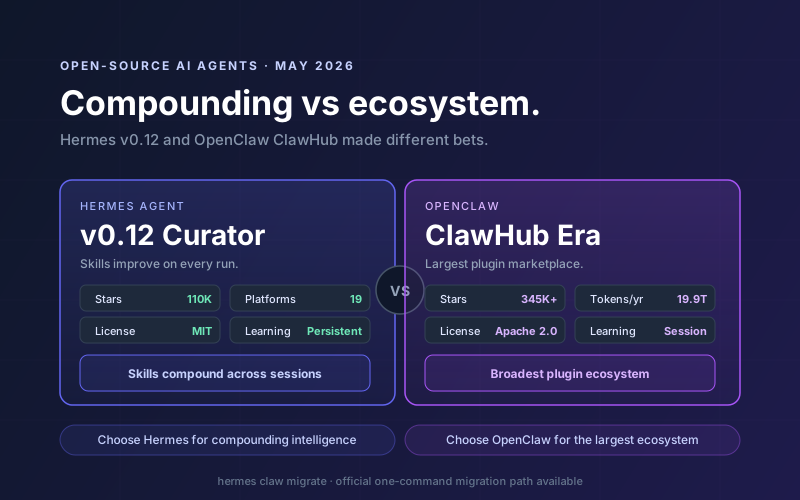
Hermes Agent v0.12 (Curator release) doubled down on self-improving skills with an autonomous Curator that maintains your skill library. OpenClaw launched ClawHub, a plugin marketplace that replaces its previous skills system with a centralized registry of community-built plugins. These are fundamentally different bets on what makes an agent valuable.
This comparison covers both agents as of May 2026, after Hermes v0.12 and OpenClaw's ClawHub migration. For the original comparison before these releases, see our Hermes vs OpenClaw key differences article.
Table of Contents
- 1.Hermes v0.12 Curator: What Changed
- 2.OpenClaw ClawHub: What Changed
- 3.Learning Architecture Comparison
- 4.Security Comparison
- 5.Provider and Platform Support
- 6.Performance and Cost
- 7.Community and Ecosystem
- 8.Migration Path
- 9.Decision Framework
- 10.Why Lushbinary for Agent Deployment
1Hermes v0.12 Curator: What Changed
Hermes Agent v0.12 shipped with 1,096 commits from 213 contributors. The headline feature is the Curator - an autonomous system that maintains your skill library without manual intervention. The Curator monitors skill usage patterns, identifies underperforming skills, suggests improvements, and can autonomously refactor skills based on rubric-based quality assessments.
Key v0.12 additions:
- Autonomous Curator: Maintains skill library, identifies degraded skills, suggests and applies improvements
- Rubric-based self-improvement: Complete rewrite of the learning system using structured rubrics instead of ad-hoc feedback
- 4 new providers: LM Studio, GMI Cloud, Azure AI Foundry, and a generic OpenAI-compatible endpoint
- 19 messaging platforms: Added Microsoft Teams, Google Meet, Spotify, and more
- 57% faster cold start: Optimized initialization pipeline
The 110,000 GitHub stars in 10 weeks reflects the community's appetite for a self-improving agent. Hermes is growing faster than any other open-source AI project in 2026 by star velocity.
2OpenClaw ClawHub: What Changed
OpenClaw's ClawHub migration represents a strategic shift from self-contained skills to a plugin marketplace model. ClawHub offers:
- Centralized plugin registry: One-click installation of community-built plugins with versioning and dependency management
- Plugin marketplace: Developers can publish, monetize, and maintain plugins independently
- Broader ecosystem: 345,000+ stars and 19.9 trillion tokens processed through OpenRouter demonstrate massive community adoption
- Session-native architecture: Each session starts fresh with configured plugins. No persistent learning between sessions.
The ClawHub approach prioritizes breadth over depth. Rather than having a few skills that improve over time, OpenClaw gives you access to hundreds of community plugins that cover nearly every use case. The trade-off: plugins do not learn from your usage patterns or adapt to your specific workflows.
3Learning Architecture Comparison
This is the fundamental architectural difference between the two agents:
Hermes: Compounding Intelligence
Skills improve with every interaction. The Curator monitors performance, identifies patterns, and autonomously refactors skills based on rubric assessments. After 30 days of use, a Hermes deployment is measurably better at your specific tasks than it was on day one.
OpenClaw: Session-Native Breadth
Each session starts with the same plugin configuration. No learning persists between sessions. The value comes from the breadth of available plugins and the size of the community maintaining them. Performance is consistent but does not compound.
Learning Architecture: Hermes vs OpenClaw Over Time
The crossover point matters. OpenClaw starts with higher baseline capability due to its larger plugin ecosystem. Hermes starts lower but improves continuously. For teams that plan to use an agent for months, Hermes's compounding advantage becomes significant. For teams that need immediate broad capability without a ramp-up period, OpenClaw's ecosystem delivers faster time-to-value.
4Security Comparison
Security posture differs significantly between the two agents:
| Dimension | Hermes Agent | OpenClaw |
|---|---|---|
| CVEs (as of May 2026) | 0 reported | Multiple (broader attack surface) |
| Skill/Plugin Execution | Sandboxed with explicit permissions | Community-audited via ClawHub |
| Default Permissions | Deny-by-default, explicit grants | Plugin-defined permissions |
| Supply Chain Risk | Lower (fewer dependencies) | Higher (large plugin ecosystem) |
| Audit Trail | Built-in action logging | Plugin-dependent |
Hermes's safer-by-default approach reflects its smaller, more controlled architecture. OpenClaw's broader ecosystem necessarily introduces more attack surface through third-party plugins. For security-sensitive deployments, Hermes's explicit permission model and zero-CVE track record provide stronger guarantees.
5Provider and Platform Support
Both agents support a wide range of LLM providers and messaging platforms:
- Hermes Agent: 19 messaging platforms (WhatsApp, Telegram, Slack, Discord, Microsoft Teams, Google Meet, Spotify, and more). Supports OpenAI, Anthropic, Google, LM Studio, GMI Cloud, Azure AI Foundry, Ollama, and any OpenAI-compatible endpoint.
- OpenClaw: Similar messaging platform coverage. 19.9 trillion tokens processed through OpenRouter demonstrates massive provider flexibility. Supports all major providers plus OpenRouter as a unified gateway.
Platform support is effectively at parity. The differentiator is not which platforms are supported but how the agent uses them. Hermes uses messaging platforms as skill-improvement feedback channels. OpenClaw uses them as stateless interaction endpoints.
6Performance and Cost
Performance comparison depends heavily on the underlying LLM and task type. However, the agent layer itself introduces overhead:
- Cold start: Hermes v0.12 starts in ~1.2 seconds (57% improvement over v0.11). OpenClaw cold start varies by plugin count but averages 2-4 seconds with a typical configuration.
- Token overhead: Hermes's skill system adds minimal token overhead (skills are loaded on-demand). OpenClaw plugins may inject context into every request depending on configuration.
- Cost: Both agents are free and open-source (MIT and Apache 2.0 respectively). The primary cost is the underlying LLM API usage, which is identical for both agents given the same provider and model.
Over time, Hermes's self-improving skills can reduce token usage by learning more efficient approaches to recurring tasks. This creates a compounding cost advantage that grows with usage duration.
7Community and Ecosystem
OpenClaw has the larger community by raw numbers: 345,000+ GitHub stars, 19.9 trillion tokens processed, and a mature plugin ecosystem through ClawHub. Hermes is growing faster (110K stars in 10 weeks) but from a smaller base.
The community dynamics differ:
- OpenClaw: Broader community, more plugins, more tutorials, more Stack Overflow answers. If you hit a problem, someone has likely solved it before.
- Hermes: Smaller but more focused community. Contributions tend toward skill quality and learning improvements rather than breadth. Nous Research provides active maintainer support.
For teams that value community support and ecosystem breadth, OpenClaw is the safer bet. For teams that value architectural innovation and are comfortable with a newer project, Hermes offers more upside. For a detailed comparison of both alongside other agents, see our best self-hosted AI agents comparison.
8Migration Path
Hermes provides an official migration tool for OpenClaw users:
# Migrate from OpenClaw to Hermes Agent
hermes claw migrate --source ~/.openclaw/config.yaml

# What it does:
# 1. Imports provider configurations
# 2. Converts compatible skills to Hermes format
# 3. Maps messaging channel configurations
# 4. Preserves cron job schedules
# 5. Generates a migration report with manual steps

# Verify migration
hermes doctor
hermes skills list
The migration is not lossless. OpenClaw plugins that rely on ClawHub-specific APIs will not convert automatically. However, core functionality (messaging, provider config, scheduling) transfers cleanly. For a complete migration walkthrough, see our OpenClaw to Hermes migration guide.
9Decision Framework
Choose Hermes Agent if:
- You want compounding intelligence that improves over time
- You need rubric-based self-improvement for your workflows
- Security is a top priority (zero CVEs, sandboxed execution)
- You plan to use the agent for months and want it to learn your patterns
- You value faster cold start and lower token overhead
Choose OpenClaw if:
- You want the largest ecosystem and community (345K+ stars)
- You need the broadest plugin selection via ClawHub
- You do not need persistent learning between sessions
- You value community support and existing tutorials
- You want maximum provider flexibility through OpenRouter
The short version: choose Hermes if you want compounding intelligence. Choose OpenClaw if you want the largest ecosystem and do not need persistent learning.
10Why Lushbinary for Agent Deployment
Whether you choose Hermes or OpenClaw, deploying a production agent requires infrastructure, security hardening, and integration work that goes beyond installing the package. Lushbinary handles:
- Agent selection: We analyze your workflows and recommend the right agent (or combination) for your use case
- Production deployment: AWS infrastructure, Docker orchestration, monitoring, and alerting
- Security hardening: Sandboxing, permission configuration, and vulnerability scanning
- Custom skill/plugin development: Building domain-specific capabilities for your team
- Migration support: Moving between agents or upgrading existing deployments
Free Agent Assessment
Not sure whether Hermes or OpenClaw fits your team? Lushbinary offers a free assessment where we analyze your workflows, evaluate both agents against your requirements, and recommend the optimal deployment strategy. Includes a proof-of-concept with your actual use cases.
Ready to Build Something Great?
Get a free 30-minute strategy call. We'll map out your project, timeline, and tech stack - no strings attached.
Prefer email? Reach us directly:
Contact Us
Frequently Asked Questions
What is the main difference between Hermes Agent and OpenClaw in May 2026?
The core difference is learning architecture. Hermes Agent v0.12 uses rubric-based self-improvement where skills compound over time through the Curator system. OpenClaw with ClawHub is session-native - it has the largest plugin ecosystem but does not retain learning between sessions. Choose Hermes for compounding intelligence, OpenClaw for the largest community and ecosystem.
How many GitHub stars does Hermes Agent have?
Hermes Agent reached 110,000 GitHub stars in just 10 weeks after its initial release, making it one of the fastest-growing open-source projects in 2026. OpenClaw has 345,000+ stars accumulated over a longer period.
What is ClawHub and how does it replace OpenClaw skills?
ClawHub is OpenClaw's new plugin marketplace that replaces the previous skills system. It offers a centralized registry of community-built plugins with one-click installation, versioning, and dependency management. Unlike Hermes skills which self-improve, ClawHub plugins are static packages that receive manual updates from their maintainers.
Is Hermes Agent more secure than OpenClaw?
Hermes Agent has a safer-by-default architecture with no reported CVEs as of May 2026. OpenClaw has had multiple CVEs related to its broader attack surface from supporting more integrations. Hermes uses sandboxed skill execution and explicit permission grants, while OpenClaw relies on community-audited plugins through ClawHub.
Can I migrate from OpenClaw to Hermes Agent?
Yes, Hermes provides an official migration tool: 'hermes claw migrate'. It imports your OpenClaw configuration, converts compatible skills to Hermes format, and maps messaging channel configurations. The migration preserves your automation workflows while adding Hermes's self-improving skill system.
Which agent should I choose for my team?
Choose Hermes Agent if you want compounding intelligence where the agent gets better over time, need rubric-based learning, or want safer-by-default security. Choose OpenClaw if you want the largest ecosystem and community (345K+ stars, 19.9T OpenRouter tokens), need the broadest plugin selection via ClawHub, or do not need persistent learning between sessions.