
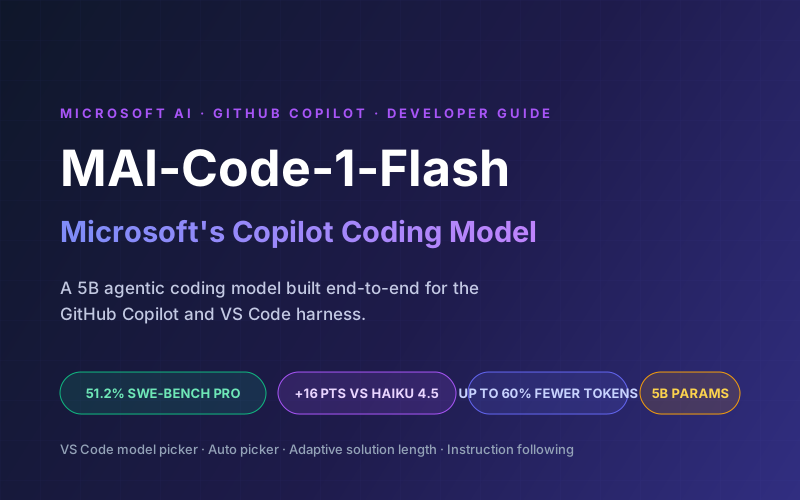
Most coding models are optimized for benchmarks. MAI-Code-1-Flash was optimized for the editor you actually work in. Announced at Build 2026 as part of Microsoft's seven-model MAI family, it is a small, fast, agentic coding model built end-to-end for the GitHub Copilot and VS Code harness. At just 5 billion parameters it is designed to be cheap to run, quick to respond, and unusually efficient with tokens.
The numbers back up the pitch. Microsoft reports MAI-Code-1-Flash beats Claude Haiku 4.5 across every core coding benchmark it tested, including a 16-point lead on the real-world tasks of SWE-Bench Pro, while using up to 60% fewer tokens on SWE-Bench Verified. For developers, that combination of higher accuracy and lower token spend is the whole point: faster feedback loops at lower cost.
This guide covers what makes MAI-Code-1-Flash different, the published benchmarks, how adaptive solution length works, and how to start using it in VS Code. For the full MAI lineup, see our Microsoft MAI models developer guide.
What This Guide Covers
1What MAI-Code-1-Flash Is
MAI-Code-1-Flash is a 5 billion parameter agentic coding model. Where MAI-Thinking-1 is the heavyweight reasoning flagship, Code-1-Flash is the lightweight workhorse, designed for the high-frequency, everyday coding requests that make up most of a developer's day. Microsoft built it end-to-end on clean, appropriately licensed data, with the explicit goal of high-quality coding help at better efficiency.
The three capabilities Microsoft highlights are agentic coding in real developer environments, adaptive thinking that scales reasoning budget to task difficulty, and strong instruction-following across both single-turn and multi-turn scenarios. In other words, it is built to act inside the editor, not just answer questions about code.
2Built for the Copilot Harness, Not Benchmarks
The most important design decision behind MAI-Code-1-Flash is that Microsoft trained it directly against the GitHub Copilot harness used in production, rather than optimizing only for offline benchmarks. That means the model learned to interact with the surrounding tools and systems that agentic coding actually requires: invoking commands, reading repository context, and working through multi-step tasks the way Copilot orchestrates them.
During training, Microsoft evaluated checkpoints across core software engineering tasks, repository question answering, refactoring, and telemetry-grounded tasks adapted from real GitHub Copilot usage. The payoff of aligning training, evaluation, and production is that offline gains translate into real-world developer quality instead of evaporating when the model hits a real codebase.
Why harness-specific training matters
A model that scores well on SWE-Bench in isolation can still fumble inside a real agent loop if it has not learned the tool-calling conventions and recovery behaviors that loop depends on. By training inside the Copilot harness, MAI-Code-1-Flash is tuned for the exact environment where developers will use it.
3Adaptive Solution Length: Value per Token
MAI-Code-1-Flash was trained with what Microsoft calls adaptive solution length control. The model adjusts the depth of its response to the task: it stays concise for simple requests and spends more reasoning budget when a problem needs deeper analysis or broader code changes. The practical effect is that developers start seeing useful output sooner.
Microsoft reports the model solving harder problems with up to 60% fewer tokens. That efficiency compounds in three ways: lower latency, lower cost, and smoother interactive workflows. For teams running coding assistance at scale, token efficiency is often the difference between a tool that is economical to deploy broadly and one that gets rationed.
The efficiency math
If a model solves the same task in 60% fewer output tokens, you pay for roughly 40% of the output you would otherwise. Across thousands of daily requests per developer, that is a large, recurring saving, and it is the core of Microsoft's price-to-performance argument for Code-1-Flash.
4Benchmarks vs Claude Haiku 4.5
Microsoft positions MAI-Code-1-Flash against Claude Haiku 4.5, a model in the same lightweight, fast tier. All evaluations were run in the same production harness developers use, measuring both task success and the average tokens needed to complete each task. The figures below are vendor-reported.
| Benchmark | MAI-Code-1-Flash | Claude Haiku 4.5 |
|---|---|---|
| SWE-Bench Pro | 51.2% | 35.2% |
| SWE-Bench Verified | Higher pass rate, up to 60% fewer tokens | Baseline |
| SWE-Bench Multilingual | Higher | Baseline |
| Terminal Bench 2 | Higher | Baseline |
| IF Bench (precise instruction following) | +28.9 pts | Baseline |
| Advanced IF (rubric-based) | +14.5 pts | Baseline |
The standout result is SWE-Bench Pro, where MAI-Code-1-Flash scores 51.2% against Haiku 4.5's 35.2%, a 16-point lead on diverse, real-world tasks. Microsoft also reports the model leads on every instruction-following benchmark tested, with the widest margin on IF Bench precise instruction following at +28.9 points, and that this strength carries over into agentic tool use. It additionally beats Haiku 4.5 on math, science, and visual generation coding.
Microsoft also built a 186-question, 34-category adversarial benchmark around traps like inverted classic puzzles, impossible tasks, and underdetermined scenarios, to test whether models reason or just pattern-match. MAI-Code-1-Flash reached 85.8% adjusted accuracy overall and surpassed Haiku 4.5, with particular strength in recognizing impossible problems.
5Getting Started in VS Code
MAI-Code-1-Flash is rolling out to GitHub Copilot individual users in Visual Studio Code, and no additional setup is required. As the rollout reaches your account, you will see it become available in two places.
# Using MAI-Code-1-Flash in VS Code Copilot

1. Update VS Code and the GitHub Copilot extension
2. Open the Copilot Chat model picker
3. Select "MAI-Code-1-Flash" if listed
   - or leave the Auto picker on; Copilot may
     route suitable tasks to it automatically
4. Use Copilot Chat / agent mode as usual
Because the model is integrated into the default Auto picker, you may already be using it without selecting it manually. Microsoft is gathering developer feedback through the GitHub Community discussions. If you want to compare it against other coding tools, our AI coding agents comparison is a useful reference.
6Limitations & Honest Caveats
MAI-Code-1-Flash is a small model, and Microsoft is candid about the tradeoffs. On its own adversarial benchmark, core categories like Einstellung traps (where a familiar approach blocks a simpler solution) remained below 50% accuracy. That is a useful honesty signal: the model is strong for its size, but it is not a frontier reasoning model.
- Reach for a larger model on hard reasoning. For deep architectural work or gnarly multi-system debugging, a heavier model like MAI-Thinking-1 or a frontier model will often be worth the extra cost.
- Benchmarks are vendor-reported. Independent third-party evaluations had not landed at launch, so validate against your own repositories before standardizing on it.
- Availability is rolling out. At launch it targets GitHub Copilot individual users in VS Code; broader API access and other surfaces may follow.
The right mental model is a fast, efficient first responder: let Code-1-Flash handle the bulk of routine coding, and escalate the hard problems to a larger model. That is exactly the kind of tiering our model routing guide is built around.
7Where MAI-Code-1-Flash Fits
Code-1-Flash shines on the high-frequency tasks that dominate a working day:
- Inline edits and refactors where speed and low latency matter more than deep reasoning
- Repository question answering and quick explanations of unfamiliar code
- Routine agentic tasks inside Copilot: running tests, applying small multi-file changes, fixing build errors
- High-volume coding assistance where token efficiency keeps the cost of broad rollout manageable
8Why Lushbinary for AI Coding Workflows
Getting real value from coding models is about workflow design, not just picking a model. Lushbinary helps engineering teams build the guardrails, routing, and evaluation that turn AI coding tools into reliable productivity gains rather than a source of subtle bugs.
- Coding-model evaluation - benchmark MAI-Code-1-Flash and alternatives against your real repositories
- Tiered routing - route routine work to fast models and escalate hard tasks to frontier models behind one gateway
- Copilot & agent integration - wire AI coding into your CI, review, and testing workflows safely
- Quality gates - automated review and security scanning so AI-generated code meets your standards
🚀 Free Consultation
Want to roll out AI coding assistance the right way? Lushbinary will assess your workflow, recommend a model mix that balances speed and quality, and help you ship with confidence, no obligation.
9Frequently Asked Questions
What is MAI-Code-1-Flash?
MAI-Code-1-Flash is Microsoft's inference-efficient agentic coding model, announced at Build 2026. It is a 5 billion parameter model built end-to-end by Microsoft and tailor-made for the GitHub Copilot and VS Code harness, designed for fast, token-efficient coding assistance in everyday developer workflows.
How does MAI-Code-1-Flash compare to Claude Haiku 4.5?
Microsoft reports MAI-Code-1-Flash outperforms Claude Haiku 4.5 across SWE-Bench Verified, SWE-Bench Pro, SWE-Bench Multilingual, and Terminal Bench 2, with a +16-point lead on SWE-Bench Pro (51.2% vs 35.2%). It also solves harder problems with up to 60% fewer tokens on SWE-Bench Verified.
How do I use MAI-Code-1-Flash?
MAI-Code-1-Flash is rolling out to GitHub Copilot individual users in Visual Studio Code. No extra setup is required. As the rollout progresses, GitHub Copilot may route tasks to it through the Auto picker, or you can select it directly in the model picker.
Why is MAI-Code-1-Flash so token-efficient?
It was trained with adaptive solution length control, so it stays concise for simple requests and spends more reasoning budget on complex tasks. Microsoft reports this lets it solve harder problems with up to 60% fewer tokens, which lowers cost and latency while keeping interactive workflows smooth.
Is MAI-Code-1-Flash good at instruction following?
Yes. Microsoft reports MAI-Code-1-Flash beats Claude Haiku 4.5 on every instruction-following benchmark it tested, with the widest margin on IF Bench precise instruction following (+28.9 points). It reached 85.8% adjusted accuracy on a 186-question adversarial reasoning benchmark, though some categories like Einstellung traps stayed below 50%.
📚 Sources
- Microsoft AI - Introducing MAI-Code-1-Flash
- Microsoft AI - Building a hill-climbing machine
- GitHub Community - MAI-Code-1-Flash feedback discussion
Content was rephrased for compliance with licensing restrictions. Benchmark figures, token-efficiency claims, and availability sourced from official Microsoft AI announcements as of June 2, 2026. All benchmark numbers are vendor-reported and may change - always verify on Microsoft's website.
Rolling Out AI Coding Tools?
From model evaluation to tiered routing and quality gates, Lushbinary helps teams adopt AI coding assistance that is fast, cost-efficient, and safe. Let's talk about your workflow.
Ready to Build Something Great?
Get a free 30-minute strategy call. We'll map out your project, timeline, and tech stack - no strings attached.
Prefer email? Reach us directly: