
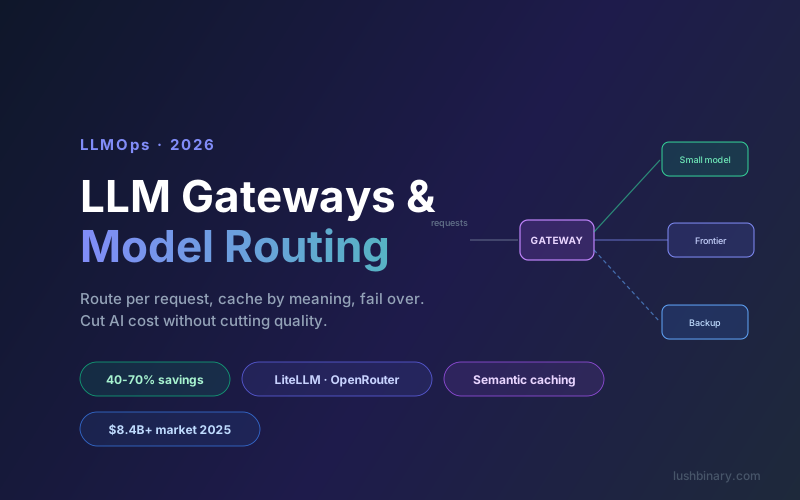
LLM API spending is exploding. Industry estimates put enterprise model API spend past $8.4 billion in 2025, with projections climbing well beyond that through 2026, and most teams have no systematic strategy to control it. They hardcode a single frontier model, send every request to it regardless of difficulty, and watch the bill climb while latency degrades the user experience at scale.
The fix is architectural. By 2026, every serious AI product routes per request, falls over to a backup provider when the primary one blinks, and treats the choice of model as a runtime decision rather than a hardcoded constant. The component that makes this possible is the LLM gateway: a layer between your app and model providers that centralizes routing, caching, failover, cost tracking, and governance behind a single API.
This guide explains what an LLM gateway does, the routing strategies that cut cost without cutting quality, how semantic caching works, how to compare the leading gateways in 2026, and a reference architecture you can adopt. If your LLM bill is growing faster than your usage, this is where you start.
🚦 What This Guide Covers
1What an LLM Gateway Actually Does
An LLM gateway sits between your application code and model providers. Your app calls one API; the gateway handles everything behind it. It centralizes the five concerns every team rediscovers the hard way: multi-model routing, cost observability, semantic caching, resilience and failover, and quality monitoring. Without a gateway, each of these ends up half-implemented and scattered across your codebase.
| Concern | What the Gateway Provides |
|---|---|
| Routing | Per-request model choice by cost, complexity, or domain |
| Caching | Semantic and exact caches that skip redundant calls |
| Resilience | Automatic retries and failover to backup providers |
| Observability | Per-request cost, latency, and token tracking |
| Governance | Budgets, rate limits, key management, access control |
The single most valuable thing a gateway buys you is decoupling. When your app talks to one stable interface instead of a specific provider's SDK, switching models, adding a fallback, or routing by cost becomes a configuration change rather than a refactor. That is what makes the choice of model a runtime decision.
2Routing Strategies That Cut Cost
Routing is where the savings come from. The core idea: simpler models suffice for routine queries, while complex tasks demand more capable models. A router directs each request to the right one. The main strategies, often combined:
- Complexity-based routing - classify the request and send easy ones to a cheap or local model, hard ones to a frontier model. The highest-leverage strategy for most products.
- Cost-based routing - pick the cheapest model that clears a quality bar for the task type, within a budget.
- Cascading - try the cheap model first, and escalate to a stronger one only when the cheap output fails a quality check. Pays the premium only when needed.
- Latency-based routing - send latency-sensitive interactive requests to fast models, batch or background work to cheaper, slower ones.
- Domain routing - direct code to a coding-specialized model, vision to a multimodal model, and so on.
The economic case is concrete. Consider a workload of 1 million requests per day where 80 percent are simple and 20 percent are complex. Routing all of it to a frontier model at a blended $15 per million tokens, with 2,500 tokens per request, costs roughly:
Total tokens/day = 1,000,000 x 2,500 = 2.5B tokens

All frontier ($15/M blended):
  2,500 M-tokens x $15 = $37,500/day

Routed (80% to a $1.50/M small model, 20% frontier):
  simple:  2.0B tokens x $1.50/M = $3,000/day
  complex: 0.5B tokens x $15/M   = $7,500/day
  ------------------------------------------------
  total: $10,500/day

Savings: ~72% ($27,000/day)
The exact percentage depends on your simple-to-complex ratio and the price gap between models, but the shape holds: moving the bulk of routine traffic off the frontier model is the biggest single lever on your bill. This is the same logic behind the heterogeneous architecture in our small language models guide, now applied at the gateway layer.
⚠️ Route on Measured Quality
Aggressive routing only works if you verify the cheap model actually handles the requests you send it. Pair routing with an eval suite so you know quality holds on each route. Routing without measurement saves money and loses customers. See our eval-driven development guide.
3Semantic Caching and Other Cost Levers
Routing is the biggest lever, but a gateway centralizes several others that compound. Semantic caching is the standout. A literal cache only hits when text matches exactly. A semantic cache recognizes when an incoming prompt means the same thing as a previous one, even when worded differently, and returns the cached response instead of making a new API call. On workloads with repetitive intent, like support FAQs or common queries, this cuts both token spend and latency significantly.
The other levers a gateway-level approach centralizes:
- Prompt caching passthrough - preserve provider-side prompt caching by keeping stable prefixes, so cached tokens get steep discounts.
- Token and agent budget management - cap tokens per request and per session to stop runaway agent loops from burning the budget.
- Governance - hierarchical budgets, per-team and per-project limits, and alerts before you blow past a threshold.
- Observability - per-request cost and token attribution so you can see which features and teams drive spend.
💡 Watch the Overhead
A gateway adds a hop, so its own latency matters. The fastest production gateways add only microseconds of overhead even at thousands of requests per second. When evaluating one, measure its added latency under your real load, because a slow gateway can erase the latency wins from caching and routing.
4Comparing the Leading Gateways
The 2026 gateway market has several production-ready options. They differ on performance overhead, model coverage, caching, governance, and the self-host versus managed tradeoff. A high-level comparison:
| Gateway | Model | Best For |
|---|---|---|
| LiteLLM | Open-source, self-host | Flexible proxy with broad provider support |
| OpenRouter | Managed | One API across a very large model catalog |
| Cloudflare AI Gateway | Managed, edge | Edge caching for teams already on Cloudflare |
| Kong AI Gateway | Self-host / enterprise | API-management teams extending an existing gateway |
| Microsoft Foundry router | Managed, platform | Trained router dispatching across many models per prompt |
There is no single best choice. If you live on Cloudflare, its edge gateway is the path of least resistance. If you want full control and self-hosting, LiteLLM is the common open-source pick. If you want the widest model catalog with zero infrastructure, OpenRouter. The right answer depends on your existing stack, your governance needs, and whether you can run infrastructure. Evaluate two or three against your real traffic before committing.
5A Reference Gateway Architecture
Here is how the pieces fit. A request enters the gateway, hits the cache, gets routed by complexity, and falls over to a backup if the chosen provider fails, all while cost and latency are logged.
The order matters: check the cache before routing, because a cache hit skips the model call entirely. Route by complexity, attempt the chosen provider, and fall over to a backup on failure. Log cost and latency on every path so the savings are visible. Layer governance (budgets, rate limits) across the whole thing.
6Build vs Buy and Common Pitfalls
Should you adopt an existing gateway or build your own? For most teams, adopt. The mature gateways have solved caching, failover, and observability already, and reinventing them is rarely a good use of engineering time. Build only if you have requirements none of them meet, such as highly custom routing logic or strict data-residency constraints, and even then consider extending an open-source gateway rather than starting from scratch.
The pitfalls that bite teams:
- Routing without evals. Sending hard requests to a cheap model to save money, then quietly degrading quality. Always verify each route holds.
- Stale cache returning wrong answers. Semantic caching on requests that depend on fresh or personalized data returns outdated responses. Scope what is cacheable carefully.
- Single point of failure. A self-hosted gateway with no redundancy becomes the thing that takes everything down. Make the gateway itself highly available.
- Ignoring gateway latency. A slow gateway erases the latency wins from caching. Measure its overhead under real load.
- No cost attribution. A gateway without per-team or per-feature cost tracking hides which part of the product drives spend. Turn on attribution from day one.
💡 Start With Observability
Before optimizing, measure. Put a gateway in place purely for cost and latency visibility first. The data will show you exactly which requests to route, what to cache, and where the spend actually goes, so your routing rules are grounded in your real traffic instead of guesses.
7Why Lushbinary for Cost-Aware AI
An LLM gateway is one of the highest-ROI pieces of infrastructure you can add to an AI product, and getting the routing and caching right is where the savings live. Lushbinary designs and deploys gateway architectures that cut LLM spend without cutting quality, with the observability to prove it. We work across managed and self-hosted options and tune routing to your real traffic.
- Cost audit - we profile your LLM spend and find the routing and caching opportunities hiding in your traffic
- Gateway selection and setup - LiteLLM, OpenRouter, Cloudflare, or a custom build, matched to your stack and governance needs
- Routing and caching - complexity-based routing, cascading, and semantic caching tuned and validated with evals
- Resilience and observability - failover, budgets, rate limits, and per-feature cost attribution built in
🚀 Free Consultation
Watching your LLM bill climb? Lushbinary will audit your AI spend, estimate the savings from routing and caching, and lay out a gateway architecture that keeps quality high, with no obligation.
8Frequently Asked Questions
What is an LLM gateway?
An LLM gateway is a layer that sits between your application and model providers, exposing a single API while centralizing the concerns every team rediscovers the hard way: multi-model routing, cost observability, semantic caching, resilience and failover, and quality monitoring. It lets you treat the choice of model as a runtime decision instead of a hardcoded constant.
What is LLM model routing?
Model routing is the practice of directing each request to the most appropriate model based on complexity, cost, latency, or domain. Simple prompts go to a cheap or local model, hard prompts go to a frontier model, and the router makes that choice per request. Done well it cuts cost substantially without hurting quality on the requests that matter.
How does semantic caching reduce LLM costs?
Semantic caching recognizes when an incoming prompt means the same thing as a previous one, even if worded differently, and returns the cached response instead of making a new API call. Because it matches on meaning rather than exact text, it catches far more repeats than a literal cache, cutting both token spend and latency on repetitive workloads.
What are the leading LLM gateways in 2026?
Commonly compared production gateways in 2026 include LiteLLM, OpenRouter, Cloudflare AI Gateway, Kong AI Gateway, and Bifrost, alongside platform-level options like Microsoft Foundry's model router. They differ on performance overhead, number of supported models, caching, governance features, and whether you self-host or use a managed service.
Why do production AI products need fallbacks?
Model providers have outages, rate limits, and latency spikes. Without a fallback, a provider blip takes your feature down. A gateway lets you automatically retry on a backup provider or model when the primary fails, turning a hard dependency on one vendor into a resilient multi-provider setup.
📚 Sources
- Maxim AI - Top 5 LLM Gateways in 2026: A Production-Ready Comparison
- LiteLLM - Routing Documentation
- Cloudflare - AI Gateway Documentation
- Microsoft - Architecting Cost-Aware LLM Workloads with Model Router
Content was rephrased for compliance with licensing restrictions. Market figures, gateway capabilities, and routing patterns sourced from official vendor documentation and independent engineering publications as of May 2026. Cost examples are illustrative calculations based on representative pricing, always model your own traffic and verify current vendor pricing. Feature sets change, confirm with each vendor.
Cut Your LLM Bill, Keep the Quality
Lushbinary designs LLM gateway architectures with smart routing, semantic caching, and failover that cut spend without cutting quality. Let's talk about your AI costs.
Ready to Build Something Great?
Get a free 30-minute strategy call. We'll map out your project, timeline, and tech stack - no strings attached.
Prefer email? Reach us directly: