
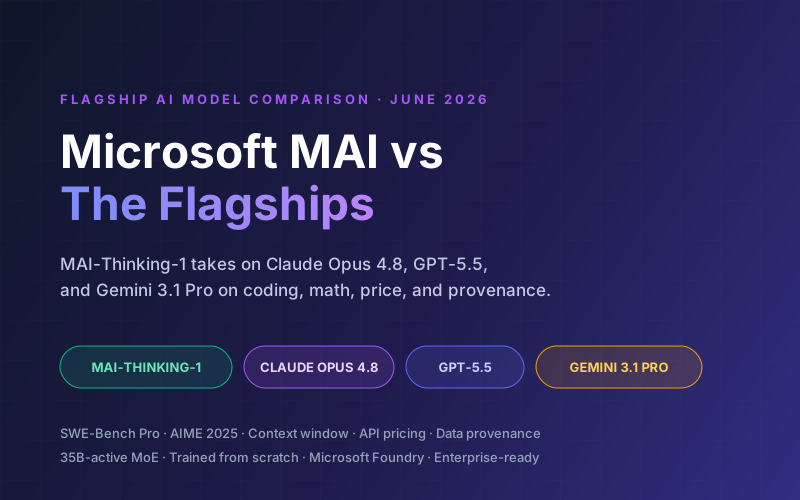
Updated June 3, 2026. Microsoft launched its first in-house reasoning model, MAI-Thinking-1, at Build 2026 on June 2. This comparison pits it against the current flagships: Claude Opus 4.8 (May 28), GPT-5.5 (April 23), and Gemini 3.1 Pro (Feb 19). All figures are vendor-reported and verified against official model cards and pricing pages as of June 3, 2026.
For years, Microsoft's AI story was someone else's model. Copilot ran on OpenAI, then later added Anthropic. At Build 2026, Microsoft changed the narrative: it shipped seven homegrown MAI models, led by MAI-Thinking-1, its first in-house reasoning model. The pitch is bold but specific. This is not a GPT-killer. It is a 35B-active Mixture of Experts model, trained from scratch with zero distillation, that Microsoft claims goes toe-to-toe with Claude Opus 4.6 on real software engineering tasks.
So how does Microsoft's new flagship actually stack up against the models developers reach for today? In this guide we put MAI-Thinking-1 head-to-head with Claude Opus 4.8, GPT-5.5, and Gemini 3.1 Pro across the things that matter: architecture, coding benchmarks, math and reasoning, context window, pricing, data provenance, and ecosystem.
The short version: MAI-Thinking-1 does not top the leaderboard, and Microsoft is not pretending it does. Its real story is efficiency, clean data lineage, and tight Microsoft Foundry integration. Whether that beats a higher benchmark score depends entirely on what you are building. Let's get into the numbers. For a deeper look at the model itself, see our MAI-Thinking-1 developer guide.
📋 Table of Contents
- Meet the Four Contenders
- Architecture & Specs at a Glance
- Coding Benchmarks: SWE-Bench Pro & Verified
- Math & Reasoning: AIME and GPQA
- Context Window & Throughput
- Pricing: What Each Model Costs
- Data Provenance: Microsoft's Real Differentiator
- Availability & Ecosystem
- Which Model Should You Choose?
- How Lushbinary Helps You Pick & Integrate
- Frequently Asked Questions
- Sources
1Meet the Four Contenders
These are the four flagship reasoning-capable models in play as of June 2026, each from a different lab with a different philosophy.
MAI-Thinking-1
June 2, 2026Microsoft AI
First in-house reasoning model. 35B-active sparse MoE, trained from scratch with no distillation. Built for clean data provenance and Foundry integration.
Claude Opus 4.8
May 28, 2026Anthropic
The agentic coding leader. Tops SWE-Bench Pro, ships Dynamic Workflows in Claude Code, and runs on a 1M-token context window.
GPT-5.5
April 23, 2026OpenAI
The default ChatGPT model. Strong on terminal/CLI work, computer use, and broad tooling, with a roughly 1M-token API context window.
Gemini 3.1 Pro
Feb 19, 2026Google DeepMind
The price-performance king. Native multimodal, 1M-token context, and the lowest per-token cost among the major labs.
A note on fair comparison
Every number below is self-reported by the vendor that published it, run on that vendor's own harness. Scaffolding, retries, and prompt formatting differ between labs, and self-reported figures tend to flatter the publisher. Microsoft compared MAI-Thinking-1 to Claude Opus 4.6 and Sonnet 4.6, not to the newer Opus 4.8. Read these as directional signals, not as a single controlled experiment.
2Architecture & Specs at a Glance
The headline architectural story is size. MAI-Thinking-1 is a sparse Mixture of Experts model that activates only about 35 billion of its roughly 1 trillion parameters per token. That keeps inference cheaper than a dense frontier model of comparable quality, at the cost of a smaller context window than its rivals.
| Spec | MAI-Thinking-1 | Claude Opus 4.8 | GPT-5.5 | Gemini 3.1 Pro |
|---|---|---|---|---|
| Vendor | Microsoft AI | Anthropic | OpenAI | Google DeepMind |
| Architecture | Sparse MoE (~35B active / ~1T total) | Not disclosed | Not disclosed | Not disclosed |
| Context window | 256K | 1M | ~1M (1.05M listed) | 1M (1,048,576) |
| Max output | Not disclosed | 128K | 128K | ~64K |
| Model type | Reasoning | Reasoning / hybrid | Reasoning / hybrid | Reasoning / multimodal |
| Multimodal input | Text | Text + image | Text + image + audio | Text + image + audio + video |
| Released | Jun 2, 2026 | May 28, 2026 | Apr 23, 2026 | Feb 19, 2026 |
The takeaway: MAI-Thinking-1 is the only model here that publishes its architecture in detail, and the only one that is text-only and capped at a 256K context window. The other three are larger-context, multimodal frontier models. Microsoft is competing on a different axis, efficiency and provenance, rather than trying to win the spec sheet.
3Coding Benchmarks: SWE-Bench Pro & Verified
Coding is where MAI-Thinking-1 was positioned most aggressively. Microsoft says it is "toe-to-toe with Claude Opus 4.6" on SWE-Bench Pro, a benchmark that measures how well an agent resolves complex, multi-step coding tasks. Here is how the vendor-reported SWE-Bench Pro numbers line up.
| Model | SWE-Bench Pro | Note |
|---|---|---|
| Claude Opus 4.8 | 69.2% | Current agentic coding leader (Anthropic) |
| GPT-5.5 | 58.6% | Standard tier (OpenAI / Anthropic data) |
| Gemini 3.1 Pro | 54.2% | Per Anthropic's published comparison |
| MAI-Thinking-1 | ~53% | Microsoft: toe-to-toe with Claude Opus 4.6 |
The version gap matters
MAI-Thinking-1 matching Claude Opus 4.6 is a real achievement for a 35B-active model. But Opus 4.6 is two point releases behind the current Opus 4.8, which jumped to 69.2% on SWE-Bench Pro. In other words, MAI-Thinking-1 is competitive with where Anthropic was a few weeks ago, not where it is today. For a 35B-active footprint, that is still impressive efficiency-per-dollar.
It is worth separating SWE-Bench Pro from SWE-Bench Verified. Pro is the harder, contamination-resistant variant with longer, more realistic tasks, so scores run lower across the board. Verified is the more commonly cited number and runs much higher. Claude Opus 4.8, for example, reports around 88.6% on SWE-Bench Verified. When you see a coding score quoted without the variant, assume Verified and discount accordingly.
For agentic coding workflows specifically, see how the current leaders compare in our Claude Opus 4.8 vs GPT-5.5 comparison.
4Math & Reasoning: AIME and GPQA
Math is where MAI-Thinking-1 looks strongest relative to its weight class. Microsoft reports 97.0% on AIME 2025 and 94.5% on AIME 2026, competitive with the frontier models despite the smaller active footprint.
| Model | AIME 2025 | Reasoning note |
|---|---|---|
| MAI-Thinking-1 | 97.0% | Also 94.5% on AIME 2026 (Microsoft) |
| GPT-5.5 | 95.2% | Strong agentic + scientific reasoning (OpenAI) |
| Gemini 3.1 Pro | ~94% | 94.3% on GPQA Diamond (Google / third-party) |
| Claude Opus 4.8 | Not emphasized | Anthropic leads on coding, not AIME marketing |
A caveat that applies to all of these: AIME is a saturated benchmark. When every frontier model scores in the mid-to-high 90s, a two-point gap is mostly noise driven by sampling and harness differences. The honest read is that all four models are excellent at competition math, and MAI-Thinking-1 punches above its weight class here. Real-world reasoning quality is better judged on your own multi-step tasks than on a benchmark that is approaching its ceiling.
5Context Window & Throughput
This is the clearest spec disadvantage for MAI-Thinking-1. Its 256K context window is roughly a quarter of what the other three offer.
A 256K window still covers a lot: large codebases, full contract sets, or a 600-page document in a single pass, which is how Microsoft frames it. But for genuinely massive context, like ingesting an entire monorepo or hundreds of documents at once, the 1M-token models have a clear edge. With MAI-Thinking-1 you would lean harder on retrieval or chunking for those workloads.
On throughput, the active-parameter design is MAI-Thinking-1's advantage. Microsoft argues that a smaller active footprint determines where advanced assistance can be deployed and how often it can be used without blowing the budget. Microsoft has not published independent latency benchmarks, so treat the speed claim as directional until third-party numbers land.
6Pricing: What Each Model Costs
Pricing is where the comparison gets awkward, because Microsoft has not published per-token API rates for MAI-Thinking-1 yet. It is in private preview on Microsoft Foundry as of June 3, 2026, with public pricing expected when it reaches general availability. Here is what the other three cost, all per million tokens.
| Model | Input / 1M | Output / 1M | Notes |
|---|---|---|---|
| Gemini 3.1 Pro | $2.00 | $12.00 | Up to 200K context; $4 / $18 above 200K |
| Claude Opus 4.8 | $5.00 | $25.00 | Fast Mode $10 / $50 |
| GPT-5.5 | $5.00 | $30.00 | Standard; Instant $1.50/$6, Pro $15/$60 |
| MAI-Thinking-1 | Not public | Not public | Private preview on Foundry (Jun 3, 2026) |
On published rates, Gemini 3.1 Pro is the clear value pick, roughly 60% cheaper on input and half the output cost of Claude and GPT. To make the gap concrete, take a workload of 10 million tokens per day split 70% input and 30% output, using the formula cost = tokens x (0.7 x input_price + 0.3 x output_price) / 1,000,000:
- Gemini 3.1 Pro: 10,000,000 x (0.7 x $2 + 0.3 x $12) / 1,000,000 = 10 x ($1.40 + $3.60) = $50.00/day
- Claude Opus 4.8: 10,000,000 x (0.7 x $5 + 0.3 x $25) / 1,000,000 = 10 x ($3.50 + $7.50) = $110.00/day
- GPT-5.5: 10,000,000 x (0.7 x $5 + 0.3 x $30) / 1,000,000 = 10 x ($3.50 + $9.00) = $125.00/day
MAI-Thinking-1's whole cost thesis rests on its 35B-active design translating into a low published price when it launches. Until Microsoft posts rates, you cannot put it on this chart. If it lands meaningfully below Gemini 3.1 Pro while matching Opus 4.6 on coding, it becomes a serious value option. If it prices at parity with the frontier, the efficiency argument weakens. Watch the Foundry pricing page.
7Data Provenance: Microsoft's Real Differentiator
If MAI-Thinking-1 does not win on benchmarks, why ship it? The answer is provenance. Microsoft repeatedly stressed that MAI-Thinking-1 was trained from the ground up, with no distillation from third-party models, on clean and commercially licensed data, with AI-generated content excluded from pre-training.
This is a direct play for enterprises that worry about three things:
- Legal exposure: models trained on opaque or scraped data carry copyright and licensing risk that legal teams increasingly flag.
- Lineage and control: Microsoft argues that if you cannot account for what shaped a model, you cannot fully understand its behavior or credibly improve it.
- Vendor independence: a model Microsoft owns end-to-end reduces its reliance on OpenAI and Anthropic, and gives enterprise customers a Microsoft-controlled option inside Foundry.
Why this is a genuine wedge
For regulated industries, finance, healthcare, government, defense, clean data lineage can outweigh a few benchmark points. A model you can attest was trained on licensed data is easier to get through procurement and compliance review. None of the other three flagships lead with this story in the same way, which makes it MAI-Thinking-1's most defensible advantage.
8Availability & Ecosystem
Where you can actually run each model shapes the decision as much as the benchmarks.
| Model | Where to run it | API status |
|---|---|---|
| MAI-Thinking-1 | Microsoft Foundry (private preview), MAI Playground soon | Chat Completions API, function calling |
| Claude Opus 4.8 | Claude API, Amazon Bedrock, Google Vertex AI, Microsoft Foundry | Generally available |
| GPT-5.5 | OpenAI API, ChatGPT, Azure, Amazon Bedrock, Copilot | Generally available |
| Gemini 3.1 Pro | Gemini API, Google AI Studio, Vertex AI | Preview / GA |
The other three flagships are broadly available and battle-tested in production. MAI-Thinking-1 is the newcomer: private preview only, no public pricing, and limited real-world track record as of June 2026. If you are shipping this quarter, the mature options are safer. If you are planning for the next two quarters and live inside the Microsoft ecosystem, MAI-Thinking-1 is worth a pilot. Its Chat Completions API compatibility means swapping it in for testing is low-friction.
9Which Model Should You Choose?
There is no single winner. The right model depends on what you optimize for. Here is a practical decision framework.
Pick Claude Opus 4.8 if
- +Agentic coding is your top priority
- +You want the highest SWE-Bench Pro score
- +You use Claude Code and Dynamic Workflows
Pick GPT-5.5 if
- +You live in the OpenAI / Codex / Copilot ecosystem
- +Terminal, CLI, and computer-use tasks matter
- +You want the broadest tooling and integrations
Pick Gemini 3.1 Pro if
- +Cost per token is the deciding factor
- +You need native multimodal (video, audio, images)
- +You want a 1M context window at the lowest price
Pick MAI-Thinking-1 if
- +Clean data provenance is a compliance requirement
- +You are standardized on Microsoft Foundry
- +Cost-efficient inference matters more than top benchmarks
A pragmatic team does not standardize on one model. The cheapest architecture in 2026 routes each request to the model that fits the task: Gemini for high-volume cheap calls, Opus 4.8 for hard coding, GPT-5.5 for tool-heavy agents, and a model like MAI-Thinking-1 for provenance-sensitive workloads. Our LLM gateway and model routing guide walks through how to build exactly that.
10How Lushbinary Helps You Pick & Integrate
Choosing a model is the easy part. Wiring it into a production system, with routing, evals, guardrails, cost controls, and a fallback when a provider has an outage, is where most teams stall. That is what we do.
Lushbinary helps you:
- Benchmark MAI-Thinking-1, Claude Opus 4.8, GPT-5.5, and Gemini 3.1 Pro on your actual tasks, not vendor benchmarks
- Build an LLM gateway that routes each request to the best-fit model and fails over cleanly
- Set up eval pipelines so you catch quality regressions before your users do
- Integrate models through Microsoft Foundry, Amazon Bedrock, Vertex AI, or direct APIs with provenance and compliance in mind
- Optimize token spend so you are not overpaying for a frontier model on tasks a cheaper one handles fine
🚀 Free Consultation
Not sure which flagship model fits your product or compliance requirements? Lushbinary will benchmark the options on your real workloads, recommend an architecture, and give you a realistic integration timeline with no obligation.
11Frequently Asked Questions
Is MAI-Thinking-1 better than Claude Opus 4.8 or GPT-5.5?
Not on raw benchmarks. On SWE-Bench Pro, MAI-Thinking-1 scores about 53%, which Microsoft says is toe-to-toe with the older Claude Opus 4.6. The current flagships score higher: Claude Opus 4.8 at 69.2% and GPT-5.5 at 58.6%. MAI-Thinking-1's edge is its 35B-active footprint, clean data provenance, and being preferred over Claude Sonnet 4.6 in blind human evaluations, not topping the leaderboard.
What is MAI-Thinking-1's context window compared to the others?
MAI-Thinking-1 has a 256,000-token context window. That is smaller than Claude Opus 4.8 (1 million tokens), GPT-5.5 (officially 1.05 million), and Gemini 3.1 Pro (about 1.05 million). 256K covers most long-document and codebase workloads, but for genuinely massive context you may still need retrieval or chunking with MAI-Thinking-1.
How much does MAI-Thinking-1 cost versus Claude, GPT and Gemini?
As of June 3, 2026, Microsoft has not published per-token API pricing for MAI-Thinking-1, which is in private preview on Microsoft Foundry. For reference, Claude Opus 4.8 is $5 input / $25 output per million tokens, GPT-5.5 Standard is $5 / $30, and Gemini 3.1 Pro is $2 / $12 (up to 200K context). Microsoft positions MAI as cost-efficient because only 35B of roughly 1 trillion parameters activate per token.
Why does Microsoft emphasize that MAI-Thinking-1 was trained from scratch?
Microsoft states MAI-Thinking-1 was trained without distillation from third-party models, on clean and commercially licensed data with AI-generated content excluded from pre-training. The pitch targets enterprises worried about data provenance, copyright exposure, and model lineage. It is a differentiator the other three flagships do not foreground in the same way.
Which model should I use for production in 2026?
For top-tier agentic coding, Claude Opus 4.8 leads SWE-Bench Pro. For the cheapest frontier-class option with a huge context window, Gemini 3.1 Pro is the price-performance pick. GPT-5.5 is strong for terminal and CLI workflows and broad tooling. MAI-Thinking-1 is worth evaluating when data provenance, Microsoft Foundry integration, or cost-efficient inference matter more than topping benchmarks.
Are these benchmark numbers directly comparable?
Treat them with caution. Vendors run benchmarks on their own harnesses with different scaffolding, retries, and prompts, and self-reported numbers tend to flatter the publisher. SWE-Bench Pro and SWE-Bench Verified are different tests, and AIME scores vary by year. Use the figures as directional signals, then validate on your own tasks before committing.
12Sources
- Microsoft AI: Introducing MAI-Thinking-1
- Microsoft AI: Launching seven new MAI models
- GeekWire: Microsoft unveils seven homegrown AI models
- OpenAI API: GPT-5.5 pricing and context length
- Google DeepMind: Gemini 3.1 Pro model card
- Vellum: Claude Opus 4.8 benchmarks explained
Content was rephrased for compliance with licensing restrictions. Benchmark scores, pricing, and specifications sourced from official vendor model cards, pricing pages, and launch announcements as of June 3, 2026. All benchmark figures are vendor-reported and run on different harnesses, so they are directional rather than directly comparable. Pricing and capabilities may change - always verify on the vendor's website before committing.
Build on the Right Model, the Right Way
Tell us what you're building and we'll help you choose between MAI-Thinking-1, Claude, GPT-5.5, and Gemini, then integrate it into a production-ready system.
Ready to Build Something Great?
Get a free 30-minute strategy call. We'll map out your project, timeline, and tech stack - no strings attached.
Prefer email? Reach us directly: