
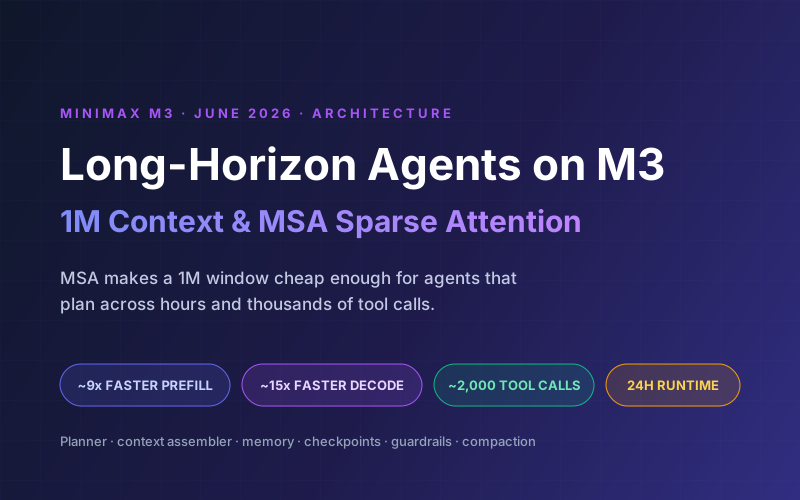
The most striking claim about MiniMax M3 was not a benchmark. MiniMax said M3 reproduced the experiments of an ICLR paper in 12 hours, and ran continuously for 24 hours without reference code while making nearly 2,000 tool calls. That is the profile of a true long-horizon agent, and it is only practical because M3's MSA architecture makes a 1M-token context window cheap enough to keep filled.
Cheap long context changes what agents can do. Instead of constantly truncating and re-fetching, an agent can keep an entire codebase, a long task history, and tool output resident while it plans across hours. But a big window alone does not make an agent reliable. The hard parts are managing that context, knowing when not to use it, and recovering from failures.
This guide explains how MSA works, why long context is still not a substitute for memory, a reference architecture for long-horizon agents on M3, and the patterns that keep them stable in production. For the model overview, see our MiniMax M3 developer guide.
📑 What This Guide Covers
1Why Long-Horizon Agents Are Practical Now
Long-horizon agents have been the goal for years, but two costs got in the way: the quality cost of short context (the agent forgets what it was doing) and the dollar cost of long context (filling a large window on every step was prohibitively expensive). M3 attacks both at once with a cheap 1M window.
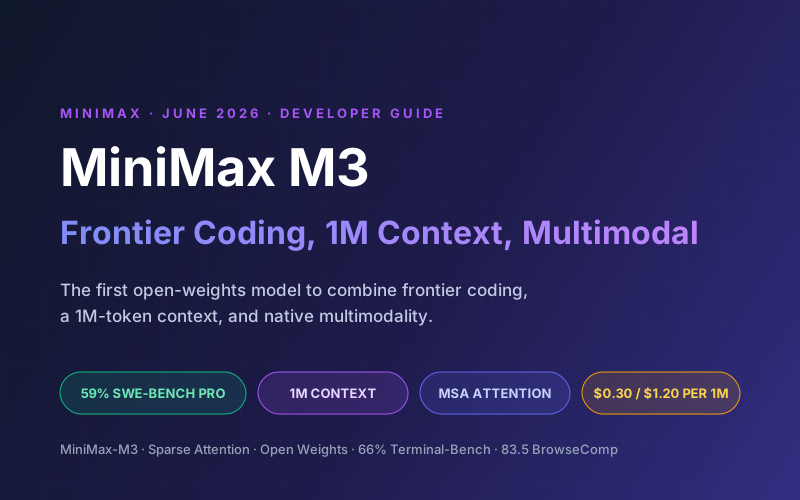
At promo pricing of roughly $0.30 per million input tokens, an agent can carry hundreds of thousands of tokens of context across thousands of steps without the bill becoming the limiting factor. That is the unlock: the constraint shifts from "can we afford the context" to "can we manage it well," which is an engineering problem you can actually solve.
2How MSA Makes 1M Context Affordable
Standard attention is quadratic: doubling the context roughly quadruples attention compute. MiniMax Sparse Attention (MSA) replaces it with KV-block selection: instead of every query attending to every key, the model picks the most relevant blocks of the key-value cache. That cuts per-token compute at long context while keeping quality across most tasks.
MiniMax reports that at 1M tokens, versus the prior generation, MSA delivers about 9x faster prefill, 15x faster decoding, and roughly one-tenth the per-token compute. For a long-horizon agent that re-reads a large context on every step, that compounding saving is the difference between viable and not.
The key insight
MSA does not just make long context cheaper, it makes the cost scale closer to linearly with length. That changes the agent design budget: you can afford to keep more in view per step instead of paying a quadratic penalty for it.
3Why Long Context Is Not Memory
The tempting shortcut is to treat a 1M window as a memory system: just keep everything in context. That breaks down for two reasons.
- Context is per-session and ephemeral. When the session ends, it is gone. Memory persists across sessions, which is what lets an agent improve over days and weeks.
- Context rot is real. As a window fills with transcripts and tool output, the signal-to-noise ratio drops and the model's focus degrades. A 1M window full of noise is worse than a 100K window of curated, relevant context.
Production long-horizon agents use both layers: a large, well-curated context for the current task, and an external memory system for durable facts. We cover the memory side in depth in our agent memory systems guide, and the curation side in our context engineering guide.
4Reference Architecture
A reliable long-horizon agent on M3 wraps the model in a control loop with memory, planning, and checkpointing. Here is a reference layout:
- Planner/Orchestrator decomposes the goal into steps and decides what to do next from each observation
- Context Assembler curates and compacts what goes into M3's window, pulling only relevant memory and tool output
- MiniMax M3 does the reasoning over the assembled context with its MSA-efficient long window
- Tools + Guardrails execute actions with validation and limits so a bad step cannot cause damage
- Memory stores durable facts outside the window; Checkpoints make the run resumable after a failure
5Patterns That Keep Agents Reliable
Compaction over truncation
When the window grows, summarize old turns into compact notes instead of dropping them. You keep the thread without paying for raw history.
Checkpoint every milestone
A 24-hour run that crashes at hour 23 should resume, not restart. Persist state at each milestone so failures cost minutes, not the whole run.
Guard the tools, not just the model
Over thousands of tool calls, a single destructive action can ruin a run. Validate arguments, sandbox shells, and require confirmation for irreversible operations.
Re-anchor the goal periodically
Long runs drift. Periodically re-inject the original objective and success criteria so the agent does not wander off task as context accumulates.
If you want a self-improving agent that already implements much of this loop, our Hermes Agent + MiniMax M3 guide shows how to wire M3 into an agent with memory, skills, and tool isolation out of the box.
6Pitfalls to Avoid
- Treating the window as a dumping ground. More tokens is not more intelligence. Curate aggressively.
- Skipping memory. Without persistence, every session starts from zero and the agent cannot improve.
- No checkpointing. Long runs without resumable state are fragile and expensive to retry.
- Trusting raw cost estimates. Long-context agents can quietly burn tokens. Track per-run cost and set budget ceilings.
- Ignoring the promo expiry. Build your unit economics against M3's standard $0.60/$2.40 rate, not the launch promo.
7Why Lushbinary
At Lushbinary, we build long-horizon agents that survive contact with production. On a model like M3 we deliver:
- Agent architecture - planners, context assemblers, memory, and checkpointing designed for long runs
- Context strategy - using the 1M window without context rot or runaway cost
- Guardrails - tool validation, sandboxing, and budget ceilings so autonomous agents stay safe
- Observability - per-run cost, trajectory tracking, and evals so you can trust the agent in production
🚀 Free Consultation
Want to build a long-horizon agent on MiniMax M3? Lushbinary will design the architecture, context strategy, and guardrails, and ship it to production - no obligation.
❓ Frequently Asked Questions
What is a long-horizon AI agent?
A long-horizon agent works on a task over an extended period, making many sequential decisions and tool calls, sometimes for hours. MiniMax reported M3 running continuously for 24 hours and making nearly 2,000 tool calls in extreme tests. These agents need cheap long context plus reliable memory and planning to stay coherent.
How does MiniMax M3's MSA make long context affordable?
MSA (MiniMax Sparse Attention) replaces full quadratic attention with KV-block selection, so each query attends only to the most relevant blocks of the cache. MiniMax reports roughly 9x faster prefill and 15x faster decoding at 1M tokens versus the prior generation, with about one-tenth the per-token compute, which is what makes filling a 1M window economical.
Is a 1M context window a replacement for agent memory?
No. A long context window helps but is not a substitute for a persistent memory system. Context is per-session and gets diluted as it fills (context rot), while memory persists across sessions and stays compact. Production long-horizon agents use both: a large context for the current task and external memory for durable facts.
What breaks long-horizon agents in production?
The common failure modes are context rot (quality degrading as the window fills with noise), error compounding over many steps, missing checkpoints so a failure loses all progress, and weak guardrails on tool use. Reliable long-horizon agents add compaction, memory, checkpointing, and guardrails on top of the model.
📚 Sources
- MiniMax Research - MiniMax M3 Announcement
- MiniMax M3 Model Page (MSA & long context)
- OpenRouter - MiniMax M3 (MSA cost description)
Content was rephrased for compliance with licensing restrictions. Architecture and performance claims sourced from official MiniMax and OpenRouter publications as of June 2026. The 24-hour and 2,000-tool-call figures are vendor-reported test anecdotes. Pricing may change - always verify on the vendor's website.
Build a Long-Horizon Agent on MiniMax M3
We design the architecture, context strategy, memory, and guardrails that keep autonomous agents reliable in production.
Ready to Build Something Great?
Get a free 30-minute strategy call. We'll map out your project, timeline, and tech stack - no strings attached.
Prefer email? Reach us directly: