
The single biggest reason AI agents fail in production is not a weak model. It is bad context. An agent that loses track of what it was doing, hallucinates a function that does not exist, or contradicts a decision it made three steps earlier is almost always suffering from a context problem, not an intelligence problem. As 2026 arrived, this challenge acquired a name that has become the defining skill of AI engineering: context engineering.
Where prompt engineering asks "what do we say to the model?", context engineering asks "what information does the model see at inference time, when, and in what form?" It is a systems-level discipline that covers retrieval, memory, tool results, conversation history, and the cache state that ties a long task together. Get it right and a mid-tier model outperforms a frontier model with a sloppy window. Get it wrong and no amount of model upgrade saves you.
This guide breaks down what context engineering actually is, why long context windows do not solve the problem, the four core strategies production agents use, an anti-pattern checklist, and a reference architecture you can adapt. If you are building agents that need to stay coherent across long, multi-step tasks, this is the playbook.
🧭 What This Guide Covers
1What Context Engineering Actually Is
Context engineering is the discipline of designing and managing the information fed into an AI agent's context window to maximize task performance. Everything the model sees at inference time is context: the system prompt, the user request, retrieved documents, tool call results, prior conversation turns, memory recalled from past sessions, and any scratchpad the agent keeps. Context engineering is the set of decisions about what goes in, what stays out, how it is ordered, and how it is maintained over a long task.
The distinction from prompt engineering matters. Prompt engineering is about phrasing: the wording of instructions, the few-shot examples, the output format. That still counts, but it is now one piece of a larger system. For a single-turn chatbot, prompt wording is most of the game. For an agent that runs for fifty turns, calls a dozen tools, and reads thousands of tokens of intermediate output, the wording of the original instruction is a small fraction of what the model sees. The rest is context, and managing it is the harder problem.
💡 The Core Insight
An LLM is a stateless function. It has no memory between calls and no awareness beyond the tokens in its window. Whatever coherence, personalization, or long-horizon planning your agent shows is something you engineered into the context, not something the model does on its own. Treat the context window as the agent's entire world at each step.
This reframing changes how you build. Instead of asking "how do I write the perfect prompt?" you ask "what is the minimal, highest-signal set of tokens this model needs to take the next correct action?" That question drives retrieval design, memory design, tool output formatting, and history management all at once. For a deeper look at how this plays out in multi-agent setups, see our multi-agent orchestration patterns guide.
2Why Bigger Context Windows Do Not Fix It
A natural reaction is: models now have million-token windows, so why not just stuff everything in? Because LLMs have a finite attention budget. Every token in the window competes for that attention. As context grows, precision drops, reasoning weakens, and the model starts missing information it should catch. Practitioners call this context rot, and it is observable across every frontier model.
The failure modes are specific and they compound:
| Failure Mode | What Happens | Trigger |
|---|---|---|
| Context poisoning | A hallucination or error enters the context and gets treated as fact in later steps | Unverified tool output fed back into history |
| Context distraction | The model fixates on the bulk of accumulated history instead of reasoning fresh | Very long conversation logs |
| Context confusion | Irrelevant content in the window influences the response in unintended ways | Dumping entire documents or too many tools |
| Context clash | Contradictory information in the window makes the model inconsistent | Stale memory mixed with fresh state |
There is also a hard economic argument. A million-token call is slow and expensive on every single request, even when ninety percent of those tokens are irrelevant to the current step. On a long-running agent that makes hundreds of calls, paying for a bloated window every time turns a profitable feature into one that quietly destroys your margins. Smaller, sharper context is faster, cheaper, and more accurate at the same time, which is rare in engineering.
⚠️ The Trap
"We have a big context window" is not a strategy. Treating the window as unlimited storage is the most common cause of agents that work in a demo and fall apart in production after a few dozen turns. The window is a working set, not a database.
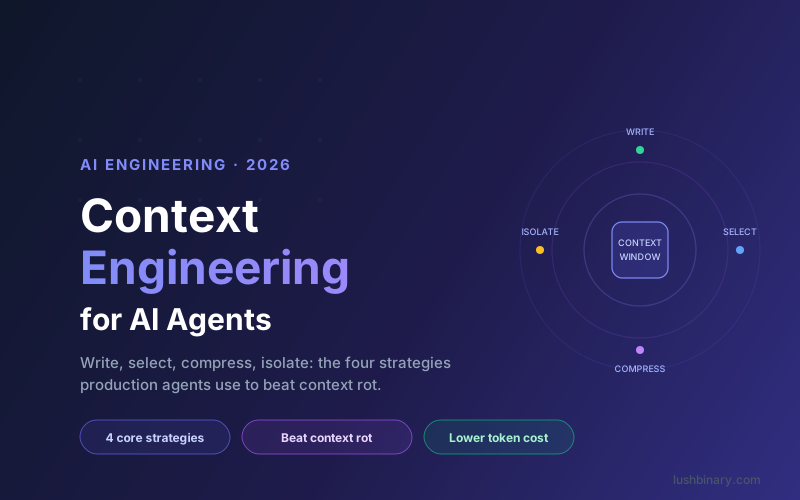
3The Four Core Strategies: Write, Select, Compress, Isolate
Production-grade agents converge on the same four strategies for keeping context coherent across long tasks. They are not mutually exclusive. The most robust agents combine all four.
Write: Offload State to External Storage
Instead of keeping every plan, decision, and intermediate result in the window, write them to external storage the agent can read back later. A scratchpad file, a task list, a database row, or a structured notes document all work. The window holds a pointer or a summary; the full detail lives outside. This is how agents survive tasks that span hours without their window filling up. It also makes the agent auditable, because the externalized state is inspectable.
Select: Retrieve Only What This Step Needs
Rather than front-loading all knowledge, retrieve the right context dynamically for each step. This is where retrieval-augmented generation, semantic search over a vector store, and tool result filtering live. The skill is selecting a small, high-signal set rather than the top-fifty chunks by cosine similarity. Over-retrieval causes context confusion as surely as under-retrieval causes missing information. For the production patterns here, see our Model Context Protocol developer guide.
Compress: Summarize What Accumulates
When history grows past a threshold, compress it. Replace a long back-and-forth with a concise summary of decisions made, facts established, and open questions. Many agent frameworks call this compaction, and it is what lets a coding agent keep working on a task after the raw transcript would have overflowed the window. The art is compressing without dropping the one detail that turns out to matter three steps later, which is why compaction should preserve concrete identifiers, file paths, and decisions verbatim.
Isolate: Split Work Across Separate Agents
Give each subtask its own clean context window by isolating work across separate agent processes. A supervisor agent decomposes a job and hands focused subtasks to workers, each with a narrow context scoped to its piece. The workers never see each other's noise, and the supervisor only sees their results, not their full transcripts. This is the context-engineering rationale behind the multi-agent architectures that dominate complex automation in 2026.
4A Reference Context Architecture
Here is how the four strategies fit together in a production agent. The request enters, the agent assembles a window from layered sources, acts, and writes results back out before the next step.
The key component is the context assembler: a budget-aware packer that decides, for each step, how many tokens to allocate to each source. A good assembler reserves room for the system prompt and current task, allots a fixed budget to retrieval, caps tool output, and uses whatever is left for compacted history. When the budget is tight, it drops the lowest-priority source first rather than truncating everything uniformly.
// Budget-aware context assembly (pseudo-code)
const BUDGET = 32_000; // working-set tokens, not the model max

function assembleContext(step) {
  const parts = [];
  parts.push(systemPrompt());          // always included
  parts.push(currentTask(step));       // always included

  let used = tokens(parts);
  const remaining = BUDGET - used;

  // priority order: task-relevant retrieval first
  parts.push(retrieve(step.query, capTokens(remaining * 0.4)));
  parts.push(recallMemory(step.user, capTokens(remaining * 0.2)));
  parts.push(capToolOutput(step.lastTool, capTokens(remaining * 0.2)));
  parts.push(compactHistory(step.history, capTokens(remaining * 0.2)));

  return parts.filter(Boolean).join("\n\n");
}
One more lever worth its own mention: prompt caching. Keep the stable prefix of your context (system prompt, tool definitions, durable instructions) identical across calls so the provider can cache it. Frontier APIs offer steep discounts on cached prefix tokens, so a stable layout is both a quality and a cost decision. Reordering your context on every call quietly throws that discount away.
5Context Anti-Patterns That Break Agents
Most context failures trace back to a handful of repeated mistakes. Here are the ones worth auditing for first.
- Dumping whole documents. Pasting a full PDF or an entire codebase into the window guarantees context confusion. Chunk, index, and retrieve the relevant sections instead.
- Never compacting history. Letting the transcript grow unbounded is the top cause of agents degrading over a long session. Set a threshold and compact.
- Feeding raw tool output back verbatim. A 5,000-line log or a giant JSON blob crowds out reasoning. Summarize or extract the fields that matter before returning them to the model.
- Too many tools. Exposing fifty tools at once causes the model to pick wrong or hesitate. Scope the toolset to the task or use a router that narrows it.
- Stale memory with no decay. Memory that never expires eventually contradicts current state, causing context clash. Memory needs recency weighting and a way to supersede old facts.
- Reordering the cached prefix. Shuffling the stable part of the context on every call breaks prompt caching and inflates both latency and cost.
💡 Rule of Thumb
If you cannot explain why each block of tokens is in the window for this specific step, it probably should not be there. Default to less context and add back only what measurably improves task success.
6Tooling and How to Measure Context Quality
Context engineering without measurement is guesswork. The ecosystem in 2026 has matured around a few categories of tooling: retrieval and vector stores for the select step, memory layers like Mem0 and Zep for persistent state, and observability platforms that trace exactly what tokens entered the window on each call. The non-negotiable is the last one. You cannot debug context you cannot see.
Track these signals as you tune:
| Signal | What It Tells You |
|---|---|
| Tokens per step | Rising token counts over a session signal missing compaction |
| Retrieval precision | Fraction of retrieved chunks actually used in the response |
| Cache hit rate | Low hit rate means your prefix is not stable |
| Task success rate | The bottom line: does the agent complete the goal end to end |
The discipline that ties this together is evaluation. Every context change should be validated against a test suite before it ships, the same way you would test a code change. We cover that loop in detail in our eval-driven development guide, and the memory side in our AI agent memory systems guide.
7Why Lushbinary for Production AI Agents
Context engineering is the difference between an agent that demos well and one that holds up in production after thousands of real sessions. Lushbinary builds AI agents and LLM integrations with context architecture as a first-class concern, not an afterthought. We have shipped retrieval pipelines, memory layers, and multi-agent systems for clients across SaaS, healthcare, fintech, and e-commerce.
Here is what we bring to a production agent build:
- Context architecture design - we design the assembler, retrieval, memory, and compaction layers your agent needs to stay coherent over long tasks
- Cost and latency tuning - prompt caching, retrieval budgets, and token discipline that cut spend without losing quality
- Observability - tracing that shows exactly what entered the window on every call so failures are debuggable
- Evaluation harnesses - so every context change is validated before it reaches production
🚀 Free Consultation
Building an AI agent that needs to stay reliable over long, multi-step tasks? Lushbinary will review your context architecture, find the bottlenecks, and recommend a concrete plan to make your agent faster, cheaper, and more accurate, with no obligation.
8Frequently Asked Questions
What is context engineering?
Context engineering is the practice of designing and managing the information an AI agent sees at inference time: what you include, what you exclude, what you compress, where you position it, and how you preserve cache state across a long-running task. Where prompt engineering focuses on how you phrase a request, context engineering focuses on what information the model has access to when it generates a response.
What are the four core context engineering strategies?
Production agents combine four strategies: write context to external storage so the model does not carry everything in-band, select the right context dynamically from that storage, compress accumulated context to fit the attention budget, and isolate work across separate agents or processes so each has a clean, focused window.
Why do long-context windows not solve the context problem?
LLMs have a finite attention budget. Every token in the window competes for that attention, so as context grows, precision drops, reasoning weakens, and the model starts missing information it should catch. This is often called context rot. A 1M-token window does not fix it because filling the window degrades quality and inflates cost and latency.
Is context engineering replacing prompt engineering?
Context engineering is the broader discipline that prompt engineering now sits inside. Prompt wording still matters, but for agents that run for many turns and call tools, the bigger lever is managing the full context: retrieval, memory, tool results, history compaction, and cache strategy. Most teams in 2026 treat prompt engineering as one component of context engineering.
How does context engineering reduce AI costs?
Smaller, well-curated context means fewer input tokens per call, which directly cuts API spend and latency. Techniques like prompt caching, retrieval instead of front-loading, and history compaction can reduce token usage several-fold on long-running agents while improving accuracy because the model is not distracted by irrelevant material.
📚 Sources
- Anthropic Engineering - Effective Context Engineering for AI Agents
- LangChain - Context Engineering for Agents
- Philipp Schmid - The New Skill in AI is Context Engineering
Content was rephrased for compliance with licensing restrictions. Context engineering strategies and terminology sourced from official Anthropic, LangChain, and independent engineering publications as of May 2026. Practices and tooling evolve quickly, always verify against current vendor documentation.
Build AI Agents That Stay Coherent
From context architecture to retrieval, memory, and cost tuning, Lushbinary builds AI agents that hold up in production. Let's talk about your agent project.
Ready to Build Something Great?
Get a free 30-minute strategy call. We'll map out your project, timeline, and tech stack - no strings attached.
Prefer email? Reach us directly: