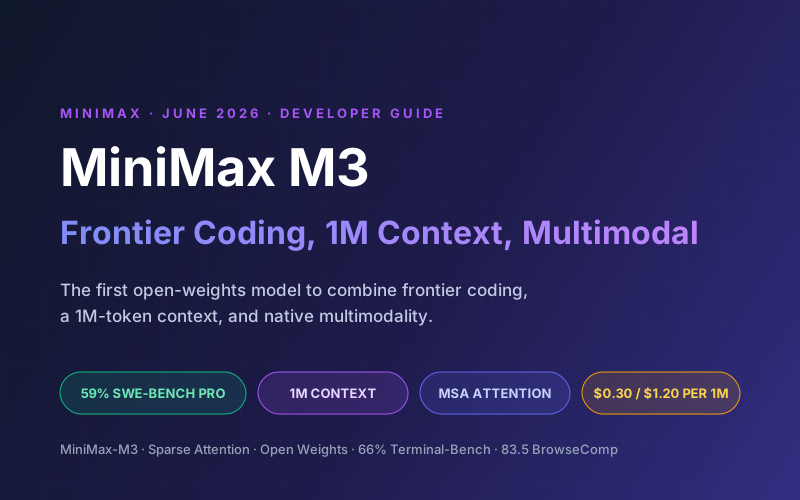

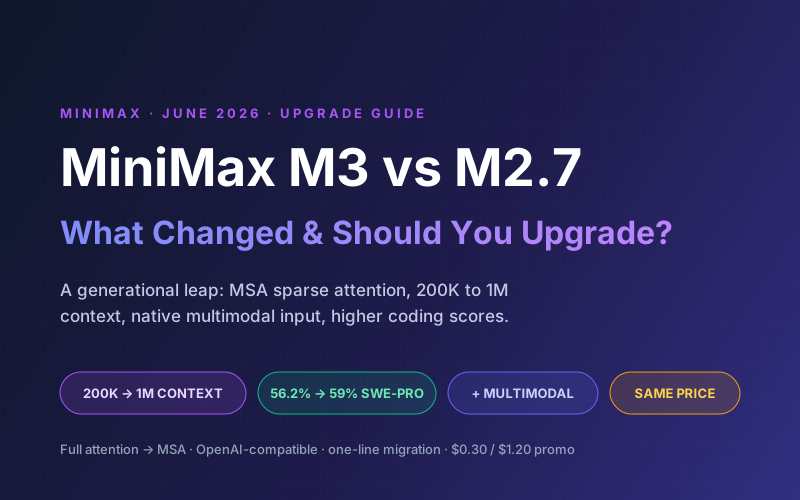
MiniMax M2.7 was a strong, cheap, text-only agentic coding model with a 200K context. MiniMax M3, launched June 1, 2026, is not a point release on top of it. It is a generational change: a new MSA sparse-attention architecture, a jump to a 1-million-token context window, native multimodal input, and higher coding and agentic scores.
The most interesting part is that, at launch promotional pricing, M3 costs roughly the same as M2.7 did. So the question is not really "is M3 better" (it is), but "is the migration worth it for your workload, and what changes when you switch."
This guide gives you the before-and-after on architecture, context, benchmarks, and pricing, plus a migration checklist. For a full M3 deep dive, see our MiniMax M3 developer guide.
📑 What This Guide Covers
1M3 vs M2.7 at a Glance
| Dimension | MiniMax M2.7 | MiniMax M3 |
|---|---|---|
| Released | March 18, 2026 | June 1, 2026 |
| Attention | Full attention | MSA (sparse, KV-block selection) |
| Context window | 200K tokens | Up to 1M tokens |
| Modalities | Text only | Text, image, video in |
| SWE-Bench Pro | 56.2% | 59.0% |
| Terminal-Bench | 57.0% (TB 2) | 66.0% (TB 2.1) |
| Pricing (promo) | $0.30 / $1.20 | $0.30 / $1.20 |
Note the Terminal-Bench versions differ (2 vs 2.1), so that row is directional rather than a strict apples-to-apples comparison. The headline is clear regardless: M3 is more capable across the board, and the architecture change is what enables it.
2Architecture: MSA Returns
The M2 generation (including M2.7) used full attention: every token attends to every other token. That is simple and high-quality, but quadratic in cost, which is why M2.7 capped out at a 200K context that got expensive to fill.
M3 reintroduces sparse attention in a new form, MiniMax Sparse Attention (MSA), which replaces full attention with KV-block selection. Each query attends only to the most relevant blocks of the key-value cache, cutting per-token compute at long context. MiniMax reports the result at 1M tokens versus the prior generation:
- ~9x faster prefill (processing the input)
- ~15x faster decoding (generating output)
- ~1/10 the per-token compute cost at that length
In short: M2.7 used a simpler, more expensive attention that limited how long its context could practically go. M3's MSA is what makes a 1M window affordable. To understand the mechanism in more depth, see the architecture section of our MSA and long-horizon agents guide.
3Context: 200K to 1M
The context window grows 5x, from 200K to up to 1M tokens (with a 512K guaranteed minimum). For practical workloads that means:
What 200K bought you (M2.7)
- A large module or a few files at once
- Medium-length documents
- Moderate session history before truncation
What 1M unlocks (M3)
- An entire mid-size codebase in context
- Book-length documents and long transcripts
- Hours of agent session history without dropping turns
Bigger window, same discipline
A 1M window does not mean you should fill it. Stuffing irrelevant content still costs money and can hurt focus. Treat the extra capacity as headroom and keep your working context lean.
4Benchmark Gains
The benchmark story is incremental on coding and larger on agentic and multimodal axes, which is where the new architecture and modalities pay off:
- SWE-Bench Pro: 56.2% (M2.7) to 59.0% (M3), a 2.8 point gain that pushes M3 past GPT-5.5 and Gemini 3.1 Pro on this benchmark
- Terminal-Bench: 57.0% on TB 2 (M2.7) to 66.0% on TB 2.1 (M3), a large jump in agentic terminal tasks
- BrowseComp: M3 reaches 83.5, ahead of Claude Opus 4.7's 79.3, a capability M2.7 did not emphasize
- Multimodal: M3 adds image and video understanding entirely, which M2.7 lacked
As always, vendor benchmarks are a starting point, not a verdict. Run your own evals on representative tasks before committing, as covered in our eval-driven development guide.
5Pricing Comparison
This is where the upgrade math gets easy. At launch promotional pricing, M3 matches what M2.7 charged:
| Model | Input /M | Output /M |
|---|---|---|
| M2.7 | $0.30 | $1.20 |
| M3 (promo) | $0.30 | $1.20 |
| M3 (standard) | $0.60 | $2.40 |
At promo pricing the upgrade is essentially free: same cost per token, more capability. The one caveat is that the promotion is temporary. At the standard $0.60/$2.40 rate, M3 is about 2x M2.7's old price per token, so factor that into long-term budgeting if you are running high volume.
6Should You Upgrade?
Upgrade now if you
- Run long-context coding or whole-repo agents
- Need image or video input
- Run autonomous browsing or research agents
- Want the higher coding and agentic scores at the same cost
Upgrade can wait if you
- Run short text-only tasks well within 200K
- Are happy with M2.7 quality and have tuned prompts for it
- Need a strictly fixed long-term cost (watch the promo expiry)
7Migration Checklist
Both models use OpenAI-compatible APIs, so migration is mostly a model identifier change plus validation:
- Change the model identifier from
MiniMax-M2.7toMiniMax-M3in your client or agent config - Re-run your eval suite on M3 to confirm quality holds or improves on your tasks
- Re-check tool/function-calling schemas, since behavior can shift slightly between model generations
- Revisit any hardcoded context-length limits to take advantage of the larger window (but keep working context lean)
- Budget against the standard $0.60/$2.40 rate, not the promo, for long-term planning
- If you self-host, wait for your inference engine (vLLM, SGLang) to add MSA support, and review the M3 license terms
Running Hermes Agent? Switching is a one-line model change. Our Hermes Agent + MiniMax M3 setup guide walks through the config and tuning.
8Why Lushbinary
At Lushbinary, we help teams migrate between models without breaking production. For an M2.7 to M3 move we handle:
- Eval-based validation - confirming M3 matches or beats M2.7 on your real tasks before you switch
- Prompt and tool-schema tuning - adjusting for the new generation's behavior
- Context strategy - using the 1M window without blowing up cost or focus
- Cost-aware routing - blending M3 with frontier models for the tasks that need them
🚀 Free Consultation
Thinking about moving from M2.7 to M3? Lushbinary will validate the upgrade on your workloads, tune your prompts and routing, and ship the migration safely - no obligation.
❓ Frequently Asked Questions
What is the difference between MiniMax M3 and M2.7?
MiniMax M3 is a generational upgrade over M2.7. It swaps full attention for MSA sparse attention, expands the context window from 200K to 1M tokens, adds native multimodal (image and video) input, and lifts SWE-Bench Pro from 56.2% to 59.0%. M2.7 was a text-only 230B sparse MoE with a 200K context.
Should I upgrade from MiniMax M2.7 to M3?
For long-context, agentic, multimodal, or coding workloads, M3 is a clear upgrade thanks to its 1M context, MSA efficiency, and higher benchmark scores. If you run short text-only tasks where 200K context is plenty and M2.7 already meets quality, the upgrade is optional. Both share OpenAI-compatible APIs, so migration is low-effort.
How does MiniMax M3 pricing compare to M2.7?
M3 launched on OpenRouter at $0.60 input / $2.40 output per million tokens, with a temporary 50% promo bringing it to about $0.30 / $1.20. That promo rate matches M2.7's $0.30 input / $1.20 output, so at promo pricing M3 costs roughly the same as M2.7 while delivering more capability.
Is migrating from M2.7 to M3 difficult?
No. Both models use OpenAI-compatible endpoints, so in most cases you only change the model identifier from MiniMax-M2.7 to MiniMax-M3. Test prompts and tool schemas on M3 before switching, and re-tune any context-length assumptions to take advantage of the larger window.
📚 Sources
- MiniMax Research - MiniMax M3 Announcement
- OpenRouter - MiniMax M3 Pricing & Providers
- OpenRouter - MiniMax M2.7 Benchmarks & Pricing
- MiniMax API Docs - Pay-As-You-Go Pricing
Content was rephrased for compliance with licensing restrictions. Benchmark and pricing data sourced from official MiniMax and OpenRouter publications as of June 2026. Terminal-Bench versions differ between models (2 vs 2.1). Pricing and promotional discounts may change - always verify on the vendor's website.
Migrate to MiniMax M3 the Safe Way
We validate the upgrade on your real workloads, tune prompts and routing, and ship the migration without breaking production.
Ready to Build Something Great?
Get a free 30-minute strategy call. We'll map out your project, timeline, and tech stack - no strings attached.
Prefer email? Reach us directly: