
Most teams ship LLM features the same way: tweak a prompt, eyeball a few examples, and push. It works until it does not. LLM outputs are non-deterministic, so a change that looks fine on three test cases quietly regresses on thirty others you did not check. The result is a product that gets subtly worse with every "improvement," and a team with no way to prove whether the last release helped or hurt.
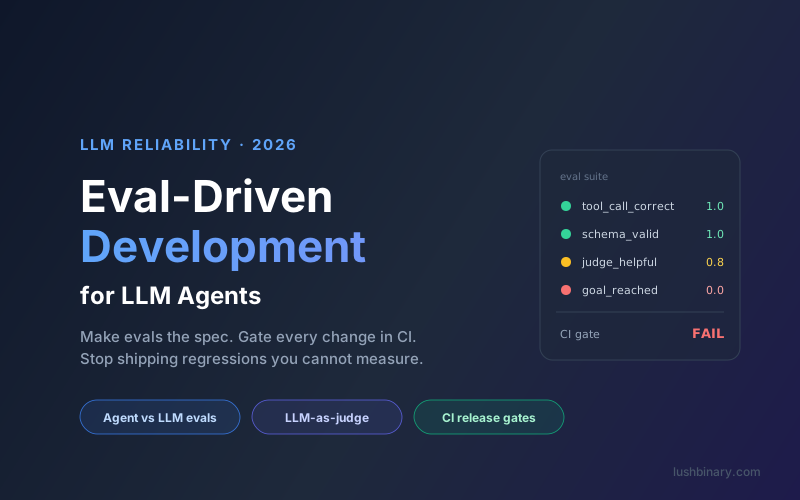
The fix is evals. An eval is a test for an AI system: give it an input, apply grading logic to its output, and measure success. Run during development without real users, evals are to LLM applications what unit tests are to software. And eval-driven development, where evaluations serve as the working specification you test every change against, has become the discipline that separates teams shipping reliable agents from teams shipping vibes.
This guide covers what evals are, why agent evaluation is harder than single-response evaluation, the grading methods that actually work, how to build an eval-driven loop that gates releases in CI, and the production testing patterns teams use in 2026. If you are shipping anything LLM-powered and cannot answer "did that change make it better?" with a number, this is for you.
🧪 What This Guide Covers
1What Evals Are and Why They Matter
An evaluation is a test for an AI system. You give the AI an input, then apply grading logic to its output to measure success. Automated evals run during development without real users, which means you can run them on every change, the same way you run a test suite. That repeatability is the entire point: it turns "this feels better" into "this scores 87 versus 81 on our suite."
Three building blocks make up an eval:
- A dataset - inputs paired with what good looks like. Real production examples beat synthetic ones, and edge cases matter more than happy paths.
- A task - the prompt, chain, or agent under test, run against each input in the dataset.
- Scorers - the grading logic that turns each output into a score, from a simple equality check to an LLM judging against a rubric.
💡 The Core Idea
Evals are infrastructure, not overhead. They are what let you iterate fast without breaking things, because every change gets a measurable verdict before it ships. A team with good evals can swap models, rewrite prompts, and refactor agents with confidence. A team without them is guessing.
This matters more as the model landscape churns. New frontier and open models ship constantly, and the only honest way to decide whether to switch is to run your own evals on your own tasks. Our open-source LLM comparison gives you candidates; evals tell you which one is actually better for your use case.
2Agent Evaluation vs LLM Evaluation
A critical distinction that trips up teams: evaluating a single LLM response is not the same as evaluating an agent. LLM evaluation scores one input-output pair. Agent evaluation has to assess goal-level outcomes across multi-turn sessions, because an agent can score well on every individual turn and still fail the user's overall intent.
Picture a support agent that gives a polite, accurate answer at every step but never actually resolves the ticket. Turn-level scoring says it is great. The user says it failed. That gap is why agent evals have to look at the whole trajectory.
| Dimension | LLM Eval | Agent Eval |
|---|---|---|
| Unit of measure | Single response | Full multi-turn trajectory |
| What it checks | Accuracy, format, tone of one output | Goal completion, tool use, efficiency |
| Tool calls | Usually not evaluated | Did it call the right tools correctly |
| Failure example | Wrong or malformed answer | Good turns, goal never reached |
Practically, this means agent evals need to capture the entire run: every tool call, every intermediate step, and the final outcome. You score the trajectory (did it take a sensible path), the tool use (right tools, right arguments), and the end state (did it accomplish the goal). Single-response metrics are still useful as components, but they do not tell you if the agent works.
3Grading Methods That Actually Work
The scorer is where evals live or die. There are four broad approaches, and mature suites combine them, using the cheapest reliable method for each check.
| Method | Best For | Tradeoff |
|---|---|---|
| Exact / rule-based | Deterministic outputs, classifications | Cheap and reliable, but brittle on free text |
| Code assertions | Schema checks, did the code run, valid JSON | Deterministic, but only checks structure |
| Model-based (LLM judge) | Nuance: helpfulness, faithfulness, tone | Flexible, but costs tokens and needs calibration |
| Human review | Ground truth, judge calibration, edge cases | Gold standard, but slow and expensive |
The LLM-as-judge method deserves a caution. A model grading another model is powerful for subjective criteria, but it has biases: it can favor longer answers, its own style, or the first option in a pairwise comparison. Calibrate it against human labels before you trust it, and keep humans in the loop for a sample of judgments to catch drift.
// A simple eval case (pseudo-code)
const evalCase = {
  input: "Refund order #4821, it arrived broken",
  scorers: [
    // deterministic: did it call the right tool
    (trace) => trace.toolCalls.some(
      (t) => t.name === "issue_refund" && t.args.orderId === "4821"
    ) ? 1 : 0,

    // structural: response is valid + has a confirmation
    (output) => output.includes("refund") && isValid(output) ? 1 : 0,

    // model-judge: was the reply empathetic and clear
    (output) => llmJudge(output, "empathetic, clear, no jargon"),
  ],
};
// suite passes if mean score across all cases >= threshold
The pattern to internalize: use deterministic checks wherever the answer is objectively right or wrong, and reserve the LLM judge for the genuinely subjective dimensions. This keeps your suite fast, cheap, and trustworthy.
4The Eval-Driven Development Loop
Eval-driven development flips the usual order. Instead of building then testing, you define the quality criteria first, then make changes against them. Evaluations become the working specification for the application. The loop looks like this:
The step that delivers the most value is gating in CI. Wire your eval suite into the pipeline so a prompt or model change that drops the score below threshold fails the build, exactly like a failing unit test. This is what stops regressions from reaching users. Without a gate, evals are a report nobody reads; with a gate, they are a guardrail.
💡 Treat Failures as Fuel
Every production failure should become a new eval case. When a user hits a bug, capture the input, add it to the dataset, and your suite now guards against that failure forever. Over time your eval set becomes a precise map of your application's real failure modes.
5Testing in Production: Online Evals
Offline evals on a fixed dataset are necessary but not sufficient. Real users do things your dataset never anticipated. Online evals close the gap by scoring real production traffic, either by sampling live traces and grading them, or by attaching lightweight judges directly to production spans.
The 2026 production testing loop that teams converge on has a clear shape: instrument every LLM and tool call with tracing, score those traces with automated judges, gate releases in CI against an offline suite, simulate hard scenarios, sample live traffic for online scoring, and feed failures back into prompt and model improvements. Each loop tightens the system.
| Stage | Purpose |
|---|---|
| Instrument | Trace every call so behavior is observable |
| Gate in CI | Block changes that regress the offline suite |
| Simulate | Stress-test hard and adversarial scenarios |
| Sample live | Score real traffic to catch the unexpected |
| Optimize | Turn failures into fixes and new eval cases |
A common trap is confusing evals with product analytics. Analytics tells you what users did; evals tell you whether the AI did its job well. You need both, but do not let a dashboard of usage metrics convince you the agent is working. Quality is a separate measurement. This pairs naturally with strong production guardrails, which catch the failures evals flag before they cause damage.
6Getting Started Without Boiling the Ocean
Teams often stall because building a comprehensive eval suite feels enormous. It is not, if you start small and grow from real failures.
- Start with 20 cases. Pull 20 real inputs, including the ones that have failed, and write down what a good output looks like. That is a usable suite.
- Add the cheapest scorers first. Exact match and schema checks where outputs are deterministic. You will be surprised how much these catch.
- Add an LLM judge for the subjective parts. Calibrate it against a handful of human labels before trusting it.
- Wire it into CI. Fail the build on regression. This is the step that changes behavior.
- Grow from production. Every real failure becomes a new case. The suite gets sharper without a big upfront project.
⚠️ The Most Common Mistake
Waiting for the perfect, comprehensive eval set before starting. A small suite wired into CI today beats a perfect suite that ships never. Twenty real cases with a gate will catch more regressions than months of manual spot-checking.
7Why Lushbinary for Reliable AI Products
Evals are the difference between an AI product you can improve with confidence and one you change by guesswork and prayer. Lushbinary builds eval-driven development into every AI engagement: we set up the datasets, scorers, CI gates, and online monitoring that let your team ship LLM features without breaking them.
- Eval suite design - datasets from your real traffic, scorers matched to your quality criteria, and agent-level trajectory evaluation
- CI integration - release gates that block regressions before they reach users
- LLM-as-judge calibration - judges tuned against human labels so the scores you trust are actually trustworthy
- Online evals and observability - tracing and live scoring so you catch what offline tests miss
🚀 Free Consultation
Shipping LLM features and unable to prove whether changes help or hurt? Lushbinary will review your current process, set up a starter eval suite, and show you how to gate releases on quality, with no obligation.
8Frequently Asked Questions
What is an eval in AI development?
An evaluation, or eval, is a test for an AI system: you give the AI an input, then apply grading logic to its output to measure success. Automated evals run during development without real users, the same way unit tests run in software. They are how teams measure whether a prompt, model, or agent change made things better or worse.
What is eval-driven development?
Eval-driven development is a methodology where evaluations serve as the working specification for an LLM application. Before you change a prompt or swap a model, you define quality criteria and test every change against them before it reaches production. It is the LLM equivalent of test-driven development.
How is agent evaluation different from LLM evaluation?
LLM evaluation scores individual responses. Agent evaluation must assess goal-level outcomes across multi-turn sessions, because an agent can rate well on every individual turn and still fail the user's overall intent. Agent evals measure trajectory, tool use, and final task success, not just single-response quality.
What are the main types of LLM evals?
The common grading methods are exact or rule-based matching for deterministic outputs, code-based assertions and schema checks, model-based grading where an LLM judges the output against criteria, and human review for the cases automation cannot cover. Most production suites combine all of these, using cheap deterministic checks where possible and LLM-as-judge where nuance is required.
Why do AI teams need evals instead of just testing manually?
Manual testing does not scale and is not repeatable. LLM outputs are non-deterministic, so a change that looks fine on a few examples can regress on dozens of others. Evals give you a repeatable, measurable signal that catches regressions, lets you compare models and prompts objectively, and gates releases in CI before bad changes reach users.
📚 Sources
- Anthropic Engineering - Demystifying Evals for AI Agents
- Braintrust - What Is Eval-Driven Development
- Latitude - Agent Evaluation vs LLM Evaluation (2026)
- OpenAI - Evals Framework
Content was rephrased for compliance with licensing restrictions. Definitions, methods, and production patterns sourced from official Anthropic, OpenAI, Braintrust, and independent engineering publications as of May 2026. Tooling and best practices evolve, always verify against current vendor documentation.
Ship LLM Features With Confidence
Lushbinary builds eval-driven development into your AI stack: datasets, scorers, CI gates, and online monitoring. Let's talk about making your AI product reliable.
Ready to Build Something Great?
Get a free 30-minute strategy call. We'll map out your project, timeline, and tech stack - no strings attached.
Prefer email? Reach us directly: