
Every RAG pipeline and AI agent eventually needs data that lives on the open web. The problem is that raw HTML is hostile to language models: navigation menus, footers, cookie banners, and tracking scripts blow up token budgets and distract the model from the content that matters. The job of a modern scraping tool is not just to fetch a page, it is to return clean, LLM-ready Markdown or structured JSON.
That shift has split the market. Traditional scraping APIs return HTML and leave parsing to you. AI-native tools convert pages to Markdown and extract structured fields with an LLM, so a site redesign does not break your selectors. Proxy-and-infrastructure providers focus on getting past anti-bot defenses at enterprise scale. Picking the wrong category means either maintaining brittle parsers forever or overpaying for infrastructure you do not need.
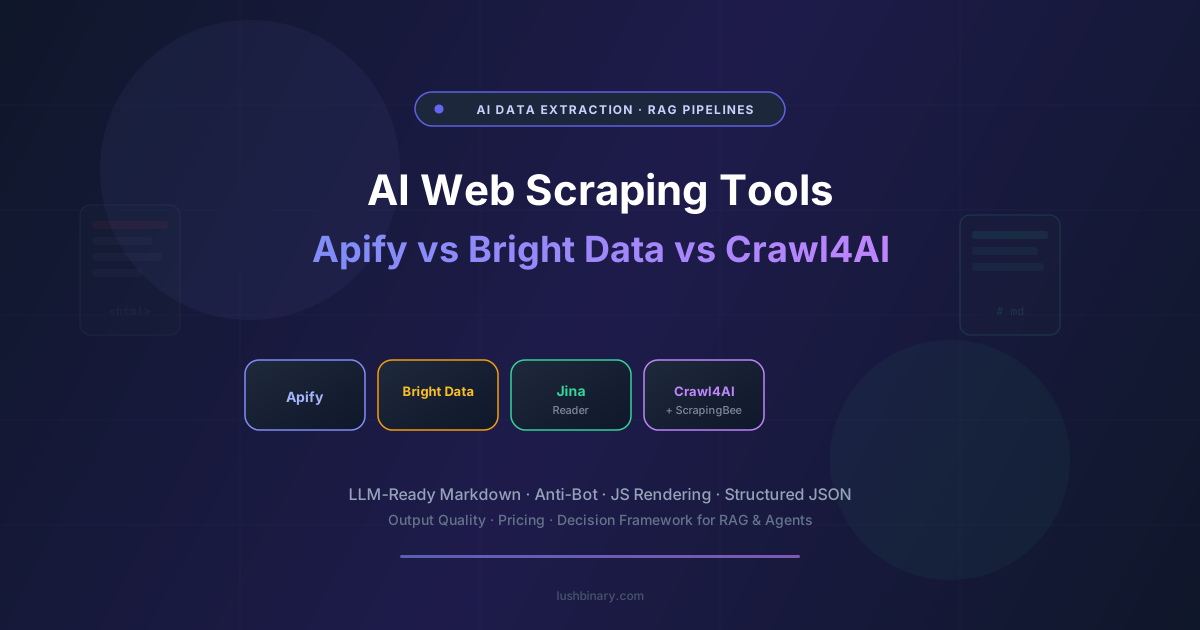
This guide compares the web scraping and data-extraction tools developers actually use for AI workloads: Apify, Bright Data, ScrapingBee, Jina Reader, Crawl4AI, and ScrapeGraphAI. We cover output quality, anti-bot handling, JavaScript rendering, pricing shape, and which fits which workload. Pricing is sourced from vendor pages as of May 2026 and should be re-verified before you commit.
Scrape responsibly
Before scraping any site, check its terms of service and robots.txt, respect rate limits, and avoid collecting personal data without a lawful basis. The tools below are for legitimate data collection; using them to violate a site's terms or applicable law is on you, not the vendor.
Table of Contents
- Why Raw HTML Breaks AI Pipelines
- Three Categories of Scraping Tool
- Apify: The Actor Marketplace
- Bright Data: Enterprise Proxy and Scale
- ScrapingBee: Simple Rendering API
- Jina Reader: Free URL-to-Markdown
- Crawl4AI: Open-Source LLM-Ready Crawling
- ScrapeGraphAI: LLM-Driven Extraction
- Head-to-Head Comparison Table
- Decision Framework
- How Scraping Feeds a RAG Pipeline
- Why Lushbinary for Data Extraction
1Why Raw HTML Breaks AI Pipelines
If you have ever piped raw HTML into an LLM, you know the failure mode: the token count explodes, half the context is navigation and ads, and the model gets distracted by markup instead of content. Traditional tools like BeautifulSoup or Selenium are great at extracting specific fields, but they struggle to produce the clean, semantic context that retrieval-augmented generation needs.
A scraping tool built for AI has to solve three things:
- Clean output. Strip boilerplate and return Markdown or structured JSON the model can actually use, not the full DOM.
- JavaScript rendering. Most modern sites render content client-side, so a tool that only fetches the initial HTML gets an empty shell.
- Anti-bot resilience. Rate limits, fingerprinting, and CAPTCHAs will block naive scrapers. Getting through reliably is often the hardest and most expensive part.
2Three Categories of Scraping Tool
AI-native extractors
Return clean Markdown or LLM-extracted JSON. No selector maintenance, so a site redesign does not break your scraper. Best for RAG and agents.
Rendering APIs
Fetch and render a page, handle proxies and JS, and return HTML. You still build parsers, but you control the output.
Proxy and infra
Enterprise-grade proxy networks and unblocking built for scale. Powerful and pricey, overkill for small jobs.
The cost gap is large. Per-page costs across providers range from roughly $0.002 to over $0.008 depending on volume and features, and HTML-only services hide a second cost: you still build and maintain the parsers on top. AI-native APIs eliminate that selector maintenance, which is often the bigger long-term expense.
3Apify: The Actor Marketplace
Apify is a platform plus a marketplace. Beyond its own scraping infrastructure, it hosts thousands of pre-built scrapers (Actors) for specific sites and tasks, so for many common targets someone has already built and maintained the scraper. Entry pricing is reported around $39/month, with per-Actor costs that vary by what you run.
Strengths
- Huge library of pre-built Actors
- JavaScript rendering supported
- Full platform: scheduling, storage, APIs
- Good for site-specific scraping tasks
Weaknesses
- Per-Actor pricing can be hard to predict
- AI-clean output depends on the Actor used
- Quality varies across community Actors
Best for: teams scraping well-known sites where a maintained Actor already exists, and anyone who wants a full platform rather than a single endpoint.
4Bright Data: Enterprise Proxy and Scale
Bright Data is the enterprise option, built around one of the largest proxy networks in the industry plus unblocking infrastructure. When you need to collect at very large scale against sites with serious anti-bot defenses, it is the heavyweight. That power comes with enterprise pricing, commonly reported starting around $499 to $500 per month and up, with no meaningful free tier.
Strengths
- Massive proxy network and unblocking
- Built for enterprise-scale collection
- Handles the hardest anti-bot targets
- Compliance and enterprise support
Weaknesses
- High entry cost, no real free tier
- Overkill for small or medium jobs
- Output is data, not LLM-clean by default
Best for: enterprise-scale data collection against hard targets where reliability at volume justifies the price.
5ScrapingBee: Simple Rendering API
ScrapingBee is a straightforward rendering API: send a URL, it handles headless browsers, proxies, and JavaScript rendering, and returns the page. With entry pricing reported around $49/month, it is a pragmatic middle ground for teams that want managed rendering and unblocking without enterprise commitment, and who are comfortable parsing the result themselves.
Strengths
- Simple, well-documented API
- Handles JS rendering and proxies
- Stealth options for harder targets
- Predictable mid-tier pricing
Weaknesses
- Returns HTML, you build the parsing
- No marketplace of pre-built scrapers
- Less suited to billion-page scale
Best for: teams that want reliable managed rendering and proxies and are happy to handle extraction themselves.
6Jina Reader: Free URL-to-Markdown
Jina Reader does one thing extremely well: prefix a URL and get back clean, LLM-ready Markdown. It has a generous free, rate-limited tier, which makes it the fastest way to add web content to a RAG pipeline or give an agent a read-a-page tool. For straightforward content pages it is hard to beat on simplicity and price.
Strengths
- Free, rate-limited tier
- Clean Markdown output, LLM-ready
- Dead-simple integration
- Great for agent read-a-page tools
Weaknesses
- Lighter on heavy anti-bot targets
- Less control over extraction logic
- Rate limits constrain large crawls
Best for: RAG ingestion and agent tools that need clean Markdown from content pages with minimal setup and cost.
7Crawl4AI: Open-Source LLM-Ready Crawling
Crawl4AI is the open-source choice for teams that want full control and no per-page bill. It is purpose-built to produce LLM-ready Markdown and structured output, runs on your own infrastructure, and avoids third-party rate limits and data-handling concerns. The trade-off is that you operate it, including proxies and anti-bot handling, yourself.
Strengths
- Open source, no per-page cost
- LLM-ready Markdown and structured output
- Full control, self-hosted, data stays local
- Active community and integrations
Weaknesses
- You operate proxies and unblocking
- More setup than a hosted API
- Scaling is your responsibility
Best for: teams that want self-hosted, cost-controlled crawling with LLM-ready output and are willing to run the infrastructure.
8ScrapeGraphAI: LLM-Driven Extraction
ScrapeGraphAI uses LLMs to extract structured data from pages based on a prompt or schema rather than hand-written selectors. You describe the data you want and it figures out how to pull it, which means a site layout change is far less likely to break your pipeline. It is offered as both an open-source library and a hosted API.
Strengths
- Prompt or schema-driven extraction
- Resilient to layout changes
- Open-source library plus hosted API
- Structured JSON output for agents
Weaknesses
- LLM extraction adds token cost
- Anti-bot still needs a proxy layer
- Accuracy depends on prompt and schema design
Best for: structured extraction where you want to describe the target fields instead of maintaining selectors per site.
9Head-to-Head Comparison Table
| Tool | Category | LLM-clean output | Entry pricing |
|---|---|---|---|
| Apify | Platform + marketplace | Depends on Actor | ~$39/mo |
| Bright Data | Proxy + infra | No, raw data | ~$499+/mo |
| ScrapingBee | Rendering API | No, returns HTML | ~$49/mo |
| Jina Reader | AI-native extractor | Yes, Markdown | Free tier |
| Crawl4AI | Open-source crawler | Yes, Markdown/JSON | Free (self-host) |
| ScrapeGraphAI | LLM extractor | Yes, JSON | OSS + paid API |
Pricing tiers and feature sets change frequently. Treat figures as directional and confirm against each vendor's current page.
10Decision Framework
- RAG ingestion or agent read-a-page tool: Jina Reader for the free, clean-Markdown path, or Crawl4AI self-hosted for control and no per-page cost.
- Structured field extraction across many layouts: ScrapeGraphAI so you describe fields instead of maintaining selectors.
- Well-known target sites: Apify, where a maintained Actor likely already exists.
- Managed rendering without enterprise commitment: ScrapingBee.
- Enterprise scale against hard anti-bot targets: Bright Data, accepting the higher cost.
11How Scraping Feeds a RAG Pipeline
Scraping is the front door of a knowledge pipeline. Clean extraction here saves token cost and improves retrieval quality at every later stage.
The vector store you load this into matters too. See our vector database comparison for picking the right one.
12Why Lushbinary for Data Extraction
We build data-collection and extraction pipelines for clients, choosing the scraping stack that fits the targets, scale, and budget rather than forcing one tool onto every job. We handle the messy parts: rendering, anti-bot resilience, clean output, and feeding the result into retrieval or analytics downstream, all within responsible-use limits.
What we typically deliver:
- Scraping stack selection matched to your targets and volume
- LLM-ready Markdown or structured JSON output for RAG and agents
- Self-hosted crawling with Crawl4AI when cost control matters
- Anti-bot and proxy strategy for harder targets, used responsibly
- Extraction wired directly into your vector store or warehouse
Free Consultation
Need clean web data for your AI product? Lushbinary builds extraction pipelines that return LLM-ready data and feed straight into your stack, no obligation.
Sources
Content was rephrased for compliance with licensing restrictions. Pricing and feature availability sourced from official vendor pages and community comparisons as of May 2026 and may change. Per-page costs vary by volume and configuration. Always verify on the vendor's site, and scrape only within each site's terms and applicable law.
Frequently Asked Questions
What is the best web scraping tool for AI in 2026?
It depends on the job. Jina Reader is best for free, clean URL-to-Markdown in RAG pipelines, Crawl4AI is the best self-hosted open-source option, ScrapeGraphAI is best for LLM-driven structured extraction, Apify wins for well-known target sites via its Actor marketplace, ScrapingBee is a simple mid-tier rendering API, and Bright Data is the enterprise proxy heavyweight.
Why not just feed raw HTML to an LLM?
Raw HTML explodes token counts and fills the context with navigation, footers, ads, and scripts, which distracts the model and raises cost. AI-native scraping tools return clean Markdown or structured JSON so the model only sees the content that matters, which improves both cost and answer quality.
How much does web scraping cost per page?
Per-page costs across providers range from roughly $0.002 to over $0.008 depending on volume and features like stealth and rendering. HTML-only services also carry a hidden cost: you build and maintain the parsers. Self-hosted options like Crawl4AI have no per-page fee but you run the infrastructure. Verify current rates on each vendor page.
Is web scraping legal?
Scraping publicly available data is common, but legality depends on the site's terms of service, robots.txt, the type of data, and your jurisdiction. Avoid collecting personal data without a lawful basis, respect rate limits, and review each site's terms. These tools are for legitimate collection; misuse is the user's responsibility, not the vendor's.
When do I need an enterprise proxy provider like Bright Data?
When you scrape at very large scale against sites with serious anti-bot defenses and need high reliability. For small to medium jobs, a rendering API like ScrapingBee or an AI-native tool like Jina Reader or Crawl4AI is cheaper and simpler. Bright Data's enterprise pricing (commonly around $499+/month) is hard to justify below that scale.
What is the advantage of LLM-driven extraction over CSS selectors?
Selector-based scrapers break when a site changes its layout. LLM-driven extraction, as in ScrapeGraphAI, works from a prompt or schema describing the data you want, so it is far more resilient to redesigns. The trade-off is added token cost per extraction and accuracy that depends on prompt and schema design.
Turn the Web Into Clean Data
We build extraction pipelines that return LLM-ready data and feed straight into your RAG or analytics stack.
Ready to Build Something Great?
Get a free 30-minute strategy call. We'll map out your project, timeline, and tech stack - no strings attached.
Prefer email? Reach us directly: