
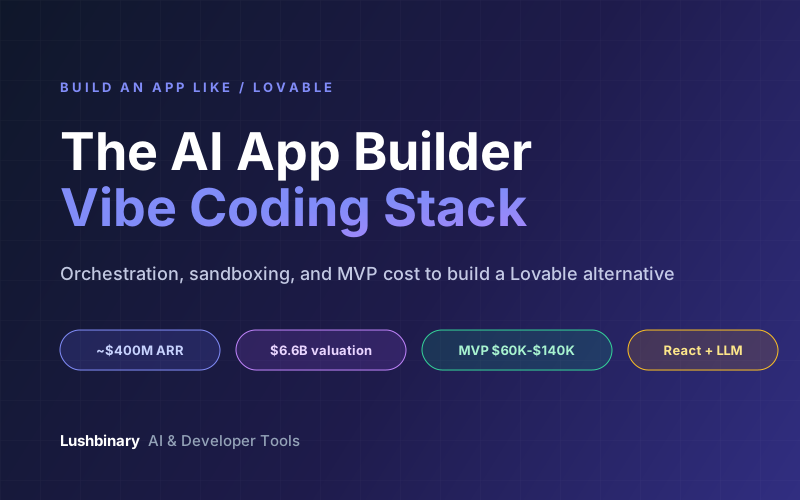
Lovable went from $0 to roughly $400 million in ARR in about 14 months and raised a $330 million Series B at a $6.6 billion valuation. The pitch is simple and intoxicating: describe the app you want in plain English, and an AI fullstack engineer builds it, deploys it, and lets you keep iterating by chatting. This is the "vibe coding" wave, and Lovable is its breakout consumer-facing name.
But the category is far from settled. Bolt, v0, Replit, Base44, and a dozen others are fighting for the same users, and Lovable's own customers complain loudly about credit burn, a stingy free tier, and generated apps that get hard to maintain past the prototype stage. Those gaps, plus the explosion of demand for AI-built software, leave real room for focused, vertical app builders.
This guide breaks down how Lovable works, how it monetizes, the complaints you can build around, the features and architecture of an AI app builder, the AI orchestration that makes it good, what it costs to build, and how Lushbinary can help you ship a competitor.
📋 Table of Contents
- 1.What Makes Lovable Successful
- 2.Lovable’s Revenue Model & Pricing
- 3.User Complaints & Market Gaps You Can Exploit
- 4.Core Features for an AI App Builder MVP
- 5.System Architecture & Tech Stack
- 6.AI Orchestration That Differentiates
- 7.Development Cost & Timeline Breakdown
- 8.Why Lushbinary for Your AI App Builder MVP
1What Makes Lovable Successful
Lovable's growth was not luck. It rode three forces: frontier models good enough to write real apps, a founder-led brand that turned building in public into a distribution channel, and a product loop that delivers a working, deployed app in minutes.
Prompt to Deployed App in Minutes
The magic moment is seeing a real, styled, working web app appear from a sentence. Lovable generates a React and Tailwind frontend wired to a Supabase backend, shows a live preview, and gives you a shareable URL. That instant payoff is what converts curiosity into a subscription.
Conversational Iteration
You do not edit code, you describe changes. "Add a login page," "make the header sticky," "connect this form to the database." The AI applies the change and re-renders. This chat-driven editing is what makes non-engineers feel capable, and it is the core experience to replicate.
Distribution as a Product Feature
Lovable grew organically through founder content, open-source roots (the founder's earlier GPT Engineer project hit tens of thousands of GitHub stars), and a product that begs to be shared. Apps built on Lovable show a badge by default, turning every project into an ad. A credible competitor needs a distribution loop, not just a good builder.
| Metric | Lovable |
|---|---|
| ARR (Feb 2026, est.) | ~$400M |
| Valuation (Series B) | $6.6B |
| Series B Raise | $330M (CapitalG, Menlo) |
| ARR Milestones | $100M Jul 2025 to $400M Feb 2026 |
| Generated Stack | React + Tailwind + Supabase |
| Pricing Model | Credit-based subscriptions |
| Founded | 2023 (Stockholm) |
| Category | AI app builder / vibe coding |
2Lovable's Revenue Model & Pricing
Lovable monetizes with credits. Each AI action consumes credits, and plans grant a monthly allotment. This aligns price with the real cost driver (LLM inference) but also creates the friction users complain about most.
| Plan | Price | Credits |
|---|---|---|
| Free | $0 | ~5 daily credits (about 30/month cap) |
| Pro | ~$25/month | 100 monthly credits |
| Business | ~$50/month | 100 credits, more control and speed |
| Enterprise | Custom | Security, audit logs, SSO, support |
The credit model is smart because it caps your exposure to inference costs, but it also makes pricing feel unpredictable to users. A competitor can win trust with clearer, more generous pricing, or a bring-your-own-key option for power users who would rather pay the model provider directly. The biggest revenue expansion is enterprise: internal tools, admin panels, and prototypes that teams build instead of buying off-the-shelf.
💡 Revenue Opportunity
A vertical builder (internal tools, e-commerce storefronts, CRMs for a specific industry) can charge more per seat than a generalist because the output is tailored and immediately useful. Pair a transparent credit or seat price with a self-hosted or BYOK tier and you address the two loudest complaints at once.
3User Complaints & Market Gaps You Can Exploit
We reviewed reviews, Reddit threads, and comparison teardowns across Lovable, Bolt, and v0. These are the recurring pain points, and each is a wedge.
🔥 Credit Burn
Long iteration sessions chew through credits fast, especially when the AI retries failed builds. Users feel they are paying to fix the AI's mistakes.
🪙 Tight Free Tier
Roughly 5 credits per day is barely enough to evaluate the product. Skeptics churn before they reach the magic moment.
🧩 Struggles With Complex Apps
Great for prototypes and simple CRUD apps, shakier on large codebases, complex state, and intricate business logic. Quality degrades as projects grow.
🐛 Hard to Debug Generated Code
When something breaks, non-engineers are stuck and engineers find the generated code unfamiliar. The 'last mile' to production is rough.
🔐 Backend & Vendor Lock-In
Tight coupling to a specific backend (Supabase) and platform makes it hard to move a serious project off the builder later.
🎨 Same-Looking Output
Generated apps share a recognizable look. Teams that want a distinct brand or design system have to fight the defaults.
💡 The Opportunity
The biggest gap is production readiness for a niche. Pick a vertical (internal tools, dashboards, a specific framework, a regulated industry), generate clean code on a stack the user owns, and make export and self-hosting first-class. Transparent pricing and maintainable output beat raw breadth for serious builders.
4Core Features for an AI App Builder MVP
Phase 1: Lean MVP (10-16 weeks)
- Prompt-to-App Generation - Turn a natural-language prompt into a working React and Tailwind app with sensible structure
- Live Preview - Render the generated app instantly in a sandbox so users see changes as they chat
- Conversational Editing - Apply incremental changes from chat instructions and re-render without a full rebuild
- Code View & Export - Show the real code and let users download or push it, so nothing is locked in a black box
- Auth & Credit Metering - Accounts, usage tracking, and a credit or seat-based billing system
- One-Click Deploy - Publish to a shareable URL with a custom-domain option
Phase 2: Differentiation (10-14 weeks)
- Backend Provisioning - Auto-create a database, auth, and API routes, with a choice of backend rather than a single locked vendor
- GitHub Sync - Two-way sync so developers can edit in their own tools and keep the AI in the loop
- Templates & Design Systems - Starting points and brandable themes so output does not all look the same
- Error Recovery - Detect failed builds, explain them in plain language, and self-heal instead of silently burning credits
- Version History - Snapshots and rollback so users can experiment without fear
Phase 3: Scale & Teams (12-16 weeks)
- Team Workspaces - Shared projects, roles, and comments for collaborative building
- BYOK & Self-Hosting - Bring-your-own-key and on-prem options for cost control and compliance
- Agent Mode - Long-horizon tasks where the AI plans multi-step changes and verifies them against tests
- Marketplace - Community templates and components that compound the platform's value
5System Architecture & Tech Stack
An AI app builder has three hard parts: code generation orchestration (turning intent into correct, runnable code), safe execution (running untrusted generated code in a sandbox), and cost control (metering inference so margins survive). Here is the architecture we recommend.
Recommended Tech Stack
| Layer | Technology | Why |
|---|---|---|
| Frontend | Next.js + React + Tailwind | The editor UI and the live-preview surface |
| Coding Model | Claude / GPT / Gemini | Frontier models write the highest-quality app code today |
| Orchestration | Custom agent loop + tool calling | Plan, generate, run, read errors, and repair in a loop |
| Sandbox | WebContainers or Firecracker/Docker | Run untrusted generated code safely with resource limits |
| Generated Stack | React + Tailwind + Supabase or Postgres | A familiar, deployable target users can own |
| Backend | Node.js + PostgreSQL + Redis | Project metadata, sessions, and queues |
| Deploy | AWS / Cloudflare + CDN | Fast publishing and custom domains |
| Billing | Stripe + usage metering | Credit or seat plans tied to inference cost |
To keep inference costs sane, route requests across models by difficulty. Our LLM gateway and model routing guide covers the patterns, and our context engineering guide explains how to feed the model the right code context.
6AI Orchestration That Differentiates
The model is a commodity. The orchestration around it is the product. This is where a focused competitor can out-build a generalist.
🧭 Plan-Then-Build
Have the model produce a short plan and file map before writing code. Planning first reduces wasted generations and the credit burn users hate.
🔧 Self-Healing Builds
Run the generated app, capture errors, and feed them back so the agent fixes its own mistakes instead of charging the user for the retry.
🗂️ Smart Context Selection
Send only the relevant files and a project map to the model. Good context engineering keeps output coherent as the codebase grows.
✅ Eval-Gated Output
Run lint, type checks, and lightweight tests before showing a result as 'done'. Quality gates prevent the broken-output churn.
🎚️ Effort Routing
Use a small fast model for trivial edits and a frontier model for architecture. Difficulty-based routing protects both speed and margin.
🧱 Component Memory
Reuse the user's existing components and design tokens so new screens match the app instead of drifting into a generic look.
7Development Cost & Timeline Breakdown
An AI app builder is one of the more complex products to build because the orchestration, sandboxing, and cost-control layers are all non-trivial. Here is a realistic breakdown.
Get Detailed Cost Breakdown
Fill in your details to unlock pricing and cost information.
8Why Lushbinary for Your AI App Builder MVP
At Lushbinary, we build AI agent systems and developer tools, exactly the muscles an app builder needs. Here is what we bring:
- Agent orchestration - We build plan-generate-repair loops with tool calling, eval gates, and self-healing so output quality stays high
- Safe code execution - We run untrusted generated code in isolated sandboxes with resource limits and clean teardown
- Cost-aware AI - We implement model routing, semantic caching, and usage metering so your margins survive scale
- Full-stack delivery - We build the editor, preview, deployment, GitHub sync, and billing as one coherent product
- Speed - We use AI coding tools ourselves to ship faster, and we know where they help and where they hurt
🚀 Free Consultation
Want to build an AI app builder that competes? Lushbinary specializes in AI agent platforms and developer tools. We'll scope your project, recommend the right model and sandbox architecture, and give you a realistic timeline with no obligation.
❓ Frequently Asked Questions
How much does it cost to build an AI app builder like Lovable?
A focused MVP costs $60,000-$140,000 over 4-7 months. A full vibe-coding platform with live preview, GitHub sync, backend provisioning, and teams ranges from $180,000-$400,000 over 9-15 months. LLM inference is the largest ongoing cost.
How does Lovable make money?
A credit-based subscription: a free tier with about 5 daily credits, Pro around $25/month for 100 monthly credits, and Business around $50/month. Lovable reached roughly $400M ARR in early 2026 at a $6.6B valuation.
What tech stack powers an AI app builder like Lovable?
A frontier coding model behind an orchestration layer, a sandboxed execution environment (WebContainers or remote containers), a generated React + Tailwind + Supabase stack, live preview, GitHub integration, and credit metering with billing.
What are the biggest complaints about Lovable?
Credit burn during long sessions, a tight free tier (about 5 credits per day), struggles with complex or large apps, and difficulty debugging generated code once a project grows beyond a prototype.
Is it realistic to compete with Lovable in 2026?
Head-on is hard, but vertical and niche builders are wide open. A builder tuned for a specific framework, industry, or internal-tools use case, with transparent pricing and cleaner code, can win an underserved audience.
📚 Sources
- Lovable - Series B announcement - Funding and valuation
- Sacra - Lovable revenue and growth - ARR milestones
- Lovable pricing and credits breakdown - Plan and credit details
Content was rephrased for compliance with licensing restrictions. Revenue, valuation, and pricing data sourced from public reporting and official announcements as of May 2026. Figures may change - always verify current numbers before relying on them.
Build an AI App Builder That Ships Production Code
Clean code, transparent pricing, and self-healing generation. Let Lushbinary build your Lovable alternative with the orchestration that protects both quality and margins.
Ready to Build Something Great?
Get a free 30-minute strategy call. We'll map out your project, timeline, and tech stack - no strings attached.
Prefer email? Reach us directly: