
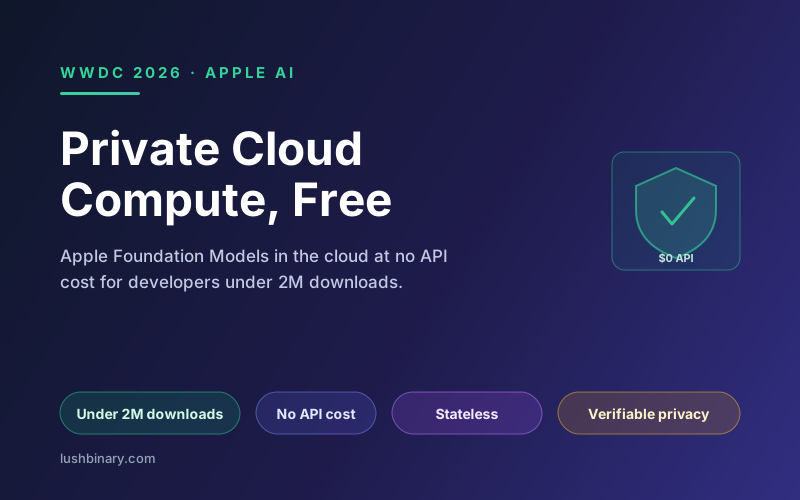
Buried in the WWDC 2026 developer announcements was a line that quietly changes the economics of building AI into an app: developers in the App Store Small Business Program with fewer than 2 million first-time downloads can run Apple Foundation Models on Private Cloud Compute with no cloud API cost. For most indie and small-team apps, that is free access to a capable, private cloud model.
The usual blocker for shipping AI is not the idea, it is the bill. Per-token cloud pricing turns a popular feature into a liability, so teams either water the feature down or skip it. Apple just removed that blocker for the developers most exposed to it, and wrapped it in a privacy model that is stronger than a typical cloud API.
This guide explains what Private Cloud Compute is, who qualifies for the free tier, how it relates to the Google Gemini partnership, what the privacy guarantees actually mean, and how to design an app so the free tier is a launchpad rather than a trap when you scale.
On this page
1What Private Cloud Compute is
Private Cloud Compute is Apple's server-side extension of on-device Apple Intelligence. Most Apple Intelligence requests run locally on the device. When a request needs more capability than the on-device model can deliver, it is sent to Apple Silicon servers that are engineered around two principles: they are stateless, and their behavior is cryptographically verifiable. In plain terms, the servers use your data only to fulfill the request, retain nothing afterward, and are built so that independent researchers can check those claims.
For developers, the important shift in 2026 is that PCC is no longer just the invisible backend for Apple's own features. Through the Foundation Models framework, you can target Apple Foundation Models running on PCC directly from your app, using the same Swift session API you use for the on-device model. See our Foundation Models framework guide for how that API is shaped.
2Who qualifies for the free tier
Apple was specific about eligibility:
- You must be enrolled in the App Store Small Business Program.
- Your apps must have fewer than 2 million first-time App Store downloads in total.
- Qualifying developers get Apple Foundation Models on Private Cloud Compute with no cloud API cost.
- iCloud+ subscribers get additional access on top of that.
That covers the vast majority of apps on the store. The threshold is first-time downloads, not active users or revenue, so a small team with a focused, well-loved app can build a genuinely useful AI feature without provisioning or paying for inference infrastructure.
3The Gemini question
A lot of the WWDC 2026 coverage tangled two separate things, so it is worth separating them clearly.
- Apple Foundation Models (on device and on PCC) are Apple's own models. They were developed with the aid of Google Gemini and its technologies through distillation and training, not by embedding Gemini wholesale. Apple has stated these models remain private and run within its own boundary.
- The new Siri AI separately relies on a larger custom Google model for its most complex reasoning, with contractual privacy terms. That is a different system from the Foundation Models you call in your app.
For your purposes as a developer: when you target Apple Foundation Models on PCC, you are using Apple's models under Apple's privacy guarantees, regardless of how those models were trained. If you want a frontier third-party model instead, the framework lets you route to Claude or Gemini explicitly, which is a separate, paid, and disclosed path.
4What the privacy guarantees mean
The practical privacy hierarchy for a developer is:
- On-device is the strongest guarantee: data never leaves the device, works offline, and costs nothing.
- Private Cloud Compute is the next step: data leaves the device but stays within Apple's stateless, verifiable boundary and is not retained.
- Third-party cloud (Claude, Gemini) is governed by that provider's terms, so reserve it for cases that justify leaving Apple's boundary.
5The economics vs a typical cloud API
Consider a modestly successful app with 200,000 active users where 10% use an AI summarization feature a few times a day. On a per-token cloud API, that traffic can run into hundreds or thousands of dollars a month before the feature has proven its worth. On the on-device model it costs nothing, and PCC fills the gap for the harder requests at no API cost while you are under the threshold.
The strategic read
Apple is using free inference to pull small developers deeper into its AI stack, the same way it once used free developer tools to grow the platform. The upside for you is real: ship AI features at zero marginal cost while you grow. The tradeoff is platform lock-in, which is why the provider abstraction matters.
6Designing for the threshold
The free tier is generous, but you should build as if you will cross 2 million downloads, because the apps worth building often do.
- Default to on-device. Every request you can serve locally is free and private forever, regardless of your download count.
- Keep the provider behind a seam. Wrap model calls in your own thin service so you can switch from free PCC to a metered arrangement, or to a third-party model, without touching feature code.
- Instrument usage now. Track how often each feature escalates to PCC so you can forecast cost before you hit the threshold.
- Have a degradation plan. Decide what the feature does on older, non-Apple-Intelligence devices, and what it does if cloud access is ever rate-limited.
7Build it right with Lushbinary
Lushbinary designs AI features that lean on the free, private tiers first and escalate only when the product needs it. We build the provider abstraction, instrument escalation rates, and plan the path past the 2 million download threshold so a hit app does not turn into a surprise inference bill. On-device first, PCC when it helps, third-party only when it earns its place.
🚀 Free Consultation
Want to add an AI feature without taking on cloud costs? We'll scope it against Apple's free Private Cloud Compute tier and the on-device model, and give you a realistic plan with no obligation.
❓ Frequently Asked Questions
Is Apple's Private Cloud Compute free for developers?
Yes, within limits. At WWDC 2026 Apple announced that developers in the App Store Small Business Program with fewer than 2 million first-time App Store downloads can run Apple Foundation Models on Private Cloud Compute with no cloud API cost. iCloud+ subscribers get additional access. It removes per-token infrastructure cost as a barrier to shipping AI features.
What is Private Cloud Compute?
Private Cloud Compute (PCC) is Apple's server-side extension of on-device Apple Intelligence. When a request needs more than the on-device model can handle, it runs on Apple Silicon servers designed to be stateless and cryptographically verifiable, so data is used only to fulfill the request and is not retained or accessible to Apple staff.
Do Apple's foundation models use Google Gemini?
The next-generation Apple Foundation Models were built with the aid of Google Gemini and its technologies through distillation and training, not by dropping Gemini in wholesale. Apple has stated the models running on device and on Private Cloud Compute are Apple's own and remain private. A separate, larger custom Gemini model powers parts of the new Siri AI.
What happens when my app passes 2 million downloads?
Apple framed the free tier as removing the initial barrier for smaller developers. Past the threshold, expect the relationship to change to a paid or metered arrangement. Architect your AI feature so the provider can be swapped or metered without rewriting the feature, using the Foundation Models provider abstraction.
Is Private Cloud Compute private enough for sensitive data?
PCC is designed to be stateless and independently verifiable, which is a stronger posture than typical cloud APIs. Even so, for the most sensitive data the on-device model is the safest choice because nothing leaves the device. Use PCC when you need more capability than on-device but still want Apple's privacy guarantees.
Sources
- Apple Developer - Private Cloud Compute
- MacRumors - Apple Outlines Major AI and Developer Tool Updates
- AppleInsider - Apple's foundation models and the Gemini partnership
Content was rephrased for compliance with licensing restrictions. Eligibility and program details sourced from official Apple developer materials and WWDC 2026 coverage as of June 2026. Free-tier terms, thresholds, and program rules may change - always verify on Apple's developer site before relying on them.
Add AI to Your App Without the Cloud Bill
We'll design your feature around Apple's free, private AI tiers and plan for scale. Tell us what you want to build.
Ready to Build Something Great?
Get a free 30-minute strategy call. We'll map out your project, timeline, and tech stack - no strings attached.
Prefer email? Reach us directly: