
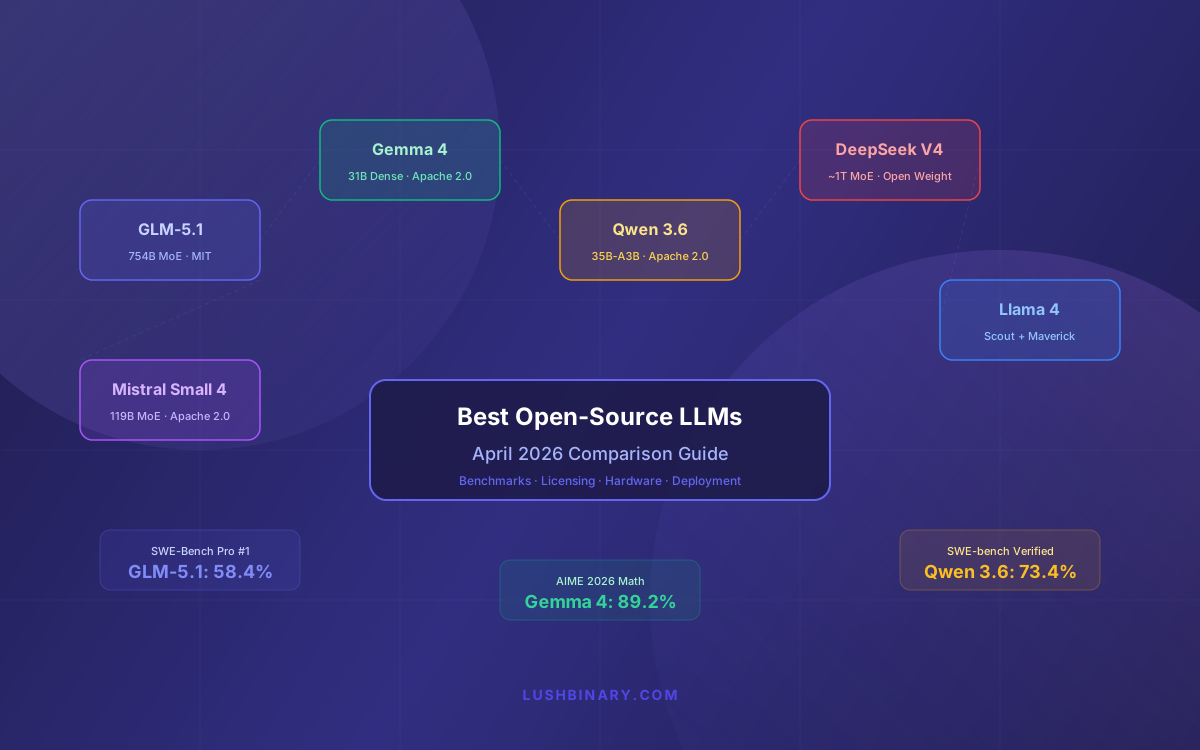
Twelve months ago, picking an open-source LLM meant choosing between "good enough for prototyping" and "not ready for production." That era is over. In April 2026, six major labs ship open-weight models that match or beat proprietary alternatives on key benchmarks — and you can run several of them on a single consumer GPU.
GLM-5.1 just topped SWE-Bench Pro ahead of GPT-5.4 and Claude Opus 4.6. Gemma 4 outperforms Llama 4 Maverick on math and coding despite being a fraction of the size. Qwen 3.6 scores 73.4% on SWE-bench Verified while activating only 3 billion parameters per token. The question is no longer whether open-source models are production-ready — it's which one fits your workload.
This guide ranks the best open-source LLMs available right now, covers benchmarks, licensing, hardware requirements, deployment options, and gives you a clear decision framework for choosing the right model for your project.
📋 Table of Contents
- 1.Why Open-Source LLMs Matter More Than Ever
- 2.The Top 8 Open-Source LLMs in April 2026
- 3.Head-to-Head Benchmark Comparison
- 4.Licensing: MIT vs Apache 2.0 vs Custom
- 5.Hardware Requirements & Deployment Options
- 6.Best Model by Use Case
- 7.Self-Hosting Stack: Ollama, vLLM & llama.cpp
- 8.Cost Comparison: Self-Hosted vs API
- 9.Agentic AI & Function Calling Support
- 10.How Lushbinary Deploys Open-Source LLMs for Production
1Why Open-Source LLMs Matter More Than Ever
The open-source AI landscape has undergone a fundamental shift. In early 2025, proprietary models held a clear lead on every major benchmark. By April 2026, that gap has collapsed. Six labs — Google (Gemma 4), Alibaba (Qwen 3.6), Meta (Llama 4), Mistral (Small 4), Zhipu AI (GLM-5.1), and DeepSeek (V4) — now ship competitive open-weight models that rival or surpass closed alternatives on practical workloads.
This matters for three reasons:
- Data sovereignty: Your code, customer data, and proprietary information never leave your infrastructure. For regulated industries (healthcare, finance, defense), this isn't optional — it's a compliance requirement.
- Cost control: API costs compound fast at scale. A team making 100K requests/day to Claude Opus 4.6 at $15/MTok input can spend $45K+/month. Self-hosting a comparable open model on 4x A100s costs roughly $8-12K/month on AWS — and the cost is fixed regardless of volume.
- Customization: Fine-tuning, LoRA adapters, custom system prompts without vendor restrictions, and the ability to modify model behavior at the weight level. You own the model, not a subscription.
📊 Key Stat
As of April 2026, the top open-source model (GLM-5.1) scores 58.4% on SWE-Bench Pro, surpassing both GPT-5.4 (57.7%) and Claude Opus 4.6 (57.3%). This is the first time an open-weight model has claimed the #1 spot on this benchmark.
2The Top 8 Open-Source LLMs in April 2026
Here are the models that matter right now, ranked by overall capability and practical utility for developers and teams building production AI systems.
1. GLM-5.1 (Zhipu AI) — Best for Agentic Coding
Released April 7, 2026 under the MIT license, GLM-5.1 is a 754-billion-parameter Mixture-of-Experts model designed for long-horizon agentic tasks. It can autonomously work on a single coding task for up to 8 hours, rethinking its strategy across hundreds of iterations without getting stuck in dead ends.
- Parameters: 754B total (MoE), ~32B active per token
- SWE-Bench Pro: 58.4% (#1 globally)
- NL2Repo: 42.7% (repo-level code generation)
- License: MIT (fully permissive)
- Hardware: 4-8x A100/H100 GPUs for full precision
GLM-5.1's standout feature is its "marathon runner" architecture — it doesn't just generate code, it plans, executes, tests, and iterates autonomously. In one demonstration, it ran 6,000+ tool calls to build a vector database achieving 21.5K QPS from scratch. Read our full GLM-5.1 developer guide for deployment details.
2. Gemma 4 (Google DeepMind) — Best Quality-per-VRAM
Released April 2, 2026 under Apache 2.0, Gemma 4 is the most capable open model you can run on consumer hardware. The flagship 31B Dense model ranks #3 among all open models on the Arena AI text leaderboard, outperforming Llama 4 Maverick on math, coding, and reasoning despite being a fraction of the size.
- Variants: E2B (2.3B), E4B (4B), 26B MoE (3.8B active), 31B Dense
- AIME 2026: 89.2% (31B Dense)
- Context: 128K-256K tokens
- License: Apache 2.0
- Hardware: E2B runs on phones; 31B fits a single 24GB GPU (quantized)
Gemma 4's PLE (Parallel Linear Experts) architecture with shared KV cache makes it exceptionally efficient. The 26B MoE variant achieves similar quality to the 31B Dense while activating only 3.8B parameters per token. Multimodal support covers text, images, and audio. See our Gemma 4 developer guide for the full breakdown.
3. Qwen 3.6 (Alibaba) — Best Efficiency at Scale
Alibaba's Qwen 3.6 generation launched in two forms: the proprietary Qwen 3.6 Plus (March 31 – April 2, 2026) and the open-weight Qwen 3.6-35B-A3B (April 14, 2026). The open model is a sparse MoE with 35B total parameters but only 3B active per token — making it one of the most compute-efficient frontier models available.
- Parameters: 35B total, 3B active (MoE)
- SWE-bench Verified: 73.4% (open-weight model)
- Context: 262K native, extensible to 1M tokens
- License: Apache 2.0
- Hardware: Runs on dual RTX 5060 Ti at 21.7 tok/s
The Plus variant (proprietary, API-only) scores 78.8% on SWE-bench Verified and 61.6% on Terminal-Bench 2.0, beating Claude Opus 4.5 on terminal tasks. It's currently free on OpenRouter during preview. Check our Qwen 3.6 developer guide for self-hosting instructions.
4. DeepSeek V4 (DeepSeek AI) — Largest Open-Weight Model
DeepSeek V4 is the most ambitious open-weight release of 2026: a ~1 trillion parameter MoE model with ~32-37B active parameters per token, a 1 million token context window powered by Engram conditional memory, and native multimodal generation (text, image, video).
- Parameters: ~1T total, ~32-37B active (MoE, 256 experts)
- SWE-bench: 80-85% (pre-release claims)
- HumanEval: ~90%
- Context: 1M tokens (Engram memory)
- License: DeepSeek open-weight license
- Hardware: 4-8x H100 GPUs minimum
Engram memory is the headline innovation — a conditional memory system that lets the model selectively recall and apply knowledge across extremely long contexts without the degradation typical of standard attention mechanisms. Read our DeepSeek V4 developer guide for the full architecture breakdown.
5. Llama 4 (Meta) — Best Multimodal Open Model
Meta's Llama 4 ships two models: Scout (109B total, 17B active, 16 experts) for efficiency and long contexts, and Maverick (400B total) for raw capability. Both are natively multimodal (text + images + video) and use MoE to keep inference costs manageable.
- Scout: 109B total, 17B active, 10M token context
- Maverick: 400B total, competes with GPT-4.5 on reasoning
- Multimodal: Native image + video understanding
- License: Meta Llama License (commercial use allowed for <700M MAU)
- Hardware: Scout fits 2x A100; Maverick needs 4-8x A100/H100
Scout's 10 million token context window is the largest of any open model — enough to ingest entire codebases or document collections in a single pass. Maverick competes with proprietary models on general knowledge benchmarks (MMLU 83+).
6. Mistral Small 4 (Mistral AI) — Best Unified Model
Released March 16, 2026 under Apache 2.0, Mistral Small 4 is a 119B-parameter MoE that unifies four previously separate products (Mistral Small, Magistral, Pixtral, and Devstral) into a single deployment with configurable reasoning effort. It activates only ~6B parameters per token.
- Parameters: 119B total, ~6B active (MoE)
- Capabilities: Instruct, reasoning, multimodal vision, agentic coding
- License: Apache 2.0
- Hardware: Runs on a single A100 (quantized)
The key innovation is configurable reasoning effort — you can dial between fast responses and deep chain-of-thought reasoning without switching models. For teams that previously maintained separate models for different tasks, Small 4 consolidates everything into one deployment.
7. Qwen 3.5 (Alibaba) — Best Established Model Family
While Qwen 3.6 is the latest, the Qwen 3.5 family remains one of the most deployed open-source model families in production. Eight models from 0.8B to 397B parameters, all Apache 2.0, all natively multimodal (text, image, video), built on a hybrid architecture mixing linear attention with traditional transformers.
- Range: 0.8B to 397B parameters
- Architecture: Hybrid linear + transformer attention
- License: Apache 2.0
- Ecosystem: Massive community, extensive fine-tunes
Qwen 3.5 is the safe, battle-tested choice. It has the largest ecosystem of fine-tuned variants, community tooling, and production deployment guides. If you need stability over bleeding-edge performance, this is your pick. See our Qwen 3.5 developer guide.
8. DeepSeek-R1 — Best Open Reasoning Model
DeepSeek-R1 remains the go-to open-source reasoning model. Its chain-of-thought approach and distilled variants (1.5B to 70B) make it accessible across hardware tiers. While V4 is the newer flagship, R1 has a more mature ecosystem and is easier to deploy.
- Distilled variants: 1.5B, 7B, 8B, 14B, 32B, 70B
- Strength: Mathematical reasoning, step-by-step problem solving
- License: MIT
- Hardware: 7B variant runs on 8GB VRAM
R1's distilled models are particularly useful for edge deployment and resource-constrained environments where you need reasoning capability without the overhead of a full-size model.
3Head-to-Head Benchmark Comparison
Numbers don't tell the whole story, but they're a useful starting point. Here's how the top open-source models stack up against each other and the leading proprietary models as of April 2026.
| Model | SWE-Bench | AIME 2026 | Active Params | Context |
|---|---|---|---|---|
| GLM-5.1 | 58.4% (Pro) | - | ~32B | 128K |
| Qwen 3.6-35B-A3B | 73.4% | 92.7% | 3B | 262K–1M |
| Gemma 4 31B | - | 89.2% | 31B | 256K |
| DeepSeek V4 | ~80-85% | - | ~32-37B | 1M |
| Llama 4 Maverick | - | - | ~17B | 1M |
| Llama 4 Scout | - | - | 17B | 10M |
| Mistral Small 4 | - | - | ~6B | 128K |
| Qwen 3.5-235B | - | - | 22B | 128K |
⚠️ Benchmark Caveat
SWE-Bench Pro and SWE-bench Verified are different benchmarks with different difficulty levels. GLM-5.1's 58.4% on Pro and Qwen 3.6's 73.4% on Verified are not directly comparable. Always check which specific benchmark variant is being cited.
For proprietary reference points: GPT-5.4 scores 57.7% on SWE-Bench Pro, Claude Opus 4.6 scores 57.3% on SWE-Bench Pro, and Qwen 3.6 Plus (proprietary) scores 78.8% on SWE-bench Verified. The gap between open and closed models has effectively closed on coding benchmarks.
Where proprietary models still lead is in general knowledge breadth, instruction following nuance, and safety alignment. For specific technical tasks — coding, math, reasoning — the best open models are now competitive or superior.
4Licensing: MIT vs Apache 2.0 vs Custom
Licensing determines what you can actually do with a model. This is where the differences between "open-source" and "open-weight" matter.
| Model | License | Commercial Use | Modification | Restrictions |
|---|---|---|---|---|
| GLM-5.1 | MIT | ✅ Unrestricted | ✅ Full | None |
| DeepSeek-R1 | MIT | ✅ Unrestricted | ✅ Full | None |
| Gemma 4 | Apache 2.0 | ✅ Unrestricted | ✅ Full | Patent grant |
| Qwen 3.5/3.6 | Apache 2.0 | ✅ Unrestricted | ✅ Full | Patent grant |
| Mistral Small 4 | Apache 2.0 | ✅ Unrestricted | ✅ Full | Patent grant |
| Llama 4 | Meta Llama | ⚠️ Conditional | ✅ Full | >700M MAU restricted |
| DeepSeek V4 | Custom | ✅ Most uses | ✅ Full | Some use-case limits |
MIT is the most permissive — do anything you want, no strings attached. Apache 2.0 adds an explicit patent grant (good for enterprise) but is otherwise equally permissive. Meta's Llama license is the most restrictive of the group, blocking companies with over 700 million monthly active users from using the model without a separate agreement.
For enterprise deployment, MIT and Apache 2.0 are the safest choices. If you're a startup or mid-size company, Llama 4's license is fine. If you're building a product that could scale to hundreds of millions of users, stick with GLM-5.1, Gemma 4, Qwen, or Mistral.
5Hardware Requirements & Deployment Options
One of the biggest advantages of the MoE revolution is that trillion-parameter models don't need trillion-parameter hardware. Active parameter count is what determines your VRAM needs.
| Model | Min VRAM (Q4) | Recommended GPU | AWS Instance |
|---|---|---|---|
| Gemma 4 E2B | 2GB | Any (phone/edge) | t3.medium (CPU) |
| Gemma 4 26B MoE | 16GB | RTX 4090 / A5000 | g5.xlarge |
| Gemma 4 31B Dense | 20-24GB | RTX 4090 / A6000 | g5.2xlarge |
| Qwen 3.6-35B-A3B | 20GB | RTX 4090 / 2x 5060 Ti | g5.2xlarge |
| Mistral Small 4 | 48GB | A6000 / 2x RTX 4090 | g5.4xlarge |
| Llama 4 Scout | 48-80GB | 2x A100 | p4d.24xlarge |
| GLM-5.1 | 320GB+ | 4-8x A100/H100 | p4d/p5.48xlarge |
| DeepSeek V4 | 320GB+ | 4-8x H100 | p5.48xlarge |
Quantization is the key to running large models on smaller hardware. Q4_K_M quantization typically reduces memory requirements by 50-60% with minimal quality loss (1-3% on most benchmarks). Tools like llama.cpp and Ollama handle quantization automatically.
For MoE models, the total parameter count is misleading. Qwen 3.6-35B-A3B has 35B total parameters but only activates 3B per token — so its inference speed and memory footprint are closer to a 3B dense model than a 35B one. This is why MoE architectures dominate the 2026 open-source landscape.
6Best Model by Use Case
There's no single "best" model. The right choice depends on your specific workload, hardware constraints, and deployment requirements.
🖥️ Coding & Software Engineering
GLM-5.1 or Qwen 3.6-35B-A3B
GLM-5.1 leads SWE-Bench Pro; Qwen 3.6 offers similar quality at a fraction of the hardware cost.
🧮 Math & Reasoning
Gemma 4 31B or DeepSeek-R1
Gemma 4 scores 89.2% on AIME 2026. DeepSeek-R1 excels at step-by-step mathematical proofs.
📱 Edge & Mobile Deployment
Gemma 4 E2B or E4B
2.3B-4B parameters, runs on phones and IoT devices. Apache 2.0 license.
🖼️ Multimodal (Images + Video)
Llama 4 Scout/Maverick
Native multimodal from training. Best image and video understanding among open models.
🤖 AI Agents & Tool Use
GLM-5.1 or Mistral Small 4
GLM-5.1 for long-horizon autonomous tasks. Mistral Small 4 for configurable reasoning effort.
📄 Long-Context Processing
Llama 4 Scout or DeepSeek V4
Scout: 10M tokens. DeepSeek V4: 1M tokens with Engram memory for better recall.
💰 Budget-Constrained
Qwen 3.6-35B-A3B
Only 3B active params. Runs on dual RTX 5060 Ti. Scores 73.4% SWE-bench Verified.
🏢 Enterprise (Strict Licensing)
GLM-5.1 (MIT) or Gemma 4 (Apache 2.0)
Most permissive licenses. No usage restrictions. Patent grants with Apache 2.0.
7Self-Hosting Stack: Ollama, vLLM & llama.cpp
Three tools dominate the self-hosting landscape in 2026. Each serves a different deployment profile.
Ollama — Easiest Local Setup
Ollama is the fastest way to get an open-source LLM running locally. One command to install, one command to run. It handles model downloads, quantization, GPU memory management, and exposes both a CLI and an OpenAI-compatible REST API.
# Install and run Gemma 4
curl -fsSL https://ollama.com/install.sh | sh
ollama run gemma4:31b
# Or Qwen 3.6
ollama run qwen3.6:35b-a3b
vLLM — Best for Production Serving
vLLM is the standard for high-throughput production inference. It uses PagedAttention for efficient memory management, supports continuous batching, and provides an OpenAI-compatible API server out of the box. Best for multi-user deployments where you need to maximize requests/second.
# Serve GLM-5.1 with vLLM
pip install vllm
vllm serve zai-org/GLM-5.1 \
--tensor-parallel-size 8 \
--max-model-len 131072
llama.cpp — Best for CPU & Edge
llama.cpp runs models on CPU, Apple Silicon (Metal), and NVIDIA GPUs with minimal dependencies. It's the backbone of Ollama and many other tools. Use it directly when you need maximum control over quantization, context length, and memory allocation.
8Cost Comparison: Self-Hosted vs API
The economics of self-hosting vs API access depend on your volume. At low volumes, APIs win on simplicity. At scale, self-hosting saves significantly.
| Approach | Monthly Cost | Best For | Tradeoff |
|---|---|---|---|
| Claude Opus 4.6 API | $15/MTok in, $75/MTok out | Low volume, prototyping | Costs scale linearly |
| GPT-5.4 API | $10/MTok in, $30/MTok out | General-purpose tasks | Vendor lock-in |
| Qwen 3.6 Plus API | $0.29/MTok in, $1.65/MTok out | Cost-sensitive coding | Alibaba Cloud dependency |
| Self-host Gemma 4 31B (1x A100) | ~$2,500-3,500/mo | Medium volume, data privacy | Ops overhead |
| Self-host GLM-5.1 (8x H100) | ~$25,000-35,000/mo | High volume, frontier quality | Significant infra |
| Self-host Qwen 3.6-35B (1x RTX 4090) | ~$200/mo (electricity) | Individual/small team | Consumer hardware limits |
The breakeven point for self-hosting typically comes at around 50,000-100,000 API calls per month. Below that, APIs are simpler and cheaper. Above that, self-hosting starts saving 40-70% depending on the model and hardware choice.
A hybrid approach often works best: use APIs for prototyping and low-volume tasks, self-host for high-volume production workloads. Many teams run a smaller model (Gemma 4 or Qwen 3.6) locally for routine tasks and route complex queries to a proprietary API as a fallback. Check our guide to running open-source LLMs on AWS for detailed cost breakdowns.
9Agentic AI & Function Calling Support
The biggest shift in 2026 isn't just model quality — it's that open-source models now support the agentic patterns (function calling, tool use, MCP integration) that were previously exclusive to proprietary APIs.
GLM-5.1
Native function calling, 6,000+ tool calls in a single session, 8-hour autonomous task execution. Best agentic model available.
Gemma 4
Native function calling via gemma-mcp package. Works with MCP servers. Supports tool-use in agentic workflows.
Qwen 3.6
preserve_thinking parameter for agent loops. Works with Claude Code, OpenClaw, and Qwen Code via OpenAI-compatible API.
Mistral Small 4
Configurable reasoning effort for agent tasks. Unified model means one deployment handles all agent subtasks.
Llama 4
Function calling support via tool_use format. Works with LangChain, CrewAI, and other agent frameworks.
DeepSeek V4
Engram memory enables persistent context across agent sessions. 1M token window for complex multi-step tasks.
For teams building AI agents with open-source models, the Model Context Protocol (MCP) is the standard integration layer. MCP lets any model connect to any tool through a single protocol, and most open-source models now support it natively or through adapters. See our Gemma 4 agent building guide and Gemma 4 + MCP + AWS guide for hands-on examples.
Self-hosted AI agents like Hermes Agent, OpenClaw, and IronClaw all support swapping in open-source models as their LLM backend, giving you a fully self-hosted, privacy-preserving AI agent stack.
10How Lushbinary Deploys Open-Source LLMs for Production
At Lushbinary, we help teams move from API dependency to self-hosted open-source LLM infrastructure. Our approach covers the full stack:
- Model selection & benchmarking: We test candidate models against your specific workload — not generic benchmarks — to find the right quality/cost tradeoff.
- Infrastructure design: AWS GPU instances (EC2 p4d, p5, g5), SageMaker endpoints, or Bedrock AgentCore for managed deployment. We right-size hardware to your throughput needs.
- Serving stack: vLLM or SGLang for production inference, with auto-scaling, load balancing, and monitoring.
- Fine-tuning & LoRA: Custom adapters trained on your domain data to improve model performance on your specific tasks.
- Agent integration: MCP server setup, function calling configuration, and integration with your existing tools and workflows.
- Cost optimization: Spot instances, model routing (cheap model for simple tasks, premium for complex), and quantization tuning.
🚀 Free Consultation
Want to move from API dependency to self-hosted open-source LLMs? Lushbinary specializes in production LLM deployment on AWS. We'll benchmark models against your workload, design the infrastructure, and get you running — no obligation.
❓ Frequently Asked Questions
What is the best open-source LLM in April 2026?
It depends on your use case. GLM-5.1 leads on agentic coding (58.4% SWE-Bench Pro, MIT license). Gemma 4 offers the best quality-per-VRAM on consumer hardware (Apache 2.0). Qwen 3.6-35B-A3B is the most compute-efficient with only 3B active parameters scoring 73.4% on SWE-bench Verified.
Can I run open-source LLMs on my own hardware in 2026?
Yes. Gemma 4 E2B (2.3B params) runs on phones. Gemma 4 26B MoE runs on a single 24GB GPU. Qwen 3.6-35B-A3B activates only 3B parameters per token. Tools like Ollama, vLLM, and llama.cpp make local deployment straightforward.
Which open-source LLM has the most permissive license?
GLM-5.1 uses MIT - the most permissive option with zero restrictions. Gemma 4 and Qwen 3.6 use Apache 2.0, also very permissive. Llama 4 uses Meta's custom license restricting companies with over 700M monthly active users.
How do open-source LLMs compare to GPT-5.4 and Claude Opus 4.6?
The gap has closed on coding benchmarks. GLM-5.1 beats both GPT-5.4 (57.7%) and Claude Opus 4.6 (57.3%) on SWE-Bench Pro at 58.4%. Proprietary models still lead on general knowledge breadth and safety alignment.
What hardware do I need to self-host a large open-source LLM?
For small models (7-8B): 8GB RAM. For Gemma 4 31B: 24-48GB VRAM (RTX 4090). For trillion-parameter models like DeepSeek V4: 4-8x A100/H100 GPUs. Q4_K_M quantization halves memory requirements with minimal quality loss.
📚 Sources
- GLM-5.1 Model Card — Hugging Face
- Gemma 4 Announcement — Google DeepMind
- Qwen 3.6 Release Notes — Alibaba Cloud
- Llama 4 Model Family — Meta AI
- Mistral Small 4 Release — Mistral AI
- DeepSeek V4 — DeepSeek AI
Content was rephrased for compliance with licensing restrictions. Benchmark data sourced from official model cards and release announcements as of April 2026. Pricing and benchmarks may change — always verify on the vendor's website.
Deploy Open-Source LLMs With Confidence
Stop paying per token. Let Lushbinary design and deploy a self-hosted LLM stack on AWS that matches your workload, budget, and compliance requirements.
Ready to Build Something Great?
Get a free 30-minute strategy call. We'll map out your project, timeline, and tech stack - no strings attached.
Prefer email? Reach us directly: