
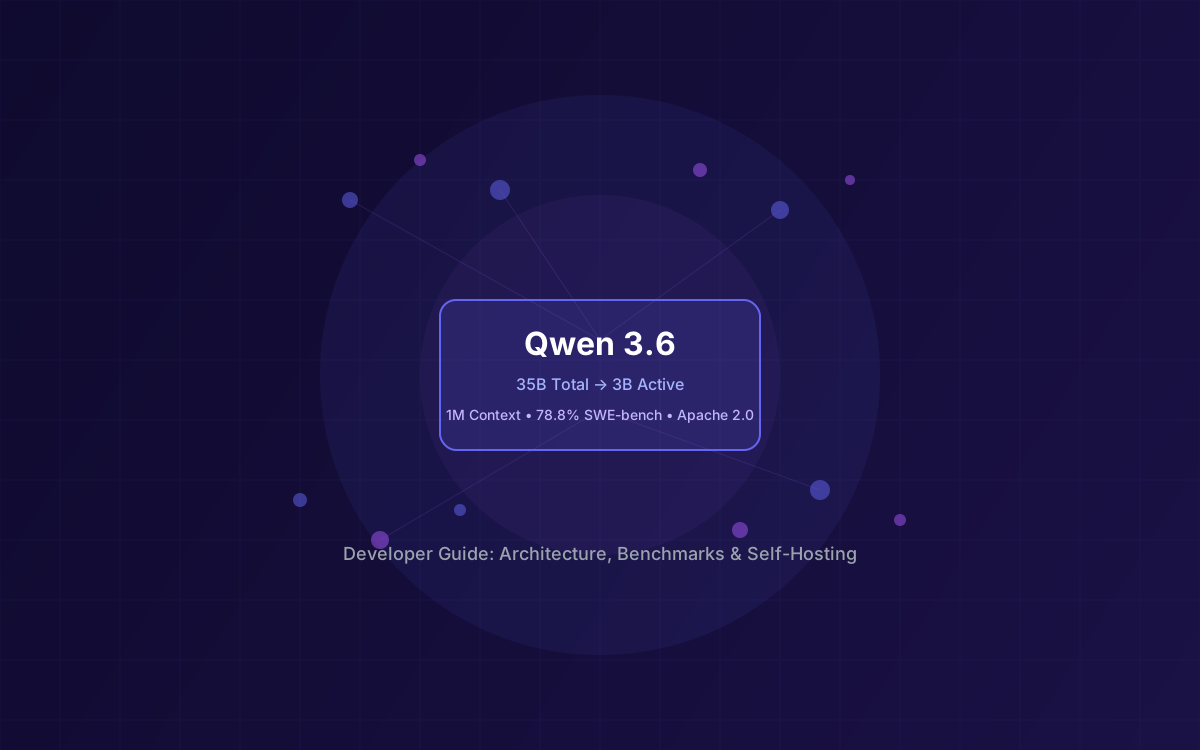
Alibaba's Qwen team has been on a tear. After the Qwen 3.5 series landed in February 2026 with MoE efficiency that defied parameter counts, the 3.6 generation arrived in late March and April with two distinct releases: Qwen 3.6 Plus, a proprietary flagship with a 1 million token context window, and Qwen 3.6-35B-A3B, an open-weight model that beats Gemma 4-31B on most coding benchmarks while activating only 3 billion parameters per token.
The numbers are hard to ignore: 78.8% on SWE-bench Verified for the Plus model, always-on chain-of-thought reasoning, a preserve_thinking parameter for agent loops, and pricing that undercuts Western competitors by 10-40x. Whether you're building agentic coding pipelines, deploying local AI assistants, or evaluating models for production, Qwen 3.6 demands attention.
This guide covers everything developers need to know: architecture, benchmarks, API access, self-hosting the open-weight variant, and practical integration patterns. If you've been following our Qwen 3.5 developer guide, consider this the sequel.
📋 Table of Contents
- 1.The Qwen 3.6 Family: Plus vs 35B-A3B
- 2.Architecture: Hybrid Linear Attention + Sparse MoE
- 3.Always-On Chain-of-Thought & Thinking Preservation
- 4.Benchmark Deep Dive
- 5.API Access & Pricing
- 6.Self-Hosting the Open-Weight Model
- 7.Agentic Coding: What Makes 3.6 Different
- 8.Multimodal Capabilities
- 9.Integration Patterns & Code Examples
- 10.Why Lushbinary for Your Qwen 3.6 Integration
1The Qwen 3.6 Family: Plus vs 35B-A3B
Qwen 3.6 isn't a single model - it's a generation split across two release tracks that serve different use cases.
| Spec | Qwen 3.6 Plus | Qwen 3.6-35B-A3B |
|---|---|---|
| Release Date | March 30, 2026 (preview); April 2, 2026 (official) | April 14, 2026 |
| Type | Proprietary (API-only) | Open-weight (Apache 2.0) |
| Architecture | Hybrid Linear Attention + Sparse MoE | Gated DeltaNet + Gated Attention + MoE |
| Total Parameters | Undisclosed (estimated 400B+) | 35B total, 3B active |
| Context Window | 1,000,000 tokens | 262,144 native (extensible to 1,010,000) |
| Max Output | 65,536 tokens | 65,536 tokens |
| SWE-bench Verified | 78.8% | 73.4% |
| Multimodal | Yes (images, documents, video, UI screenshots) | Yes (vision encoder) |
| License | Proprietary | Apache 2.0 |
The Plus model is the flagship - designed for production agentic workflows where you need maximum reasoning capability and the largest context window. The 35B-A3B is the self-hostable variant that brings most of the 3.6 improvements to hardware you control, with only 3B active parameters making it runnable on consumer GPUs.
2Architecture: Hybrid Linear Attention + Sparse MoE
Qwen 3.6 introduces a novel hybrid architecture that combines two key innovations to achieve both scale and efficiency.
Linear Attention (Plus Model)
Traditional transformer attention scales quadratically with sequence length - doubling the context doubles the compute by 4x. Qwen 3.6 Plus replaces this with a linear-complexity attention mechanism, which is what makes the 1M token context window feasible without astronomical compute costs. This is the same architectural direction that models like Mamba and RWKV have explored, but applied at frontier scale.
Gated DeltaNet + Gated Attention (35B-A3B)
The open-weight model uses a more detailed architecture that Alibaba has fully disclosed. Each of the 40 layers follows a repeating pattern:
10 × (3 × (Gated DeltaNet → MoE) → 1 × (Gated Attention → MoE))
- Gated DeltaNet: A linear attention variant with 32 heads for values and 16 for query/key, each with 128-dimensional heads. This handles the bulk of token processing efficiently.
- Gated Attention: Standard attention with 16 query heads and 2 KV heads (GQA), 256-dimensional heads, and 64-dimensional rotary position embeddings. This provides the precise long-range reasoning that linear attention alone can miss.
- Mixture of Experts: 256 total experts with 8 routed + 1 shared expert activated per token, each with a 512-dimensional intermediate layer.
The result: 35 billion total parameters, but only 3 billion active per forward pass. You get the learned capacity of a large model at the inference cost of a small one.
3Always-On Chain-of-Thought & Thinking Preservation
One of the most significant architectural decisions in Qwen 3.6 is the removal of the thinking/non-thinking toggle from the 3.5 series. In Qwen 3.5, developers chose between a "thinking" mode (slower, more accurate) and a "non-thinking" mode (faster, simpler). The most common complaint was "overthinking" - excessive reasoning on simple tasks that inflated token counts.
Qwen 3.6 Plus makes reasoning always-on by default. There's no toggle. The model reasons through every request but reaches conclusions faster and uses fewer tokens. The practical impact is better agent reliability - when a model consistently reasons rather than sometimes reasoning and sometimes not, it produces more predictable outputs for production pipelines.
💡 New: preserve_thinking Parameter
Qwen 3.6 introduces a preserve_thinking parameter that retains reasoning context from previous messages in multi-turn agent loops. Instead of the model re-deriving context each turn, it can reference its prior chain-of-thought - reducing token overhead and improving consistency across long agentic sessions. This is particularly valuable for coding agents that iterate over dozens of tool calls.
The open-weight 35B-A3B model also supports thinking preservation, making it the first self-hostable model to offer this capability natively.
4Benchmark Deep Dive
Qwen 3.6 delivers strong results across coding, reasoning, and knowledge benchmarks. Here's how both variants stack up.
Qwen 3.6 Plus (Proprietary)
| Benchmark | Score | Context |
|---|---|---|
| SWE-bench Verified | 78.8% | Real-world GitHub issue resolution |
| Terminal-Bench 2.0 | 61.6% | Beats Claude Opus 4.5 on terminal tasks |
| LiveCodeBench v6 | ~80% | Competitive coding problems |
| GPQA Diamond | ~86% | Graduate-level science reasoning |
| MMLU-Pro | ~86% | Broad knowledge evaluation |
Qwen 3.6-35B-A3B (Open-Weight)
| Benchmark | Qwen 3.6-35B-A3B | Gemma 4-31B | Qwen 3.5-27B |
|---|---|---|---|
| SWE-bench Verified | 73.4% | 52.0% | 75.0% |
| SWE-bench Multilingual | 67.2% | 51.7% | 69.3% |
| SWE-bench Pro | 49.5% | 35.7% | 51.2% |
| Terminal-Bench 2.0 | 51.5% | 42.9% | 41.6% |
| GPQA Diamond | 86.0% | 84.3% | 85.5% |
| MMLU-Pro | 85.2% | 85.2% | 86.1% |
| LiveCodeBench v6 | 80.4% | 80.0% | 80.7% |
| AIME 2026 | 92.7% | 89.2% | 92.6% |
| MCPMark | 37.0% | 18.1% | 36.3% |
| NL2Repo | 29.4% | 15.5% | 27.3% |
📊 Key Takeaway
The 35B-A3B model with only 3B active parameters beats Gemma 4-31B (a dense model) on nearly every coding benchmark while using a fraction of the compute. On Terminal-Bench 2.0, it scores 51.5% vs Gemma 4's 42.9% - a 20% improvement. On MCPMark (tool use), it more than doubles Gemma 4's score (37.0% vs 18.1%).
5API Access & Pricing
Qwen 3.6 Plus is accessible through multiple channels, each with different pricing and capabilities.
| Platform | Input (per 1M tokens) | Output (per 1M tokens) | Notes |
|---|---|---|---|
| OpenRouter (Preview) | $0.00 | $0.00 | Free during preview period |
| Alibaba Bailian | ~$0.29 | ~$1.65 | Production API, no long-context surcharge |
| DashScope | ~$0.29 | ~$1.65 | Alibaba Cloud developer API |
For comparison: Claude Opus 4.6 costs $15/$75 per million tokens, and GPT-5.4 costs $2.50/$15. Qwen 3.6 Plus on Bailian is roughly 12x cheaper than Claude and 6x cheaper than GPT-5.4 for output tokens. And unlike Claude or Gemini, Qwen doesn't charge extra for long-context requests - you pay the same rate whether you send 10K or 900K tokens.
The OpenRouter model ID is qwen/qwen3.6-plus-preview:free. The API is OpenAI-compatible, so you can use it as a drop-in replacement in most toolchains:
import OpenAI from "openai";

const client = new OpenAI({
  baseURL: "https://openrouter.ai/api/v1",
  apiKey: process.env.OPENROUTER_API_KEY,
});

const response = await client.chat.completions.create({
  model: "qwen/qwen3.6-plus-preview:free",
  messages: [
    { role: "user", content: "Refactor this React component..." }
  ],
  max_tokens: 65536,
});6Self-Hosting the Open-Weight Model
The Qwen 3.6-35B-A3B model is available on Hugging Face under Apache 2.0 and is compatible with vLLM, SGLang, KTransformers, and Hugging Face Transformers. With only 3B active parameters, it's remarkably efficient to run.
vLLM Deployment
# Install vLLM with Qwen 3.6 support
pip install vllm>=0.8.0

# Serve the model with OpenAI-compatible API
vllm serve Qwen/Qwen3.6-35B-A3B \
  --tensor-parallel-size 1 \
  --max-model-len 262144 \
  --trust-remote-code \
  --port 8000
Hardware Requirements
FP16 / BF16
~70 GB VRAM - 1× A100 80GB or 2× A6000 48GB
INT8 Quantized
~35 GB VRAM - 1× A100 40GB or 1× A6000
INT4 / GPTQ
~18 GB VRAM - 1× RTX 4090 24GB (with offloading)
GGUF (Q4_K_M)
~20 GB RAM - CPU inference via llama.cpp
7Agentic Coding: What Makes 3.6 Different
The headline capability of Qwen 3.6 is agentic coding - the ability to autonomously navigate complex, multi-step software engineering tasks. Both the Plus and 35B-A3B models show substantial improvements over 3.5 in this area.
What's Improved
- Frontend workflows: The model handles React, Vue, and Svelte component generation with greater fluency. QwenWebBench scores jumped from 978 (3.5-35B) to 1397 (3.6-35B) - a 43% improvement.
- Repository-level reasoning: NL2Repo scores improved from 20.5 to 29.4, meaning the model is significantly better at understanding and modifying code across entire repositories.
- Tool use: MCPMark scores went from 27.0 to 37.0, showing improved ability to use MCP tools, function calls, and external APIs in agentic loops.
- Terminal operations: Terminal-Bench 2.0 jumped from 40.5% to 51.5%, the highest score among all models in its weight class.
Compatible Agent Frameworks
Qwen 3.6 Plus works directly with major coding agent tools via its OpenAI-compatible API:
Claude Code
Via custom API endpoint configuration
OpenClaw / Hermes
As primary or routing LLM backend
Qwen Code
Native integration from Alibaba
Cursor / Windsurf
Via OpenRouter or custom endpoint
LangGraph / CrewAI
As LLM provider in agent chains
MCP Servers
Native function calling support
8Multimodal Capabilities
Both Qwen 3.6 variants include vision capabilities. The Plus model goes further with support for documents, UI screenshots, and video understanding.
- Image understanding: Analyze screenshots, diagrams, charts, and photos with natural language queries
- Document processing: Extract and reason over PDFs, invoices, and structured documents
- UI screenshot analysis: Understand application interfaces for automated testing and accessibility audits
- Video comprehension (Plus only): Process video content for summarization and analysis
The 35B-A3B model includes a vision encoder (noted as "Causal Language Model with Vision Encoder" in its model card), making it one of the few open-weight MoE models with native multimodal support at this parameter efficiency.
9Integration Patterns & Code Examples
Here are practical patterns for integrating Qwen 3.6 into production workflows.
Multi-Turn Agent Loop with Thinking Preservation
const response = await client.chat.completions.create({
  model: "qwen/qwen3.6-plus-preview:free",
  messages: conversationHistory,
  max_tokens: 65536,
  // Preserve reasoning context across turns
  extra_body: {
    preserve_thinking: true,
  },
  tools: [
    {
      type: "function",
      function: {
        name: "read_file",
        description: "Read a file from the repository",
        parameters: {
          type: "object",
          properties: {
            path: { type: "string", description: "File path" },
          },
          required: ["path"],
        },
      },
    },
    // ... more tools
  ],
});
Cost-Optimized Model Routing
A practical pattern is routing between the free Plus preview for complex tasks and the self-hosted 35B-A3B for high-volume simple tasks:
function selectModel(task: TaskType): string {
  // Complex multi-file refactoring → Plus (1M context)
  if (task.contextTokens > 200_000 || task.complexity === "high") {
    return "qwen/qwen3.6-plus-preview:free";
  }
  // Standard coding tasks → self-hosted 35B-A3B
  return "http://localhost:8000/v1"; // vLLM endpoint
}10Why Lushbinary for Your Qwen 3.6 Integration
Lushbinary has been building with Qwen models since the 3.5 series launch. We help teams integrate Qwen 3.6 into production workflows - from API setup and model routing to self-hosted deployments on AWS with vLLM and cost optimization.
- Production-grade agentic coding pipelines with Qwen 3.6 Plus
- Self-hosted 35B-A3B deployments on AWS EC2 (Spot Instances for 60-70% savings)
- Multi-model routing architectures (Qwen + Claude + GPT fallback chains)
- MCP server development for custom tool integrations
- Cost analysis and optimization for high-volume AI workloads
🚀 Free Consultation
Want to integrate Qwen 3.6 into your product or workflow? Lushbinary specializes in AI model integration and agentic coding pipelines. We'll evaluate your use case, recommend the right model configuration, and give you a realistic timeline — no obligation.
❓ Frequently Asked Questions
What is Qwen 3.6 and when was it released?
Qwen 3.6 is Alibaba Cloud's latest generation of large language models, released in two forms: Qwen 3.6 Plus (proprietary, March 30-31, 2026 preview, April 2 official) and Qwen 3.6-35B-A3B (open-weight, April 14, 2026). The Plus model features a 1M token context window and always-on chain-of-thought reasoning.
How much does Qwen 3.6 Plus cost?
Qwen 3.6 Plus is currently free on OpenRouter during its preview period. On Alibaba Cloud's Bailian platform, paid pricing is approximately $0.29 per million input tokens and $1.65 per million output tokens - roughly 12x cheaper than Claude Opus 4.6.
What is the context window of Qwen 3.6?
Qwen 3.6 Plus supports a 1 million token context window with up to 65,536 output tokens. The open-weight Qwen 3.6-35B-A3B supports 262,144 tokens natively, extensible to 1,010,000 tokens.
What benchmarks does Qwen 3.6 achieve?
Qwen 3.6 Plus scores 78.8% on SWE-bench Verified and 61.6% on Terminal-Bench 2.0. The open-weight 35B-A3B model scores 73.4% on SWE-bench Verified, 86.0% on GPQA, and 92.7% on AIME 2026.
Can I self-host Qwen 3.6?
Yes. The Qwen 3.6-35B-A3B model is open-weight under Apache 2.0 and compatible with vLLM, SGLang, KTransformers, and Hugging Face Transformers. With only 3B active parameters per token, it runs efficiently on consumer hardware.
📚 Sources
- Qwen 3.6-35B-A3B Model Card - Hugging Face
- Qwen3.6-Plus: Towards Real World Agents - Alibaba Cloud Blog
- OpenRouter - Model Pricing & Availability
Content was rephrased for compliance with licensing restrictions. Benchmark data sourced from official Qwen model cards and Alibaba Cloud documentation as of April 2026. Pricing may change - always verify on the vendor's website.
Build with Qwen 3.6 - We'll Help You Ship
From API integration to self-hosted deployments, Lushbinary builds production AI pipelines with the latest open-source and proprietary models.
Ready to Build Something Great?
Get a free 30-minute strategy call. We'll map out your project, timeline, and tech stack - no strings attached.
Prefer email? Reach us directly: