
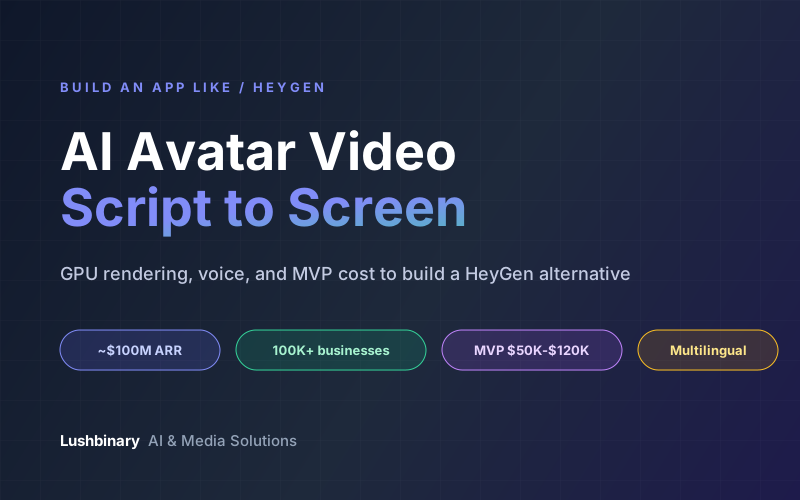
HeyGen grew from roughly $1 million in recurring revenue in early 2023 to around $100 million by late 2025 by making studio-quality video as easy as writing a script. Type your words, pick an AI avatar, choose a voice, and get a polished talking-head video in minutes, no camera, studio, or editor required. For businesses that need marketing, training, and explainer videos at volume, that replaces a workflow that used to cost thousands of dollars per video.
The AI video market is booming and crowded. Synthesia raised at a $4 billion valuation, OpenAI's Sora pushed generative video into the mainstream, and dozens of tools compete for creators and enterprises. But HeyGen users still complain about confusing credits, uncanny avatars, limited post-generation editing, and pricing that climbs fast. Those gaps, plus a fast-growing market, leave real room for a focused competitor.
This guide breaks down what makes HeyGen work, how it monetizes, the gaps you can exploit, the features and architecture of an AI avatar video tool, the AI capabilities that differentiate, what it costs to build, and how Lushbinary can help you ship it.
📋 Table of Contents
- 1.What Makes HeyGen Successful
- 2.HeyGen’s Revenue Model & Pricing
- 3.User Complaints & Market Gaps You Can Exploit
- 4.Core Features for an AI Video MVP
- 5.System Architecture & Tech Stack
- 6.AI-Powered Features That Differentiate
- 7.Development Cost & Timeline Breakdown
- 8.Why Lushbinary for Your AI Video MVP
1What Makes HeyGen Successful
HeyGen won by collapsing video production into a text box. The value is not the avatar, it is the elimination of cameras, actors, studios, and editing. A business can produce a localized training video in twenty languages over a weekend instead of a quarter.
Script-to-Video in Minutes
Write a script, choose an avatar and voice, and generate. That core loop is the entire product. If your alternative does not make the first video feel effortless and the result presentable, nothing else matters.
Avatars and Voice Cloning
A large library of stock avatars plus custom avatars and voice cloning lets businesses build a consistent on-screen presence. The ability to clone a spokesperson or a founder and then scale their presence across hundreds of videos is a major draw for marketing teams.
Translation and Localization
HeyGen's video translation, which re-voices and lip-syncs a video into other languages, is a standout. For global businesses, turning one video into many localized versions is a clear, measurable cost saving, and it is one of the strongest wedges for a focused competitor.
| Metric | HeyGen |
|---|---|
| ARR (late 2025) | ~$100M |
| ARR (early 2023) | ~$1M |
| Series A | $60M at ~$500M valuation |
| Businesses Served | 100,000+ |
| Creator Plan | ~$29/month |
| Core Tech | AI avatars, voice, lip-sync, translation |
| Founded | 2020 |
| HQ | Los Angeles |
2HeyGen's Revenue Model & Pricing
HeyGen monetizes with credit-based subscriptions. Each minute of generated video consumes credits, which ties revenue to the real cost driver: GPU rendering and voice synthesis.
| Plan | Price | Notes |
|---|---|---|
| Free | $0 | A few short videos with watermark |
| Creator | ~$29/month | More monthly minutes, no watermark, more avatars |
| Team | Higher per seat | Shared assets, brand kit, collaboration |
| Enterprise | Custom | Custom avatars, API, security, volume rendering |
Credit-based pricing protects margins but frustrates users who cannot predict their bill. The real revenue expansion is the API and enterprise tier: companies embedding avatar video into their own products, e-commerce platforms generating UGC-style ads at scale, and training teams localizing content. That B2B and API motion is higher margin and stickier than consumer subscriptions.
💡 Revenue Opportunity
An API-first avatar video product lets other apps generate video programmatically: e-commerce stores turning product data into ads, LMS platforms turning lessons into talking-head videos, and sales tools generating personalized outreach at scale. Usage-based API pricing on top of a credit subscription is the durable revenue engine.
3User Complaints & Market Gaps You Can Exploit
We reviewed reviews and community threads across the AI video space. These complaints come up repeatedly, and each is a feature opportunity.
🪙 Confusing Credits
Credit consumption per video minute is hard to predict, and users report burning through their allotment faster than expected.
😐 Uncanny Valley
Some avatars still feel slightly off in expression and lip-sync, which undermines trust for customer-facing content.
✂️ Limited Post-Editing
Once a video is generated, fine editing is limited. Fixing one line often means regenerating and spending more credits.
⏳ Render Times
Longer videos and high-quality renders can take a while, which slows iterative work.
💸 Pricing Climbs Fast
For teams producing at volume, costs escalate quickly, pushing them toward expensive enterprise deals.
🔌 Shallow Integrations
Limited deep integration with LMS, CRM, and e-commerce platforms means video creation stays a separate, manual step.
💡 The Opportunity
The biggest gap is a workflow built for one use case. A tool that does e-commerce UGC ads, sales outreach videos, or course localization end to end, with the right integrations and transparent pricing, beats a broad generalist for that audience. Pick the use case where video has clear ROI and own the entire workflow.
4Core Features for an AI Video MVP
Phase 1: Lean MVP (10-14 weeks)
- Script-to-Video - Enter a script, pick an avatar and voice from a library, and render a talking-head video
- Avatar & Voice Library - A curated set of stock avatars and voices, sourced from partner APIs to start
- Scene Editor - Add backgrounds, captions, logos, and simple b-roll over the avatar
- Render Queue - A queue with progress and notifications so long renders do not block the user
- Export & Share - Download in common formats and share via link
- Accounts & Credits - Auth and credit-based metering tied to billing
Phase 2: Differentiation (10-14 weeks)
- Custom Avatars - Let users create an avatar from a short recording or photos, with consent and verification
- Voice Cloning - Clone a brand voice with explicit consent for consistent narration
- Video Translation - Re-voice and lip-sync a video into other languages
- Brand Kits & Templates - Reusable templates, intros, and brand styling
- Team Collaboration - Shared assets, roles, and review workflows
Phase 3: Scale & API (12-16 weeks)
- Video API - Generate videos programmatically for partners and embedded use cases
- Integrations - Connect to LMS, CRM, and e-commerce platforms so video generation fits existing workflows
- Custom Model Training - Move from partner APIs to in-house avatar and voice models to control quality and cost
- Consent & Safety - Identity verification, watermarking, and misuse detection for responsible avatar use
5System Architecture & Tech Stack
An AI avatar video tool has three hard parts: generation quality (avatars, voice, and lip-sync that do not feel fake), GPU render orchestration (queuing and scaling expensive jobs), and cost control (rendering is costly, so margins depend on efficiency). Here is the architecture we recommend.
Recommended Tech Stack
| Layer | Technology | Why |
|---|---|---|
| Frontend | Next.js + React | Script entry, scene/timeline editor, and preview |
| Voice / TTS | ElevenLabs, Cartesia, or partner API | Natural narration and voice cloning |
| Avatar / Lip-Sync | Partner avatar API, then custom models | Talking-head generation; start on APIs to ship fast |
| Job Queue | Redis / SQS + workers | Orchestrate long-running GPU render jobs |
| GPU Compute | AWS GPU instances or serverless GPU | Run rendering with autoscaling to control cost |
| Backend | Node.js or Python (FastAPI) | APIs, job management, and webhooks |
| Storage / CDN | S3 + CloudFront | Store and deliver rendered video fast |
| Billing | Stripe + credit metering | Credit plans and usage-based API pricing |
Voice quality is half the experience. Our AI voice and TTS API comparison helps you pick a voice engine, and our S3 and CloudFront delivery guide covers fast, cheap video delivery.
6AI-Powered Features That Differentiate
Generation quality and workflow intelligence are where you out-build a generalist. These features turn a video generator into a product teams rely on.
🎭 High-Fidelity Avatars
Invest in expression and lip-sync quality so avatars clear the uncanny valley. This is the single biggest trust factor for customer-facing video.
🌍 Translation & Lip-Sync
Re-voice and re-sync a video into many languages while keeping mouth movements natural. This is the clearest ROI feature for global teams.
✍️ Script Assistance
Generate or tighten scripts from a prompt, a product page, or a document, so users do not start from a blank page.
🛒 Data-to-Video
Turn structured input (product catalogs, lesson plans, CRM records) into personalized videos at scale via the API.
🎬 Smart B-Roll
Automatically suggest and place relevant backgrounds, captions, and visuals so a talking head becomes a finished video.
🛡️ Consent & Safety
Identity verification for custom avatars, watermarking, and misuse detection. Responsible avatar handling is a differentiator and a requirement.
⚠️ Build Responsibly
Avatar and voice cloning can be abused for impersonation and fraud. Require explicit consent and identity verification before cloning a person, watermark generated video, and build misuse detection from day one. Responsible design protects your users and your business.
7Development Cost & Timeline Breakdown
Starting on partner avatar and voice APIs keeps the MVP affordable. Custom model training is where costs jump, but it is also where long-term margins improve. Here is a realistic breakdown.
Get Detailed Cost Breakdown
Fill in your details to unlock pricing and cost information.
8Why Lushbinary for Your AI Video MVP
At Lushbinary, we build AI media products and the GPU-backed infrastructure they need. Here is what we bring to an AI video project:
- Generation pipelines - We integrate voice, avatar, and lip-sync APIs and build the render orchestration around them
- GPU infrastructure - We design autoscaling render queues on AWS so you pay for compute only while jobs run
- Media delivery - We build S3 and CloudFront pipelines for fast, cheap video storage and streaming
- API-first design - We expose generation as a clean API so partners and your own products can build on it
- Responsible AI - We build consent, verification, and watermarking so avatar features are safe to ship
🚀 Free Consultation
Want to build an AI video tool that competes? Lushbinary specializes in AI media products and GPU-backed infrastructure. We'll scope your project, recommend the right generation stack, and give you a realistic timeline with no obligation.
❓ Frequently Asked Questions
How much does it cost to build an AI avatar video tool like HeyGen?
An MVP using partner avatar and voice APIs costs $50,000-$120,000 over 4-7 months. A full platform with custom avatars, translation, and an editor ranges from $150,000-$400,000 over 9-16 months. GPU rendering and voice synthesis are the main ongoing costs.
How does HeyGen make money?
A credit-based subscription: a free tier, a Creator plan around $29/month, and Team and Enterprise tiers. It reached roughly $100M ARR by late 2025, up from about $1M in early 2023, serving over 100,000 businesses.
What tech stack powers an AI avatar video tool?
A TTS engine or partner API, a talking-head or lip-sync model on GPUs, a script and scene editor, a render queue, object storage for video, a Node.js or Python backend, PostgreSQL, and credit-based billing. Most MVPs start on partner APIs.
What are the biggest complaints about HeyGen?
Confusing credit consumption, the uncanny-valley feel of some avatars, limited editing once a video is generated, render times for long videos, and pricing that climbs quickly for teams producing at volume.
Can a new AI video tool compete with HeyGen and Synthesia?
Yes. The AI video market is growing fast, and vertical tools for training, sales outreach, e-commerce UGC ads, or localization are underserved. A tool focused on one use case with better avatars, clearer pricing, or tighter integrations can win.
📚 Sources
- Sacra - HeyGen revenue and valuation - ARR and funding data
- HeyGen official site - Product and pricing reference
- Forbes - HeyGen rides the AI video boom - $100M ARR milestone and market size
Content was rephrased for compliance with licensing restrictions. Revenue, valuation, and pricing data sourced from public reporting and official sources as of May 2026. Figures may change - always verify current numbers before relying on them.
Build an AI Avatar Video Tool for Your Niche
High-fidelity avatars, multilingual translation, and an API-first workflow. Let Lushbinary build your HeyGen alternative on GPU-backed infrastructure that controls cost.
Ready to Build Something Great?
Get a free 30-minute strategy call. We'll map out your project, timeline, and tech stack - no strings attached.
Prefer email? Reach us directly: