
Clinical documentation is the number one cause of physician burnout. The average physician spends 4.5 hours per day in the EHR, half of it on notes. AI medical scribes like Abridge, Nuance DAX, and Oracle Clinical AI Agent have become a $1B+ category in 2026 because they solve a real problem: clinicians want to talk to patients, not type.
The market leaders charge $200 to $1,200 per provider per month, and every major health system is piloting or deploying one. The opportunity for specialty-focused or regionally-focused scribes is still wide open: most commercial scribes target primary care and internal medicine, leaving orthopedics, behavioral health, dermatology, dental, and veterinary medicine under-served.
This guide walks through how to actually build an AI medical scribe that is HIPAA compliant, integrates with Epic or Oracle Health, and produces notes clinicians will sign without rewriting. Lushbinary builds these systems for clinics and health-tech startups end to end.
📋 Table of Contents
- 1.The AI Medical Scribe Market in 2026
- 2.What a Good Scribe Actually Does
- 3.End-to-End Architecture
- 4.Speech-to-Text: Whisper, Nova-2 & Clinical ASR
- 5.LLM Note Generation & Prompt Design
- 6.Epic & Oracle Health Integration
- 7.Specialty Templates & Billing Code Suggestions
- 8.HIPAA, Audit Logs & Physician Review Flow
- 9.Cost, Timeline & Build vs Buy
- 10.Why Lushbinary for Your Scribe Build
1The AI Medical Scribe Market in 2026
The leaders today, per industry reviews:
- Abridge: deep Epic integration, favored by large health systems, premium pricing.
- Nuance DAX Copilot: Microsoft-owned, Dragon Medical One heritage, strongest enterprise go-to-market.
- Oracle Clinical AI Agent: Cerner/Oracle Health native, GA in the UK in early 2026.
- Suki: broad EHR support, voice-first interface.
- Freed, Heidi, PatientNotes: SMB pricing, solo practitioner focus.
The white space: vertical scribes for orthopedics, physical therapy, behavioral health, dental, veterinary, and international markets where the big three do not have local EHR integrations. A focused scribe that nails one specialty often beats a general scribe that gets everything 80% right.
2What a Good Scribe Actually Does
Beyond the basic dictate-to-note flow:
- Ambient capture: records the natural conversation without clinician prompting.
- Multi-speaker diarization: tells clinician from patient from family member.
- Structured notes: generates SOAP, HPI, Assessment/Plan, and referral letters in a single pass.
- Specialty templates: follows the dot-phrase style the clinician already uses.
- Billing code suggestions: proposes ICD-10 and CPT codes as drafts for the clinician or coder to confirm.
- EHR writeback: pushes the signed note into Epic, Oracle Health, or another EHR via FHIR or HL7 v2.
- Pre-visit prep: summarizes recent history, labs, imaging, and meds before the clinician walks in.
- Post-visit tasks: drafts patient instructions, follow-up orders, refill requests.
3End-to-End Architecture
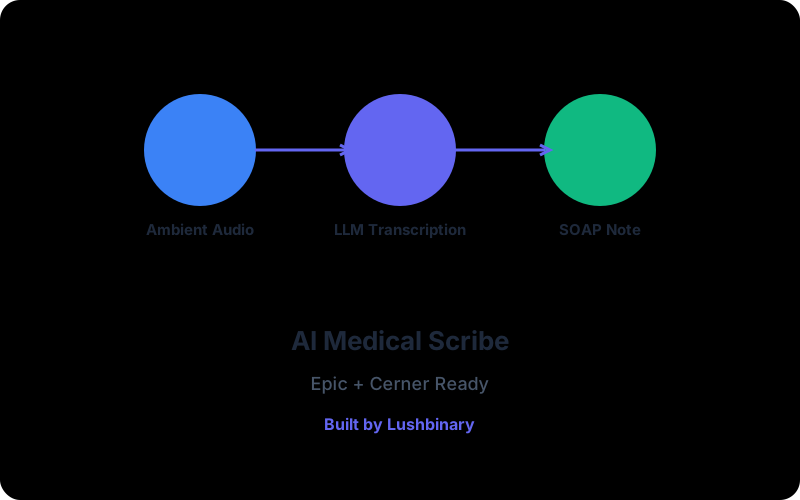
Every leg of this pipeline runs inside a BAA boundary. Audio is encrypted in transit, never stored long-term in plaintext, and the transcript-to-note step logs both input and output for the 6-year HIPAA retention window.
4Speech-to-Text: Whisper, Nova-2 & Clinical ASR
Off-the-shelf ASR still struggles with medical vocabulary. Your choices:
| Model | BAA | Notes |
|---|---|---|
| OpenAI Whisper (API) | Yes, via OpenAI BAA | Strong accuracy, decent medical vocab, batch-oriented |
| Deepgram Nova-2 Medical | Yes | Streaming, purpose-built medical model, diarization included |
| Azure AI Speech | Yes, Microsoft BAA | Great for Microsoft-centric orgs, good diarization |
| AWS HealthScribe | Yes, AWS BAA | Medical-specific, outputs transcript plus clinical entities |
| Self-hosted Whisper large-v3 | No BAA needed, in your VPC | Max privacy, higher infra cost, good for on-prem hospitals |
Most production scribes use a streaming ASR for real-time feedback plus a batch high-accuracy pass that the LLM consumes. Pair with a clinical-term post-processor that normalizes drug names, dosages, and lab values against UMLS or RxNorm before the LLM sees them.
5LLM Note Generation & Prompt Design
The LLM prompt is where most scribes succeed or fail. A typical structure:
System: You are a clinical documentation assistant. Produce a SOAP note from the supplied transcript. Use the clinician's preferred template. Do not invent findings. If something is unclear, mark it [verify]. Never produce a diagnosis the clinician did not state.
User: Specialty: Family Medicine. Template: SOAP (short). Patient age: 47 M. Prior visits summary: [hypertension, metformin]. Allergy list: penicillin. Transcript: [...]
Anti-hallucination patterns we use in production:
- Grounded prompts: include prior encounter summary and active problem list in-context.
- Source attribution: ask the model to emit, for each assertion, the transcript line range that supports it.
- Two-pass generation: generate the note, then run a critic prompt that flags any claim unsupported by the transcript.
- Strict schemas: emit JSON with required fields, reject outputs that do not parse, retry with explicit constraints.
- Billing code caution: suggest but never finalize ICD-10/CPT. Keep the clinician or coder as the decision-maker.
💡 Model choice in 2026
Claude Opus 4.7 and GPT-5.5 are our defaults for long-form clinical note generation under BAA. For self-hosted scenarios, fine-tuned Llama 4 70B and MedGemma deliver strong results without external network calls. Budget for roughly 8K to 16K output tokens per note plus the transcript size, which is where most of your per-visit cost lives.
6Epic & Oracle Health Integration
Integration is usually the longest pole in the tent. The patterns that work:
- Launch: SMART on FHIR EHR Launch flow for in-context launch from Epic Hyperspace or Cerner PowerChart.
- Read: FHIR R4 endpoints for Patient, Encounter, Condition, MedicationRequest, AllergyIntolerance, Observation.
- Write:
DocumentReferencefor the generated note, or HL7 v2 MDM messages for EHRs that do not support FHIR writes. - Scheduling: FHIR Appointment for pre-visit prep triggers, or a real-time ADT feed.
- Orders: writing orders back typically requires a sponsored integration and is a later-stage project, not day one.
In practice you will also need an HL7 v2 adapter for older Cerner deployments and for the billing export. Treat the integration layer as its own service with its own observability, because every EHR has its own quirks around extensions, missing fields, and rate limits.
7Specialty Templates & Billing Code Suggestions
The difference between a scribe clinicians tolerate and one they love is the template library. Modern scribes support 30 to 100+ specialty templates out of the box:
- Family medicine and internal medicine (the workhorses)
- Orthopedics, cardiology, dermatology, OB/GYN
- Behavioral health (often requires its own privacy regime)
- Pediatrics, with parent-present speaker handling
- Urgent care, emergency medicine
- Physical therapy and occupational therapy
Each template has a structured prompt plus example notes (few-shot or retrieval-augmented). Allow clinicians to clone and edit their own templates. That single feature is one of the highest-impact reasons physicians stick with a product.
Billing code suggestions (ICD-10 and CPT) are the revenue-side feature. You can drive 1% to 3% uplift in captured revenue by surfacing codes the clinician would have missed. Keep the coder in the loop, and make the audit trail clear: the AI suggested code X, the coder accepted or modified.
8HIPAA, Audit Logs & Physician Review Flow
Everything from our HIPAA-compliant AI architecture guide applies here, plus scribe-specific needs:
- Consent capture: record that the patient was informed that the visit is being recorded; state law varies, some require two-party consent.
- Ephemeral audio: default to deleting audio within 7 to 30 days, keep the transcript longer, keep the signed note permanently.
- Clinician-as-signer: no note leaves draft status without a clinician signature. This single rule keeps you out of SaMD territory.
- Diff preservation: store the AI draft and the signed final version, with a diff view for audit.
- Prompt-level logs: retain the system prompt, the transcript fed to the LLM, and the raw LLM output for every note.
9Cost, Timeline & Build vs Buy
| Scope | Timeline | Cost |
|---|---|---|
| Single specialty, 1 EHR, review-only | 5 to 8 months | $180,000 to $400,000 |
| Multi-specialty, EHR writeback, billing codes | 9 to 14 months | $500,000 to $1,200,000 |
| Enterprise scribe with multi-EHR, custom models | 12 to 18 months | $1,200,000 to $3,000,000 |
| Inference cost per visit | Ongoing | $0.60 to $2.50 |
Build vs buy calculus:
- Buy: if you are a single clinic or health system and just need the outcome, one of the top five commercial scribes will beat a custom build for TCO.
- Build: if you are a specialty with poor market fit, a digital health product that needs an embedded scribe, or a health system with >3,000 providers where you can amortize the build cost, custom wins on fit and economics.
- Hybrid: many teams license an underlying speech and LLM stack (Deepgram + Bedrock) and build the clinical workflow and templates themselves.
10Why Lushbinary for Your Scribe Build
Medical scribes look simple on the outside. The hard parts are in the details: the ASR that understands your specialty vocabulary, the prompt that does not hallucinate findings, the EHR integration that survives a major Epic release, the audit trail that passes an OCR review. We have built enough of these to know where the landmines are.
What we ship:
- End-to-end scribe platforms on AWS Bedrock, Azure, or your own infrastructure.
- Specialty template libraries tuned with real clinician feedback.
- Epic, Oracle Health, athenahealth, and eClinicalWorks integrations using SMART on FHIR and HL7 v2.
- Native mobile capture apps for iOS and Android plus Epic-embedded SMART apps.
- Physician-in-the-loop review and sign workflows that make the product actually usable in clinic.
🚀 Free Scribe Consultation
Thinking about building or buying an AI scribe? Lushbinary will scope the problem, benchmark commercial options, and recommend the right stack for your specialty and volume. No obligation.
❓ Frequently Asked Questions
How does an AI medical scribe work?
Ambient audio capture, speech-to-text via Whisper or Nova-2, LLM note generation with Claude Opus 4.7 or GPT-5.5, clinician review, then FHIR writeback to Epic or Oracle Health. Every step runs under a BAA.
How much does it cost to build a scribe like Abridge or DAX?
Focused single-specialty MVPs run $180K to $400K over 5 to 8 months. Multi-specialty enterprise scribes run $600K to $2M. Ongoing inference is $0.60 to $2.50 per visit.
Which EHRs can I integrate with?
Epic, Oracle Health (Cerner), athenahealth, eClinicalWorks, NextGen, Allscripts, Practice Fusion, and DrChrono all support FHIR R4 reads. Writeback needs a sponsored integration on most platforms.
Is an AI scribe a medical device?
Not when the clinician signs every note. Autonomous diagnosis or treatment recommendations push it into SaMD territory and trigger FDA review.
What models work best for clinical notes?
Claude Opus 4.7 and GPT-5.5 for reasoning, Whisper or Deepgram Nova-2 for transcription. Self-hosted Llama 4 or MedGemma for maximum privacy.
📚 Sources
- PatientNotes AI scribe comparison
- Nuance DAX Copilot official site
- Epic FHIR developer portal
- AWS HealthScribe
- Deepgram Nova-2
Content was rephrased for compliance with licensing restrictions. Pricing and product details sourced from official vendor sites as of April 2026. Always verify pricing before contract.
Build an AI Scribe Clinicians Will Actually Use
Lushbinary has built AI scribes for specialty clinics and digital health startups. Tell us your specialty and EHR and we will come back with a scoped proposal.
Ready to Build Something Great?
Get a free 30-minute strategy call. We'll map out your project, timeline, and tech stack - no strings attached.
Prefer email? Reach us directly: