
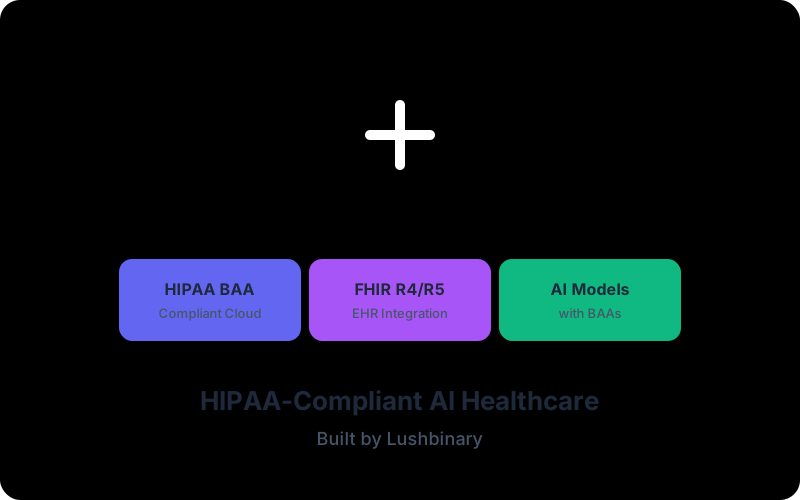
Healthcare is the hardest place to ship AI. The technology works: GPT-5.5, Claude Opus 4.7, and Gemini 3.1 Pro can read lab results, summarize visits, and draft clinical notes. The problem is that one mishandled row of Protected Health Information (PHI) can trigger a six or seven-figure HIPAA fine, an OCR audit, a breach-notification cascade, and a loss of trust that takes years to rebuild.
This guide covers how to build an AI healthcare app that is both useful and defensible. We walk through the architecture, the compliance checklist, the AI provider landscape, EHR integration with Epic and Cerner, cost estimates, and the production patterns that separate a demo from a deployable system.
Lushbinary builds HIPAA-compliant AI applications for clinics, digital health startups, and enterprise health systems. If you want the short version: the AI is the easy part. Everything around it is where the work lives.
📋 Table of Contents
- 1.Why AI Healthcare Apps Are Different
- 2.The HIPAA Compliance Baseline
- 3.AI Model Providers That Offer BAAs
- 4.Reference Architecture for a HIPAA-Compliant AI App
- 5.Where AI Fits: High-Value Healthcare Use Cases
- 6.FHIR, Epic & Cerner Integration
- 7.FDA SaMD: When Your AI Becomes a Medical Device
- 8.Audit Logs, Access Control & Breach Response
- 9.Cost & Timeline to Ship a Production MVP
- 10.Why Lushbinary for Healthcare AI
1Why AI Healthcare Apps Are Different
A B2B SaaS that leaks a Slack message loses credibility. A healthcare app that leaks a patient record loses the company. HIPAA enforcement actions routinely exceed $1 million, and as of 2026 the Office for Civil Rights has expanded its Right of Access and AI-era audit scope. Beyond the fines, HIPAA violations trigger state attorney general actions, class actions under state privacy laws, and public breach notifications.
On top of HIPAA, AI introduces a fresh set of failure modes that traditional healthcare IT never had to think about:
- Hallucination risk: a model that confidently invents a medication dosage can cause patient harm in a way a buggy scheduler cannot.
- Training data leakage: sending PHI to a model that might train on it can constitute a disclosure of PHI, even if no human sees the data directly.
- Output attribution: if the AI drafts clinical content, the audit log needs to capture what the model saw and what it produced, not just who clicked what.
- Vendor sprawl: a single AI feature might route PHI through a frontend, an API, a vector database, a model provider, and an observability tool, each of which is a potential subprocessor.
💡 Key Insight
HIPAA is not a feature. It is a design constraint that shapes every architectural choice, from which database you pick to which model you call. Retrofitting compliance after the fact is usually more expensive than building it in from day one.
2The HIPAA Compliance Baseline
Before any AI enters the picture, an app that handles PHI needs to satisfy the HIPAA Security Rule and Privacy Rule. The non-negotiable baseline:
| Control | What It Means |
|---|---|
| BAAs everywhere | Every vendor that touches PHI signs a Business Associate Agreement. Includes cloud, database, email, analytics, LLM provider, monitoring. |
| Encryption | AES-256 at rest, TLS 1.2+ in transit. Key management handled via AWS KMS, Azure Key Vault, or Google Cloud KMS with HSM backing. |
| Access control | Role-based access, multi-factor authentication, least privilege, automatic session timeouts, access reviews every 90 days. |
| Audit logging | Immutable log of every PHI read and write, retained for 6+ years, tamper-evident, with separate read access for auditors. |
| Backups & DR | Encrypted backups, documented recovery point and time objectives, regularly tested restore procedures. |
| Breach response | Documented playbook for detection, notification within 60 days to HHS and affected individuals, evidence preservation. |
| Workforce training | All engineers, support, and contractors with PHI access take annual HIPAA training, documented. |
| Risk analysis | A formal HIPAA Risk Assessment documenting threats, controls, residual risk. Required, not optional. |
Most modern healthcare startups pair HIPAA compliance with a SOC 2 Type II audit. The overlap is high, and SOC 2 is what enterprise buyers ask for. Plan for roughly 9 to 12 months from zero to your first SOC 2 Type II report, with HIPAA running as a subset of the same controls.
3AI Model Providers That Offer BAAs
The provider list has matured significantly in 2026. These are the models and endpoints we actively use for healthcare work:
| Provider / Endpoint | BAA Coverage | Best For |
|---|---|---|
| Anthropic Claude (API) | Yes, via Claude for Healthcare | Clinical reasoning, summarization, long-form notes |
| OpenAI API + Enterprise | Yes, enterprise and sales-managed | General LLM tasks, transcription (Whisper), embeddings |
| AWS Bedrock | HIPAA-eligible under AWS BAA | Multi-model access (Claude, Llama, Titan), tightest AWS fit |
| Google Vertex AI / MedGemma | Yes, via Google Cloud BAA | Gemini and MedGemma for healthcare-specific fine-tunes |
| Azure OpenAI Service | Yes, under Microsoft BAA | Enterprises already on Microsoft, hospitals on Azure |
| Self-hosted open weights (Gemma 4, Llama 4, Qwen 3.6) | No BAA needed, PHI stays in your VPC | Highest privacy posture, on-prem or single-tenant |
⚠️ Not BAA-eligible
ChatGPT Free, Plus, Team, and Business tiers, consumer Claude.ai, and consumer Gemini are not appropriate for PHI. Staff using these products to summarize real patient data is one of the most common sources of quiet HIPAA violations in 2026. Enforce this with data loss prevention and policy training, not just documentation.
We lean on AWS Bedrock for most healthcare clients because it covers Claude, Llama, and Titan under a single AWS BAA, keeps traffic inside the VPC, and integrates cleanly with AWS HealthLake and HealthImaging.
🎤 AWS re:Invent 2025 Update
At re:Invent 2025, AWS highlighted healthcare customers including Lila Sciences, Bristol Myers Squibb, Cohere Health, and Pfizer in the main keynote and launched Clean Rooms privacy-enhancing synthetic datasets useful for ML training on sensitive collaborative data. HealthLake and HealthImaging remain HIPAA-eligible FHIR R4 services, and Bedrock AgentCore is now a practical option for building agentic healthcare workflows entirely inside an AWS BAA boundary.
📺 Recommended re:Invent Session
AWS re:Invent 2025 keynote highlighting healthcare and life sciences customer stories alongside Bedrock, Clean Rooms, and analytics announcements.
Watch on YouTube →4Reference Architecture for a HIPAA-Compliant AI App
Here is the architecture we use as a starting point for most AI healthcare projects. Every arrow represents a BAA-covered connection.
What lives where
- Frontend: Next.js for web, React Native or Swift / Kotlin for mobile. MFA enforced on any account that can read PHI.
- API tier: AWS API Gateway or Azure API Management in front of Lambda or Fargate. Every request is logged with user, patient, and resource IDs.
- Data layer: RDS Postgres for transactional data, HealthLake for FHIR persistence, S3 with Object Lock for documents and DICOM. All KMS-encrypted, all private-only.
- AI orchestrator: the only service allowed to call LLM providers. Applies PHI redaction policy, logs prompts and outputs separately, enforces model allowlists.
- Model layer: Bedrock as the default, with OpenAI API or Azure OpenAI as alternates under BAA. Self-hosted open-weight models on Inferentia or GPU for the most sensitive workloads.
5Where AI Fits: High-Value Healthcare Use Cases
Not every healthcare problem needs an LLM. The ones that pay back their compliance investment quickly:
Ambient clinical documentation
Record the visit, generate a SOAP note, save clinicians 90+ minutes of charting per day. See our medical scribe guide.
Patient intake & triage
Voice or chat-based intake that reduces front-desk load 40%+ and routes urgent cases faster.
Revenue cycle automation
Claim prep, denial management, prior authorization. McKinsey estimates 30 to 60% reduction in cost to collect.
Remote patient monitoring
Passive wearable data plus LLM summaries for chronic conditions. Covered in our RPM guide.
Clinical decision support
Guideline-aware suggestions at the point of care. Warning: SaMD territory, plan for FDA review.
Care navigation & coaching
Chronic disease coaching, post-discharge follow-up, benefits navigation. High volume, low clinical risk.
6FHIR, Epic & Cerner Integration
Most clinically useful AI features need access to real patient data, which means integrating with EHR systems. In the U.S. market, that primarily means Epic and Oracle Health (Cerner). Both support FHIR R4 and SMART on FHIR for app launch and authentication.
- Epic: onboarding through fhir.epic.com. USCDI v3 data elements available as standard FHIR resources. Write access requires health system sponsorship and is narrower than read.
- Oracle Health (Cerner Millennium): FHIR R4 plus legacy DSTU2 in some deployments. Well-Known SMART Configuration endpoint for discovery.
- Auth: OAuth 2.0 with PKCE, SMART App Launch for embedded apps, backend-services flow for server-to-server integrations.
- Backend integration: for workloads that need 24/7 access regardless of EHR uptime, pair SMART on FHIR with a backend HL7 v2 or bulk FHIR pipeline into your own HealthLake or FHIR server.
Traditional EHR integrations took 6 to 18 months. With AI-assisted mapping, pre-built FHIR adapters, and test harnesses, we routinely deliver first integrations in 6 to 10 weeks. Expect slower cycles with enterprise health systems where security review itself is a 3-month process.
7FDA SaMD: When Your AI Becomes a Medical Device
The FDA regulates Software as a Medical Device (SaMD) when software makes clinical decisions or provides diagnosis, treatment, or management recommendations for a specific condition. In 2026 the agency has been clearer that AI chatbots producing clinical-sounding output can qualify.
Heuristics we use with clients:
- Likely SaMD: diagnostic suggestions, triage decisions that replace a clinician, dosing calculations, autonomous care plan generation.
- Likely not SaMD: appointment scheduling, billing automation, clinical note drafting that a human clinician must sign, patient education, administrative summaries.
- Gray zone: chronic disease coaching, symptom checkers, wearable-based early warnings. Get a regulatory opinion early.
If your product is SaMD, expect a 9 to 24-month timeline for 510(k) or De Novo clearance, a predicate analysis, a Quality Management System (ISO 13485 or equivalent), and a clinical validation study. Budget $300,000 to $1.5 million for clearance depending on pathway and novelty. Building this into your roadmap from the start is cheaper than reverse-engineering it after launch.
8Audit Logs, Access Control & Breach Response
Auditability is where AI healthcare apps most often fail. The checklist we hold our own builds to:
- Every PHI read and write logged with actor, patient ID, resource, timestamp, and client IP.
- Every prompt sent to an AI model logged, along with the redacted-or-not decision that was applied.
- Every AI output stored, with a link from the output to the clinical record it influenced.
- Logs stored in immutable storage (S3 Object Lock, Azure Immutable Blob) with separate access controls for auditors.
- Anomaly detection on access patterns, with alerts for bulk reads, after-hours activity, or access to VIP records.
- Documented breach response playbook with 60-day HHS notification flow and evidence preservation.
Pair this with an annual third-party penetration test and a quarterly internal access review. Most buyers will ask to see both.
9Cost & Timeline to Ship a Production MVP
| Phase | Duration | Cost Range |
|---|---|---|
| Focused MVP (1 EHR, 1-2 AI features) | 4 to 7 months | $120,000 to $350,000 |
| Full platform (multi-EHR, agentic) | 9 to 14 months | $500,000 to $1,500,000 |
| SOC 2 Type II first audit | 9 to 12 months | $45,000 to $90,000 |
| FDA SaMD clearance (if needed) | 9 to 24 months | $300,000 to $1,500,000 |
| Ongoing compliance (annual) | Continuous | $40,000 to $120,000 |
Bedrock and OpenAI inference typically land at $800 to $4,000 per month for early traction, scaling roughly linearly with active clinicians or patients.
10Why Lushbinary for Healthcare AI
We build production AI systems for clinics, digital health startups, and enterprise health systems. Healthcare is one of our core verticals because it is where thoughtful engineering actually matters: the same discipline that prevents HIPAA fines is the discipline that makes software feel reliable.
What we ship:
- HIPAA-compliant AWS and Azure environments with BAAs signed across every subprocessor.
- Epic, Oracle Health (Cerner), and athenahealth integrations via SMART on FHIR and backend-services flows.
- Multi-model AI orchestration (Claude, GPT-5.5, Gemma 4 self-hosted) with prompt redaction, output validation, and full audit trails.
- Patient-facing chat, voice intake, clinician copilots, and revenue-cycle agents built on Bedrock AgentCore or custom orchestration.
- SOC 2 Type II readiness support and FDA SaMD pathway advisory for products that touch clinical decision-making.
🚀 Free Healthcare AI Consultation
Planning an AI feature for a clinic, payer, or digital health product? Lushbinary will scope your project, recommend the right HIPAA-compliant architecture, and give you a realistic timeline and cost estimate. No obligation.
❓ Frequently Asked Questions
What makes an AI healthcare app HIPAA compliant?
A signed BAA with every vendor that touches PHI, AES-256 encryption in transit and at rest, 6+ years of audit logs, granular RBAC, a documented breach response flow, and controls an external auditor can verify. Encryption alone is not enough.
Which AI providers offer BAAs?
As of April 2026, OpenAI API and Enterprise, Anthropic Claude via Claude for Healthcare, AWS Bedrock (covering Claude, Llama, Titan), Google Vertex AI and MedGemma, and Azure OpenAI. Consumer ChatGPT, Claude.ai, and Gemini are not BAA-eligible.
How much does a HIPAA-compliant AI MVP cost?
Focused MVPs run $120K to $350K over 4 to 7 months. Full platforms with multi-EHR, advanced AI, and enterprise audit tooling run $500K to $1.5M. Ongoing compliance adds $40K to $120K per year.
Do I need FDA clearance?
Only if your app makes clinical decisions, produces diagnoses, or recommends treatment. Documentation assistants, intake tools, and administrative AI are typically not SaMD. Get a regulatory opinion early if you are in the gray zone.
Can I use ChatGPT or Claude directly?
Yes, via the BAA-eligible API tiers routed through your own infrastructure. Never via consumer ChatGPT, ChatGPT Business, or Claude.ai. Enforce zero retention options where available.
📚 Sources
- AWS HIPAA Compliance program
- AWS HealthLake product page
- Anthropic Claude for Healthcare announcement
- OpenAI for Healthcare overview
- Epic FHIR documentation
- HHS HIPAA resources
Content was rephrased for compliance with licensing restrictions. Pricing, BAA availability, and regulatory details sourced from official vendor and agency sites as of April 2026. Always verify with the vendor before contract.
Ship HIPAA-Compliant AI Without the Guesswork
Lushbinary builds AI healthcare apps that pass security reviews and make clinicians actually want to use them. Tell us about your project and we will reply within one business day.
Ready to Build Something Great?
Get a free 30-minute strategy call. We'll map out your project, timeline, and tech stack - no strings attached.
Prefer email? Reach us directly: