
Patient intake is the most overlooked leverage point in healthcare. Every missed insurance verification costs a clinic $40 to $120 in downstream rework. Every abandoned form drops a patient out of the funnel. Every phone call the front desk takes is a patient who is not getting seen. Industry analysis shows AI intake tools cut call volume around 40%, speed triage 30%, and push form completion above 90%.
The global healthcare chatbot market crossed $1 billion in 2025 and is expected to grow roughly tenfold by 2035. In 2026, the bar for a production chatbot has also moved. Static forms will not cut it. Buyers want agentic AI that handles voice, chat, and scheduling end to end, with HIPAA compliance, safe clinical guardrails, and tight integration with the EHR and practice management systems clinics already run.
This guide walks through how to actually build one. Lushbinary ships patient-facing AI for clinics, telehealth platforms, and digital health startups. Here is the playbook we use.
📋 Table of Contents
- 1.Why AI Intake & Triage Now
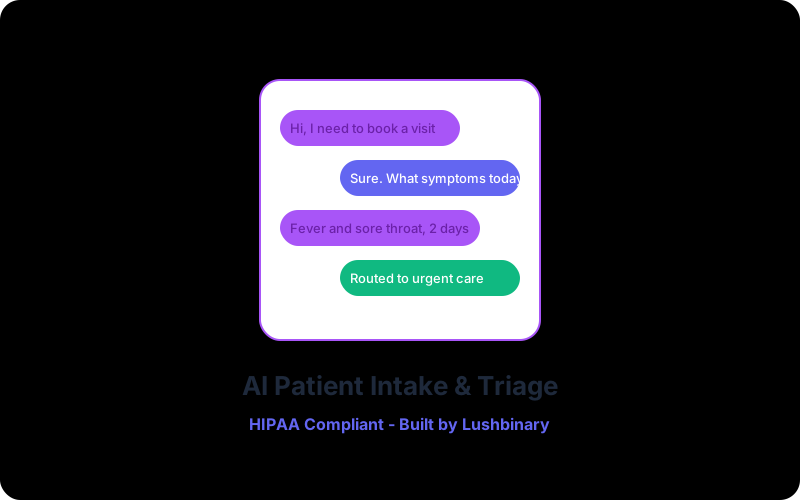
- 2.What a Good Intake Bot Actually Does
- 3.Safety-First Chatbot Design
- 4.Architecture: Voice, Chat & WhatsApp
- 5.EHR & Practice Management Integration
- 6.Insurance Verification & Eligibility
- 7.HIPAA, PHI Handling & BAAs
- 8.Measuring Success: KPIs That Matter
- 9.Cost, Timeline & Team Composition
- 10.Why Lushbinary for Patient-Facing AI
1Why AI Intake & Triage Now
A few things converged in 2025 and 2026 that make intake AI viable:
- Voice quality crossed the bar. Low-latency realtime voice models (OpenAI Realtime, Gemini Live, ElevenLabs Conversational) now sound indistinguishable from a human front-desk agent for simple tasks.
- LLMs hold their own on clinical vocabulary. Claude Opus 4.7 and GPT-5.5 handle medical terminology well and can be steered tightly with system prompts and function calling.
- BAAs are routine. Every major provider offers a BAA, so the compliance question is architecture, not vendor hunting.
- Staffing shortages got worse. Front-desk and medical assistant roles are the hardest to keep staffed. Automation is no longer optional.
- Patients changed. Patients under 45 prefer text and self-service over phone calls by a wide margin.
The result is a category that pays back inside 6 to 12 months for most mid-size clinics and is a durable product opportunity for health-tech founders.
2What a Good Intake Bot Actually Does
The checklist we use when scoping:
New patient registration
Demographics, contact, consents, HIPAA acknowledgment, emergency contact.
Insurance capture
Card photo, real-time eligibility check, copay and deductible, plan-specific rules.
Symptom capture
Chief complaint, HPI, red-flag detection, structured output to the EHR.
Triage & routing
Urgent vs routine vs ER. Hand off to a clinician when confidence is low.
Appointment scheduling
Finds available slots, respects provider rules, books directly in the EHR or PM system.
Medication reconciliation
Captures active meds, allergies, and supplements before the visit.
Pre-visit instructions
Fasting, prior auth status, document uploads, driving directions.
Post-visit follow-up
Medication adherence check-ins, satisfaction survey, referral confirmation.
3Safety-First Chatbot Design
The most important thing your bot does is know when to stop and escalate. Our layered safety design:
- Emergency detector: a fast classifier runs on every user message and intercepts symptoms that require 911. Chest pain, stroke signs, suicidal ideation, anaphylaxis, severe bleeding. On a positive match, the bot immediately displays emergency instructions and hangs up or hands off.
- Scope guard: the system prompt tightly scopes the bot to intake, scheduling, and general information. Any request for diagnosis, dosing, or treatment recommendation is refused with a handoff.
- Confidence threshold: when the LLM flags itself as uncertain about a symptom category, the bot invites the patient to speak with a clinician rather than guessing.
- Human handoff: a "speak to a person" escape is available from every screen and via voice keyword.
- Clinical review: triage rules, symptom scripts, and routing logic are reviewed by a licensed provider before release. This is both clinically necessary and protective if the product is ever scrutinized as SaMD.
⚠️ Hard rule
The bot never diagnoses, never recommends dosing, never tells a patient they do not need to see a doctor. These are SaMD behaviors and they are also how patients get hurt. Build your prompts and tests around this hard rule.
4Architecture: Voice, Chat & WhatsApp
We default to a multi-channel orchestrator so the same conversation can start on the web, move to WhatsApp, and finish with a voice call, all with the same state and memory. Voice uses a realtime speech model feeding the orchestrator. Chat and SMS both go through the same LLM with channel-specific rendering.
5EHR & Practice Management Integration
The integrations that deliver real value:
- Appointment write: FHIR
Appointmentor HL7 v2 SIU messages to the PM system. Epic and Oracle Health usually need sponsored access for writes. - Patient write: FHIR
Patientcreate/update for new registrations. - DocumentReference: the full intake transcript and summary stored as a document attached to the encounter.
- Questionnaire / QuestionnaireResponse: structured intake forms in FHIR R4 format.
- Eligibility check: X12 270/271 via a clearinghouse (Waystar, Change Healthcare, Availity) to verify coverage in real-time.
- Payments: Stripe or a HIPAA-friendly payment partner for copay and deductible collection inside the bot.
athenahealth and DrChrono expose cleaner scheduling APIs than hospital-grade EHRs. For a startup, starting on one of these before tackling Epic is often the fastest path to revenue.
6Insurance Verification & Eligibility
Real-time eligibility is the single highest-ROI feature. The stack:
- Image capture of the insurance card plus OCR for payer, member ID, group number.
- LLM-assisted data cleanup (handwriting, photo angles, smudged cards).
- X12 270 request through a clearinghouse, parse the 271 response.
- Return active/inactive, plan type, copay, deductible balance, referral or prior auth requirements.
- Store the result against the patient record and surface it to the front desk before the visit.
Done well, this eliminates the single biggest source of claim denials: patients showing up with inactive or wrong coverage. Clinics see 5% to 15% revenue uplift when eligibility is automated and verified before the visit.
7HIPAA, PHI Handling & BAAs
Same baseline as our HIPAA AI architecture guide, with chatbot-specific notes:
- No consumer channels for PHI: SMS is fine for appointment reminders that only mention visit times; WhatsApp Business API can be BAA-covered in some deployments, but never assume.
- Voice recordings: same treatment as scribe audio, ephemeral and encrypted, with the transcript being the durable artifact.
- Tool-call logging: every function call the LLM makes to an EHR, payment, or eligibility service is logged with actor, inputs, and outputs.
- Consent and transparency: patients are told up front they are talking to AI and can switch to a human anytime.
- Data minimization: collect only what you need for the workflow you are automating.
8Measuring Success: KPIs That Matter
| Metric | Benchmark | Why It Matters |
|---|---|---|
| Intake completion rate | 85%+ | Top predictor of show-rate and billing readiness |
| Call deflection rate | 35% to 55% | Direct labor cost savings |
| Time to first appointment | < 10 minutes | Patient acquisition funnel conversion |
| Eligibility hit rate | > 95% pre-visit | Fewer claim denials, faster collections |
| Escalation rate | 10% to 20% | Low enough to save labor, high enough to keep patients safe |
| CSAT / NPS | 70+ CSAT | If patients hate the bot, staff has to fix every loose end |
9Cost, Timeline & Team Composition
| Scope | Timeline | Cost |
|---|---|---|
| Chat-only MVP, 1 PM system, eligibility | 3 to 5 months | $90,000 to $220,000 |
| Multi-channel (voice + chat), multi-EHR | 6 to 10 months | $280,000 to $650,000 |
| Enterprise platform with audit, admin, analytics | 10 to 14 months | $700,000 to $1,500,000 |
| Inference cost per intake | Ongoing | $0.10 to $0.50 |
Core team for a full build:
- 1 product / clinical lead who understands the workflow
- 1 AI engineer focused on prompts, tools, and evals
- 2 full-stack engineers for the UI, API, and integrations
- 1 integrations engineer for EHR and eligibility plumbing
- 1 QA and clinical reviewer (often a licensed nurse or MA)
- Fractional security / compliance lead for HIPAA and SOC 2
10Why Lushbinary for Patient-Facing AI
Patient-facing AI is where healthcare product quality is most visible. Patients use it directly, they notice when it feels clumsy, and they will abandon a clinic that does this badly. We build intake and triage products that pass clinical review and feel like a polished consumer experience.
What we ship:
- Voice, chat, SMS, and WhatsApp patient-facing agents on AWS Bedrock or Azure.
- Epic, Oracle Health, athenahealth, eClinicalWorks, and DrChrono integrations.
- Real-time eligibility with Waystar, Change Healthcare, and Availity.
- Clinical safety reviews with licensed providers before every release.
- Mobile and web UIs for patients, admin dashboards for practice managers.
🚀 Free Intake Automation Consultation
Want to see how much call volume and claim denial you can remove with AI intake? Lushbinary will audit your current patient intake flow and come back with a scoped proposal. No obligation.
❓ Frequently Asked Questions
What can an AI intake chatbot do?
New patient registration, insurance capture and eligibility, symptom intake, appointment scheduling, medication reconciliation, and post-visit follow-up. It should support 90%+ completion rates and cut call volume around 40%.
Is a healthcare chatbot regulated by the FDA?
Intake and scheduling bots typically are not regulated. Autonomous diagnosis, dosing, or treatment recommendations push the product into SaMD territory and trigger FDA review.
How do chatbots stay safe?
Emergency keyword detection, strict scope guards, confidence thresholds, human handoffs, and clinical review of all triage scripts by a licensed provider.
How much does an intake bot cost?
Chat-only MVPs run $90K to $220K. Multi-channel platforms with full EHR integration run $280K to $650K. Enterprise platforms with audit and analytics run $700K to $1.5M.
Does it integrate with Epic and athena?
Yes. Epic, Oracle Health (Cerner), athenahealth, eClinicalWorks, NextGen, and DrChrono all support FHIR R4 or HL7 v2. Scheduling writeback usually needs sponsored integration.
📚 Sources
- McKinsey: Agentic AI and the race to a touchless revenue cycle
- AWS Bedrock
- SMART on FHIR documentation
- Experian: AI in healthcare RCM 2026
Content was rephrased for compliance with licensing restrictions. Market and pricing data sourced from official vendor and analyst sites as of April 2026. Always verify before contract.
Remove 40% of Your Call Volume With AI Intake
Lushbinary builds patient-facing AI that clinics actually run in production. Tell us your EHR and specialty and we will come back with a scoped proposal.
Ready to Build Something Great?
Get a free 30-minute strategy call. We'll map out your project, timeline, and tech stack - no strings attached.
Prefer email? Reach us directly: