
Follow Up Boss, kvCORE, Chime, Salesforce: the CRM market for real estate has options. What it does not have, as of 2026, is a truly AI-native platform built from the ground up for the way MLS data, voice, SMS, and transaction documents actually flow through a brokerage. The incumbents bolt AI onto legacy data models. The result is suggestion boxes and smart replies, not agents that do work.
Building your own AI-powered real estate CRM is a serious undertaking, but the economics make sense for brokerages above ~30 agents, for proptech startups targeting a vertical (luxury, new construction, commercial, short-term rental), and for any team spending $5K+/month on stitched-together SaaS tools.
This guide walks through the architecture of a modern AI-first real estate CRM: MLS ingestion, data model, AI agents, integrations, and how Lushbinary ships these platforms end-to-end.
📋 Table of Contents
- 1.Why Build vs Buy: Where Custom Wins
- 2.The MLS Data Foundation (RESO Web API)
- 3.Core Data Model for a Real Estate CRM
- 4.AI Agents Inside the CRM
- 5.Messaging & Voice Stack
- 6.Tech Stack & Reference Architecture
- 7.Fair Housing, DNC & Compliance Layer
- 8.Cost, Timeline & Team Shape
- 9.How Lushbinary Delivers This
- 10.FAQ
1Why Build vs Buy: Where Custom Wins
Follow Up Boss, kvCORE, Chime, Lofty (BoomTown + Brivity), Sierra Interactive: all decent tools, all locked into their own data models. If your workflow fits inside their stock pipeline stages, buy. If it does not, every integration feels like a workaround.
Custom AI-native CRMs make sense when at least two of these are true:
- You run a specialized vertical (luxury, new construction, commercial, vacation rental, builder rep) where off-the-shelf stages do not fit.
- You are paying for 4+ SaaS tools that duplicate data (dialer, SMS, CRM, CMA generator, TC software).
- You want AI agents that take action, not just suggest: booking tours, drafting offers, scheduling inspections.
- You are building a proptech product and the CRM is the wedge, not a supporting tool.
- You need deep MLS integration across multiple regions with custom search and AVM logic.
For teams that do not meet this bar, layering AI on top of Follow Up Boss via their API is a cheaper path. Lushbinary does both; the question is always whether the custom build pays back within 12-18 months.
2The MLS Data Foundation (RESO Web API)
The MLS is the source of truth for listings. The RESO Web API is the modern, OData-based standard for pulling that data. RETS, the older XML-based protocol, is deprecated and RESO stopped certifying RETS back in 2018.
Three RESO surfaces matter most for a CRM build:
- Property resource: active, pending, sold, and off-market listings, with fields governed by the RESO Data Dictionary. This is what powers search, CMA, and listing display.
- Member and Office resources: licensed agent and brokerage metadata. Used for attribution and IDX compliance.
- Media resource: listing photos, videos, virtual tours. Images are the most cost-sensitive part (S3 or R2 bill adds up fast).
// Minimal RESO Web API pull (TypeScript)
const res = await fetch(
  `${baseUrl}/Property?` +
    new URLSearchParams({
      $filter:
        "StandardStatus eq 'Active' and ModificationTimestamp gt 2026-04-01T00:00:00Z",
      $select: "ListingKey,ListPrice,BedroomsTotal,BathroomsTotalInteger,City",
      $top: "100",
      $orderby: "ModificationTimestamp asc",
    }),
  { headers: { Authorization: `Bearer ${token}` } },
);
const { value } = await res.json();
The practical rules we enforce on every CRM build:
- Use
ModificationTimestampfor incremental sync, not full reloads. Most MLSes throttle hard on bulk pulls. - Store normalized data in your own Postgres. The MLS is the source of truth, but you cannot hit it on every page load.
- Respect per-MLS rate limits and concurrent session caps. These are in the data license, not the API docs.
- Cache media with signed S3 URLs. Do not proxy MLS photos through your app server.
- Track data lineage. Every piece of listing data should carry its MLS source and pull timestamp.
⚠️ Multi-MLS Is Harder Than It Looks
Even with RESO, field enumerations vary across MLSes. "ActiveUnderContract" in one region may mean "PendingTakeBackups" in another. Build a normalization layer from day one or you will pay for it later.
3Core Data Model for a Real Estate CRM
The schema below is a skeleton. Real builds add transaction stages, commission splits, lender workflows, and sometimes full GL accounting. This is the core that every AI-first real estate CRM needs:
| Table | Purpose |
|---|---|
| contacts | Buyers, sellers, tenants, past clients, sphere. One row per person, with dedupe. |
| listings | Normalized MLS rows keyed by ListingKey, with source MLS and sync metadata. |
| deals | The transaction. Links contacts to a listing, tracks stage, commission, milestones. |
| events | Append-only activity log: calls, emails, SMS, showings, AI actions. Source of truth for timelines. |
| messages | Inbound/outbound SMS, email, chat. Both human and AI authored, with an author_type column. |
| tasks | Human and agent-assigned work items with due dates and completion tracking. |
| embeddings | pgvector columns for listings, contact notes, call transcripts, and inspection docs. |
| ai_runs | Every AI invocation: prompt, model, tools used, output, cost, latency. Non-negotiable for compliance. |
Two opinionated choices save a ton of pain later: the events table as append-only source of truth for every activity, and the ai_runs table linked to every contact/deal/message. Regulators love it, and so will your QA team.
4AI Agents Inside the CRM
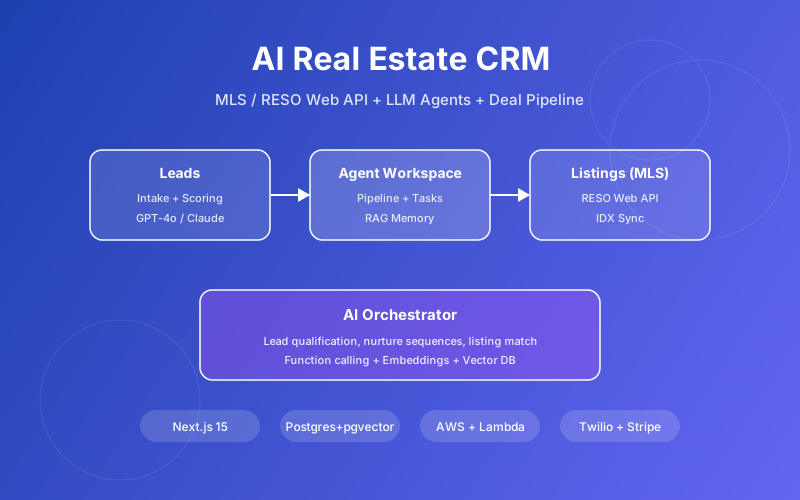
The AI layer is a set of specialized agents, not one monolithic chatbot. Each agent owns a narrow job, uses function calling to take action, and returns structured output to the system of record.
- Lead Concierge Agent: handles inbound web chat, SMS, and Facebook messages. Qualifies intent (buy/sell/rent), collects budget/timeline/area, books tours.
- Nurture Agent: runs long-horizon sequences (6-24 months), rewrites copy per recipient, pauses on opt-outs and DNC, escalates on high-intent replies.
- CMA / Valuation Agent: given a subject property, retrieves comps from the MLS, runs adjustments, and produces a branded PDF. Covered in depth in our AI valuation guide.
- Showing Coordinator: negotiates times across ShowingTime/Aligned Showings APIs, sends prep materials, captures agent feedback post-tour.
- Transaction Coordinator Agent: reads inspection reports, purchase agreements, and disclosures; flags deadlines and red flags; drafts addenda for human review.
- Seller Prospector: scores likely sellers from CRM plus public records, generates personalized outreach, routes to the right agent.
💡 Function Calling > Prompt Engineering
Every action an AI agent can take should be a typed tool with structured inputs. It makes outputs auditable, lets you scope permissions (no DB writes for the nurture agent), and is the single biggest lever for reducing hallucinations.
5Messaging & Voice Stack
Real estate conversation happens on SMS, phone, and email. A modern CRM has to treat all three as first-class citizens with AI in the loop.
- SMS: Twilio Programmable Messaging, with 10DLC brand and campaign registration (non-optional in the US since 2023) and STOP/HELP handling at the gateway level.
- Voice: Twilio Programmable Voice plus OpenAI's Realtime API or LiveKit Agents for AI voice handling. Our multimodal AI agents guide covers the voice architecture in depth.
- Email: Postmark or SendGrid for transactional, AWS SES for volume, with Gmail OAuth for agent-authored threads so inbox history stays in the CRM.
- Web chat: a custom widget you own, backed by WebSockets. Keep vendor widgets (Intercom, Drift) only if the integration cost is worth it.
- Call transcripts: Deepgram Nova-3 or Whisper Large-v3 for real-time transcription, with speaker diarization for multi-party calls.
6Tech Stack & Reference Architecture
The stack Lushbinary recommends for AI-first real estate CRMs, battle-tested across brokerage and proptech builds:
| Layer | Recommended Choice |
|---|---|
| Frontend | Next.js 15 (App Router), React 19, TypeScript, Tailwind |
| Mobile | Flutter 3.41 or React Native 0.84 for agent apps |
| API | Node.js 22 + Fastify or Hono, tRPC or REST with OpenAPI |
| Database | PostgreSQL 17 + pgvector for embeddings |
| Cache / Queue | Redis 7 for sessions & rate limiting, Inngest or SQS for workflows |
| AI Orchestration | Vercel AI SDK 4.x or custom TS SDK, LiteLLM for routing |
| Models | Claude Opus 4.7, GPT-5.5, Gemini 3.1 Pro, Haiku/Mini for bulk |
| Voice | Twilio + OpenAI Realtime API, Deepgram for transcription |
| Infra | AWS ECS/Fargate, RDS, S3, CloudFront, Lambda |
| Observability | Langfuse for LLM traces, Mixpanel for product analytics, Sentry for errors |
7Fair Housing, DNC & Compliance Layer
The compliance layer is not a feature, it is a requirement. Three systems must be wired in from day one:
- Fair Housing filter: every AI-generated message passes through a second model (or classifier) that flags language touching protected classes, neighborhood demographics, or steering. Lushbinary uses an LLM-as-judge pass with an escalation queue to a human for anything scored high-risk.
- DNC and consent: SMS consent is non-negotiable in the US (TCPA + state rules). Outbound AI messaging must check the national DNC registry, your internal suppression list, and the contact's opt-in history before every send.
- MLS display compliance: each MLS has its own IDX rules around listing refresh frequency, attribution, and display restrictions for sold data. Encode these as tool-level policies, not buried in UI code.
Plus the universal AI agent safety practices from our AI agent production guardrails guide: least-privilege tokens, environment isolation, human-in-the-loop on outbound actions, rate limits, and immutable audit logs.
🚨 TCPA Violations Are Expensive
TCPA statutory damages start at $500 per unlawful message and can triple for willful violations. AI-generated outbound SMS must be rate-limited, opt-in-verified, and time-gated per state rules. Build the compliance layer before the growth features.
8Cost, Timeline & Team Shape
Cost ranges for a full AI-powered real estate CRM build, based on Lushbinary deployments and comparable market rates:
| Scope | Build Cost | Timeline | Hosting/mo |
|---|---|---|---|
| Lean MVP | $45K-$90K | 10-14 weeks | $800-$1,800 |
| Full CRM | $180K-$420K | 5-9 months | $1,800-$3,500 |
| Multi-MLS Proptech | $400K-$900K+ | 9-14 months | $4K-$15K+ |
Typical team for the Full CRM tier:
- 1 tech lead / architect
- 2 senior full-stack engineers (Next.js + Node)
- 1 AI/ML engineer (orchestration, evals, fine-tuning)
- 1 data engineer (MLS ingestion, normalization, analytics)
- 1 designer / PM
- 0.5 QA + compliance reviewer
9How Lushbinary Delivers This
Lushbinary has built AI platforms across real estate, e-commerce, healthcare, and financial services. For real estate CRMs we bring:
- Senior engineers who have shipped MLS-integrated products and understand RESO, IDX rules, and MLS data licensing.
- AI-native architecture with multi-model routing, Langfuse tracing, and cost ceilings baked in from day one.
- Compliance-first builds: Fair Housing filters, TCPA/DNC enforcement, and audit logs shipped by default.
- AWS infrastructure with cost optimization playbooks (see our AWS cost optimization guide) and full ownership of your code and data.
- Cross-platform mobile apps for agents (Flutter or React Native) sharing the same backend.
🚀 Free Scoping Session
Want to build an AI-native real estate CRM that your agents actually want to use? Lushbinary will scope the project, map required MLS integrations, and give you a realistic cost and timeline - no obligation.
❓ Frequently Asked Questions
How much does it cost to build an AI-powered real estate CRM?
A lean MVP with MLS sync, lead scoring, and AI follow-up runs $45K-$90K over 10-14 weeks. A full-featured custom CRM typically runs $180K-$420K over 5-9 months.
Can I get MLS data without being a licensed broker?
No. Every MLS requires a participating broker sponsor and a signed data license agreement. Plan 4-8 weeks per MLS for approval and legal review.
What is RESO Web API and why does it matter?
RESO Web API is the current MLS data transport standard built on OData. It replaces RETS, which RESO stopped certifying in 2018. Using RESO means field names and query patterns work across most MLSes with minimal custom logic.
Should I build on top of Follow Up Boss or start from scratch?
Solo teams and small brokerages are usually better off layering AI on Follow Up Boss, kvCORE, or Salesforce. Custom builds pay off at scale (30+ agents) or when building a proptech product.
How do AI agents actually handle real estate leads?
An AI lead concierge uses function calling to qualify intent, enrich via CRM and public records, score the lead, trigger personalized follow-up, and book tours. Human handoff kicks in based on intent score and keyword triggers.
📚 Sources
- RESO Web API Guide
- RESO Certification (RETS Deprecation)
- Twilio 10DLC Compliance Docs
- HUD Fair Housing Act Overview
- Content was rephrased for compliance with licensing restrictions. Pricing and standards data sourced from official RESO, Twilio, and HUD pages as of April 2026. Figures may change, always verify on the vendor's website.
Build a CRM Your Agents Will Actually Use
Tell us about your MLS footprint, team size, and which workflows you want AI to own. We will come back with a scoped plan within a few days.
Ready to Build Something Great?
Get a free 30-minute strategy call. We'll map out your project, timeline, and tech stack - no strings attached.
Prefer email? Reach us directly: