
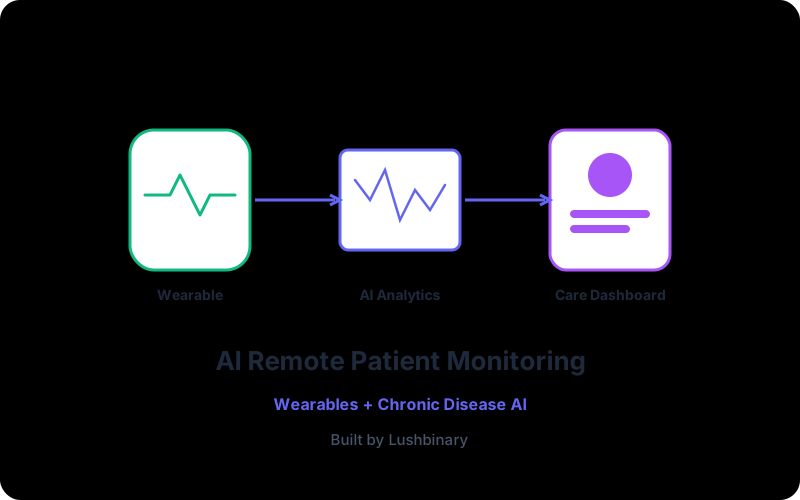
Remote patient monitoring (RPM) finally grew up in 2026. What used to be a nice-to-have pilot is now the primary way health systems manage congestive heart failure, COPD, diabetes, and post-surgical recovery populations. CMS reimburses it. Private payers follow. Wearables are everywhere, from Apple Watch to clinical-grade patches like HiCardi that continuously capture ECG, respiration, and oxygen saturation.
The problem is not data. It is that clinicians now have too much of it. A single CHF patient on an RPM program can emit thousands of events per day. Without AI, a nurse can safely manage 40 to 60 patients. With thoughtful AI, that jumps to 250 to 500 per nurse, which is what makes the CMS reimbursement math actually work.
This guide walks through how to build an AI-native RPM platform that integrates with wearables, runs continuous anomaly detection, produces billing-ready notes, and respects HIPAA. Lushbinary builds RPM for digital health startups and health systems, and we know where the failure modes hide.
📋 Table of Contents
- 1.The Modern RPM Opportunity
- 2.Device & Wearable Integrations
- 3.Edge AI vs Cloud AI: What Runs Where
- 4.Reference Architecture
- 5.AI for Alerting, Summarization & Triage
- 6.CPT Codes, Billing & Documentation
- 7.HIPAA, Consent & Data Residency
- 8.Patient Engagement & Adherence
- 9.Cost, Timeline & Team
- 10.Why Lushbinary for RPM
1The Modern RPM Opportunity
The conditions where RPM has the clearest clinical and financial evidence:
- Heart failure: weight, BP, HR, symptoms, medication adherence. Reduces 30-day readmissions by 30 to 50%.
- Hypertension: home BP cuffs plus medication titration support. Improves control rates significantly versus clinic-only management.
- Type 1 and Type 2 diabetes: CGM integration, insulin data, hypo/hyper alerting, meal logging.
- COPD and asthma: SpO2, respiration rate, inhaler telemetry, peak flow.
- Post-surgical recovery: activity, pain, vitals, wound photos.
- Pregnancy and postpartum: BP, glucose, fetal movement, mood screening.
- Oncology: symptom tracking, ePRO (electronic patient reported outcomes) between visits.
The monetization model is a combination of CMS and private-payer RPM codes, value-based contracts where the provider shares in the downstream savings, and direct contracts with health systems paying a per-member-per-month fee.
2Device & Wearable Integrations
The most common device families we integrate today:
| Category | Devices | Integration |
|---|---|---|
| Consumer wearables | Apple Watch, Fitbit, Oura, Garmin | HealthKit, Health Connect, vendor APIs |
| CGM | Dexcom G7, Abbott Libre 3, Medtronic | Vendor partner APIs, Dexcom Share |
| BP cuffs | Omron, Withings, iHealth | Vendor APIs, Bluetooth via mobile SDK |
| Clinical patches | HiCardi (Dong-A), iRhythm, VitalConnect | Vendor cloud, DICOM Waveform FHIR |
| Smart scales | Withings, BodyTrace, Eufy | Vendor APIs, cellular-connected devices |
| Aggregators | Validic, Terra, Rook, Thryve | Single API for 500+ devices |
For most builds, we recommend starting with HealthKit, Health Connect, and an aggregator like Validic or Terra. Add clinical-grade devices (Dexcom, HiCardi) as the clinical use case demands. Direct vendor integrations are worth it only when the aggregator lacks fidelity or the device is central to your product.
3Edge AI vs Cloud AI: What Runs Where
Modern RPM uses a hybrid of on-device and cloud models:
- On-device (edge) models: fall detection, atrial fibrillation detection, glucose predictions, sleep staging, activity classification. Tight latency, battery efficiency, and privacy.
- Cloud models: cross-patient population analytics, long-horizon trend detection, LLM-generated summaries, natural language querying by clinicians, risk stratification models.
- Hybrid: edge model raises a first-pass alert, cloud model confirms against broader context before paging a nurse. This is the single biggest factor in alert fatigue reduction.
Open-weight models like Gemma 4 and Qwen 3.6 now deliver strong reasoning at a cost point that lets you run patient-level summaries at scale. For the most sensitive deployments (hospital-at-home), many health systems prefer a self-hosted open-weight stack over any external LLM API.
4Reference Architecture
5AI for Alerting, Summarization & Triage
The three AI workloads that drive measurable outcomes:
- Anomaly and trend detection: detect changes in weight, HR, BP, or glucose patterns that precede an acute event by 24 to 72 hours. Heart failure decompensation is the canonical example.
- Patient-level summarization: an LLM compresses the last 7 to 30 days of data per patient into a 5-line summary a nurse can scan in seconds. Pairs with a "show me the data" drill-in.
- Draft outreach: the AI drafts a patient message ("Your BP has trended up this week, can you check your medication?") that the nurse reviews and sends in a single click.
- Natural-language patient queries: clinicians ask questions like "who has a blood sugar over 300 in the last 3 days?" and the AI returns a sorted list.
- Billing-ready monthly note: the AI drafts the CMS- compliant 99457 monthly note documenting interactive communication and care plan changes for review and sign-off.
💡 Alert fatigue is the killer
The single biggest reason RPM programs fail is alert fatigue. Thresholds fire too often, nurses stop reading alerts, a real event is missed. The test is not "can the AI detect anomalies." It is "can we keep nurse-actionable alerts to under 5 per nurse per day while still catching real decompensation." That is a machine-learning and UX problem, not a sensor problem.
6CPT Codes, Billing & Documentation
The RPM revenue model in 2026:
| Code | What It Covers | Approx. Reimbursement |
|---|---|---|
| 99453 | Initial device setup and patient education | $18 to $22 (one-time) |
| 99454 | Device supply, 16+ days of data per 30 | $50 to $65 per month |
| 99457 | First 20 minutes of monthly RPM treatment management | $48 to $55 per month |
| 99458 | Each additional 20 minutes | $37 to $44 per month |
| 98975-98981 | Remote Therapeutic Monitoring | Similar structure for RTM |
| 99490 / 99439 | Chronic Care Management | $42 to $65 per month |
Your platform has to produce billing-defensible documentation automatically: the 16+ days of transmitted data, the interactive communication log, the care plan updates, the minutes of service. If the documentation is weak, the claim gets denied and the program stops being profitable. This is where AI pays for itself.
7HIPAA, Consent & Data Residency
Baseline HIPAA controls from our healthcare AI guide, plus RPM-specific items:
- Device-side encryption: BLE pairing with the patient's phone over encrypted channels. Never store PHI on the device beyond the sync window.
- Continuous consent: patients can pause monitoring, see a real-time view of what is collected, and revoke at any time.
- Data segregation: wellness data (Apple Watch steps) and clinical data (CGM glucose) have different retention and use rules. Do not conflate them.
- State laws: consumer health data is now regulated separately under Washington's My Health My Data Act and similar state laws, with stricter consent requirements than HIPAA.
- Data residency: enterprise health system buyers increasingly require single-tenant or US-region-only deployments.
8Patient Engagement & Adherence
RPM revenue depends on 16+ days of data per month. That is an engagement problem, not a tech problem. The features that matter:
- Daily streaks, small rewards, progress visualization.
- Empathetic nudges from an AI care coach, reviewed before being sent.
- Family-share views so a spouse or adult child can support adherence.
- Auto-scheduled check-ins via SMS, voice, or WhatsApp, BAA permitting.
- Gamified challenges for populations where it fits (younger diabetes, post-surgical recovery).
- Clear, non-patronizing education, with an option to ask an AI health coach general questions scoped away from diagnosis.
9Cost, Timeline & Team
| Scope | Timeline | Cost |
|---|---|---|
| Focused MVP (1 condition, 2-3 devices, alerting) | 5 to 8 months | $200,000 to $450,000 |
| Multi-condition platform, 10+ integrations, AI summarization | 9 to 13 months | $600,000 to $1,200,000 |
| Enterprise RPM with multi-tenant, FDA-cleared algorithms | 12 to 18 months | $1,200,000 to $2,500,000 |
| Per-enrolled-patient run rate | Ongoing | $2 to $6 per month |
10Why Lushbinary for RPM
We have shipped mobile health and wearable integrations for clients in cardiology, diabetes, and post-surgical recovery. RPM sits at the intersection of mobile engineering, data pipelines, clinical workflow, and billing. We have practiced each one, which is the only way you avoid the classic RPM pitfalls: alert fatigue, weak billing documentation, and devices that do not reliably sync.
What we ship:
- iOS, Android, and web patient apps with HealthKit and Health Connect.
- Dexcom, Abbott, Omron, Withings, Oura, Fitbit, and HiCardi integrations.
- AI summarization and alerting pipelines on AWS, Azure, or self-hosted infrastructure.
- Care team consoles with billing-ready 99457 documentation.
- Epic, Oracle Health, and athenahealth writeback via FHIR.
🚀 Free RPM Architecture Review
Planning an RPM program? Lushbinary will review your proposed device stack, billing strategy, and AI summarization approach and come back with a scoped plan. No obligation.
❓ Frequently Asked Questions
What is an AI remote patient monitoring app?
A platform that collects continuous data from wearables and connected devices, runs AI for trend detection and summarization, and routes actionable alerts to care teams for chronic disease management.
Is RPM reimbursable?
Yes. CMS reimburses CPT 99453, 99454, 99457, 99458 with monthly payments in the $50 to $130 range. Private payers generally follow CMS. Remote Therapeutic Monitoring (98975-98981) and Chronic Care Management (99490) add revenue pathways.
Which devices can I integrate with?
Apple HealthKit, Google Health Connect, Dexcom G7, Abbott Libre, Omron, Withings, Oura, Fitbit, HiCardi patches, and aggregators like Validic, Terra, and Rook.
How does AI actually help in RPM?
It compresses thousands of data points per patient into scannable summaries, detects early signs of decompensation, drafts outreach messages, and generates billing-ready notes. The result is 5 to 10x more patients per nurse.
How much does it cost?
Focused MVPs run $200K to $450K over 5 to 8 months. Multi-condition platforms run $600K to $1.2M. Enterprise platforms with FDA-cleared algorithms run $1.2M to $2.5M.
📚 Sources
- CMS Physician Fee Schedule for RPM codes
- Apple HealthKit developer portal
- Google Health Connect developer docs
- Dexcom developer program
- AWS HealthLake
Content was rephrased for compliance with licensing restrictions. Device and pricing details sourced from official vendor and CMS sites as of April 2026. Reimbursement rates vary by region and year, always verify with a billing specialist.
Build an AI RPM Platform That Clinicians Trust
Lushbinary builds remote patient monitoring platforms that integrate with real devices, keep nurses out of alert hell, and produce billing-ready documentation. Tell us your population and we will reply within one business day.
Ready to Build Something Great?
Get a free 30-minute strategy call. We'll map out your project, timeline, and tech stack - no strings attached.
Prefer email? Reach us directly: