
Fair-trade retail has a dedicated buyer base but a frustrating commerce layer. Retailers like Ten Thousand Villages pay 50% of purchase price up-front to artisans to reduce risk for small producer cooperatives. Platforms like Novica and Handspoken offer curated fair-trade selections. None of them run live auctions for one-of-one handcrafted pieces, where price discovery could lift artisan earnings significantly.
A well-designed fair-trade artisan auction platform combines the trust infrastructure of certified fair-trade retail with the price discovery of auction mechanics, while respecting the real constraints of producers in remote or low-bandwidth regions. Done right, it pays artisans more, tells their story, and gives conscious buyers a competitive reason to buy now instead of later.
This guide covers exactly how to build one: cooperative onboarding, fair-trade verification, offline-first artisan tooling, cross-border payouts, maker story content, and the realistic cost and timeline to ship.
Table of Contents
- 1.Why Fair-Trade Retail Needs Auction Mechanics
- 2.How Existing Fair-Trade Platforms Compare
- 3.Core Features for a Fair-Trade Artisan Auction MVP
- 4.Fair-Trade Certification & Verification Flow
- 5.Offline-First Artisan Tooling for Remote Cooperatives
- 6.Cross-Border Payouts & Currency Handling
- 7.Maker Story Content & Cultural Preservation
- 8.System Architecture & Tech Stack
- 9.Cost, Timeline & Revenue Model
- 10.Why Lushbinary for Your Fair-Trade Platform
- 11.FAQ & Sources
1Why Fair-Trade Retail Needs Auction Mechanics
Most fair-trade commerce operates on fixed wholesale pricing: producer cooperatives set a price, retailers mark up 2-3x, and buyers pay. This model works for commodity handicrafts but leaves value on the table for:
- One-of-one pieces: hand-knotted rugs, master weavings, large ceramics where each item is unique
- Master artisan work: pieces by recognized master crafters that command premiums
- Time-limited runs: traditional festivals, seasonal crafts, heritage techniques with limited output
- Estate and archive pieces: vintage fair-trade work from cooperatives that have scaled down or closed
💡 The 50% Up-Front Model
Ten Thousand Villages pays artisans 50% of the purchase price before production begins. A fair-trade auction platform can do better: for auctioned pieces already produced, pay 80-90% of the winning bid within 3-5 days of sale, with the remainder released on buyer receipt confirmation.
2How Existing Fair-Trade Platforms Compare
| Platform | Model | Gap |
|---|---|---|
| Ten Thousand Villages | Non-profit fair-trade retail, fixed-price | No auctions, limited online catalog |
| Novica | Artisan marketplace, National Geographic partner | Fixed-price, no live auctions |
| Fair Trade Winds | Curated retail, physical + online | Wholesale-priced, small online selection |
| Handspoken / local co-ops | Single-region fair-trade retail | Limited scale, no tech platform |
| Etsy | Generic P2P with fair-trade tags | No certification verification, high fees |
3Core Features for a Fair-Trade Artisan Auction MVP
Phase 1: Lean MVP (4 to 6 months)
Cooperative onboarding
KYC for cooperative lead, fair-trade certification upload, bank details
Artisan profiles
Individual maker name, region, technique, years of experience, photos
Listing creation
Multi-language titles, photos, dimensions, materials, maker attribution
Timed auctions
7, 14, or 30-day options to accommodate slow-response regions
Reserve pricing
Cooperative-set floor reflecting living-wage production cost
Multi-currency
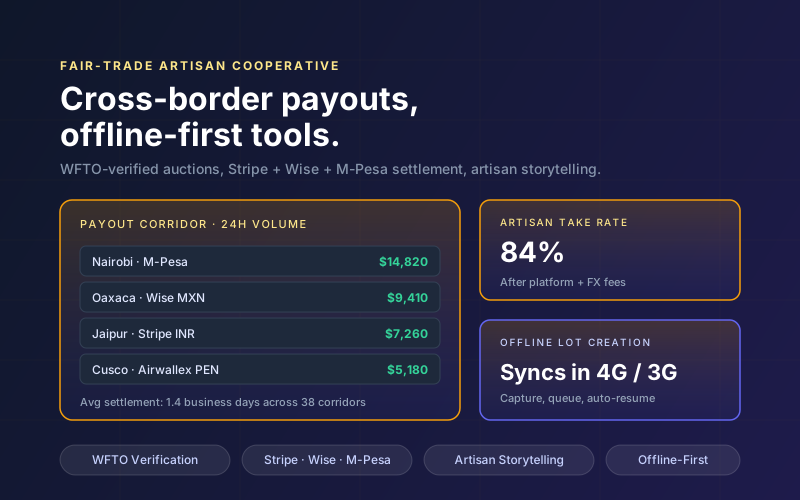
Buyer sees local currency, cooperative receives local currency via Wise
Up-front payouts
80% of winning bid transferred within 3-5 days, 20% on delivery confirmation
Cross-border shipping
DHL, FedEx International, or regional partners with duty calculation
Phase 2: Differentiation (2 to 3 months)
- Offline-first artisan app: PWA or Capacitor app with SQLite sync for low-bandwidth regions
- Video storytelling: maker videos uploaded by cooperative coordinators, transcoded and served via CDN
- Mobile money integration: M-Pesa, Orange Money, and other regional payment rails
- Impact dashboard: buyer and cooperative view of total hours funded, families supported, techniques preserved
- Multi-language UI: English, Spanish, French, Hindi, Arabic, Swahili at minimum
Phase 3: Scale (3 to 4 months)
- Cooperative grant fund: platform revenue share that funds tool upgrades, training, and new cooperative onboarding
- Technique taxonomy: searchable craft technique database (ikat, Ajrakh, mola, tingatinga) with educational content
- Collector programs: recurring subscription for curated cooperative drops
- Museum partnerships: provenance tracking compatible with institutional cataloging standards
4Fair-Trade Certification & Verification Flow
Trust is the product. Buyers pay premiums for fair-trade because they trust the certification chain. The platform must enforce it:
- World Fair Trade Organization (WFTO): cooperative-level fair-trade status, renewable annually
- Fair Trade Federation: US-focused membership with similar standards
- Fairtrade International: product-level certification primarily for commodities
- Local equivalents: SIPPO, national cooperative registries, and third-party audits for regions outside major certifiers
Verification workflow:
- Cooperative uploads certification document and declares membership ID at onboarding
- Platform verifies via certifier API or manual check against public registry
- Certification stored with expiration date; listings are auto-paused if certification lapses
- Annual re-verification triggered 30 days before expiration with cooperative admin reminders
- For uncertified cooperatives, platform conducts video or in-person audits and issues a platform-internal fair-practices badge
5Offline-First Artisan Tooling for Remote Cooperatives
Many producer cooperatives are in areas with intermittent internet. A cooperative coordinator may batch-upload listings once a week when visiting a town with reliable WiFi. Build for this reality:
- Progressive Web App with IndexedDB for listing drafts, photos, and offline auction result viewing
- Capacitor native app with SQLite for regions where a PWA is too flaky on low-end Android devices
- Batch sync: upload 10-50 listings at once when online, with resumable image uploads
- SMS fallback: auction results and payout notifications delivered via Twilio SMS or Africa's Talking for non-smartphone users
- Local language: UI translated to regional languages with right-to-left support for Arabic and Urdu
We cover offline-first architecture in depth in our mobile-first offline browser tool guide.
6Cross-Border Payouts & Currency Handling
Fair payouts require fair conversion. Recommended stack:
| Region | Payout Method |
|---|---|
| Stripe supported (40+ countries) | Stripe Connect Express direct bank transfer |
| Latin America, parts of Asia/Africa | Wise multi-currency business account |
| APAC and cross-border merchants | Airwallex global account |
| East Africa, mobile-money heavy | M-Pesa via Safaricom API, Orange Money |
| Areas with no banking infrastructure | Partnership with local MFI for cash disbursement |
7Maker Story Content & Cultural Preservation
What separates a fair-trade platform from a discount marketplace is context. Every listing should carry:
- Maker photo and bio: one or two paragraphs in the maker's voice where possible
- Technique explanation: how the piece was made, how long it took, what tools and materials were used
- Cultural context: where the tradition originates, what it symbolizes, any regional variations
- Cooperative impact: how your purchase supports training, education, and the broader cooperative
- Short maker video: 30-60 seconds filmed on a smartphone, transcoded server-side and served via CDN
8System Architecture & Tech Stack
| Layer | Stack |
|---|---|
| Buyer web | Next.js 15 + React 19 + Tailwind 4, multi-locale via next-intl |
| Cooperative PWA | Next.js PWA with IndexedDB + service worker for offline |
| Native fallback | Capacitor 7 wrapping the PWA with SQLite adapter |
| Auction engine | Node.js 22 + Socket.IO 4.8 + Redis adapter |
| Sync API | REST + JSON patch with ETag conflict resolution |
| Database | PostgreSQL 17 + pgvector for technique similarity search |
| Media | S3 + CloudFront + MediaConvert for maker videos |
| Payments | Stripe Connect Express + Wise + Airwallex + M-Pesa |
| Certifications | WFTO, FTF, Fairtrade International API integrations |
| Messaging | Twilio SMS + Africa's Talking + email via SES |
| Hosting | AWS ECS Fargate + RDS + ElastiCache with multi-region CDN |
9Cost, Timeline & Revenue Model
| Scope | Timeline | Cost Range |
|---|---|---|
| Lean MVP (auctions, Stripe Connect, certification check, storytelling) | 4 to 6 months | $55K to $95K |
| Mid (offline-first PWA, Wise/M-Pesa, multi-language) | 6 to 8 months | $120K to $180K |
| Full (video storytelling, impact dashboards, technique taxonomy) | 9 to 12 months | $200K to $320K |
| Hosting, translation, and audit ops | Per month | $1,500 to $4,000 |
Revenue model: 10-15% platform commission (materially lower than retail markup), optional cooperative membership fee that funds certification audits and platform onboarding, and a dedicated cooperative grant fund financed by a slice of platform revenue.
10Why Lushbinary for Your Fair-Trade Platform
Fair-trade platforms sit at the intersection of marketplace commerce, offline-first mobile, cross-border payments, and trust verification. Relevant work includes our live auction platform case study, our offline-first mobile guide, and our MedusaJS full-stack e-commerce guide.
- Production real-time auction engine tuned for long-duration auctions (7-30 days) and slow-response bidding patterns
- Offline-first PWA with service worker sync, IndexedDB, and resumable image uploads
- Stripe Connect, Wise, Airwallex, and mobile-money payout integrations from day one
- Multi-language UI with right-to-left support and per-region currency display
- Certification verification workflow integrating WFTO, Fair Trade Federation, and Fairtrade International
🚀 Free Fair-Trade Platform Consultation
Building a platform for artisan cooperatives? Lushbinary offers a free scoping call. We will review your cooperative network, recommend the right payment and offline stack, and share a realistic timeline with no obligation.
❓ Frequently Asked Questions
What makes a fair-trade artisan auction different from a standard marketplace?
Fair-trade platforms pay artisans up-front, tie listings to verified producer cooperatives, and trace chain of custody. Standard marketplaces optimize for price and scale.
What does it cost to build a fair-trade artisan auction platform?
$55K to $95K for a lean MVP over 4 to 6 months. $140K to $240K for a full platform with offline-first sync, cross-border logistics, and video storytelling.
How do you verify fair-trade claims on an auction platform?
Integrate with WFTO, Fair Trade Federation, and Fairtrade International. Require certification documentation at onboarding, display IDs on listings, and conduct annual audits.
How do you handle cross-border payouts for artisans?
Stripe Connect for 40+ supported countries, Wise and Airwallex for others, and M-Pesa or Orange Money for mobile-money-dominant regions.
Can artisans in areas with unreliable internet use an auction platform?
Yes, with offline-first design using PWA + IndexedDB or Capacitor + SQLite. Cooperatives upload listings offline and sync when connected.
Sources
- World Fair Trade Organization
- Fair Trade Federation
- Fairtrade International
- Ten Thousand Villages fair-trade principles
- Stripe Connect documentation
- Wise Business multi-currency
Content was rephrased for compliance with licensing restrictions. Certification standards and payment rail availability sourced from official organizations as of May 2026. Rules vary by jurisdiction and cooperative, always verify directly before launch.
Build a Fair-Trade Artisan Auction Platform That Pays Makers First
Tell us about your cooperative network. We will scope the build, recommend the right payment and offline stack, and share a realistic timeline with no obligation.
Ready to Build Something Great?
Get a free 30-minute strategy call. We'll map out your project, timeline, and tech stack - no strings attached.
Prefer email? Reach us directly: