
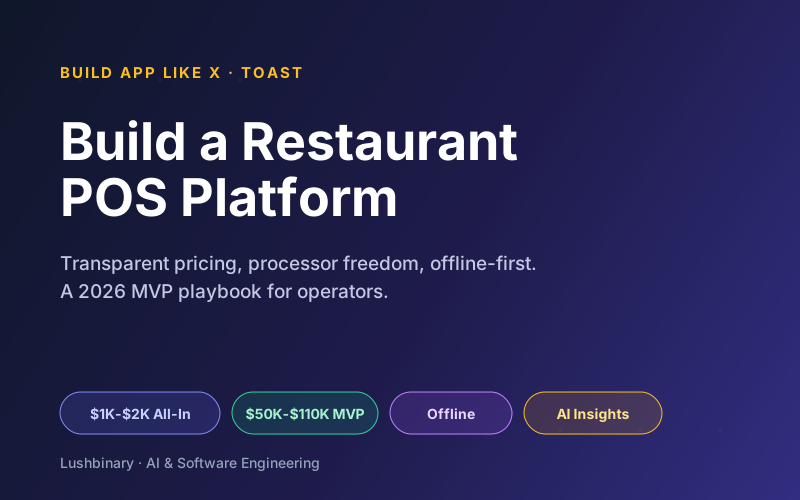
Toast became one of the most widely adopted restaurant POS platforms in the US by building hardware and software specifically for the way restaurants actually run. Its base pricing looks approachable, with a $0/month starter plan and paid plans from about $69/month per terminal, but real operators frequently report all-in costs of $1,000 to $2,000+ a month once processing, hardware, and add-ons stack up.
That gap between the sticker price and the real bill is the core of the opportunity. Operators on Reddit and industry forums consistently flag the same issues: surprise all-in costs, mandatory in-house payment processing that blocks rate negotiation, long contracts, and add-on fees for modules like online ordering. A transparent, flexible, offline-first POS aimed at a specific restaurant segment can win the operators Toast frustrates.
This guide breaks down what makes Toast work, how it monetizes, the gaps you can exploit, the MVP feature set, the architecture and tech stack, the AI features that differentiate, real cost and timeline, and how Lushbinary can help you build it.
📋 Table of Contents
- 1.What Makes Toast Successful
- 2.Toast’s Pricing & Revenue Model
- 3.Operator Complaints & Market Gaps You Can Exploit
- 4.Core Features for a Restaurant POS MVP
- 5.System Architecture & Tech Stack
- 6.AI-Powered Features That Differentiate
- 7.Development Cost & Timeline Breakdown
- 8.Why Lushbinary for Your Restaurant POS MVP
1What Makes Toast Successful
Toast did not sell a generic point of sale. It built an all-in-one restaurant operating system, hardware included, tuned for the chaos of a busy service. Three things drove its adoption.
Restaurant-Specific Workflows
Course firing, modifiers, split checks, tips, and kitchen display systems are built for how restaurants operate, not retrofitted from a retail POS. That domain fit is the foundation of the product.
Integrated Hardware and Software
Ruggedized terminals, handhelds, and kitchen displays that work together out of the box reduce setup pain and support issues. The tight hardware-software pairing is a real moat and a real cost.
One Platform, Many Modules
Online ordering, payroll, loyalty, inventory, and reporting all plug into one system. That breadth keeps restaurants on the platform, even as the add-on fees add up.
| Metric | Toast |
|---|---|
| Starter Plan | $0/month (higher processing rates) |
| Paid POS Plan | From ~$69/month per terminal |
| Processing (paid plans) | ~2.49% + $0.15 per transaction |
| Typical All-In (full-service) | $1,000 - $2,000+/month |
| Category | All-in-one restaurant POS + management |
| Main Rivals | Square, Clover, SpotOn, Lightspeed |
2Toast's Pricing & Revenue Model
Toast's headline software price is the small part of the bill. The majority of its revenue comes from payment processing, which is why it requires in-house processing and why the all-in cost surprises operators.
| Cost Component | Typical Range |
|---|---|
| Starter (pay-as-you-go) | $0/month + higher processing |
| Point of Sale plan | From ~$69/month per terminal |
| Payment processing | ~2.49% + $0.15 per transaction (paid) |
| Online ordering add-on | ~$75/month |
| Hardware | One-time terminal and device costs |
| Typical all-in (full-service) | $1,000 - $2,000+/month |
💡 Revenue Opportunity
Operators resent mandatory processing and surprise totals. A POS with transparent flat pricing, the freedom to choose a payment processor or negotiate rates, and no long lock-in contract is a compelling pitch, especially to quick-service venues, cafes, and multi-location groups that watch margins closely.
3Operator Complaints & Market Gaps You Can Exploit
We reviewed operator feedback across Reddit, review sites, and industry analysis. These pain points repeat, and each maps to a feature or positioning opportunity.
🧾 Surprise All-In Costs
The $69 base balloons to $1,000-$2,000+ once processing and add-ons stack. Transparent, predictable pricing wins trust immediately.
🔒 Mandatory Processing
In-house processing is required, blocking rate negotiation. Processor flexibility is a major differentiator.
📝 Long Contracts
Multi-year commitments frustrate operators. Month-to-month terms lower the barrier to switching.
💻 Hardware Lock-In
Proprietary hardware is expensive. Supporting commodity tablets and printers cuts upfront cost.
📡 Offline Reliability
Service must continue when the internet drops. A rock-solid offline mode is a real selling point in busy venues.
🍳 Underserved Segments
Food trucks, cafes, ghost kitchens, and small QSRs are underserved by a one-size platform. Vertical focus wins.
💡 The Opportunity
Pick a segment Toast serves poorly, such as quick-service, food trucks, or cafes, and lead with transparent flat pricing, processor choice, no lock-in, and a bulletproof offline mode. Owning a restaurant niche with a focused product beats competing head-on with an all-in-one giant.
4Core Features for a Restaurant POS MVP
Phase 1: Lean MVP (12-16 weeks)
- Order Entry - Fast tablet ordering with modifiers, courses, and split checks
- Menu Management - Items, categories, modifiers, pricing, and availability
- Payments - Card-present payments, tips, and receipts via a payment terminal SDK
- Kitchen Display - Live ticket routing to kitchen screens with bump and recall
- Offline Mode - Local-first ordering and payments that sync when the connection returns
- Basic Reporting - Daily sales, item mix, and end-of-day reconciliation
Phase 2: Differentiation (10-14 weeks)
- Online Ordering - Branded ordering site and QR ordering with the same menu
- Inventory - Track stock, recipes, and food cost with low-stock alerts
- Loyalty & Promotions - Points, rewards, and targeted offers
- Staff & Shifts - Roles, clock-in, and basic labor reporting
- Multi-Location - Central menu and reporting across sites
Phase 3: AI & Scale (10-14 weeks)
- Demand Forecasting - Predict covers and prep needs by day and daypart
- Menu Optimization - Identify high-margin and underperforming items
- Labor Scheduling - Suggest staffing levels from forecasted demand
- Inventory Automation - Auto-generate purchase orders from sales and recipes
5System Architecture & Tech Stack
A restaurant POS has three non-negotiable requirements: it must work offline, route orders to the kitchen in real time, and handle card-present payments reliably. Here is the architecture we recommend.
Recommended Tech Stack
| Layer | Technology | Why |
|---|---|---|
| POS Terminal | React Native or native tablet app | Fast touch UI with offline-first local storage |
| Backend | Node.js or Go | Real-time order routing and sync; Go for throughput |
| Database | PostgreSQL | Orders, menus, and reporting with strong consistency |
| Realtime | Redis + WebSockets | Live kitchen tickets and device sync |
| Payments | Stripe Terminal or Adyen | Card-present payments with processor flexibility |
| Online Ordering | Next.js | Branded ordering site and QR ordering |
| Cloud | AWS (ECS / Lambda) | Scalable services, queues, and reporting |
| AI | Python services + models | Demand forecasting, menu and labor optimization |
6AI-Powered Features That Differentiate
AI turns POS data into margin. These are the capabilities that help operators run leaner and more profitable kitchens.
📈 Demand Forecasting
Predict covers and item demand by daypart so kitchens prep the right amount and cut waste.
🍽️ Menu Engineering
Identify high-margin stars and underperformers, and suggest pricing and placement changes.
🧑🍳 Smart Labor Scheduling
Recommend staffing levels from forecasted demand to control labor cost without hurting service.
📦 Inventory Automation
Auto-generate purchase orders from sales and recipes, flagging shrinkage and stockouts.
💬 Natural-Language Reports
Ask 'how did Friday dinner do versus last week?' and get a grounded answer with charts.
🛡️ Fraud & Voids Detection
Flag unusual voids, discounts, and refund patterns that can indicate loss or error.
7Development Cost & Timeline Breakdown
A POS costs more than a typical app because offline reliability, card-present payments, and kitchen routing are all hard problems done right. Here is what to budget.
Get Detailed Cost Breakdown
Fill in your details to unlock pricing and cost information.
8Why Lushbinary for Your Restaurant POS MVP
At Lushbinary, we build offline-first, real-time, payment-enabled products for startups and enterprises. Here is what we bring to a restaurant POS:
- Offline-first systems - We build local-first apps that keep working and sync cleanly when the connection returns
- Card-present payments - We integrate terminal SDKs with attention to PCI scope and reliability
- Real-time routing - We build kitchen display and order systems that hold up during the rush
- AI integration - We add demand forecasting, menu engineering, and labor optimization on top of POS data
- AI-accelerated delivery - We use AI coding tools to ship MVPs 30-40% faster without cutting quality
🚀 Free Consultation
Want to build a restaurant POS that actually competes? Lushbinary specializes in offline-first, AI-powered platforms. We'll scope your project, recommend the right tech stack, and give you a realistic timeline with no obligation.
❓ Frequently Asked Questions
How much does it cost to build a restaurant POS platform like Toast?
An MVP with order entry, menu management, payments, and kitchen display costs $50,000-$110,000 over 12-16 weeks. A full platform with online ordering, inventory, payroll, loyalty, and AI ranges from $150,000-$350,000.
How much does Toast cost and how does it make money?
A $0/month starter plan with higher processing, paid plans from about $69/month per terminal, and processing around 2.49% plus $0.15 per transaction. Operators often report $1,000-$2,000+ all-in monthly. Toast earns mostly from processing, plus software and hardware.
What are the biggest complaints about Toast?
Surprise all-in costs once add-ons stack, mandatory in-house processing that blocks rate negotiation, long contracts, hardware expense, and add-on fees for online ordering and other modules.
What tech stack should I use to build a restaurant POS?
React Native or a native tablet app with strong offline mode, Node.js or Go for the backend, PostgreSQL, Redis for live tickets, a payment SDK like Stripe Terminal or Adyen, and AWS for hosting and reporting.
Can a new POS compete with Toast?
Yes, by serving a niche like quick-service, food trucks, or cafes with transparent flat pricing, processor flexibility, no lock-in contracts, and a bulletproof offline mode.
📚 Sources
- Toast POS Pricing - Plan tiers and processing rates
- Toast Online Ordering Pricing & Fees (2026) - All-in cost analysis from operators
- Stripe Terminal Documentation - Card-present payments
Content was rephrased for compliance with licensing restrictions. Pricing data sourced from official Toast pages and reputable industry analyses as of early 2026. Plans, processing rates, and all-in costs may change - always verify on the vendor's website.
Build a Restaurant POS Operators Actually Trust
Transparent pricing, processor freedom, bulletproof offline mode, and AI-powered insights. Let Lushbinary build your Toast alternative for the restaurant niche you want to own.
Ready to Build Something Great?
Get a free 30-minute strategy call. We'll map out your project, timeline, and tech stack - no strings attached.
Prefer email? Reach us directly: