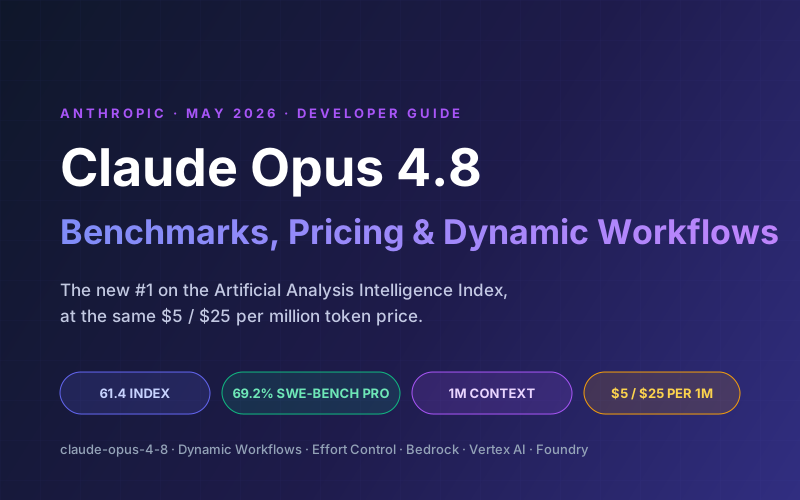

The most interesting thing Anthropic shipped on May 28, 2026 was not the benchmark jump in Claude Opus 4.8. It was Dynamic Workflows: the ability for Claude Code to plan a large job, spin up hundreds of parallel subagents, run them at the same time, and verify each result against your test suite, without you orchestrating any of it by hand.
This is the difference between a single developer working through a backlog ticket by ticket, and a team lead who breaks the work into independent pieces and hands them out in parallel. For codebase-scale migrations spanning hundreds of thousands of lines, that shift compresses wall-clock time dramatically.
This guide explains how Dynamic Workflows works, who can use it, how it differs from manual subagents, the workloads it is built for, and how to set up a migration so the model can run it end-to-end safely.
What This Guide Covers
1What Dynamic Workflows Is
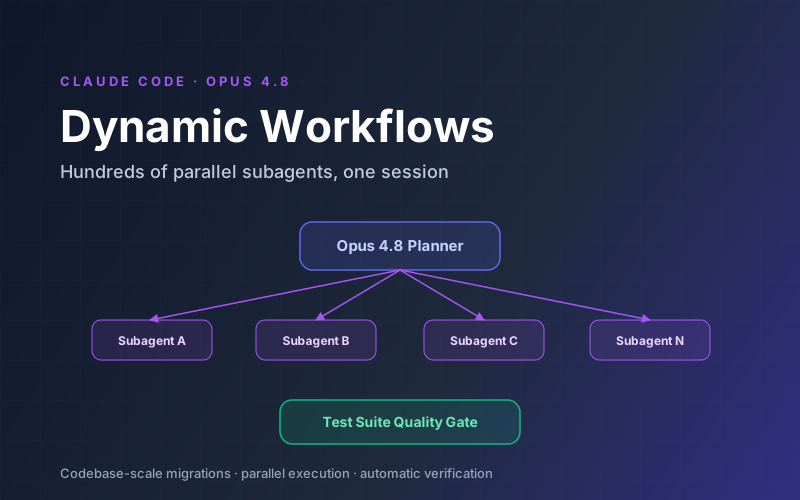
Dynamic Workflows lets Claude Opus 4.8 orchestrate hundreds of parallel subagents within a single Claude Code session. The model plans the work, distributes it across subagents, verifies their outputs, and reports results. You describe the goal; Claude figures out how to break it apart and run it.
It launched as a research preview for Claude Code Enterprise, Team, and Max users, and is also available through the Claude API, Amazon Bedrock, Google Cloud Vertex AI, and Microsoft Foundry. The flagship use case Anthropic demonstrated is carrying a migration from kickoff to merge across a codebase of hundreds of thousands of lines, using the existing test suite as the quality bar.
2How It Works Under the Hood
Conceptually, the flow has four phases: plan, distribute, verify, and integrate. The lead model decomposes the job into independent units, spawns a subagent per unit, runs them in parallel, and gates each result on the test suite before merging.
The critical detail is verification. Each subagent's output is checked against your existing tests before it is integrated. Opus 4.8's honesty improvements matter here: it is the first Claude model to score 0% on uncritically reporting flawed results and 4x less likely than 4.7 to let a defect pass unflagged. In an unattended parallel run, that is the difference between a trustworthy merge and a green checkmark that lies.
3Dynamic Workflows vs Manual Subagents
Claude Code already supported subagents and agent teams. The difference is who does the orchestration.
| Dimension | Manual Subagents | Dynamic Workflows |
|---|---|---|
| Decomposition | Developer defines roles and tasks | Model plans the decomposition |
| Scale | A handful of named agents | Hundreds of parallel subagents |
| Coordination | Manual hand-offs and prompts | Automatic distribution and verification |
| Best fit | Defined recurring roles | One-off large-scale migrations |
4Best Use Cases
Dynamic Workflows shines when a job decomposes into many independent changes that an existing test suite can verify. Strong fits include:
Framework upgrades
Migrate hundreds of files to a new major version of a framework or library in parallel.
API migrations
Replace a deprecated internal or third-party API across the entire codebase at once.
Type and lint sweeps
Apply strict type annotations or fix lint violations across thousands of files.
Dependency bumps
Update call sites for breaking changes after a major dependency upgrade.
Test backfill
Generate missing unit tests for many modules, each verified independently.
Codemod-style refactors
Rename patterns, restructure imports, or normalize conventions repo-wide.
When not to use it
Tasks with tight cross-file dependencies, weak or missing test coverage, or a need for a single coherent architectural decision are poor fits. Parallel subagents work best when the units of work are genuinely independent and verifiable in isolation.
5Setting Up a Migration
The model does the orchestration, but your repo has to be ready for it. A reliable parallel run depends on the quality gate being trustworthy.
- Make the test suite the source of truth. Ensure tests pass before you start and that they meaningfully cover the code being changed. The whole model relies on this gate.
- Write a precise goal prompt. State the migration target, constraints (minimal diffs, no behavior changes), and the definition of done.
- Use a clean branch. Run the workflow on a dedicated branch so you can review the merged result before it touches main.
- Set effort and budget. Choose an appropriate effort level and consider token budgets via the Messages API mid-run if the job grows.
- Review before merge. Treat the output like a large pull request from a capable teammate, scan the diff, run the suite once more, then merge.
For teams that have invested in CI and test coverage, this is where that investment pays off. The better your tests, the more of a migration the model can complete unattended.
6Cost & Safety Considerations
Hundreds of parallel subagents means hundreds of concurrent token streams. Opus 4.8 is priced at $5 input and $25 output per million tokens, and it is verbose, so a large migration can run up meaningful spend. Two levers keep this in check:
- Prompt caching. Shared context (the codebase overview, conventions, migration spec) re-read by many subagents benefits from the $0.50 per million cache-hit rate, a 90% discount on repeated input.
- Scoping. Run the migration in batches by directory or module rather than the whole repo at once, so you can validate cost and quality on a slice first.
On safety: parallel autonomous edits are powerful and hard to reverse if merged blindly. Always run on a branch, keep the test gate strict, and review the consolidated diff before merging. Opus 4.8's honesty gains reduce the risk of a fabricated pass, but a human merge review is still the right control for a change of this blast radius.
7Why Lushbinary for Agentic Migrations
Large migrations are exactly the kind of high-leverage, high-risk work where the setup matters more than the model. Lushbinary helps teams get their test coverage, CI gates, and branching strategy ready for agentic migrations, then runs Dynamic Workflows safely with cost controls and human review checkpoints.
🚀 Free Consultation
Have a framework upgrade or API migration sitting in the backlog? Lushbinary will assess whether Dynamic Workflows is a fit, prep your test gates, and scope the run, no obligation.
❓ Frequently Asked Questions
What are Dynamic Workflows in Claude Code?
Dynamic Workflows is a research-preview feature launched with Claude Opus 4.8 that lets Claude orchestrate hundreds of parallel subagents inside a single Claude Code session. Claude plans the work, distributes it across subagents, runs them in parallel, verifies outputs against the existing test suite, and reports results, all without manual orchestration.
Who can use Claude Code Dynamic Workflows?
Dynamic Workflows is available as a research preview to Claude Code Enterprise, Team, and Max plan users. It is also accessible through the Claude API, Amazon Bedrock, Google Cloud Vertex AI, and Microsoft Foundry.
What is the difference between Dynamic Workflows and Claude Code subagents?
Standard subagents are typically defined and invoked manually for specific roles. Dynamic Workflows lets Opus 4.8 plan the decomposition itself, spawn hundreds of subagents for independent units of work, run them in parallel, and coordinate verification automatically. It shifts orchestration from the developer to the model.
What is Dynamic Workflows best used for?
The primary use case is codebase-scale migrations and refactors spanning hundreds of thousands of lines: framework upgrades, API migrations, dependency bumps, and large-scale lint or type fixes. Anything that decomposes into many independent changes verifiable by an existing test suite is a strong fit.
How does Dynamic Workflows verify its work?
It uses your existing test suite as the quality bar. Each subagent's output is verified before integration, and Opus 4.8's honesty improvements mean it is far less likely to report a passing result that did not actually pass, which matters for autonomous runs.
Sources
Content was rephrased for compliance with licensing restrictions. Feature and pricing details sourced from official Anthropic publications as of May 28, 2026. Features and pricing may change, always verify on the vendor's website.
Run Codebase-Scale Migrations Safely
Lushbinary preps your test gates, scopes the run, and operates Claude Code Dynamic Workflows with cost controls and human review so your big migrations land without surprises.
Ready to Build Something Great?
Get a free 30-minute strategy call. We'll map out your project, timeline, and tech stack - no strings attached.
Prefer email? Reach us directly: