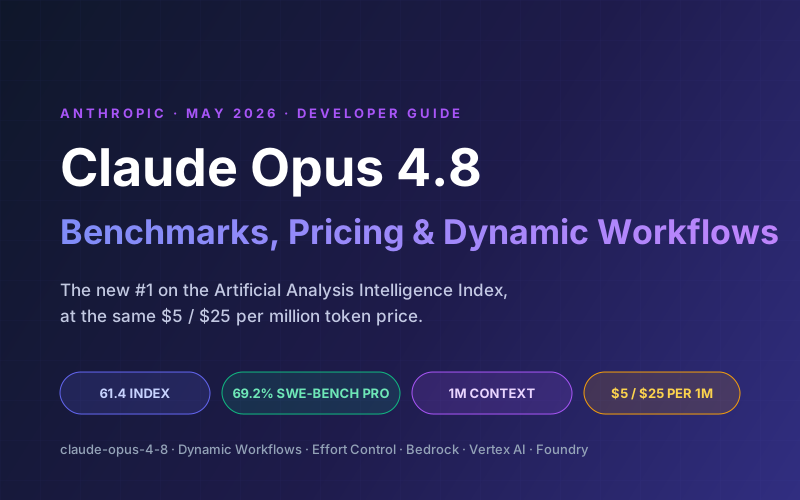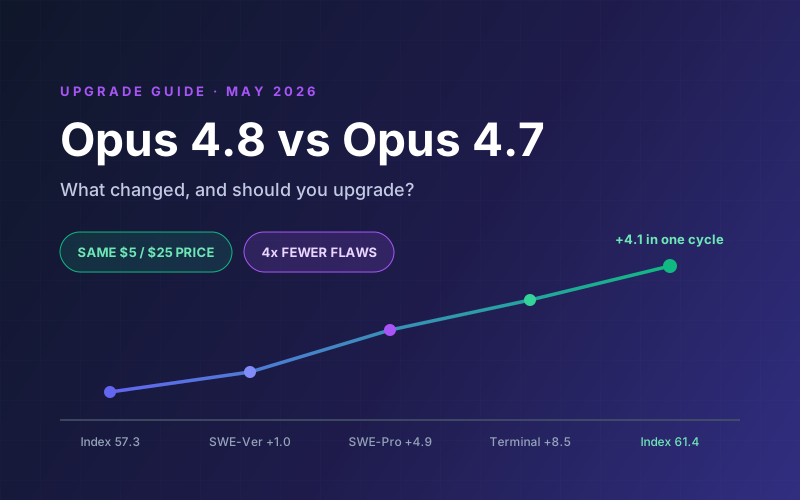

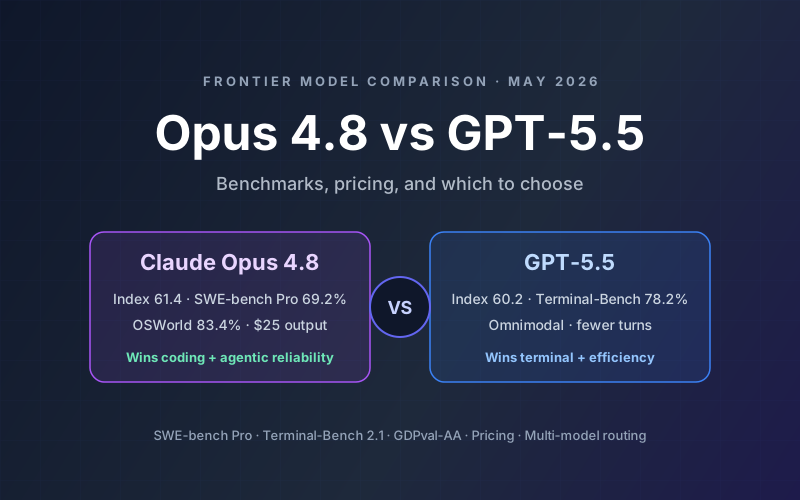
On May 28, 2026, Anthropic shipped Claude Opus 4.8 and did something no Claude model had done since April: it took the #1 spot on the Artificial Analysis Intelligence Index at 61.4, just ahead of GPT-5.5 at 60.2. The headline writes itself, but the headline is not the whole story.
These two models are close on aggregate intelligence but diverge sharply by task. Opus 4.8 dominates real-world software engineering and agentic reliability. GPT-5.5 holds the lead on terminal-driven coding and runs leaner, with fewer turns and lower verbosity. Picking the wrong one means paying more for worse results on your specific workload.
This comparison breaks down benchmarks, pricing, coding, agentic workflows, honesty, and context handling, then gives you a decision framework so you can route each task to the right model instead of guessing.
What This Guide Covers
1Release Context: What Changed
GPT-5.5, codenamed Spud, launched April 23, 2026 as OpenAI's first fully retrained base model since GPT-4.5. It is natively omnimodal, token-efficient, and built for agentic multi-tool orchestration. It held the top of the Intelligence Index for over a month.
Claude Opus 4.8 arrived May 28 as a point release over Opus 4.7, same 1M context, same $5/$25 pricing, but with sharp gains in coding, knowledge work, math, and alignment. It is Anthropic's fifth Opus release in seven months, signaling a strategy of frequent incremental upgrades rather than monolithic launches. The net effect: the two best generally available models are now separated by 1.2 points on the aggregate index, so the per-task differences matter far more than the ranking.
2Head-to-Head Benchmarks
Here is how the two models stack up across the benchmarks that matter most for developers. Green marks the leader in each row.
| Benchmark | Opus 4.8 | GPT-5.5 |
|---|---|---|
| Intelligence Index | 61.4 | 60.2 |
| SWE-bench Pro | 69.2% | 58.6% |
| Terminal-Bench 2.1 | 74.6% | 78.2% |
| OSWorld-Verified | 83.4% | 78.7% |
| GDPval-AA (Elo) | 1,890 | 1,769 |
| HLE (with tools) | 57.9% | 52.2% |
| GPQA Diamond | 93.6% | 93.6% |
Key Takeaway
Opus 4.8 leads cleanly on SWE-bench Pro (+10.6), GDPval-AA (+121 Elo), OSWorld-Verified (+4.7), and Humanity's Last Exam with tools. GPT-5.5 holds Terminal-Bench 2.1 (+3.6). They tie on GPQA Diamond. On aggregate intelligence, Opus 4.8 edges ahead by 1.2 points while costing $5 less per million output tokens.
3Coding: Where Each Model Wins
Coding is where most developers will feel the difference. Both are excellent, but they excel at different kinds of work.
Opus 4.8: Real-World Software Engineering
The 69.2% on SWE-bench Pro means Opus 4.8 resolves more real-world GitHub issues end-to-end than any other generally available model, 10.6 points ahead of GPT-5.5. In practice this shows up in complex multi-file refactoring, understanding interconnected codebases, and producing changes that pass existing test suites. Cursor's co-founder reported that Opus 4.8 exceeds prior Opus on CursorBench across all effort levels, with more efficient tool calling and fewer steps.
GPT-5.5: Terminal and Autonomous Coding
GPT-5.5's 78.2% on Terminal-Bench 2.1 is the one coding benchmark where it still beats Opus 4.8. This measures multi-tool command-line workflows that require planning, iteration, and error recovery. If your coding agents live in the shell, running build tools, CI fixers, and infrastructure scripts, GPT-5.5 has a measurable edge. It is also more token-efficient per task.
Choose Opus 4.8 for:
- Complex multi-file GitHub issue resolution
- Code review and quality-critical refactoring
- Codebase-scale migrations via Dynamic Workflows
- Reliability-critical unattended agents
- Long-context code analysis (1M tokens)
Choose GPT-5.5 for:
- Terminal-heavy CLI and DevOps workflows
- CI fixers, infra agents, and log triage
- Token-efficient, latency-sensitive paths
- Codex-powered engineering workflows
- Omnimodal input (audio and video)
4Agentic Workflows & Computer Use
This is where Opus 4.8 made its clearest gains. OSWorld-Verified, which measures driving a virtual machine, clicking through UIs, and completing mixed software tasks, hits 83.4%, ahead of GPT-5.5 at 78.7%. On MCP-Atlas it scores 82.2%, up from 77.3% on Opus 4.7. GenSpark reported that Opus 4.8 was the only model to complete every Super-Agent case end-to-end, beating prior Opus and GPT-5.5 at cost parity.
BrowserBase's team called Opus 4.8 the strongest computer-use and browser-agent model they have tested, at 84% on Online-Mind2Web. GPT-5.5 remains a strong agentic model and is more token-efficient, but on the reliability benchmarks that matter for unattended production runs, Opus 4.8 now leads. Pair that with its honesty gains and it is the safer default for agents that run without a human watching.
5Pricing & Token Economics
The per-token rates are close, but the context window and output price favor Opus 4.8. The verbosity profile favors GPT-5.5.
| Model | Input / 1M | Output / 1M | Context |
|---|---|---|---|
| Claude Opus 4.8 | $5.00 | $25.00 | 1M |
| GPT-5.5 | $5.00 | $30.00 | 922K |
On paper Opus 4.8 is about 17% cheaper on output tokens and ships a larger context window. But the per-task cost depends on token usage. Artificial Analysis found Opus 4.8 is verbose and takes roughly 30% more turns than GPT-5.5 to finish agentic tasks, which can erode the per-token advantage. The practical guidance: for output-heavy generation, Opus 4.8's lower rate helps; for long multi-turn agent loops, GPT-5.5's efficiency can win on total cost.
Both support prompt caching to cut repeated-context costs. Opus 4.8's cache-hit input rate is $0.50 per million, a 90% discount that materially changes the math for agents that re-read the same context every turn.
6Honesty, Reliability & Verbosity
Opus 4.8's biggest non-benchmark change is honesty. It is the first Claude model to score 0% on uncritically reporting flawed results, is 4x less likely than Opus 4.7 to let code flaws pass unflagged, and cut overconfidence more than 10x. For unattended agents, a model that flags its own uncertainty instead of confidently shipping broken code is a real reliability advantage.
The flip side is verbosity. Opus 4.8 produced roughly 110 million tokens during the full Intelligence Index evaluation versus a 35 million token average, and it is slower than average. GPT-5.5 is the leaner, faster model per task. If your priority is minimal latency and token spend on high-volume traffic, GPT-5.5's efficiency is a genuine advantage that the benchmark scores do not capture.
7Multi-Model Routing: Using Both
The strongest production teams do not pick one model. They route each task to the model best suited for it.
- Opus 4.8: complex coding, code review, multi-file refactoring, reliability-critical agents, codebase migrations
- GPT-5.5: terminal and DevOps automation, CI fixers, token-sensitive and latency-critical paths, omnimodal input
- Budget models: classification, summarization, and high-volume simple queries where frontier intelligence is overkill
8Decision Framework by Use Case
| Use Case | Best Model | Why |
|---|---|---|
| Complex multi-file bug fixes | Opus 4.8 | 69.2% SWE-bench Pro |
| Terminal & DevOps automation | GPT-5.5 | 78.2% Terminal-Bench 2.1 |
| Code review & refactoring | Opus 4.8 | Honesty gains, flags own flaws |
| Computer use & UI automation | Opus 4.8 | 83.4% OSWorld-Verified |
| Unattended reliability-critical agents | Opus 4.8 | 0% on reporting flawed results |
| Token-sensitive high-volume agents | GPT-5.5 | Fewer turns, less verbose |
| Audio / video input tasks | GPT-5.5 | Natively omnimodal |
| Codebase-scale migrations | Opus 4.8 | Dynamic Workflows subagents |
9Why Lushbinary for AI Integration
Choosing between Opus 4.8 and GPT-5.5 is the first decision. Building a production integration that routes tasks intelligently, controls token costs, handles failover, and scales takes deep expertise across both ecosystems.
Lushbinary has shipped production integrations with every major frontier model. We design multi-model routing, optimize token economics, implement safety guardrails, and deploy on AWS with proper monitoring and fallback chains, whether you standardize on Claude Opus 4.8 or run a hybrid stack.
🚀 Free Consultation
Not sure whether Opus 4.8, GPT-5.5, or a multi-model setup is right for your project? Lushbinary will audit your workload, recommend the optimal routing strategy, and give you a realistic cost estimate, no obligation.
❓ Frequently Asked Questions
Is Claude Opus 4.8 better than GPT-5.5 for coding?
On most coding benchmarks, yes. Opus 4.8 leads SWE-bench Pro at 69.2% versus 58.6% for GPT-5.5, a 10.6-point gap, and SWE-bench Verified at 88.6%. GPT-5.5 still wins Terminal-Bench 2.1 (78.2% vs 74.6%) for shell-driven command-line workflows. For complex multi-file pull request resolution, Opus 4.8 wins; for terminal-heavy autonomous coding, GPT-5.5 keeps an edge.
How much cheaper is Claude Opus 4.8 than GPT-5.5?
Both cost $5 per million input tokens. Opus 4.8 is $25 per million output tokens versus $30 for GPT-5.5, making Opus 4.8 about 17% cheaper on output. Opus 4.8 also has a 1M token context window versus 922K for GPT-5.5. The tradeoff is that Opus 4.8 is more verbose and takes roughly 30% more turns to complete agentic tasks.
Which model scores higher on the Artificial Analysis Intelligence Index?
Claude Opus 4.8 leads with 61.4, ahead of GPT-5.5 at 60.2 (max effort). Opus 4.8 took the top spot on May 28, 2026, the first time a Claude model dethroned GPT-5.5 since OpenAI's April launch.
Should I use Claude Opus 4.8 or GPT-5.5 for autonomous agents?
Opus 4.8 leads on agentic reliability benchmarks like OSWorld-Verified (83.4% vs 78.7%) and MCP-Atlas (82.2%), and was the only model to complete every case on the Super-Agent benchmark. Its honesty gains make it safer for unattended runs. GPT-5.5 is more token-efficient and faster per task. For reliability-critical agents, Opus 4.8; for cost and latency, GPT-5.5.
Can I use Claude Opus 4.8 and GPT-5.5 together?
Yes, multi-model routing is the recommended production pattern. Route complex coding, code review, and reliability-critical agents to Opus 4.8, terminal-heavy and token-sensitive workflows to GPT-5.5, and high-volume simple tasks to a cheaper model. This typically cuts costs 30 to 50% versus using one frontier model for everything.
Sources
- Anthropic - Introducing Claude Opus 4.8
- Artificial Analysis - Claude Opus 4.8 Analysis & Benchmarks
- OpenAI - Introducing GPT-5.5
Content was rephrased for compliance with licensing restrictions. Benchmark data sourced from official Anthropic and OpenAI publications and Artificial Analysis as of May 28, 2026. Pricing and benchmarks may change, always verify on the vendor's website.
Build With the Right AI Model
Whether you need Opus 4.8 for precision coding, GPT-5.5 for terminal-heavy agents, or a multi-model architecture that uses both, Lushbinary will design, build, and deploy it.
Ready to Build Something Great?
Get a free 30-minute strategy call. We'll map out your project, timeline, and tech stack - no strings attached.
Prefer email? Reach us directly: