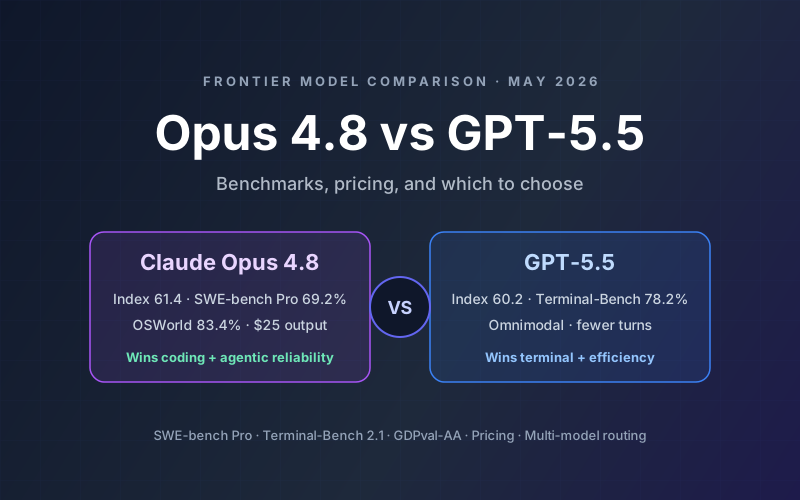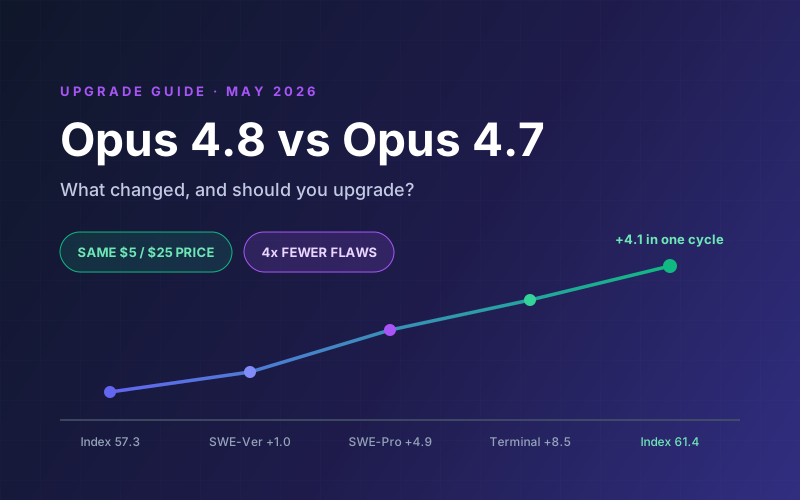

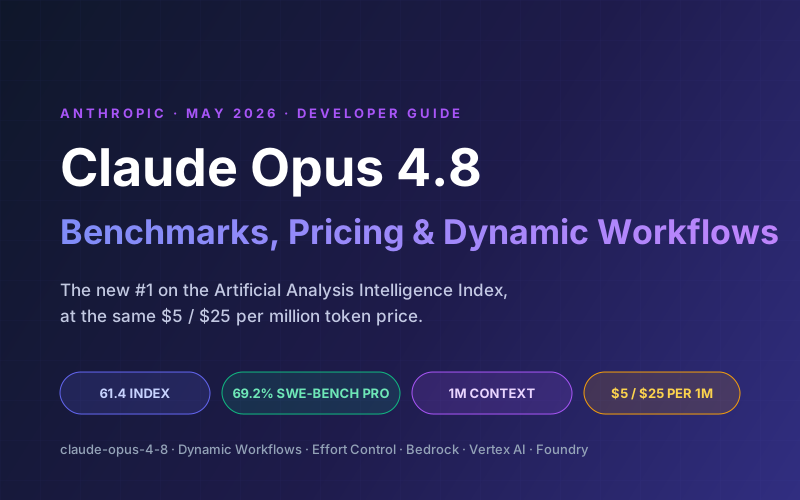
On May 28, 2026, Anthropic shipped Claude Opus 4.8 (API model ID claude-opus-4-8), and for the first time since OpenAI's April launch, a Claude model sits at the top of the Artificial Analysis Intelligence Index. Opus 4.8 scores 61.4, edging out GPT-5.5 at 60.2 and leaving Opus 4.7 (57.3) well behind. The price did not move: $5 input and $25 output per million tokens.
This is a point-release upgrade with the same 1M-token context window and the same rate card, but with measurable gains in coding, agentic reliability, long-context retrieval, mathematical reasoning, and something most release notes ignore: honesty. Opus 4.8 is the first Claude model to score 0% on uncritically reporting flawed results, and it is roughly four times less likely than 4.7 to let code defects pass unflagged.
This guide covers everything a delivery team needs: the full benchmark table, pricing math, the three same-day platform launches (Dynamic Workflows, effort control, and a Messages API enhancement), the honesty and alignment story, real caveats around cost and verbosity, and a clear migration path from Opus 4.7.
What This Guide Covers
1What Shipped and Why It Matters
Opus 4.8 is not a new model tier. It replaces Opus 4.7 as the default frontier Claude model available to the public. Anthropic positions it as a stronger collaborator: better at catching its own mistakes, more consistent across long-running projects, and meaningfully more honest about what it does and does not know.
The model arrived with three platform features on the same day, which is unusual for a point release and tells you where Anthropic thinks the value is:
Dynamic Workflows
Hundreds of parallel subagents orchestrated inside one Claude Code session, built for codebase-scale migrations.
Effort Control
Low, high, extra, and maximum effort levels across all claude.ai plans, so you trade speed for depth on demand.
Messages API Update
Inject system directives mid-conversation without breaking prompt cache, ideal for long agent runs.
The headline capabilities at a glance:
- Context window: 1 million tokens (roughly 1,500 A4 pages)
- Maximum output: 128K tokens
- Input modalities: text and image. Output is text only.
- Availability: Claude API, Amazon Bedrock, Google Cloud Vertex AI, and Microsoft Foundry
- Intelligence Index: 61.4, the highest of any generally available model as of late May 2026
2The Benchmark Table That Matters
Here is how Opus 4.8 compares to its predecessor and to the other frontier models on the evaluations developers actually care about. The green cells mark the leader in each row.
| Benchmark | Opus 4.8 | Opus 4.7 | GPT-5.5 |
|---|---|---|---|
| SWE-bench Verified | 88.6% | 87.6% | N/A |
| SWE-bench Pro | 69.2% | 64.3% | 58.6% |
| SWE-bench Multilingual | 84.4% | N/A | N/A |
| Terminal-Bench 2.1 | 74.6% | 66.1% | 78.2% |
| OSWorld-Verified | 83.4% | 82.8% | 78.7% |
| MCP-Atlas | 82.2% | 77.3% | N/A |
| GPQA Diamond | 93.6% | 94.2% | 93.6% |
| HLE (with tools) | 57.9% | 54.7% | 52.2% |
| USAMO 2026 | 96.7% | 69.3% | N/A |
| GDPval-AA (Elo) | 1,890 | 1,753 | 1,769 |
The standout is SWE-bench Pro at 69.2%. This is the harder variant that tests real-world pull request resolution across complex codebases, and Opus 4.8 leads every comparison model by a wide margin: 10.6 points over GPT-5.5 and roughly 15 points over Gemini 3.1 Pro. The 27-point jump on USAMO 2026 (69.3% to 96.7%) signals a real step up in rigorous mathematical reasoning.
The one benchmark where GPT-5.5 still wins is Terminal-Bench 2.1 (78.2% vs 74.6%), which measures multi-tool command-line workflows. The gap narrowed from 12.1 points on Opus 4.7 to 3.6 points on Opus 4.8, but it is still there. If your workload is shell-driven CI and infrastructure automation, that gap is worth noting.
Key Takeaway
Opus 4.8 leads on coding, agentic reliability, knowledge work, and math. GPT-5.5 keeps a narrow edge on terminal-driven autonomous coding. On the aggregate Artificial Analysis Intelligence Index, Opus 4.8 (61.4) edges GPT-5.5 (60.2) while costing $5 less per million output tokens.
3Pricing, Fast Mode & Token Economics
The per-token rate card is identical to Opus 4.7. The interesting change is fast mode, which is now three times cheaper than it was on previous Opus models while running at 2.5x the standard speed.
| Tier | Input / 1M | Output / 1M |
|---|---|---|
| Standard | $5.00 | $25.00 |
| Fast mode (2.5x speed) | $10.00 | $50.00 |
| Prompt cache hit | $0.50 | N/A |
Prompt caching at $0.50 per million input tokens is a 90% discount on repeated context. For agent workflows that re-reference the same documents, system prompts, or codebase context across many turns, this compounds quickly. A concrete example: an agent that reads a 200,000 token codebase context on every one of 50 turns would pay 50 x 200,000 x $5 / 1,000,000 = $50 at the standard input rate, but only 50 x 200,000 x $0.50 / 1,000,000 = $5 if that context is served from cache.
Fast mode at $10 input and $50 output per million is double the standard rate, but it was previously cost-prohibitive at the old fast-mode pricing. At 2.5x speed and one-third of the prior cost, it becomes a practical option for latency-sensitive production paths like interactive coding assistants or live chat agents.
4The Honesty & Alignment Story
This is arguably the most significant change in Opus 4.8, even though it does not have a single headline number. For anyone running unattended agents, a model that quietly fabricates a passing test report is more dangerous than one that scores a few points lower.
- 4x fewer unflagged code flaws than Opus 4.7. The model is far less likely to let a defect pass without calling it out.
- 17x fewer dishonest agentic code summaries compared to Claude Sonnet 4.6.
- First Claude model to score 0% on uncritically reporting flawed results.
- Overconfidence dropped more than 10x versus Opus 4.7. The model is more willing to say it is unsure.
Anthropic's alignment team reports that misaligned behavior rates, including deception and cooperation with misuse, are substantially lower than Opus 4.7 and now comparable to the restricted Claude Mythos Preview. Cognition's team noted that Opus 4.8 fixed the comment-verbosity and tool-calling issues they observed in 4.7 for autonomous engineering.
5Dynamic Workflows in Claude Code
Dynamic Workflows is the biggest platform launch alongside the model. It lets Claude orchestrate hundreds of parallel subagents within a single Claude Code session. The system plans the work, distributes it across subagents, verifies outputs, and reports results, all without manual orchestration.
The practical use case Anthropic highlights is codebase-scale migrations spanning hundreds of thousands of lines. Instead of working through files sequentially, Claude can spin up separate agents for independent changes, run them in parallel, and coordinate the results, using the existing test suite as its quality bar. Think of the difference between a single developer working through a backlog and a team lead distributing tickets.
Dynamic Workflows is a research preview available to Claude Code Enterprise, Team, and Max users, and is also accessible through the Claude API, Bedrock, Vertex AI, and Microsoft Foundry. We cover the end-to-end setup in our dedicated Dynamic Workflows guide.
6Effort Control & the Messages API
Effort control lets you choose how much computational effort Claude applies to a response. It is available across all plans in claude.ai and Cowork, and through the API.
| Level | Best For |
|---|---|
| Low | Simple questions, faster responses, lower rate-limit use |
| High (default) | Balanced quality and speed at roughly Opus 4.7 token budgets |
| Extra (xhigh) | Deeper thinking for difficult tasks and long-running async work |
| Maximum | Best performance at the highest token cost |
Anthropic recommends the default high setting for most work, noting it already outperforms Opus 4.7's default output at similar token budgets. Rate limits in Claude Code were expanded to accommodate the higher effort levels.
The Messages API enhancement is a quieter but important change for agent builders. You can now insert system entries directly inside the messages array during a conversation. That means you can update Claude's instructions (permissions, token budgets, environment context) mid-task without breaking prompt cache and without routing the update through a user turn.
// Inject a mid-conversation system directive (illustrative)
messages: [
  { role: "user", content: "Refactor the billing module." },
  { role: "assistant", content: "..." },
  { role: "system", content: "Budget reduced to 40k tokens. Prefer minimal diffs." },
  { role: "user", content: "Continue." }
]7Caveats: Cost, Verbosity & Turns
Opus 4.8 is the intelligence leader, but Artificial Analysis flags real tradeoffs that matter at scale. The model is among the most expensive when compared to similarly priced peers, and it is slower than average and very verbose. During the full Intelligence Index evaluation it produced roughly 110 million tokens versus a 35 million token average across models, and the total evaluation cost was $4,685.85.
On GDPval-AA, the good news is that Opus 4.8 uses 15% fewer turns and 35% fewer output tokens than Opus 4.7 while scoring higher. The caveat is that it still takes roughly 30% more turns than GPT-5.5 to complete tasks. For high-volume, cost-sensitive, or latency-critical workloads, a cheaper model like Gemini 3.5 Flash or a routing setup is often the better call. We break the economics down in our cost versus performance comparison.
8Migrating From Opus 4.7
Migration is a drop-in change. Swap the model ID and run your existing evals.
// Anthropic Messages API
- model: "claude-opus-4-7"
+ model: "claude-opus-4-8"
A short migration checklist before you flip production traffic:
- Re-run your regression and eval suite. Coding and math outputs should improve, but verify your prompt formats still parse correctly.
- Set an explicit effort level. If you relied on 4.7's default, the new high setting is the closest analog at similar token budgets.
- Confirm prompt caching is enabled on hot paths. The 90% cache discount offsets the model's verbosity.
- Add output-token budgets or max-token caps if your costs are sensitive to verbosity.
- Test on Bedrock, Vertex AI, or Foundry if you deploy through a cloud provider rather than the direct API.
Because pricing is unchanged and benchmarks improve across the board, there is no cost reason to stay on Opus 4.7. The main thing to validate is the verbosity profile against your token budget. For a deeper before-and-after, see our Opus 4.8 vs 4.7 upgrade guide.
9Why Lushbinary for AI Integration
Adopting a new frontier model is more than swapping a string. To get real value from Opus 4.8 you need eval harnesses that catch regressions, prompt-cache strategies that control cost, effort-level tuning per workload, and fallback chains for when the model is slow or rate-limited.
Lushbinary has shipped production integrations with every major frontier model, from Claude Opus 4.7 to GPT-5.5 to Gemini 3.5 Flash. We design multi-model routing, optimize token costs, implement safety guardrails, and deploy on AWS with monitoring and fallback chains.
🚀 Free Consultation
Planning to roll out Claude Opus 4.8 in production? Lushbinary will audit your workload, design the right effort and caching strategy, and give you a realistic cost estimate, no obligation.
❓ Frequently Asked Questions
What is the Claude Opus 4.8 API model ID and pricing?
The model ID is claude-opus-4-8. Standard pricing is $5 per million input tokens and $25 per million output tokens, unchanged from Opus 4.7. Fast mode (2.5x speed) is $10 input and $50 output per million, now 3x cheaper than the previous generation's fast mode. Prompt cache hits cost $0.50 per million input tokens.
How much better is Claude Opus 4.8 than Opus 4.7?
Opus 4.8 improves SWE-bench Pro from 64.3% to 69.2%, SWE-bench Verified from 87.6% to 88.6%, Terminal-Bench 2.1 from 66.1% to 74.6%, and GDPval-AA from 1,753 to 1,890 Elo. It tops the Artificial Analysis Intelligence Index at 61.4 versus 57.3 for Opus 4.7. Pricing is identical, so there is no cost reason to stay on 4.7.
What are Dynamic Workflows in Claude Code?
Dynamic Workflows is a research-preview feature that lets Claude Opus 4.8 orchestrate hundreds of parallel subagents inside a single Claude Code session. Claude plans the work, distributes it across subagents, verifies outputs, and reports results without manual orchestration. It is built for codebase-scale migrations spanning hundreds of thousands of lines.
What is effort control in Claude Opus 4.8?
Effort control lets you choose how much computation Claude applies: low for fast simple answers, high (the default) for balanced quality at roughly Opus 4.7 token budgets, extra for deeper thinking on hard tasks, and maximum for best performance at the highest cost. It is available across all claude.ai plans and via the API.
Where can I run Claude Opus 4.8?
Opus 4.8 is available through the Claude API, Amazon Bedrock, Google Cloud Vertex AI, and Microsoft Foundry. It has a 1 million token context window, 128K maximum output, and accepts text and image input with text output.
Sources
- Anthropic - Introducing Claude Opus 4.8
- Anthropic - Claude Models Documentation
- Artificial Analysis - Claude Opus 4.8 Analysis & Benchmarks
Content was rephrased for compliance with licensing restrictions. Benchmark and pricing data sourced from official Anthropic publications and Artificial Analysis as of May 28, 2026. Pricing and benchmarks may change, always verify on the vendor's website.
Ship Claude Opus 4.8 in Production
From eval harnesses to prompt caching to multi-model routing, Lushbinary designs, builds, and deploys frontier-model integrations on AWS that are fast, safe, and cost-controlled.
Ready to Build Something Great?
Get a free 30-minute strategy call. We'll map out your project, timeline, and tech stack - no strings attached.
Prefer email? Reach us directly: