

Email is the most universal interface on the internet. Every person, every business, every agent already has an address. As AI agents move from chat-only prototypes to production systems that actually do work, email is becoming their primary communication channel — for customer support, invoice processing, account verification, and multi-agent orchestration.
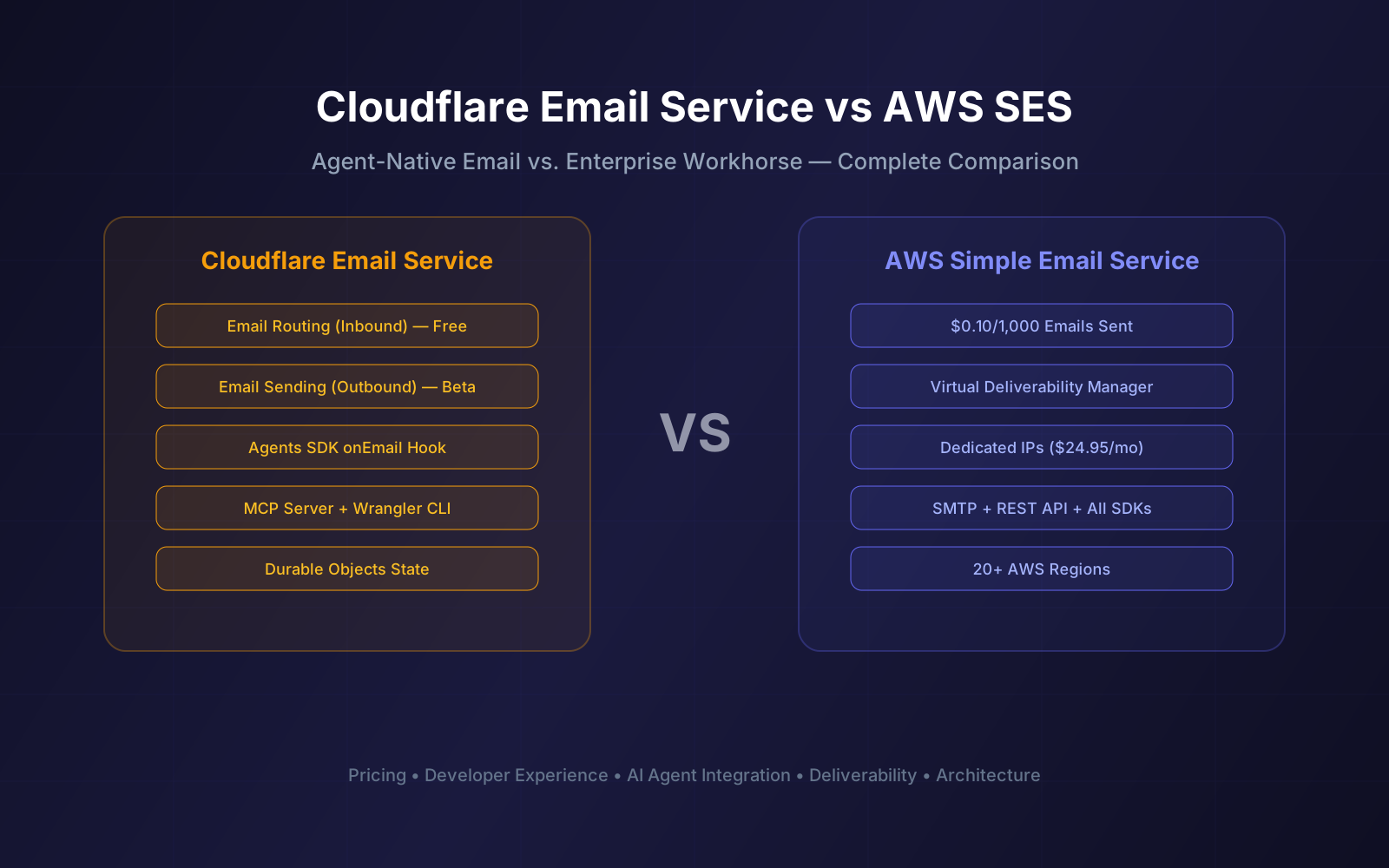
Two platforms now compete for this space: Cloudflare Email Service, which just entered public beta during Agents Week 2026 with native agent integration, and AWS Simple Email Service (SES), the industry workhorse that sends billions of emails at $0.10 per 1,000. They solve the same problem — programmatic email — but with fundamentally different architectures and philosophies.
This guide breaks down both services across pricing, developer experience, agent integration, deliverability, and architecture. Whether you're building an AI support agent that lives in the inbox or scaling transactional email for millions of users, you'll know exactly which platform fits your use case by the end.
📋 What This Guide Covers
- Cloudflare Email Service: What Just Launched
- AWS SES: The Established Workhorse
- Pricing Comparison: Cost at Every Scale
- Developer Experience & Integration
- AI Agent Email: The New Battleground
- Deliverability & Reputation Management
- Architecture Comparison: Edge vs. Region
- When to Use Which (Decision Framework)
- Building an Email Agent: Cloudflare vs. AWS
- Why Lushbinary for Your Email Infrastructure
1Cloudflare Email Service: What Just Launched
On April 16, 2026, during Agents Week, Cloudflare promoted its Email Service from private beta to public beta. The service combines two capabilities into a single platform: Email Routing (inbound, free since 2021) and the new Email Sending (outbound transactional email). Together, they give developers bidirectional email from a single Cloudflare account.
What makes this launch significant isn't just another email API. Cloudflare built Email Service specifically for the agent era. The Agents SDK now has a first-class onEmail hook, meaning an AI agent can receive an email, spend hours processing data, check external systems, and reply asynchronously — all within a single Agent class backed by Durable Objects for persistent state.
Key Features at Launch
- Email Sending binding — Send transactional emails directly from Workers with a native binding. No API keys or secrets management needed.
- REST API + SDKs — TypeScript, Python, and Go SDKs for sending from any platform, not just Workers.
- Automatic SPF/DKIM/DMARC — When you add your domain, Cloudflare configures all authentication records automatically.
- Agents SDK
onEmailhook — First-class email processing in the Agents SDK with address-based routing, state persistence, and HMAC-SHA256 signed reply routing. - Email MCP server — Agents running anywhere (Claude Code, Cursor, Copilot) can discover and call Email endpoints through the Cloudflare MCP server.
- Wrangler CLI commands —
wrangler email sendfor agents with bash access, solving the MCP context window overhead problem. - Agentic Inbox — An open-source reference app with full conversation threading, email rendering, attachment storage (R2), and a built-in MCP server for external agents to draft emails for human review.
💡 Agent Identity Model
Each agent gets its own identity from a single domain. The address-based resolver routes support@yourdomain.com to a "support" agent instance, sales@yourdomain.com to a "sales" instance. Sub-addressing like support+ticket-123@yourdomain.com routes to different agent namespaces. No separate inbox provisioning required.
2AWS SES: The Established Workhorse
Amazon Simple Email Service has been the default choice for programmatic email since 2011. It handles billions of emails daily for companies of every size, from startups sending password resets to enterprises running marketing campaigns at scale. At $0.10 per 1,000 emails, it remains the most cost-effective high-volume email sender on the market.
Core Capabilities
- Outbound sending — SMTP interface, REST API (v2), and AWS SDK support across every major language.
- Inbound receiving — Receipt rules that can route to S3, Lambda, SNS, or WorkMail.
- Virtual Deliverability Manager (VDM) — Automated deliverability optimization with engagement tracking, reputation dashboards, and advisor recommendations.
- Dedicated IPs — $24.95/month per IP for full reputation control, plus managed dedicated IPs with automatic warm-up.
- Configuration sets — Event publishing to CloudWatch, SNS, Kinesis Firehose, or EventBridge for granular tracking.
- Email templates — Server-side Handlebars templating with personalization variables.
- Suppression list management — Account-level and configuration-set-level suppression for bounces and complaints.
SES operates in 20+ AWS regions, giving teams geographic control over where email is processed — critical for data residency requirements. The sandbox mode starts with a 200 emails/day limit and 1 email/second rate, which you increase by requesting production access through AWS Support.
⚠️ SES Enforcement Thresholds
AWS SES enforces strict reputation thresholds: a bounce rate above 5% or complaint rate above 0.1% can trigger account review or suspension. The Virtual Deliverability Manager helps monitor these metrics, but the responsibility for list hygiene and engagement optimization falls entirely on you.
3Pricing Comparison: Cost at Every Scale
Pricing is where these two services diverge most sharply. AWS SES has transparent, well-documented per-email pricing. Cloudflare Email Service is still in public beta with pricing details being finalized, but the current model ties to the Workers Paid plan.
| Feature | Cloudflare Email Service | AWS SES |
|---|---|---|
| Inbound email | Free (Email Routing) | $0.10/1,000 emails (first 1,000 free) |
| Outbound email | Workers Paid plan ($5/mo) required; per-email pricing TBD (beta) | $0.10/1,000 emails |
| Free tier | Inbound: unlimited (up to 200 rules). Outbound: beta access on paid plan | 3,000 emails/mo free (first 12 months); 62,000/mo free from EC2 |
| Attachments | 25 MiB max message size | $0.12/GB attachment data; 40 MB max message size |
| Dedicated IPs | Not available (shared IP pool with automatic reputation management) | $24.95/mo per IP (standard); managed IPs with auto warm-up |
| High-volume discount | TBD | $0.02/1,000 at 50M-100M/mo |
Cost Examples
Startup (10K emails/mo)
Transactional only
Cloudflare: $5/mo (Workers Paid plan)
AWS SES: $1.00/mo (or free from EC2)
Growth (100K emails/mo)
Transactional + notifications
Cloudflare: $5/mo + per-email (TBD)
AWS SES: ~$10/mo
Scale (1M emails/mo)
Full email pipeline
Cloudflare: TBD (beta pricing)
AWS SES: ~$100/mo + $24.95/dedicated IP
For pure volume economics, AWS SES is hard to beat — $0.10 per 1,000 emails with volume discounts at scale. Cloudflare's value proposition isn't about being cheaper per email; it's about reducing total infrastructure complexity. When your email sending, receiving, processing, state management, and agent logic all live on one platform, the operational cost savings can outweigh the per-email price difference.
4Developer Experience & Integration
Developer experience is where Cloudflare pulls ahead for teams already on the Cloudflare platform. The Workers binding model eliminates credential management entirely — no API keys, no secrets rotation, no IAM policies.
Cloudflare: Send an Email from Workers
export default {
  async fetch(request, env, ctx) {
    await env.EMAIL.send({
      to: "user@example.com",
      from: "welcome@yourdomain.com",
      subject: "Your order has shipped",
      text: "Order #1234 is on its way."
    });
    return new Response("Email sent");
  },
};
AWS SES: Send an Email with SDK v3
import { SESv2Client, SendEmailCommand } from "@aws-sdk/client-sesv2";

const client = new SESv2Client({ region: "us-east-1" });

await client.send(new SendEmailCommand({
  FromEmailAddress: "welcome@yourdomain.com",
  Destination: { ToAddresses: ["user@example.com"] },
  Content: {
    Simple: {
      Subject: { Data: "Your order has shipped" },
      Body: { Text: { Data: "Order #1234 is on its way." } }
    }
  }
}));| Aspect | Cloudflare | AWS SES |
|---|---|---|
| Auth model | Workers binding (zero config) | IAM roles/policies + SDK credentials |
| DNS setup | Automatic SPF/DKIM/DMARC | Manual TXT/CNAME records (Easy DKIM available) |
| SDKs | TypeScript, Python, Go + REST API | All AWS SDK languages (JS, Python, Java, Go, .NET, Ruby, PHP, etc.) |
| SMTP support | No (API/binding only) | Yes (SMTP interface for legacy apps) |
| Templating | Build your own (Workers logic) | Built-in Handlebars templates |
| CLI tooling | wrangler email send | aws ses send-email |
AWS SES wins on breadth: SMTP support for legacy systems, Handlebars templating, and SDKs in every language. Cloudflare wins on simplicity: zero-config auth, automatic DNS, and a single platform for send + receive + process. If you're starting fresh with a modern stack, Cloudflare's DX is noticeably smoother. If you're integrating into an existing AWS ecosystem with IAM policies already in place, SES slots in with minimal friction.
5AI Agent Email: The New Battleground
This is where Cloudflare's announcement changes the game. The "Email for Agents" blog post makes the thesis explicit: email is becoming a core interface for AI agents, and developers need infrastructure purpose-built for it. Cloudflare built that infrastructure. AWS hasn't — yet.
Cloudflare: Agent-Native Email
The Agents SDK's onEmail hook turns email into a first-class agent channel. Here's the complete pipeline — receive, persist state, and reply — in a single class:
import { Agent, routeAgentEmail } from "agents";
import { createAddressBasedEmailResolver } from "agents/email";
import PostalMime from "postal-mime";

export class SupportAgent extends Agent {
  async onEmail(email) {
    const parsed = await PostalMime.parse(await email.getRaw());

    // Persist in agent state (Durable Objects)
    this.setState({
      ...this.state,
      ticket: {
        from: email.from,
        subject: parsed.subject,
        body: parsed.text,
        messageId: parsed.messageId,
      },
    });

    // Reply asynchronously
    await this.sendEmail({
      binding: this.env.EMAIL,
      from: "support@yourdomain.com",
      to: this.state.ticket.from,
      inReplyTo: this.state.ticket.messageId,
      subject: `Re: ${this.state.ticket.subject}`,
      text: "We received your message and will follow up shortly.",
    });
  }
}
Key architectural advantages of this model:
- Stateful by default — Durable Objects persist conversation history, contact info, and context across email sessions without a separate database.
- Async-first — Unlike a chatbot that must respond immediately, an email agent can spend hours processing before replying. This is the difference between answering questions and doing work.
- Secure reply routing — HMAC-SHA256 signed headers ensure replies route back to the exact agent instance that sent the original message, preventing header forgery attacks.
- Address-based identity —
support@,sales@,billing@each route to different agent instances from a single domain.
AWS SES: Build-Your-Own Agent Pipeline
AWS SES can absolutely power agent email workflows, but you assemble the pipeline yourself. A typical architecture looks like:
That's 5+ AWS services (SES, S3, Lambda, DynamoDB, SNS) to replicate what Cloudflare does in a single Agent class. Each service needs IAM permissions, error handling, retry logic, and monitoring. It works — teams have been building this for years — but the operational surface area is significantly larger.
| Agent Capability | Cloudflare | AWS SES |
|---|---|---|
| Receive + process + reply | Single Agent class | SES + S3 + Lambda + DynamoDB |
| State persistence | Built-in (Durable Objects) | DIY (DynamoDB, RDS, etc.) |
| Async reply | Native (agent replies on its own timeline) | Possible (Step Functions or SQS + Lambda) |
| Secure reply routing | HMAC-SHA256 signed headers | DIY (custom header signing) |
| MCP server access | Native (Cloudflare MCP server) | Not available |
| CLI for agents | wrangler email send | aws ses send-email |
6Deliverability & Reputation Management
Sending email is easy. Getting it into the inbox is hard. Both platforms approach deliverability differently, and the right choice depends on how much control you want versus how much you want managed for you.
AWS SES: Maximum Control
- Virtual Deliverability Manager (VDM) — Automated engagement tracking, deliverability insights, and optimization recommendations. Monitors open/click rates, bounce/complaint stats, and provides an advisor that flags issues at the account and identity level.
- Dedicated IPs — Full control over your sending reputation. Standard dedicated IPs at $24.95/month or managed dedicated IPs with automatic warm-up.
- Suppression lists — Account-level and configuration-set-level suppression for bounces and complaints, preventing repeated sends to bad addresses.
- Configuration sets — Granular event tracking (sends, deliveries, opens, clicks, bounces, complaints) published to CloudWatch, SNS, or EventBridge.
- Reputation dashboard — Real-time visibility into bounce rate, complaint rate, and overall account health.
Cloudflare: Managed Simplicity
- Automatic IP reputation management — Cloudflare manages the shared IP pool and optimizes deliverability across all senders on the platform.
- Auto-configured authentication — SPF, DKIM, and DMARC records are set up automatically when you add your domain. No manual DNS record management.
- Global delivery — Emails are delivered from Cloudflare's global network with low latency worldwide.
- No dedicated IPs (yet) — You share the IP pool. For most transactional email, this is fine. For high-volume senders who need full reputation isolation, this is a limitation.
📊 The Deliverability Trade-off
AWS SES gives you more levers to pull — dedicated IPs, VDM insights, suppression management — but also more responsibility. A 0.1% complaint rate can pause your account. Cloudflare abstracts this away with managed reputation, which is simpler but gives you less visibility and control. For agent email (typically low-volume, high-intent transactional messages), Cloudflare's managed approach is usually sufficient. For marketing email at scale, SES's tooling is essential.
7Architecture Comparison: Edge vs. Region
The fundamental architectural difference: Cloudflare runs email at the edge on its global network (330+ cities). AWS SES runs in specific AWS regions (20+). This affects latency, data residency, and how you design your email pipeline.
Cloudflare Advantages
- Global edge delivery — lowest latency
- Single platform for all email operations
- Durable Objects for stateful agents
- No region selection needed
- Native MCP server for external agents
AWS SES Advantages
- Data residency control (choose region)
- Deep AWS ecosystem integration
- Mature at massive scale (billions/day)
- SMTP for legacy system compatibility
- Dedicated IPs for reputation isolation
8When to Use Which (Decision Framework)
Neither service is universally better. The right choice depends on your use case, existing infrastructure, and where you're headed architecturally.
Choose Cloudflare Email Service When:
- You're building AI agents that communicate via email — the Agents SDK + Durable Objects + Email binding is purpose-built for this.
- You're already on the Cloudflare developer platform (Workers, R2, D1, Queues) and want email without adding another vendor.
- You want zero-config email authentication — automatic SPF/DKIM/DMARC setup saves hours of DNS debugging.
- You need bidirectional email (send + receive + process) in a single platform with no service orchestration.
- You're building a modern, API-first application and don't need SMTP compatibility.
- You want to give external coding agents (Claude Code, Cursor) email capabilities via MCP or Wrangler CLI.
Choose AWS SES When:
- You're sending high-volume email (millions/month) and need proven, predictable per-email pricing with volume discounts.
- You need dedicated IPs for full reputation control, especially for marketing email or high-stakes transactional flows.
- You have data residency requirements that mandate email processing in specific geographic regions.
- You're in an existing AWS ecosystem with IAM, CloudWatch, and EventBridge already configured.
- You need SMTP support for legacy applications that can't use REST APIs.
- You need Virtual Deliverability Manager for advanced engagement tracking and deliverability optimization.
- You need email templates with server-side Handlebars rendering for marketing campaigns.
Consider Using Both When:
Some teams are adopting a hybrid approach: Cloudflare for agent-facing email (support agents, processing pipelines, MCP-driven workflows) and AWS SES for high-volume transactional and marketing email. The two services aren't mutually exclusive — you can route different domains or subdomains to different providers. Use agents@yourdomain.com on Cloudflare and notifications@yourdomain.com on SES.
9Building an Email Agent: Cloudflare vs. AWS
Let's walk through what it takes to build a customer support email agent on each platform. The agent receives support emails, classifies them, persists ticket state, and replies with an acknowledgment.
Cloudflare: ~50 Lines of Code
Email Routing
Configure domain → route to Email Worker
Agent Class
onEmail hook receives, parses, persists state, replies
State
Durable Objects - built into the Agent class
Deploy
wrangler deploy - single command
AWS: ~200+ Lines + 5 Services
SES Receiving Rules
Configure receipt rule set → store to S3 + trigger SNS
S3 Bucket
Store raw email with lifecycle policies
Lambda Function
Parse email, classify, generate reply, call SES to send
DynamoDB Table
Persist ticket state, conversation history
IAM Policies
SES send, S3 read, DynamoDB read/write, SNS subscribe
Deploy
CloudFormation/CDK/SAM - multi-resource stack
The AWS approach gives you more flexibility — you can swap DynamoDB for Aurora, add Step Functions for complex workflows, or integrate with Bedrock for AI classification. But the initial setup cost is 4-5x higher in terms of code, configuration, and services to manage.
🔑 The MCP Advantage
Cloudflare's Email MCP server means any agent — not just ones running on Cloudflare — can send email with a simple prompt like "Send me a notification email when the build completes." This is a unique capability that AWS SES doesn't offer. For teams building multi-agent systems where different agents run on different platforms, this is a significant integration advantage.
10Why Lushbinary for Your Email Infrastructure
At Lushbinary, we've built email infrastructure on both platforms — high-volume transactional pipelines on AWS SES and agent-native email systems on Cloudflare Workers. We understand the trade-offs at every scale, from startup MVPs sending their first password reset to enterprise systems processing millions of agent-driven emails monthly.
Our team can help you:
- Design your email architecture — Choose the right platform (or hybrid approach) based on your volume, compliance, and agent requirements.
- Build AI email agents — Production-ready agents on Cloudflare's Agents SDK with stateful email processing, secure reply routing, and MCP integration.
- Optimize AWS SES deliverability — VDM configuration, dedicated IP warm-up, suppression management, and reputation monitoring.
- Migrate between platforms — Move from SES to Cloudflare (or vice versa) with zero downtime and DNS cutover planning.
- Integrate with your stack — Connect email to your existing AWS infrastructure, MCP servers, or agent frameworks.
🚀 Free Consultation
Need help choosing between Cloudflare Email Service and AWS SES? Or building an AI agent that communicates via email? Lushbinary specializes in cloud email infrastructure and AI agent development. We'll assess your requirements, recommend the right architecture, and give you a realistic timeline — no obligation.
❓ Frequently Asked Questions
Is Cloudflare Email Service free?
Cloudflare Email Routing (inbound) is free for all plans with up to 200 rules and 200 addresses per account. Email Sending (outbound) requires a Workers Paid plan starting at $5/month and is currently in public beta with pricing details still being finalized.
How much does AWS SES cost per email?
AWS SES charges $0.10 per 1,000 emails sent, plus $0.12 per GB of attachments. There is a free tier of 3,000 messages per month for the first 12 months. Dedicated IPs cost $24.95/month each. At high volumes (50M-100M/month), rates drop to $0.02 per 1,000 emails.
Can Cloudflare Email Service replace AWS SES?
For agent-driven and transactional email workflows, yes. Cloudflare provides bidirectional email with native Workers integration and Agents SDK hooks. However, AWS SES is more mature for high-volume marketing email, offers dedicated IPs, Virtual Deliverability Manager, and operates in 20+ AWS regions.
What is Cloudflare's Agents SDK onEmail hook?
The onEmail hook is a first-class method in Cloudflare's Agents SDK that lets an Agent class receive, parse, and respond to inbound emails. Combined with Email Sending, agents can orchestrate async work, persist state via Durable Objects, and reply on their own timeline.
Does AWS SES support AI agent email workflows?
AWS SES can send emails from Lambda, ECS, or any compute service, but it has no native agent SDK. You need to build the receive-parse-classify-reply pipeline yourself using SES receiving rules, S3, Lambda, and a state store like DynamoDB.
📚 Sources
- Cloudflare Blog: Email for Agents (April 2026)
- Cloudflare Email Service Documentation
- Cloudflare Email Routing Limits
- AWS Simple Email Service (SES)
- AWS SES Virtual Deliverability Manager
Content was rephrased for compliance with licensing restrictions. Pricing and feature data sourced from official Cloudflare and AWS documentation as of April 2026. Pricing and features may change — always verify on the vendor's website.
Build Email-Native AI Agents With Lushbinary
Whether you need Cloudflare's agent-first email platform or AWS SES at scale, we'll design and build the right email infrastructure for your product.
Ready to Build Something Great?
Get a free 30-minute strategy call. We'll map out your project, timeline, and tech stack - no strings attached.
Prefer email? Reach us directly: