
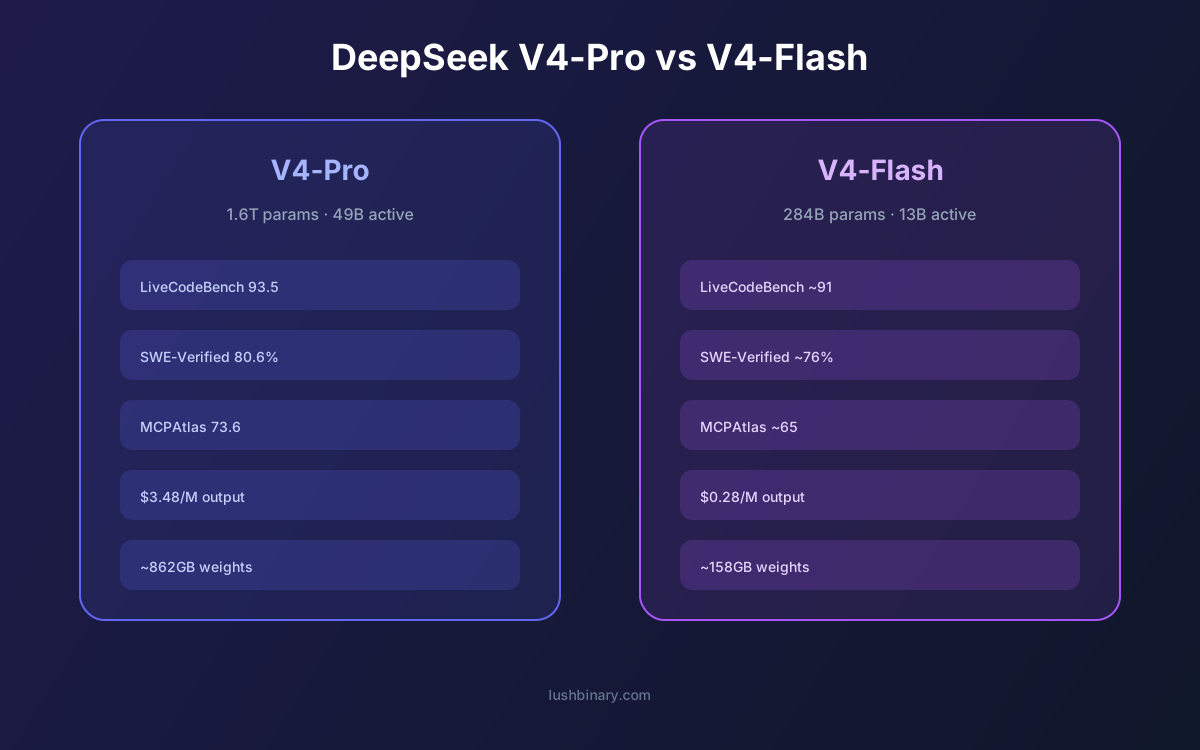
On April 23, 2026, DeepSeek dropped two V4 variants simultaneously: V4-Pro at 1.6 trillion total parameters (49B active) and V4-Flash at 284B total (13B active). Both share a 1M-token context window, MIT license, and open weights, but they target very different workloads and budgets.
This is the same product-line play OpenAI runs with GPT-5.5 / Mini, Anthropic runs with Opus / Sonnet / Haiku, and Google runs with Gemini Pro / Flash. The question every developer faces: when does the cheaper model do the job, and when do you need the big one?
We break down the architecture differences, benchmark results, pricing math, reasoning modes, and real-world use cases so you can make the right call for your stack.
What This Guide Covers
- Architecture: V4-Pro vs V4-Flash at a Glance
- Benchmark Head-to-Head
- Pricing Breakdown & Cache Economics
- Three Reasoning Modes: Non-think, Think High, Think Max
- Coding & Competitive Programming
- Agentic Capabilities & Tool Use
- Long-Context Performance at 1M Tokens
- Self-Hosting: Hardware Requirements
- Decision Framework: Which Model to Choose
- Why Lushbinary for DeepSeek V4 Integration
1Architecture: V4-Pro vs V4-Flash at a Glance
Both models use a Mixture-of-Experts (MoE) architecture with the same core innovations, Compressed Sparse Attention (CSA), Heavily Compressed Attention (HCA), manifold-constrained hyper-connections (mHC), and the Muon optimizer, but at very different scales.
| Spec | V4-Pro | V4-Flash |
|---|---|---|
| Total Parameters | 1.6T | 284B |
| Active Parameters | 49B | 13B |
| Pre-training Tokens | 32T+ | 32T+ |
| Context Window | 1M tokens | 1M tokens |
| License | MIT | MIT |
| Modality | Text-only (preview) | Text-only (preview) |
| Weight Size (FP4+FP8) | ~862GB | ~158GB |
| Inference FLOPs vs V3.2 | 27% at 1M ctx | ~10% at 1M ctx |
The key architectural difference is expert pool depth. V4-Pro routes through a much larger pool of specialized expert sub-networks, giving it stronger performance on tasks that require deep domain knowledge, complex reasoning chains, and long-horizon planning. V4-Flash uses fewer experts but benefits from the same attention innovations, making 1M-context inference practical even at its smaller scale.
2Benchmark Head-to-Head
DeepSeek published benchmark results for both variants. V4-Pro-Max (maximum reasoning effort) is the flagship configuration. Here's how they compare on key evaluations:
| Benchmark | V4-Pro Max | V4-Flash Max |
|---|---|---|
| MMLU-Pro | 87.5 | 86.2 |
| LiveCodeBench Pass@1 | 93.5 | 91.6 |
| Codeforces Rating | 3206 | 3052 |
| SWE-Verified | 80.6% | 79.0% |
| SWE-Pro | 55.4% | 52.6% |
| Terminal-Bench 2.0 | 67.9% | 56.9% |
| MCPAtlas Public | 73.6 | 69.0 |
| GPQA Diamond | 90.1 | 88.1 |
| IMOAnswerBench | 89.8 | 88.4 |
| SimpleQA-Verified | 57.9 | 34.1 |
Key Takeaway
V4-Flash-Max is within 1-3 points of V4-Pro-Max on most knowledge, reasoning, and coding benchmarks. The real gaps open up on long-horizon agentic coding (Terminal-Bench: 11-point gap) and factual recall (SimpleQA-Verified: 23.8-point gap). DeepSeek's own wording: V4-Flash “achieves comparable reasoning performance to the Pro version when given a larger thinking budget, though its smaller parameter scale naturally places it slightly behind on pure knowledge tasks and the most complex agentic workflows.”
3Pricing Breakdown & Cache Economics
DeepSeek's pricing strategy is aggressive. Both models include automatic context caching with no code changes required, and a 50% off-peak discount applies during Beijing nighttime hours (roughly 11pm–7am Beijing time).
| Pricing (per 1M tokens) | V4-Pro | V4-Flash |
|---|---|---|
| Input (cache hit) | $0.145 | $0.028 |
| Input (cache miss) | $1.74 | $0.14 |
| Output | $3.48 | $0.28 |
| Off-peak discount | 50% | 50% |
For context, Claude Opus 4.7 charges $15/M input and $25/M output. GPT-5.5 charges $5/M input and $30/M output. V4-Pro is 7–9x cheaper on output than Western closed-source competitors. V4-Flash is 90–107x cheaper.
With cache hit rates typically around 65–70% for conversational workloads, V4-Flash's effective input cost drops to roughly $0.06/M tokens, making it viable for high-volume production use cases where cost is the primary constraint.
4Three Reasoning Modes: Non-think, Think High, Think Max
Both V4-Pro and V4-Flash support three reasoning effort levels via the reasoning_effort parameter:
Non-think
Fast, intuitive responses for routine tasks. No extended reasoning chain. Best for simple Q&A, formatting, and low-risk decisions.
Think High
Conscious logical analysis with moderate reasoning depth. Good for complex problem-solving and planning tasks.
Think Max
Maximum reasoning effort with deep chain-of-thought. Best for competitive programming, math proofs, and multi-step agentic workflows.
An important detail: when DeepSeek detects a Claude Code or OpenCode request, thinking effort auto-upgrades to max. The reasoning_effort API parameter accepts high and max. Values like low, medium, and xhigh are silently mapped to the nearest supported level.
5Coding & Competitive Programming
Coding is where V4-Pro pulls furthest ahead of V4-Flash. V4-Pro-Max achieves a LiveCodeBench Pass@1 of 93.5, the highest score among models benchmarked in the DeepSeek release, ahead of Gemini 3.1 Pro (91.7) and Claude Opus 4.6 Max (88.8). Its Codeforces rating of 3206 also leads GPT-5.4 xHigh (3168) and Gemini 3.1 Pro (3052). On real-world software engineering, Claude Opus 4.7 (released April 16, 2026) is stronger, leading SWE-bench Pro at 64.3% vs V4-Pro's 55.4%.
V4-Flash is no slouch, it handles standard coding tasks, code review, and refactoring well. But for competitive programming, complex multi-file repository work, and long-horizon agentic coding, V4-Pro is measurably better. DeepSeek's own engineers use V4-Pro for internal agentic coding work, describing it as “better than Sonnet 4.5, close to Opus 4.6 non-thinking, but still a gap to Opus 4.6 thinking.”
For teams running coding agents, the practical recommendation: use V4-Flash for code completion, simple bug fixes, and code review. Route to V4-Pro for multi-step refactoring, architecture decisions, and any task where the agent needs to plan across multiple files.
6Agentic Capabilities & Tool Use
Both models support tool calling, JSON mode, and chat-prefix completion (beta). V4-Pro ships with pre-tuned adapters for Claude Code, OpenClaw, OpenCode, and CodeBuddy, meaning you can drop it into an existing Claude Code setup by swapping the base URL.
On agentic benchmarks, V4-Pro-Max scores 73.6 on MCPAtlas Public (essentially tied with Claude Opus 4.6 at 73.8), 67.9 on Terminal-Bench 2.0, and 80.6 on SWE-Verified. V4-Flash trails by 8–10 points on these agentic evaluations, the gap is larger here than on pure coding or reasoning tasks.
DeepSeek positions V4-Flash as “on par with V4-Pro on simple agent tasks” but acknowledges that “long-horizon agentic tool use and deep factual recall are the parts of Pro you don't get on Flash.” If your agents run multi-step workflows with 10+ tool calls, V4-Pro is the safer choice.
7Long-Context Performance at 1M Tokens
Both models default to a 1M-token context window with no surcharge, a significant differentiator from Western labs that either cap context or charge a premium. The hybrid CSA+HCA attention reduces V4-Pro's KV cache to 10% of V3.2's footprint at 1M context and V4-Flash's to about 7%, which is what makes this economically viable.
V4-Pro scores 83.5 on MRCR 1M (multi-round context retrieval) and 62.0 on CorpusQA 1M. V4-Flash scores are lower but still functional for document analysis and codebase-wide search. The base model benchmarks show V4-Pro at 51.5 on LongBench-V2 vs V4-Flash at 44.7, a meaningful gap for tasks requiring precise retrieval from very long contexts.
For most document processing and RAG workloads, V4-Flash's long-context performance is sufficient. Reserve V4-Pro for tasks where you need high-fidelity retrieval from 500K+ token contexts, such as full codebase analysis or legal document review.
8Self-Hosting: Hardware Requirements
Both models ship under MIT license with open weights on Hugging Face and ModelScope. The hardware requirements differ dramatically:
- V4-Flash (~158GB in FP4+FP8 mixed precision, ~170-175GB total with 1M KV cache and overhead): Fits on 2x H200 (282GB), 2x RTX Pro 6000 Blackwell (192GB), or 4x A100 80GB (320GB). This is the self-hosting sweet spot, frontier-adjacent quality on hardware a well-funded startup can afford.
- V4-Pro (~862GB in FP4+FP8 mixed precision): 8x H100 80GB (640GB) is not enough for weights alone. Minimum single-node config is 8x H200 141GB (1,128GB); two p5.48xlarge nodes (16x H100 = 1,280GB) is the multi-node alternative. This is enterprise-grade infrastructure.
For most self-hosting scenarios, V4-Flash is the practical choice. You get 85–95% of V4-Pro's quality at a fraction of the infrastructure cost. V4-Pro self-hosting makes sense for organizations with existing GPU clusters that need the absolute best open-weight performance and can't send data to external APIs.
9Decision Framework: Which Model to Choose
Here's a practical decision guide based on workload type:
| Use Case | Recommendation |
|---|---|
| Chat, Q&A, summarization | V4-Flash |
| Code completion, simple bug fixes | V4-Flash |
| Document analysis (<500K tokens) | V4-Flash |
| Multi-file refactoring | V4-Pro |
| Competitive programming | V4-Pro (Think Max) |
| Multi-step agentic workflows | V4-Pro |
| Math proofs, research | V4-Pro (Think Max) |
| High-volume production API | V4-Flash |
| Self-hosting (single node) | V4-Flash |
| Chinese language tasks | V4-Pro (C-Eval 93.1) |
The optimal strategy for most teams: route 70–80% of traffic to V4-Flash and escalate to V4-Pro for complex tasks. This gives you frontier-adjacent quality at V4-Flash prices for the majority of requests, with V4-Pro handling the long tail of difficult problems.
10Why Lushbinary for DeepSeek V4 Integration
Lushbinary helps teams integrate DeepSeek V4 into production workflows, from API integration and model routing to self-hosted deployment on AWS. We've built multi-model architectures that route between DeepSeek, Claude, and GPT based on task complexity, and we can help you do the same.
Whether you need a V4-Flash integration for high-volume chat, a V4-Pro deployment for agentic coding, or a hybrid routing layer that picks the right model per request, we've got the experience to ship it.
🚀 Free Consultation
Want to integrate DeepSeek V4 into your product? Lushbinary specializes in multi-model AI architectures and self-hosted LLM deployment. We'll help you choose between V4-Pro and V4-Flash, design your routing layer, and get to production fast, no obligation.
❓ Frequently Asked Questions
What is the difference between DeepSeek V4-Pro and V4-Flash?
V4-Pro has 1.6T total parameters with 49B active per token, while V4-Flash has 284B total with 13B active. V4-Pro leads on complex reasoning, agentic coding, and knowledge tasks. V4-Flash is faster, cheaper ($0.28 vs $3.48/M output tokens), and approaches V4-Pro quality on most general tasks.
How much does DeepSeek V4-Pro cost per million tokens?
V4-Pro costs $0.145/M input (cache hit), $1.74/M input (cache miss), and $3.48/M output. V4-Flash costs $0.028/M input (cache hit), $0.14/M input (cache miss), and $0.28/M output. Both get 50% off during Beijing off-peak hours.
Is DeepSeek V4-Flash good enough for coding tasks?
V4-Flash-Max stays within 1-3 points of V4-Pro-Max on LiveCodeBench (91.6 vs 93.5), SWE-Verified (79.0 vs 80.6), and MMLU-Pro (86.2 vs 87.5). For long-horizon agentic CLI work (Terminal-Bench gap of ~11 points) and competitive programming, V4-Pro is measurably better.
Can I self-host DeepSeek V4-Flash on a single GPU?
Not one. V4-Flash needs ~170-175GB total VRAM at 1M context, so 2x H200 (282GB), 2x RTX Pro 6000 Blackwell (192GB), or 4x A100 80GB all work. V4-Pro at 862GB needs an 8x H200 node (1,128GB) or two p5.48xlarge nodes (16x H100 = 1,280GB).
Does DeepSeek V4 support function calling and tool use?
Yes. Both models support tool calling, JSON mode, and chat-prefix completion. V4-Pro supports up to 128 parallel function calls and ships with pre-tuned adapters for Claude Code, OpenCode, OpenClaw, and CodeBuddy.
Sources
- DeepSeek V4-Pro Model Card on Hugging Face
- DeepSeek V4-Flash Model Card on Hugging Face
- DeepSeek API Pricing
Content was rephrased for compliance with licensing restrictions. Benchmark data sourced from official DeepSeek model cards and technical report as of April 24, 2026. Pricing may change, always verify on the vendor's website.
Need Help Choosing Between V4-Pro and V4-Flash?
Lushbinary builds multi-model AI architectures. Let us help you design the right routing strategy for your workload.
Ready to Build Something Great?
Get a free 30-minute strategy call. We'll map out your project, timeline, and tech stack - no strings attached.
Prefer email? Reach us directly: