
Updated June 16, 2026. GLM 5.2 (June 13) shipped with no official benchmarks, so this comparison is grounded in verifiable facts - licensing, pricing, context windows, and the GLM 5.1 track record - and is explicit about what cannot be ranked yet. Claude Opus 4.8 figures (May 28) and pricing are from Anthropic; verify all numbers on vendor pages before committing budget.
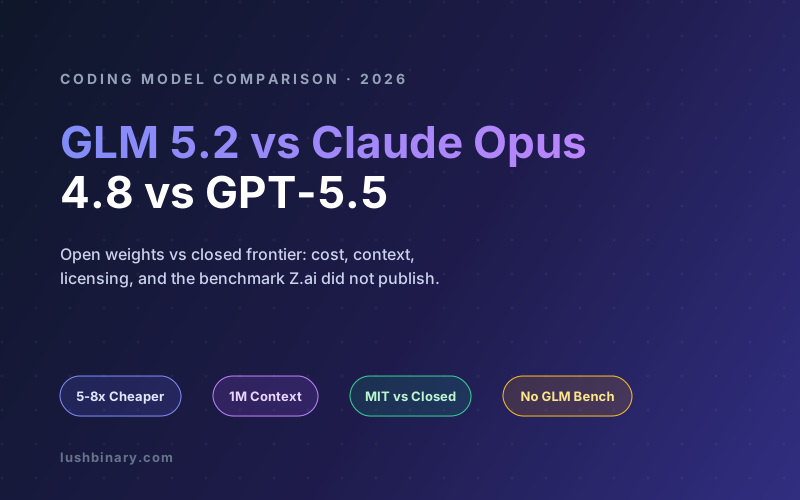
Three models dominate the coding conversation in mid-2026: GLM 5.2 from Z.ai, Claude Opus 4.8 from Anthropic, and GPT-5.5 from OpenAI. They represent two philosophies. Claude and GPT are closed, API-only, and priced at a premium for the deepest reasoning. GLM 5.2 is open-weight, MIT-licensed, and aggressively cheap, with a 1M context window that matches the longest closed models.
The wrinkle is that GLM 5.2 launched with zero benchmark numbers. That makes a clean leaderboard comparison impossible today, so this guide does something more useful: it compares the things you can actually verify - cost, licensing, context, output limits, and agentic fit - and shows you how to decide without pretending a missing score exists.
If you want the full feature breakdown of GLM 5.2 itself, start with our GLM 5.2 developer guide.
📋 Table of Contents
- 1.The Three Contenders at a Glance
- 2.Pricing: Where GLM 5.2 Wins by a Mile
- 3.Context Window and Output Limits
- 4.Benchmarks and the Missing Numbers
- 5.Licensing and Deployment Freedom
- 6.Agentic Coding and Tool Use
- 7.Decision Framework: Which to Pick
- 8.Frequently Asked Questions
- 9.How Lushbinary Helps You Choose
1The Three Contenders at a Glance
| Attribute | GLM 5.2 | Claude Opus 4.8 | GPT-5.5 |
|---|---|---|---|
| Vendor | Z.ai (Zhipu) | Anthropic | OpenAI |
| Released | June 13, 2026 | May 28, 2026 | Q2 2026 |
| License | Open (MIT) | Closed, API-only | Closed, API-only |
| Context window | 1M tokens | 1M tokens | Large (smaller than 1M) |
| Max output | 131,072 tokens | High | High |
| Launch benchmarks | None published | 88.6% SWE-Bench Verified | Vendor-reported |
| Self-hostable | Yes | No | No |
The shape of the trade-off is already visible: GLM 5.2 matches the closed models on context and beats them on openness and cost, while the closed models bring published, independently verifiable benchmark numbers that GLM 5.2 has not yet provided.
2Pricing: Where GLM 5.2 Wins by a Mile
Cost is the clearest, most verifiable advantage. The GLM line has consistently priced well below the closed frontier. GLM 5 ran around $1 per million input tokens and $3.20 per million output tokens depending on provider. Claude Opus 4.8 is $5 per million input and $25 per million output. That is a 5x to 8x gap on output tokens alone.
| Model | Input / 1M | Output / 1M |
|---|---|---|
| GLM 5 (baseline, varies by provider) | ~$1.00 | ~$3.20 |
| GLM 5.2 (API, expected near launch) | TBD | TBD |
| Claude Opus 4.8 | $5.00 | $25.00 |
Note on GLM 5.2 API pricing
Standalone GLM 5.2 API pricing was not published at launch; Z.ai said API access would follow within about a week. The GLM 5 baseline above is the best available proxy. The cheapest day-one path is the GLM Coding Plan subscription - see our pricing guide.
3Context Window and Output Limits
GLM 5.2 and Claude Opus 4.8 both offer a 1-million-token context window. Z.ai stresses that GLM 5.2's window is usable, holding performance on long-range tasks rather than degrading past a few hundred thousand tokens. GPT-5.5 offers a large window as well, though generally smaller than 1M.
For output, GLM 5.2 caps at 131,072 tokens per response, enough to regenerate or refactor very large files in one pass. For repository-scale agents that need to hold a full codebase plus a long task transcript in context, GLM 5.2 reaches parity with the best closed models while costing far less per token.
4Benchmarks and the Missing Numbers
This is where honesty matters. Z.ai published no benchmarks for GLM 5.2. We can anchor expectations on history: GLM 5.1 (March 27) reached roughly 94.6% of Claude Opus 4.6 on coding evaluations, a 28% improvement over the GLM 5 baseline. GLM 5.2 is the next step up, so competitive coding quality is a reasonable prior - but a prior is not a measurement.
Claude Opus 4.8, by contrast, posted 88.6% on SWE-Bench Verified and remains the reference point for deep reasoning across large, complex codebases. GPT-5.5 powers OpenAI Codex and leads on several terminal-and-agent benchmarks.
Practical takeaway: Do not let a missing benchmark become an assumed win or an assumed loss. Run GLM 5.2 against Claude Opus 4.8 and GPT-5.5 on your own representative tasks with an eval harness. The cost gap is large enough that even rough parity makes GLM 5.2 the rational default for most volume.
5Licensing and Deployment Freedom
GLM 5.2 ships open weights under MIT. That single fact unlocks self-hosting, fine-tuning, quantization, and air-gapped deployment in regulated environments. Your prompts and code never have to leave your infrastructure, and there is no per-token meter once you run the weights yourself.
Claude Opus 4.8 and GPT-5.5 are closed and API-only. They offer enterprise data-handling agreements, but the model never runs inside your boundary. For teams under strict data-residency rules, that is frequently a hard blocker, and it is the single biggest reason to evaluate GLM 5.2. We dig into this in the enterprise guide.
6Agentic Coding and Tool Use
All three models are strong at tool calling and multi-step agent workflows. GLM 5.2's dual thinking-effort system is a useful lever here: route the high-volume tool loop to the fast, cheap level and escalate to higher effort only for planning and verification. The 1M window lets the agent remember decisions made hundreds of steps earlier in a long task.
Claude Opus 4.8 brings Dynamic Workflows that split jobs across parallel subagents, and GPT-5.5 anchors OpenAI Codex's autonomous cloud agent. For most teams the differentiator is not raw capability but cost per completed task, and that math favors GLM 5.2.
7Decision Framework: Which to Pick
Pick GLM 5.2
You want the lowest cost per task, open weights for self-hosting or fine-tuning, strict data residency, or a 1M context window at a fraction of frontier pricing.
Pick Claude Opus 4.8
Your bottleneck is deep reasoning on large, high-stakes codebases, and you need published, independently verified benchmark performance today.
Pick GPT-5.5
You are standardized on OpenAI Codex and the ChatGPT ecosystem, or you want its autonomous cloud-agent workflow and desktop apps.
The pragmatic architecture for many teams is a routing layer: GLM 5.2 as the cost-efficient default for the bulk of agentic coding, with a premium closed model reserved for the small share of changes where a mistake is expensive.
8Frequently Asked Questions
Is GLM 5.2 better than Claude Opus 4.8 for coding?
It depends on the workload. GLM 5.2 launched on June 13, 2026 with no published benchmarks, so a direct score comparison is not possible yet. Its prior version, GLM 5.1, reached roughly 94.6% of Claude Opus 4.6 on coding evaluations. Claude Opus 4.8 still leads on deep reasoning across very large codebases (88.6% SWE-Bench Verified), while GLM 5.2 wins decisively on cost and open-weight flexibility.
How much cheaper is GLM 5.2 than Claude Opus 4.8 and GPT-5.5?
GLM models have historically priced well below the closed frontier. GLM 5 ran around $1 per million input and $3.20 per million output tokens depending on provider, versus Claude Opus 4.8 at $5 input and $25 output per million. That makes the GLM line roughly 5x to 8x cheaper on output tokens, and self-hosting the MIT weights removes per-token cost entirely.
Which model has the longest context window?
GLM 5.2 and Claude Opus 4.8 both offer a 1-million-token context window. GPT-5.5 and the Codex variants offer large but generally smaller windows. For repository-scale work, GLM 5.2 matches the longest closed models while costing far less per token.
Is GLM 5.2 open source while Claude and GPT are not?
Yes. GLM 5.2 ships open weights under the permissive MIT license, allowing self-hosting, fine-tuning, and air-gapped deployment. Claude Opus 4.8 and GPT-5.5 are closed, API-only models. For teams with data-residency or vendor lock-in concerns, that is the decisive difference.
Should I switch from Claude or GPT to GLM 5.2?
For high-volume agentic coding where cost matters, GLM 5.2 is worth evaluating as the default and reserving a premium closed model for the hardest changes. Because GLM 5.2 shipped without benchmarks, run your own evaluation on your actual tasks before migrating production workflows.
9How Lushbinary Helps You Choose
Choosing a model is an engineering decision, not a marketing one. Lushbinary builds evaluation harnesses on your real tasks, designs cost-routing layers that blend open-weight and closed models, and ships the surrounding agent tooling. We help you avoid both the trap of overpaying for a premium model on routine work and the trap of adopting an unbenchmarked model blind.
🚀 Free Consultation
Not sure whether GLM 5.2, Claude Opus 4.8, or GPT-5.5 fits your workload? We'll benchmark them on your tasks and design a cost-efficient routing strategy. No obligation.
10Sources
Content was rephrased for compliance with licensing restrictions. Pricing and benchmark data sourced from official vendor pages and technology reporting as of June 16, 2026. GLM 5.2 launched without official benchmarks and standalone API pricing; figures shown for GLM are baselines or expectations, not confirmed GLM 5.2 numbers. Pricing changes frequently - always verify on each vendor's website.
Pick the Right Model With Data, Not Hype
Lushbinary benchmarks GLM 5.2, Claude, and GPT on your real tasks and builds the routing layer that keeps costs down. Let's talk.
Ready to Build Something Great?
Get a free 30-minute strategy call. We'll map out your project, timeline, and tech stack - no strings attached.
Prefer email? Reach us directly: