
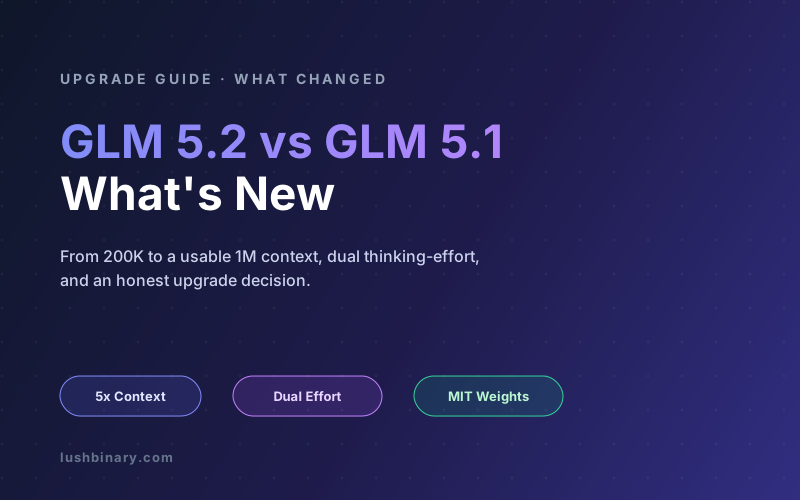
Updated June 16, 2026. GLM 5.2 launched June 13, roughly 11 weeks after GLM 5.1 (March 27). The defining change is the jump from a ~200K to a usable 1M-token context window, plus a dual thinking-effort system. GLM 5.2 shipped without benchmarks; GLM 5.1's scores remain the documented reference.
Z.ai has been shipping fast. GLM 5 landed in February, GLM 5.1 in March with a 28% coding jump, and now GLM 5.2 in June. Each step has a distinct character: 5.1 was about coding quality, 5.2 is about context scale. If you are already running GLM 5.1, the question is whether the 1M window and the new thinking-effort control are worth a switch.
This guide lays out exactly what changed, what stayed the same, and a clear-eyed upgrade decision, including the honest caveat that GLM 5.2 launched without the benchmark numbers GLM 5.1 has. For each model in depth, see the GLM 5.2 developer guide and the GLM 5.1 developer guide.
📋 Table of Contents
- 1.Side-by-Side Comparison
- 2.What's New in GLM 5.2
- 3.What Stayed the Same
- 4.The Benchmark Caveat
- 5.Should You Upgrade?
- 6.Migration Checklist
- 7.Frequently Asked Questions
- 8.How Lushbinary Helps
1Side-by-Side Comparison
| Attribute | GLM 5.1 | GLM 5.2 |
|---|---|---|
| Released | March 27, 2026 | June 13, 2026 |
| Context window | ~200K tokens | 1M tokens (usable) |
| Max output | 131,072 tokens | 131,072 tokens |
| Thinking control | Single mode | Dual thinking-effort |
| Coding benchmark | ~45.3 (~94.6% of Opus 4.6) | Not published |
| License | MIT (open weights) | MIT (open weights) |
| Training hardware | Huawei Ascend | Huawei Ascend |
2What's New in GLM 5.2
- 5x context window: from roughly 200K to a usable 1M tokens, which Z.ai says holds performance on long-range tasks.
- Dual thinking-effort system: two selectable reasoning levels to trade depth against latency and cost.
- Long-horizon focus: continued emphasis on multi-step, multi-hour agent tasks where the larger window keeps early decisions in scope.
3What Stayed the Same
- MIT open weights: both are self-hostable and fine-tunable with minimal restrictions.
- 131,072 max output tokens: unchanged output ceiling.
- Coding-first design and Ascend training: the series DNA carries over.
- OpenAI-compatible interface: most existing integrations keep working.
4The Benchmark Caveat
This is the one place where GLM 5.1 has the edge today: it has published, documented benchmark scores, and GLM 5.2 does not. GLM 5.1 posted about 45.3 on coding evaluations using Claude Code as the harness, roughly 94.6% of Claude Opus 4.6 and a 28% gain over GLM 5.
Do not assume regression or improvement
A missing GLM 5.2 benchmark is not evidence that it is worse, nor that it is better. Until Z.ai or a credible third party publishes numbers, the only reliable comparison is your own evaluation on your own tasks.
5Should You Upgrade?
Upgrade to GLM 5.2 if
- You work with large codebases or long documents
- You run long-horizon agents that lose context at 200K
- You want per-task control over reasoning effort
Stay on GLM 5.1 if
- Your tasks fit comfortably within 200K tokens
- You rely on published, audited benchmark numbers
- You have a stable, validated production pipeline
6Migration Checklist
- Switch the model name in your client or coding tool config.
- Choose a default thinking-effort level and add per-task overrides.
- Re-test tool-calling flows; confirm structured outputs still parse.
- Revisit prompts that assumed the smaller window - you can now feed far more context.
- Run your evaluation harness on both versions before flipping production traffic.
See the broader migration approach in our GLM 5.1 vs GLM 5 upgrade guide.
7Frequently Asked Questions
What is the difference between GLM 5.2 and GLM 5.1?
The headline change is context: GLM 5.2 (June 13, 2026) ships a usable 1-million-token window, about 5x GLM 5.1's roughly 200K. GLM 5.2 also adds a dual thinking-effort system and 131,072 max output tokens. GLM 5.1 (March 27, 2026) brought the big coding-quality jump, reaching about 94.6% of Claude Opus 4.6. Both are MIT-licensed and trained on Huawei Ascend hardware.
Should I upgrade from GLM 5.1 to GLM 5.2?
If you work with large codebases, long agent transcripts, or big documents, the 1M context window alone justifies the upgrade. If your tasks comfortably fit in 200K tokens and you depend on GLM 5.1's published benchmark numbers, you may wait, since GLM 5.2 launched without benchmarks. Validate GLM 5.2 on your own tasks first.
Does GLM 5.2 have better benchmark scores than GLM 5.1?
Unknown. Z.ai published no benchmarks for GLM 5.2 at launch. GLM 5.1 has a documented coding score of about 45.3 (roughly 94.6% of Claude Opus 4.6, a 28% gain over GLM 5's 35.4). Until GLM 5.2 numbers appear, compare them yourself on representative tasks.
Is the GLM 5.2 upgrade free on the GLM Coding Plan?
Yes. GLM 5.2 became available across all GLM Coding Plan tiers (Lite, Pro, Max, Team) on launch day, so existing subscribers can switch the model without changing plans. The standalone API and open weights followed shortly after.
Will my GLM 5.1 prompts work with GLM 5.2?
Largely yes - the GLM series keeps an OpenAI-compatible interface. The main new control is selecting one of the two thinking-effort levels. Review prompts that assumed the smaller context window, since you can now feed far more context, and re-test tool-calling flows after switching.
8How Lushbinary Helps
Lushbinary handles model upgrades without the regressions. We build the evaluation harness to compare versions on your tasks, migrate prompts and tool flows, tune thinking-effort routing, and roll out the new model behind a safe traffic split so you never bet production on an unverified change.
🚀 Free Consultation
Weighing a GLM 5.1 to 5.2 upgrade? We'll benchmark both on your tasks and run a safe migration. No obligation.
9Sources
Content was rephrased for compliance with licensing restrictions. Version details sourced from Z.ai announcements and technology reporting as of June 16, 2026. GLM 5.1 benchmark figures are as reported using Claude Code as the harness; GLM 5.2 launched without published benchmarks. Verify current specs on Z.ai's website.
Upgrade Models Without the Regressions
Lushbinary benchmarks GLM 5.1 against 5.2 on your tasks and runs a safe, measured migration. Let's talk.
Ready to Build Something Great?
Get a free 30-minute strategy call. We'll map out your project, timeline, and tech stack - no strings attached.
Prefer email? Reach us directly: