
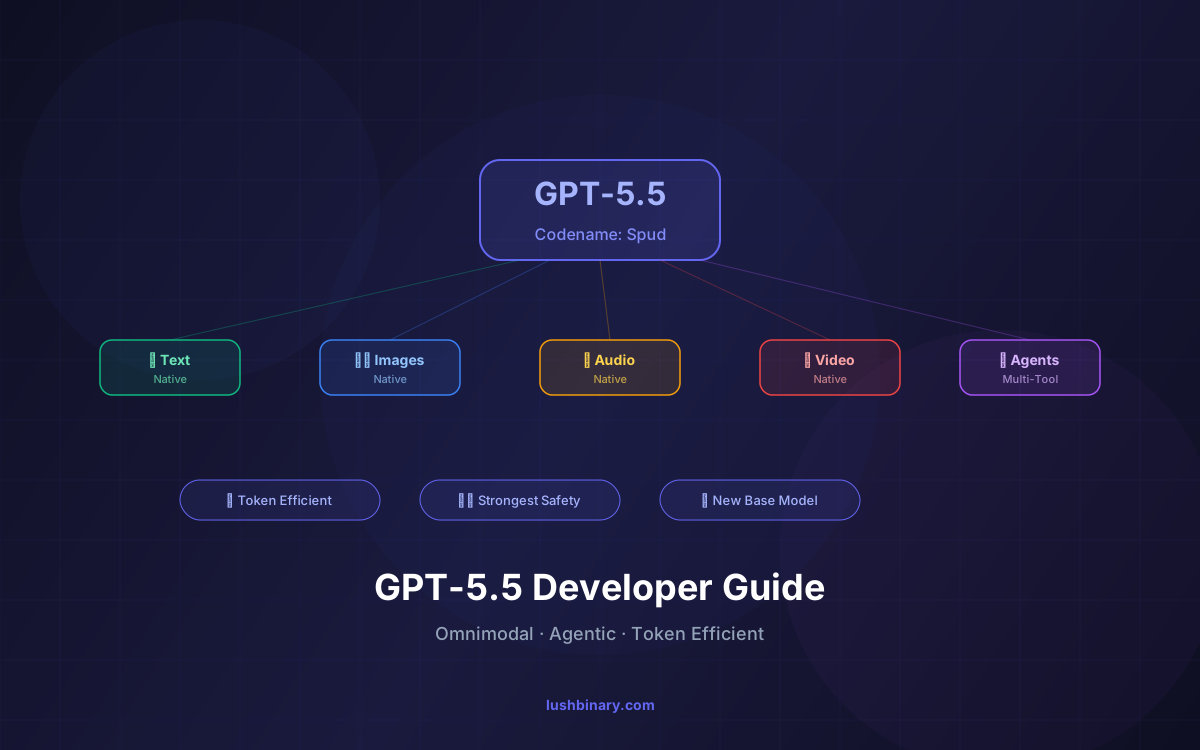
OpenAI released GPT-5.5 on April 23, 2026, and this one is different. Codenamed "Spud," it's the first fully retrained base model since GPT-4.5 — not another fine-tuned iteration of the GPT-5 family. It processes text, images, audio, and video natively in a single system, handles messy multi-step tasks with minimal guidance, and uses significantly fewer tokens to get work done in Codex.
The timing is deliberate. Anthropic just shipped Claude Opus 4.7 with SWE-bench scores in the high 80s. Google's Gemini 3.1 Pro doubled its reasoning performance on ARC-AGI-2. And OpenAI's own internal "Code Red" since December 2025 signals how seriously they're taking the competitive pressure, especially in the enterprise B2B segment where Claude has been gaining ground.
In this guide, we break down what GPT-5.5 actually brings to the table, how it compares to the competition, what the safety implications are, and how developers and teams can start building with it today. Whether you're evaluating it for your product, your coding workflow, or your enterprise stack, this is the complete picture.
📋 What This Guide Covers
- Why GPT-5.5 Matters: First New Base Model Since GPT-4.5
- Key Capabilities & What's New
- Natively Omnimodal Architecture
- Coding & Codex Performance
- Agentic Workflows & Multi-Tool Orchestration
- Pricing, Plans & API Availability
- Safety, Cybersecurity & Risk Classification
- GPT-5.5 vs Claude Opus 4.7 vs Gemini 3.1 Pro
- System Architecture for GPT-5.5 Integration
- Developer Integration Guide
- Why Lushbinary for Your GPT-5.5 Integration
- FAQ
1Why GPT-5.5 Matters: First New Base Model Since GPT-4.5
Since GPT-4.5, every model OpenAI shipped — GPT-5, 5.1, 5.2, 5.3, 5.4 — was built on the same base, refined and optimized for specific capabilities. GPT-5.5 breaks that pattern. It's a model trained from scratch, which is why OpenAI CEO Sam Altman told employees it could "really accelerate the economy" and why Greg Brockman described it as the result of "two years of research" with a "big model feel."
A fully retrained base model typically enables larger performance leaps than incremental fine-tuning. The GPT-5.x series delivered steady improvements — computer use in 5.4, Codex integration in 5.3, reasoning depth in 5.2 — but each was constrained by the original GPT-5 architecture. GPT-5.5 removes that ceiling.
💡 Key Insight
GPT-5.5 is also positioned as the technical foundation for OpenAI's upcoming "Super App" — a unified desktop application combining ChatGPT, Codex, and a dedicated browser. This signals OpenAI's strategic shift toward enterprise-oriented productivity tools and away from compute-intensive creative features like the discontinued Sora video generator.
The release also comes days before the high-profile trial between Elon Musk and OpenAI executives Sam Altman and Greg Brockman, adding a layer of strategic timing to the announcement. OpenAI is clearly signaling momentum to investors, enterprise customers, and the broader market.
2Key Capabilities & What's New
OpenAI calls GPT-5.5 its "smartest and most intuitive to use model yet." Here's what that translates to in practice:
🧠 Less Guidance Needed
Give it a messy, multi-part task and it plans, uses tools, checks its work, navigates ambiguity, and keeps going without hand-holding.
⚡ Token Efficiency
Uses significantly fewer tokens to complete tasks in Codex, directly reducing API costs for developers and enterprise users.
🔧 Multi-Tool Orchestration
Excels at writing and debugging code, researching online, making spreadsheets and documents, and working across different tools seamlessly.
🎯 Natively Omnimodal
Processes text, images, audio, and video within a single unified system - not bolted-on modalities after the fact.
🛡️ Strongest Safeguards
OpenAI's strongest set of safeguards to date, with extensive third-party red teaming for cyber and bio risks.
🚀 Pro Version
GPT-5.5 Pro includes extended reasoning capabilities for advanced applications, available to Pro, Business, and Enterprise users.
The practical difference is significant. With GPT-5.4, you still needed to carefully structure prompts and manage tool calls for complex workflows. GPT-5.5 can take an unclear problem and figure out what needs to happen next on its own. As Greg Brockman put it during the press briefing: "It really, to me, feels like it's setting the foundation for how we're going to use computers, how we're going to do computer work going forward."
3Natively Omnimodal Architecture
Previous GPT models handled different modalities by integrating them after the fact — separate vision encoders, audio processors, and text decoders stitched together. GPT-5.5 changes this fundamentally. It's designed to be natively omnimodal, processing text, images, audio, and video within a single unified system.
This matters for developers because it eliminates the latency and accuracy penalties of pipeline-based multimodal approaches. When a model processes an image through a separate encoder and then feeds the result to a text model, information is lost at each handoff. Native omnimodality means the model reasons about all modalities simultaneously, producing more coherent and contextually aware outputs.
Key architectural improvements include:
- Massively expanded context window — building on GPT-5.4's 1M token context, GPT-5.5 is expected to push this further with better long-context reasoning
- Improved coding and UI generation from images — the model can take a screenshot or mockup and produce functional code with higher fidelity than any previous version
- Stronger reasoning capabilities — the fresh base training enables deeper chain-of-thought reasoning without the accumulated quirks of iterative fine-tuning
- Native audio and video understanding — process meeting recordings, video walkthroughs, and audio instructions directly without transcription preprocessing
4Coding & Codex Performance
Coding is where GPT-5.5 makes its most tangible impact. OpenAI specifically highlighted that the model "excels" at writing and debugging code, and that it uses "significantly fewer" tokens to complete tasks in Codex. For teams paying per token, that efficiency gain translates directly to lower costs.
To put this in context, here's how the GPT-5 family has evolved on coding benchmarks:
| Model | SWE-bench Verified | Key Coding Strength |
|---|---|---|
| GPT-5 (Aug 2025) | 74.9% | First unified coding model |
| GPT-5.3 Codex | ~78-85% | Dedicated coding variant |
| GPT-5.4 | ~78.2% | Computer use + tool search |
| GPT-5.5 | TBD (expected higher) | New base + token efficiency |
| Claude Opus 4.7 | ~87.6% | Multi-file engineering |
| Claude Mythos Preview | 93.9% | Cybersecurity (limited access) |
While official SWE-bench numbers for GPT-5.5 haven't been published yet, early reports from developers using it in Codex show notable improvements in SVG generation, front-end design automation, and complex multi-file refactoring. The model has demonstrated the ability to create functional Windows OS clones, detailed 3D environments using Three.js, and game clones with real-time terrain modification.
⚠️ Benchmark Note
OpenAI has stated that SWE-bench Verified no longer adequately measures frontier coding capabilities, as progress has slowed from 74.9% to 80.9% in six months. They're shifting to SWE-bench Pro and other benchmarks. Expect GPT-5.5's official benchmarks to use newer evaluation frameworks.
The Codex integration is where GPT-5.5 shines brightest for developers. Codex now offers pay-as-you-go pricing for teams, and GPT-5.5's token efficiency means each Codex session costs less while producing higher-quality output. For teams already using Codex on Business or Enterprise plans, the upgrade is automatic.
If you're building AI-powered development tools or integrating code generation into your product, GPT-5.5's combination of better output quality and lower token consumption is a meaningful improvement. Check out our AI coding agents comparison for context on how these models fit into the broader coding tool landscape.
5Agentic Workflows & Multi-Tool Orchestration
The biggest practical leap in GPT-5.5 is how it handles agentic workflows. Previous models required careful prompt engineering to manage multi-step tasks across tools. GPT-5.5 can take an ambiguous, multi-part task and autonomously plan its approach, select the right tools, execute steps, verify results, and course-correct when things go wrong.
This is what OpenAI means when they say you can "give GPT-5.5 a messy, multi-part task and trust it to plan, use tools, check its work, navigate through ambiguity, and keep going." In practice, this looks like:
- Data analysis pipelines — upload a CSV, ask a vague question about trends, and GPT-5.5 will clean the data, choose the right analysis method, create visualizations, and write a summary document
- Research workflows — give it a research question and it will search the web, synthesize findings across sources, create a structured report, and flag areas where sources conflict
- Code + deploy workflows — describe a feature, and it will write the code, debug issues, create documentation, and prepare deployment artifacts
- Cross-tool document creation — ask for a project plan and it will create spreadsheets for timelines, documents for specs, and presentations for stakeholders, all from a single prompt
This capability is particularly relevant for enterprise teams evaluating AI agents. If you're building agent-based systems, GPT-5.5's improved autonomy reduces the amount of orchestration code you need to write. For a deeper dive into agent frameworks, see our AI agent frameworks comparison.
🔗 OpenAI Super App Context
GPT-5.5's agentic capabilities are the foundation for OpenAI's planned "Super App" — a unified desktop application combining ChatGPT, Codex, and a dedicated browser. This signals that OpenAI sees multi-tool orchestration as the primary interface for AI-powered work, not isolated chat conversations.
6Pricing, Plans & API Availability
GPT-5.5 is rolling out starting April 23, 2026 to paid ChatGPT subscribers. Here's the availability breakdown:
| Plan | Price | GPT-5.5 Access | GPT-5.5 Pro |
|---|---|---|---|
| Free | $0/mo | ❌ No | ❌ No |
| Go | $8/mo | ❌ No | ❌ No |
| Plus | $20/mo | ✅ Yes | ❌ No |
| Pro ($100) | $100/mo | ✅ Yes | ✅ Yes |
| Pro ($200) | $200/mo | ✅ Yes | ✅ Yes |
| Business | $25/user/mo | ✅ Yes | ✅ Yes |
| Enterprise | Custom | ✅ Yes | ✅ Yes |
API Pricing
OpenAI has not yet announced API pricing for GPT-5.5. The company stated that API deployments require "different safeguards" and will be available "very soon." For reference, here are the current GPT-5.4 API rates:
| GPT-5.4 Variant | Input | Cached Input | Output |
|---|---|---|---|
| GPT-5.4 | $2.50/M | $0.25/M | $15.00/M |
| GPT-5.4 mini | $0.75/M | $0.075/M | $4.50/M |
| GPT-5.4 nano | $0.20/M | $0.02/M | $1.25/M |
Based on OpenAI's pricing history and competitive pressure from Gemini 3.1 Pro ($2/M input) and Claude Opus 4.7 ($5/M input), GPT-5.5 API pricing is expected to land in a similar range to GPT-5.4. The token efficiency improvements mean that even at the same per-token price, total cost per task should be lower. We'll update this section as soon as official API pricing is announced.
7Safety, Cybersecurity & Risk Classification
OpenAI is being unusually transparent about GPT-5.5's risk profile. The model meets the criteria for OpenAI's "High" risk classification for cybersecurity, meaning it could "amplify existing pathways to severe harm." However, it does not cross the "Critical" threshold, which would indicate "unprecedented new pathways to severe harm."
🔒 Safety Classification
GPT-5.5 underwent extensive third-party safeguard testing and red teaming for cyber and bio risks. OpenAI VP of Research Mia Glaese stated they've been "iterating on cyber safeguards for months with increasingly cyber capable models." The API rollout is delayed specifically because it requires different safeguards than the ChatGPT deployment.
This context matters because of the broader AI safety landscape in April 2026. Anthropic recently limited the rollout of Claude Mythos Preview due to its ability to identify software security flaws. OpenAI responded with GPT-5.4-Cyber, a model specifically trained for defensive cybersecurity use cases. GPT-5.5's "High" risk classification suggests it's more capable than GPT-5.4 in this domain, which is both a feature and a concern.
For developers and enterprises, the key takeaways are:
- ChatGPT access is available now — the consumer-facing deployment has passed safety review
- API access is coming "very soon" — but requires additional safeguards, suggesting stricter rate limits or usage policies
- Lockdown Mode — OpenAI has introduced Lockdown Mode for security-conscious users like executives and security teams
- Trusted Access for Cyber — OpenAI's program for providing cyber-permissive model access to vetted security organizations will likely extend to GPT-5.5
For a deeper look at AI security considerations, see our AI agent security guide.
8GPT-5.5 vs Claude Opus 4.7 vs Gemini 3.1 Pro
The AI model landscape in April 2026 is the most competitive it's ever been. ChatGPT's market share has dropped from 87% to around 68%, while Gemini surged to over 18% and Claude carved out a strong niche among developers. Here's how GPT-5.5 stacks up against the current frontrunners:
| Dimension | GPT-5.5 | Claude Opus 4.7 | Gemini 3.1 Pro |
|---|---|---|---|
| Release | Apr 23, 2026 | Apr 16, 2026 | Mar 2026 |
| Architecture | New base, omnimodal | Iterative from Opus 4.6 | MoE, multimodal |
| Coding | Strong + token efficient | 87.6% SWE-bench ✅ | 77.1% ARC-AGI-2 |
| Agentic Tasks | Best-in-class ✅ | Strong (Claude Code) | Good (Vertex AI) |
| Context Window | 1M+ tokens (expected) | 200K tokens | 2M tokens ✅ |
| Multimodal | Native omnimodal ✅ | Vision + text | Strong multimodal ✅ |
| Token Efficiency | Significantly improved ✅ | Good | Good |
| API Pricing | TBD (expected ~$2.50/M) | $5/M input, $25/M output | $2/M input, $8/M output |
| Best For | Multi-tool workflows | Complex coding | Long-context + multimodal |
When to Choose Each Model
Choose GPT-5.5 when:
- • Multi-tool agentic workflows
- • Ambiguous, messy tasks
- • Token cost optimization
- • Omnimodal input (audio/video)
- • OpenAI ecosystem (Codex)
Choose Claude Opus 4.7 when:
- • Complex multi-file coding
- • Highest SWE-bench accuracy
- • Polished writing output
- • Claude Code workflows
- • Strict instruction following
Choose Gemini 3.1 Pro when:
- • Very long context (2M tokens)
- • Image/video/audio analysis
- • Google Cloud integration
- • Price-sensitive workloads
- • PhD-level science (GPQA)
For most teams, the right answer is a multi-model strategy. Use GPT-5.5 for agentic workflows and general-purpose tasks, Claude Opus 4.7 for complex coding, and Gemini 3.1 Pro for long-context and multimodal workloads. For a detailed comparison of the previous generation, see our GPT-5.4 developer guide and Claude Opus 4.7 developer guide.
9System Architecture for GPT-5.5 Integration
Here's a production architecture for integrating GPT-5.5 into an enterprise application with multi-model routing, cost optimization, and safety guardrails:
Key architectural decisions for GPT-5.5 integration:
- Multi-model routing — classify incoming tasks and route to the optimal model. GPT-5.5 for agentic multi-tool work, Claude for complex coding, Gemini for long-context analysis
- Prompt caching — GPT-5.4 offers 90% discount on cached input tokens. Expect similar or better with GPT-5.5. Cache system prompts and common tool definitions aggressively
- Token budgets — GPT-5.5's improved efficiency means you can set tighter token budgets without sacrificing quality. Monitor actual usage vs. GPT-5.4 baselines
- Safety guardrails — given the "High" risk classification, implement output filtering, content moderation, and audit logging for all GPT-5.5 API calls
- Fallback chains — route to GPT-5.4 mini or nano for simple tasks, and have fallback paths if GPT-5.5 rate limits are hit during initial rollout
10Developer Integration Guide
While API access is not yet available, here's how to prepare your codebase for GPT-5.5 integration based on the existing OpenAI API patterns and what we know about the model:
1. Update Your OpenAI SDK
# Install or update the latest OpenAI SDK
npm install openai@latest
# Or with Python
pip install --upgrade openai
2. Prepare Your Model Routing
// Multi-model routing configuration
const MODEL_CONFIG = {
  // GPT-5.5 for agentic, multi-tool tasks
  agentic: "gpt-5.5",       // Update when API available
  // Claude for complex coding tasks
  coding: "claude-opus-4.7",
  // Gemini for long-context analysis
  longContext: "gemini-3.1-pro",
  // Fallback for simple tasks
  simple: "gpt-5.4-mini",
};

function selectModel(task: TaskClassification) {
  if (task.requiresMultiTool) return MODEL_CONFIG.agentic;
  if (task.isComplexCoding) return MODEL_CONFIG.coding;
  if (task.contextLength > 500_000) return MODEL_CONFIG.longContext;
  return MODEL_CONFIG.simple;
}
3. Leverage Token Efficiency
GPT-5.5's reduced token consumption means you should revisit your token budgets and cost projections:
// Token budget optimization for GPT-5.5
const TOKEN_BUDGETS = {
  // GPT-5.5 uses fewer tokens per task
  // Start with 70% of your GPT-5.4 budgets
  // and adjust based on actual usage
  maxInputTokens: 100_000,
  maxOutputTokens: 16_000,
  // Enable prompt caching for system prompts
  cacheSystemPrompt: true,
  // Use tool search if available (47% savings on 5.4)
  enableToolSearch: true,
};
4. Implement Safety Guardrails
Given GPT-5.5's "High" cybersecurity risk classification, implement defense-in-depth:
// Safety guardrails for GPT-5.5
const SAFETY_CONFIG = {
  // Content filtering on outputs
  enableOutputModeration: true,
  // Audit logging for all API calls
  auditLog: true,
  // Rate limiting per user/session
  maxRequestsPerMinute: 30,
  // Block known prompt injection patterns
  inputSanitization: true,
  // Monitor for anomalous usage patterns
  anomalyDetection: true,
};
💡 Migration Tip
If you're currently using GPT-5.4 via the Responses API, migration to GPT-5.5 should be a model name swap once API access is available. The Responses API is OpenAI's recommended interface for all new integrations. If you're still on the legacy Chat Completions API, consider migrating to Responses API first.
11Why Lushbinary for Your GPT-5.5 Integration
GPT-5.5 is a powerful model, but shipping a production integration that's reliable, cost-effective, and secure takes real engineering work. Lushbinary has been building production AI integrations since the GPT-4 era, and we've shipped GPT-5.x integrations for enterprise clients across e-commerce, healthcare, fintech, and SaaS.
Here's what we bring to a GPT-5.5 integration project:
- Multi-model architecture — we design routing systems that use GPT-5.5, Claude, and Gemini where each excels, optimizing for both quality and cost
- Cost optimization — prompt caching, token budgets, batch processing, and model tiering to keep API costs predictable
- Safety & compliance — output moderation, audit logging, rate limiting, and content filtering aligned with your compliance requirements
- Agentic workflow design — we build the orchestration layer that lets GPT-5.5's autonomous capabilities work reliably in production
- AWS deployment — production infrastructure on AWS with auto-scaling, monitoring, and cost controls
🚀 Free Consultation
Want to integrate GPT-5.5 into your product or enterprise workflow? Lushbinary specializes in production AI integrations with multi-model routing, cost optimization, and safety guardrails. We'll scope your project, recommend the right architecture, and give you a realistic timeline — no obligation.
12Frequently Asked Questions
What is GPT-5.5 and when was it released?
GPT-5.5 (codename 'Spud') is OpenAI's latest frontier model, released on April 23, 2026. It is the first fully retrained base model since GPT-4.5, featuring natively omnimodal capabilities across text, images, audio, and video, with significantly improved coding, agentic workflows, and token efficiency.
How much does GPT-5.5 cost and which ChatGPT plans include it?
GPT-5.5 is available to ChatGPT Plus ($20/mo), Pro ($100/mo and $200/mo), Business ($25/user/mo), and Enterprise users. API pricing has not been announced yet but is expected soon. GPT-5.5 Pro is available to Pro, Business, and Enterprise tiers.
How does GPT-5.5 compare to Claude Opus 4.7 and Gemini 3.1 Pro?
GPT-5.5 outperforms both on agentic multi-tool workflows and token efficiency. Claude Opus 4.7 leads on SWE-bench Verified coding benchmarks (~87.6%). Gemini 3.1 Pro leads on multimodal tasks and offers a 2M token context window. GPT-5.5 excels at messy, multi-step tasks requiring planning and tool use across applications.
What makes GPT-5.5 different from GPT-5.4?
GPT-5.5 is a fully retrained base model, not an incremental update. It is natively omnimodal (text, images, audio, video in one system), uses significantly fewer tokens in Codex, has stronger safeguards, and can handle ambiguous multi-part tasks with less guidance than GPT-5.4.
Is GPT-5.5 safe to use in production applications?
OpenAI classifies GPT-5.5 as 'High' risk for cybersecurity, meaning it could amplify existing pathways to severe harm but does not cross the 'Critical' threshold. It underwent extensive third-party red teaming for cyber and bio risks. API access requires different safeguards and will be available 'very soon' after the ChatGPT rollout.
📚 Sources
- OpenAI Research — Introducing GPT-5.5
- OpenAI API Pricing (GPT-5.4 reference)
- OpenAI — Lockdown Mode and Elevated Risk Labels
- OpenAI — Why SWE-bench Verified No Longer Measures Frontier Coding
- OpenAI — Codex Flexible Pricing for Teams
- OpenAI — Trusted Access for Cyber Defense
Content was rephrased for compliance with licensing restrictions. Pricing, benchmarks, and feature details sourced from official OpenAI announcements and documentation as of April 23, 2026. Pricing and availability may change — always verify on the vendor's website.
Ready to Integrate GPT-5.5 Into Your Product?
From multi-model routing to production safety guardrails, Lushbinary builds AI integrations that ship. Let's talk about your GPT-5.5 project.
Ready to Build Something Great?
Get a free 30-minute strategy call. We'll map out your project, timeline, and tech stack - no strings attached.
Prefer email? Reach us directly: