
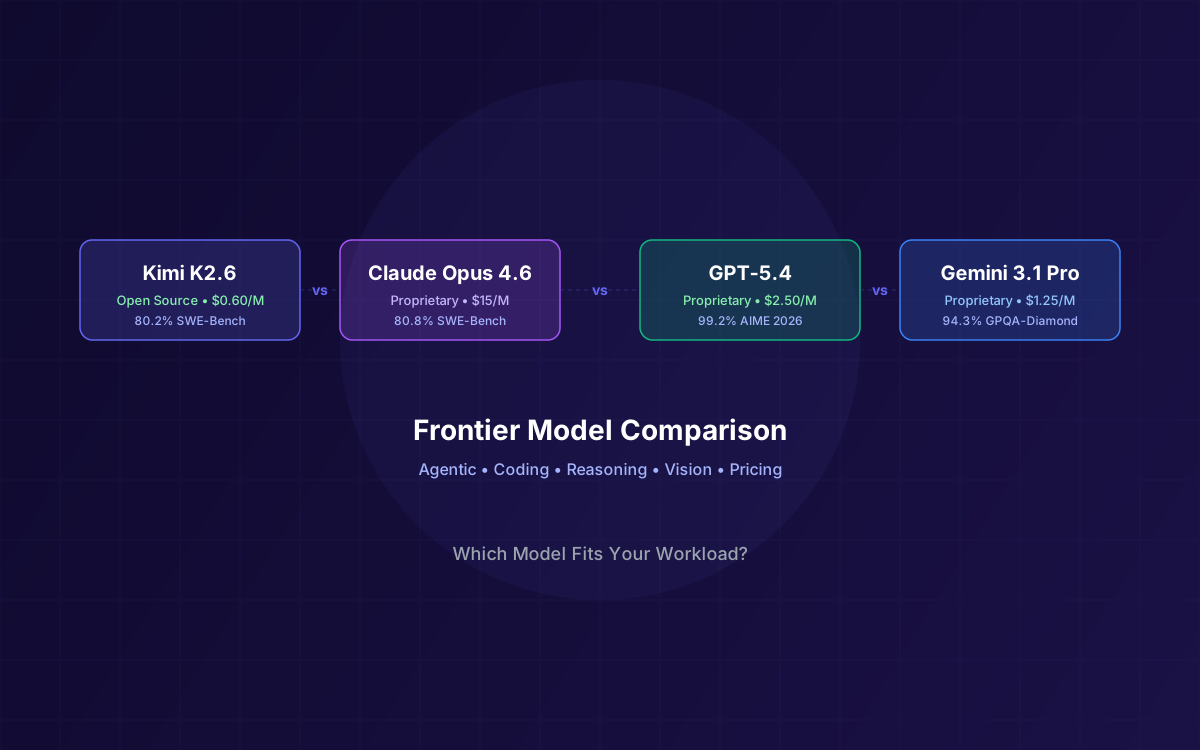
For the first time, an open-source model is genuinely competitive with the best proprietary systems across the board. Kimi K2.6 from Moonshot AI doesn't just match GPT-5.4 and Claude Opus 4.6 on a few cherry-picked benchmarks — it leads on agentic tasks, trades blows on coding, and comes within striking distance on reasoning, all at a fraction of the cost and with full self-hosting rights.
This comparison breaks down where each model excels, where it falls short, and which one you should choose based on your actual workload.
What This Guide Covers
1Model Overview & Architecture
All four models represent the current frontier, but they arrive there via very different paths. K2.6 is the only open-weight contender, built on a Mixture-of-Experts (MoE) backbone with 1 trillion total parameters and roughly 32 billion active per forward pass. Claude Opus 4.6 and GPT-5.4 remain proprietary with undisclosed architectures, while Gemini 3.1 Pro leverages Google's multimodal-native design with tight integration into Google Cloud.
| Feature | Kimi K2.6 | Claude Opus 4.6 | GPT-5.4 | Gemini 3.1 Pro |
|---|---|---|---|---|
| Developer | Moonshot AI | Anthropic | OpenAI | Google DeepMind |
| Architecture | MoE (1T total / ~32B active) | Undisclosed | Undisclosed | Multimodal-native |
| Context Window | 128K tokens | 200K tokens | 128K tokens | 1M+ tokens |
| License | Modified MIT | Proprietary | Proprietary | Proprietary |
| Self-Hosting | Yes (vLLM, SGLang) | API only | API only | API only |
| Agent Swarm | Native (300 sub-agents) | No native support | Limited | No native support |
The MoE architecture gives K2.6 a significant efficiency advantage — only ~32B parameters are active per token, meaning inference costs stay low even though the total parameter count rivals much larger proprietary models. For a deeper dive into K2.6's architecture and how to deploy it, see our Kimi K2.6 developer guide.
2Agentic Benchmark Comparison
Agentic benchmarks measure how well a model performs when given tools, browsing capabilities, and multi-step tasks that require planning and execution over extended horizons. This is where K2.6 makes its strongest case — particularly in swarm-based workflows where multiple sub-agents coordinate in parallel.
| Benchmark | Kimi K2.6 | Claude Opus 4.6 | GPT-5.4 | Gemini 3.1 Pro |
|---|---|---|---|---|
| HLE-Full (tools) | 54.0% | 53.0% | 52.1% | 51.4% |
| BrowseComp | 83.2% | 83.7% | 82.7% | 85.9% |
| BrowseComp (Swarm) | 86.3% | - | 78.4% | - |
| DeepSearchQA f1 | 92.5% | 91.3% | 78.6% | 81.9% |
| OSWorld | 73.1% | 72.7% | 75.0% | - |
🐝 Swarm Advantage
K2.6's native agent swarm capability is a game-changer. On BrowseComp (Swarm), K2.6 scores 86.3% using up to 300 parallel sub-agents with 4,000 coordinated steps — outperforming GPT-5.4's swarm score of 78.4% by a wide margin. Neither Claude Opus 4.6 nor Gemini 3.1 Pro offer comparable native swarm orchestration, making K2.6 the clear choice for complex multi-agent workflows.
On HLE-Full (tools), K2.6 takes the top spot at 54.0%, narrowly beating Claude Opus 4.6 (53.0%) and GPT-5.4 (52.1%). This benchmark measures how effectively a model uses external tools to solve hard problems — a proxy for real-world agentic performance. K2.6 also leads on DeepSearchQA with a 92.5% f1 score, demonstrating strong information retrieval and synthesis capabilities.
GPT-5.4 takes OSWorld (75.0%), the desktop automation benchmark, suggesting it handles GUI-based tasks slightly better. Gemini 3.1 Pro leads on single-agent BrowseComp (85.9%), likely benefiting from deep Google Search integration.
3Coding Benchmark Comparison
Coding benchmarks are where the rubber meets the road for most developers evaluating these models. SWE-Bench Verified and SWE-Bench Pro test real-world bug fixing in open-source repositories, while Terminal-Bench 2.0 measures terminal-based task completion.
| Benchmark | Kimi K2.6 | Claude Opus 4.6 | GPT-5.4 | Gemini 3.1 Pro |
|---|---|---|---|---|
| SWE-Bench Verified | 80.2% | 80.8% | - | 80.6% |
| SWE-Bench Pro | 58.6% | 53.4% | 57.7% | 54.2% |
| Terminal-Bench 2.0 | 66.7% | 65.4% | 65.4% | 68.5% |
The headline number: K2.6 leads SWE-Bench Pro at 58.6%, beating GPT-5.4 (57.7%), Gemini 3.1 Pro (54.2%), and Claude Opus 4.6 (53.4%). SWE-Bench Pro is the harder variant that tests multi-file, multi-step bug fixes — the kind of work that matters most in production codebases. A 5+ point lead over Claude Opus 4.6 is significant.
On SWE-Bench Verified, the three models with reported scores are within 0.6 points of each other: Claude Opus 4.6 (80.8%), Gemini 3.1 Pro (80.6%), and K2.6 (80.2%). This is effectively a tie for single-file bug fixes.
Gemini 3.1 Pro takes Terminal-Bench 2.0 at 68.5%, with K2.6 (66.7%) slightly ahead of Claude and GPT (both 65.4%). Terminal-Bench tests command-line task completion, so the differences here may reflect training data emphasis rather than fundamental capability gaps.
💡 Key Takeaway
For agentic coding workflows that involve multi-file changes, K2.6 is the strongest option. For single-shot code fixes, all four models are within margin of error. If you're building coding agents, K2.6's SWE-Bench Pro lead combined with its cost advantage makes it the most compelling choice. See also our comparison of Qwen 3.6 for self-hosted coding if you're evaluating open-weight alternatives.
4Reasoning & Knowledge
Pure reasoning benchmarks test mathematical problem-solving, scientific knowledge, and graduate-level question answering. This is where GPT-5.4 and Gemini 3.1 Pro flex their muscles — but K2.6 is closer than you might expect from an open-weight model.
| Benchmark | Kimi K2.6 | Claude Opus 4.6 | GPT-5.4 | Gemini 3.1 Pro |
|---|---|---|---|---|
| AIME 2026 | 96.4% | 96.7% | 99.2% | 98.3% |
| GPQA-Diamond | 90.5% | 91.3% | 92.8% | 94.3% |
| HLE-Full (tools) | 54.0% | 53.0% | 52.1% | 51.4% |
GPT-5.4 dominates AIME 2026 at 99.2% — near-perfect on competition-level math. Gemini 3.1 Pro leads GPQA-Diamond at 94.3%, the graduate-level science benchmark. Both proprietary models have a clear edge on pure reasoning tasks.
However, the story flips on HLE-Full (tools), which measures reasoning with tool use. K2.6 leads at 54.0%, suggesting that while it may not match GPT-5.4 on raw math, it's better at combining reasoning with tool calls — the pattern that matters most in agentic applications.
K2.6's 96.4% on AIME 2026 is still exceptional. The gap to GPT-5.4 is less than 3 points, and for most practical applications, the difference between 96% and 99% accuracy on competition math is negligible. Where it matters — tool-augmented reasoning — K2.6 is the leader.
5Vision & Multimodal
Multimodal benchmarks test how well models understand images, diagrams, charts, and visual math problems. MMMU-Pro is the primary benchmark here, testing college-level multimodal understanding across subjects like science, engineering, and medicine.
| Benchmark | Kimi K2.6 | Claude Opus 4.6 | GPT-5.4 | Gemini 3.1 Pro |
|---|---|---|---|---|
| MMMU-Pro | 79.4% | 73.9% | 81.2% | 83.0% |
Gemini 3.1 Pro leads MMMU-Pro at 83.0%, followed by GPT-5.4 (81.2%) and K2.6 (79.4%). Claude Opus 4.6 trails at 73.9%, a notable gap that suggests Anthropic has prioritized text-based reasoning over multimodal capabilities.
K2.6's 79.4% is impressive for an open-weight model — it outperforms Claude Opus 4.6 by over 5 points and sits within 4 points of the leader. For teams that need strong vision capabilities alongside coding and agentic performance, K2.6 offers a well-rounded package.
If multimodal is your primary use case — document understanding, chart analysis, visual QA — Gemini 3.1 Pro is the strongest choice, benefiting from Google's multimodal-native architecture and massive training on visual data. GPT-5.4 is a close second.
6Pricing & Cost Analysis
Cost is where K2.6 creates the widest gap. At ~$0.60 per million input tokens and ~$3.00 per million output tokens, it's dramatically cheaper than every proprietary competitor — and that's before factoring in the 75–83% cache savings from automatic prompt caching.
| Model | Input / 1M tokens | Output / 1M tokens | Cache Savings |
|---|---|---|---|
| Kimi K2.6 | ~$0.60 | ~$3.00 | 75–83% |
| Gemini 3.1 Pro | ~$1.25 | ~$5.00 | Varies |
| GPT-5.4 | $2.50 | $15.00 | 50% (cached) |
| Claude Opus 4.6 | $15.00 | $75.00 | 90% (cached) |
To put this in perspective, consider a typical agentic coding workflow that uses ~2,000 input tokens and ~1,500 output tokens per request. At 1 million requests per month:
| Model | Est. Monthly Cost (1M requests) | vs K2.6 |
|---|---|---|
| Kimi K2.6 | ~$5,700 | - |
| Gemini 3.1 Pro | ~$10,000 | 1.8× |
| GPT-5.4 | ~$27,500 | 4.8× |
| Claude Opus 4.6 | ~$142,500 | 25× |
Claude Opus 4.6 is 25× more expensive than K2.6 for the same workload. Even GPT-5.4 costs nearly 5× more. For high-volume agentic applications, the cost difference is the difference between a viable product and an unsustainable burn rate.
And if you self-host K2.6, the per-token API cost drops to zero — you only pay for compute. With the MoE architecture activating only ~32B parameters per token, K2.6 runs efficiently on a single 8×H100 node, making self-hosting practical for teams with existing GPU infrastructure.
7Licensing & Self-Hosting
K2.6 is released under the Modified MIT License, which is remarkably permissive for a frontier-class model. You can use it commercially, modify it, redistribute it, and self-host it without royalties. The only restriction: attribution is required if your deployment exceeds 100 million monthly active users or $20 million in monthly revenue — thresholds that won't affect the vast majority of teams.
| Capability | Kimi K2.6 | Claude Opus 4.6 | GPT-5.4 | Gemini 3.1 Pro |
|---|---|---|---|---|
| License | Modified MIT | Proprietary | Proprietary | Proprietary |
| Open Weights | Yes | No | No | No |
| Commercial Use | Yes (free) | Via API | Via API | Via API |
| Self-Hosting | vLLM, SGLang, TensorRT-LLM | Not available | Not available | Not available |
| Fine-Tuning | Full (LoRA, QLoRA, full) | Limited API fine-tuning | API fine-tuning | API fine-tuning |
| Data Sovereignty | Full control | Vendor-dependent | Vendor-dependent | Vendor-dependent |
For regulated industries — healthcare, finance, government — the ability to self-host is often a hard requirement. K2.6 is the only frontier-class model that offers this. You get full data sovereignty, no vendor lock-in, and the ability to fine-tune on proprietary data without sending it to a third-party API.
The Modified MIT license also means you can build and sell products on top of K2.6 without revenue sharing or usage-based licensing fees. For startups building AI-powered products, this eliminates a major cost variable from the business model.
8When to Use Each Model
There's no single "best" model — the right choice depends on your workload, budget, and deployment constraints. Here's a decision framework based on the benchmarks:
🟣 Choose Kimi K2.6 if…
- • You need multi-agent swarm orchestration
- • Agentic coding is your primary use case (SWE-Bench Pro leader)
- • Cost matters — 5–25× cheaper than proprietary options
- • You require self-hosting or data sovereignty
- • You want to fine-tune on proprietary data
- • You're building deep search / research agents (DeepSearchQA leader)
🟠 Choose Claude Opus 4.6 if…
- • You need the longest context window (200K tokens)
- • Single-shot code fixes are your primary pattern (SWE-Bench Verified leader)
- • You value safety and alignment features
- • Your team is already in the Anthropic ecosystem
- • Budget is not a primary constraint
🟢 Choose GPT-5.4 if…
- • Math and reasoning are critical (AIME 2026: 99.2%)
- • You need desktop automation (OSWorld leader)
- • You want the broadest ecosystem and integrations
- • Multimodal is important but not primary (strong MMMU-Pro)
- • You need reliable function calling at scale
🔵 Choose Gemini 3.1 Pro if…
- • Multimodal understanding is your top priority (MMMU-Pro leader)
- • You need the largest context window (1M+ tokens)
- • Google Cloud integration is important
- • You need strong scientific reasoning (GPQA-Diamond leader)
- • Terminal-based tasks are a key workflow (Terminal-Bench leader)
🔀 Multi-Model Strategy
Many production teams are adopting a multi-model approach: K2.6 for high-volume agentic tasks and swarm workflows (where cost and self-hosting matter), GPT-5.4 or Gemini for reasoning-heavy or multimodal tasks, and Claude Opus 4.6 for safety-critical applications. A smart routing layer can direct requests to the optimal model based on task type, reducing costs by 60–80% compared to using a single premium model for everything.
9Why Lushbinary for Multi-Model AI
Choosing the right model — or the right combination of models — depends on your specific workloads, latency requirements, compliance needs, and budget. At Lushbinary, we help engineering teams evaluate, integrate, and deploy frontier AI models into production. Whether you're building agentic workflows with K2.6, setting up multi-model routing, or self-hosting open-weight models on your own infrastructure, we've done it before and can accelerate your path to production.
🚀 Free Consultation
Not sure which model fits your workload? We offer a free 30-minute consultation to evaluate your use case, benchmark options against your data, and recommend the right approach — whether that's a single model, a multi-model strategy, or a self-hosted deployment.
- • Model evaluation and benchmarking on your data
- • Multi-model routing architecture design
- • Self-hosting setup for K2.6 and other open-weight models
- • Agent swarm implementation and optimization
- • Cost optimization for high-volume AI workloads
❓ Frequently Asked Questions
Is Kimi K2.6 better than Claude Opus 4.6 for coding?
K2.6 leads on SWE-Bench Pro (58.6% vs 53.4%) and Terminal-Bench 2.0 (66.7% vs 65.4%), while Claude Opus 4.6 edges ahead on SWE-Bench Verified (80.8% vs 80.2%). For agentic coding with many tool calls, K2.6 has the advantage. For single-shot code fixes, they’re nearly identical.
How much cheaper is Kimi K2.6 than GPT-5.4?
K2.6 costs approximately $0.60/$3.00 per million tokens (input/output) vs GPT-5.4’s $2.50/$15.00. That’s 4× cheaper on input and 5× cheaper on output, with additional 75–83% savings from automatic caching.
Which model is best for agent swarm workflows?
K2.6 is the clear leader for agent swarms, scoring 86.3% on BrowseComp (Agent Swarm) vs GPT-5.4’s 78.4%. It supports up to 300 parallel sub-agents with 4,000 coordinated steps. Neither Claude nor GPT offer comparable native swarm capabilities.
Is Kimi K2.6 open-source?
Yes. K2.6 is released under the Modified MIT License, allowing full commercial use with attribution required only above 100M MAU or $20M monthly revenue. GPT-5.4 and Claude Opus 4.6 are proprietary with no self-hosting option.
Which model has the best reasoning capabilities?
GPT-5.4 leads on pure math reasoning (AIME 2026: 99.2%) and GPQA-Diamond (92.8%). K2.6 scores 96.4% and 90.5% respectively. For agentic reasoning with tools, K2.6 leads on HLE-Full (54.0% vs 52.1% GPT-5.4, 53.0% Claude Opus 4.6).
📚 Sources
- HuggingFace — Moonshot AI / Kimi-K2.6 Model Weights & Benchmarks
- Moonshot AI Platform — Kimi K2.6 API Documentation & Pricing
- Anthropic — Claude Opus 4.6 Model Card & Pricing
- OpenAI — GPT-5.4 Benchmarks & API Pricing
- Google DeepMind — Gemini 3.1 Pro Technical Report
Content was rephrased for compliance with licensing restrictions. Benchmark data sourced from official Moonshot AI, Anthropic, OpenAI, and Google DeepMind publications. Pricing and availability may change — always verify on the vendor's website.
Need Help Choosing the Right Model?
Let Lushbinary help you evaluate and integrate the right frontier model for your team — from benchmarking to production deployment.
Ready to Build Something Great?
Get a free 30-minute strategy call. We'll map out your project, timeline, and tech stack - no strings attached.
Prefer email? Reach us directly: